MEC&F Expert Engineers

Thursday, June 30, 2016

significant damage to the boom on one of the Murchison platform cranes following an incident that occurred during a lifting operation


UK: Crane incident on North Sea platform spurs investigation


Murchison platform

A crane collapsed on a platform in the UK sector of the North Sea prompting an investigation by the operating company that notified the Health and Safety Executive of the incident.

According to BBC, the incident happened early on Wednesday on CNR International-operated Murchison platform, located 280 nautical miles North of Aberdeen, during a lifting operation.

No injuries were reported and all 102 personnel on board the platform were safe and well, the news agency reported.

Offshore Energy Today reached out to CNR seeking confirmation of these reports.

The company’s spokesperson confirmed the incident occurred on Wednesday: “There has been significant damage to the boom on one of the Murchison platform cranes following an incident that occurred during a lifting operation yesterday (9th March).”

The spokesperson also added: “The cause of the incident is still being established, however as a precaution, all crane operations on the platform have been suspended.”

The CNR International owned and operated Murchison field is located in the Northern North Sea Block 211/19, north of Aberdeen in the East Shetland Basin, straddling the United Kingdom/Norwegian sector median line.

The decommissioning activities at the Murchison platform started in the fourth quarter of 2013, and the company estimated the decommissioning efforts would continue for approximately 5 years.

This is not the first time for an accident to happen on the Murchison platform after the decommissioning started. Namely, an injured offshore worker had to be airlifted from the platform to a hospital in December 2014 after being struck by a pipe.


================================================= Investigation after Rowan Drilling crane boom collapses on North Sea rig


Written by Niamh Burns - 06/29/2016

An investigation is underway after the extraction of crude petroleum from a jack-up rig in the North Sea when a crane boom collapsed.

Rowan Drilling has been hit with an improvement notice after a crane boom collapsed, resulting in two pieces of the boom falling to the sea, with the remaining piece resting on the rig.

The incident resulted in three of the jack-up rigs six lifeboats being rendered inoperative.

A spokesman for the Health and Safety Executive (HSE) said and the investigation into the incident, which happened at the end of March, is still ongoing.


It’s understood the Gorilla VII jack-up rig had been operating as an “offshore installation” meaning it was on location at the time of the incident.

In an improvement notice to the company, the HSE said: “Following investigation of the Rowan Gorilla VII port bow crane collapse which revealed deficiencies in the effective control, monitoring and review of preventative and protective measures for safe crane operations as evidenced by the discovery that: all crane secondary upper boom limit switches were incorrectly set such that they would not provide the required boom protection.

“All crane slew, hoist and boom lever neutral position indents had been overridden such that they could be inadvertently operated.

“Crane cab display units were incorrectly calibrated with the boom angle.

“Crane operators were unaware of the correct upper boom limits, access to control switches in the machinery house were not adequately controlled.

“The port bow crane slew limits had been grossly exceeded causing damage to the crane electrical cables and restricting cables and restricting crane movement and the primary boom limit switch of the port bow crane was overridden.”

The incident comes after another accident involving a crane on CNR’s Murchison platform.

A lessons learned report found that it was a “high potential” incident.

The Murchison platform is located in the Northern North Sea, 280 nautical miles North of Aberdeen.

Sunfield Inc., an Ohio auto parts manufacturer faces $3.42M in fines after OSHA finds company willfully exposed temporary workers to machine hazards

June 29, 2016

Sunfield Inc., an Ohio auto parts manufacturer faces $3.42M in fines after OSHA finds company willfully exposed temporary workers to machine hazards
  Sunfield Inc. faces near record penalty for an automotive parts industry company

HEBRON, Ohio - The U.S. Department of Labor's Occupational Safety and Health Administration issued 57 citations for safety violations to Sunfield Inc., an Ohio auto parts' manufacturer. The agency has also proposed the company pay more than $3.42 million in total fines for its failure to disconnect machinery from a power supply and prevent sudden movement before maintenance and service, and to train workers in how to operate machine presses safely and to service and maintain them.

The fines assessed are one of the largest OSHA penalties ever filed against a company in the automotive parts industry.

Federal investigators inspected Sunfield's Hebron plant after two workers suffered severe injuries in separate incidents in January and February 2016. The facility has an extensive history of federal safety violations dating back 20 years. The company, which investigators found to have a high rate of employee turnover, supplies parts for several major Japanese and domestic automakers.

OSHA today issued citations for 46 egregious willful, two willful, one repeated and eight serious safety violations with penalties totaling $3,426,900 to Sunfield. The agency also placed the company in OSHA's Severe Violator Enforcement Program for failure to address these safety hazards. Most of the violations involve lack of machine safety procedures which expose workers to amputation, lacerations and other injuries.

"When companies prioritize production and profit over the health and safety of their workforce, too often it is the workers that pay the price," said U.S. Secretary of Labor Thomas E. Perez. "OSHA's investigation found the company's leadership failed in its obligation to properly train workers for the jobs they were hired to do, and created a culture that routinely tolerated willful and serious safety violations."

OSHA investigation found:
  • On Jan. 6, 2016, a 22-year-old male temporary worker employed by the staffing agency, Employers Overload, suffered multiple lacerations and a fractured right elbow, while removing scrap from a blanking press after operating machine parts caught his arm because safety light curtains were not operating correctly. OSHA's investigation found a supervisor had identified the safety issue two hours prior to the injury, and failed to place the equipment out of service. The injured worker had been on the job just six months.
  • On Feb. 18, 2016, a full-time 58-year-old Sunfield employee had to undergo surgical amputation of his right arm above the elbow after his arm was crushed as he removed scrap on a robotic press line. Investigators again found that the machine's danger zone did not have adequate safe guards to prevent employees from coming in contact with operating machine parts. He had been on the job for just a year.
Prior to these inspections, Sunfield had an extensive history of OSHA violations. Since 1997, 16 of 20 inspections conducted found multiple violations. In total, the agency has issued 118 citations that have addressed numerous machine hazards similar to those cited today and resulted in 90 serious, eight willful and five repeated violations to the company, which has repeatedly assured OSHA that it would address the unsafe conditions.

"Sunfield made and broke countless promises to improve safety conditions and eliminate serious hazards on the factory floor. The company also ignored its own corporate safety manuals and its safety manager's warnings that workers lacked the training to protect themselves. And still, the company risked the safety and well-being of its employees as they operated dangerous and powerful industrial machines," said Dr. David Michaels, Assistant Secretary of Labor of Occupational Safety and Health.

"Sunfield has shown a total disregard for its workers, the kind rarely seen since the darkest days of the past when callous industrialists ruled and put profits before human suffering and common decency," Michaels added. "This has to stop. We hope that today's action brings an end to these conditions and convinces this employer that their behavior is intolerable."

OSHA found that the company did not take the necessary steps to protect its workers from being injured by moving machine parts. It did not prevent machines from unintentionally starting when workers were performing service and maintenance such as clearing scrap, and also failed to provide adequate safety mechanisms such as guards, locking devices and other procedures to prevent contact with those moving parts. These types of violations are among the most frequently cited by OSHA and often result in death or permanent disability.

The agency also found multiple electrical safety violations including lack of personal protective equipment, workers exposed to "live" electrical parts, and use of damaged equipment.

Under OSHA's regulations, temporary and host employers are both responsible for ensuring employees are trained about safety hazards in the facility where they are placed to work. Three agencies, Atrium Personnel and iforce of Heath, as well as Employers Overload of Newark have been cited by OSHA for failing to provide lockout/tagout training for affected employees and for failing to provide mechanical power press safe operation training prior to sending temporary employees to the site. Each company faces proposed penalties of $7,000.
View citations for January and February investigations.

With a daily workforce of about 175, Sunfield Inc. is a motor vehicle metal parts stamping operation established in 1993. The Hebron site is the only U.S. plant. The parent company, Ikeda Manufacturing Company LTD. is headquartered in Ota-City, Gunma, Japan.

The company has 15 business days from receipt of its citations and penalties to comply, request an informal conference with OSHA's area director, or contest the findings before the independent Occupational Safety and Health Review Commission.

To ask questions, obtain compliance assistance, file a complaint, or report amputations, eye loss, workplace hospitalizations, fatalities or situations posing imminent danger to workers, the public should call OSHA's toll-free hotline at 800-321-OSHA (6742) or the agency's Columbus office at 614-469-5582.
Under the Occupational Safety and Health Act of 1970, employers are responsible for providing safe and healthful workplaces for their employees. 

OSHA's role is to ensure these conditions for America's working men and women by setting and enforcing standards, and providing training, education and assistance. For more information, visit http://www.osha.gov.

Alliance Industries Inc. lacked proper precautions for using sulfur dioxide at its foundry core manufacturing, metal coating facility in Waupaca, WI

June 29, 2016

OSHA finds Alliance Industries Inc. lacked proper precautions for using
sulfur dioxide at its foundry core manufacturing, metal coating facility in Waupaca, WI

Employer name: Alliance Industries Inc.
Waupaca, Wisonsin


Citations issued: June 27, 2016

Investigation findings: The U.S. Department of Labor's Occupational Safety and Health Administration issued nine serious violations and one other-than-serious safety violation to Menasha-based Alliance Industries Inc. A February 2016 complaint investigation found the company failed to comply with OSHA's process safety management standards for using sulfur dioxide at its Waupaca facility that manufactures foundry sand cores and performs metal coating.

An investigation by the agency's Appleton area office found the company failed to:
  • Incorporate good engineering practices for the sulfur dioxide delivery system.
  • Compile process safety technology and equipment information for the sulfur dioxide delivery system.
  • Develop and implement a mechanical integrity program for the sulfur dioxide delivery system.
  • Conduct a process hazard analysis of the sulfur dioxide delivery system.
  • Develop written procedures for start-ups, shutdowns and maintenance of the sulfur dioxide delivery system.
  • Conduct an annual inspection of energy control procedures.
Quote: "Sulfur dioxide is a toxic gas that can cause respiratory and other serious health issues when inhaled," said Robert Bonack, OSHA's area director in Appleton. "When highly hazardous chemicals are not properly controlled and stored, there is a potential for unintentional release. Companies using sulfur dioxide in their manufacturing process must utilize engineering and administrative controls to reduce the potential for an uncontrolled release and take steps to protect workers from exposure."

Proposed Penalties: $41,580

View Citations here.
To ask questions, obtain compliance assistance, file a complaint, or report amputations, eye loss, workplace hospitalizations, fatalities or situations posing imminent danger to workers, the public should call OSHA's toll-free hotline at 800-321-OSHA (6742) or the agency's Appleton Area Office at (920) 734-4521.

Chem Venus Oil Tanker Strikes Three Moored Sailboats Leaving Portsmouth, New Hampshire


June 29, 2016 by Mike Schuler


MT Chem Venus (former Golden Venus). Credit: MarineTraffic.com/Les Blair

A 477-foot oil tanker collided with three moored sailboats Wednesday at the mouth of the Piscataqua River near Portsmouth, New Hampshire and Kittery, Maine, the U.S. Coast Guard reported.

The sailboats were unmanned at the time and no injuries or pollution have been reported.

The Coast Guard says it was notified at approximately 4 p.m. of the collision involving the tanker Chem Venus and the sailboats.

All three sailboats, which were unoccupied at anchorage, were damaged but remained afloat, the Coast Guard said.

AIS data showed the Chem Venus at anchor just off at the Maine, New Hampshire border as of Wednesday evening.

The same data showed the tanker had just departed from Portsmouth, NH and was sailing to Teesport, England when the incident likely occurred.

The cause of the collision is under investigation.

The Coast Guard reported that it is taking initial response actions to determine if there is any damage to the Chem Venus, and working to contact the owners of the sailboats.

The 19,887 DWT Chem Venus is flagged in Panama and was built in 2004.


========================================


Tanker collides with sailboats near Portsmouth
Coast Guard performing pollution assessment
UPDATED 11:50 PM EDT Jun 29, 2016


PORTSMOUTH, N.H. —A 477-foot oil tanker collided with three sailboats Wednesday near the mouth of the Piscataqua River, U.S. Coast Guard officials said.

The collision involved a Panamanian-flagged tanker, Chem Venus, and occurred near Portsmouth and Kittery, Maine.

The three sailboats were unmanned and moored, and no one was hurt, officials said.

All three boats were damaged but remained afloat, according to Lt. David Bourbeau.

USCG vessel inspectors boarded the Chem Venus and determined that it sustained damage to its bow, causing it to take on water.

The rate of flooding was stabilized and it is being monitored by the Coast Guard and the tanker's crew.

The Coast Guard launched two 45-foot motor lifeboats from Station Portsmouth Harbor to determine if there is any pollution in the water from the collision.

An HC-144 Ocean Sentry aircraft was also dispatched from Air Station Cape Cod to assist with the pollution assessment.

Despite the damage, no pollution has been reported, and the tanker remains safely anchored outside of the Piscataqua River.

Chem Venus was carrying a load of used vegetable oil and a variety of other industrial chemicals.

The Coast Guard is working to contact the owner of the sailboats.

The USCG Salvage Engineering Response Team has been engaged to conduct a vessel stability assessment, and divers are expected to conduct a survey of the damage early Thursday morning.

The cause of the collision is still under investigation.

5 workers suffered injuries at Bonnell Aluminum Plant’s casting operation that blew molten aluminum and concrete at neighboring property and shook buildings miles away in Newnan, GA


Bonnell Aluminum plant's casting area to remain shut after blast
Wed Jun 29, 2016 8:32pm GMT


NEWNAN, GA, June 29 (Reuters) - The casting area of Bonnell Aluminum's Newnan, Georgia, extrusion plant will remain shut until an investigation into the cause of a Wednesday morning explosion is complete, the company said in a statement.

The blast injured five people and prompted the company to temporarily halt operations at the entire plant. The rest of the plant besides the casting area will resume operations on Thursday morning, the company said. (Reporting by Luc Cohen; Editing by Sandra Maler)
=========================================================


Five injured in explosion at Bonnell; Blast felt throughout Newnan.
By The Newnan Times-Herald
|
Jun. 29, 2016 - 4:29 PM

Clay Neely / The Newnan Times-Herald

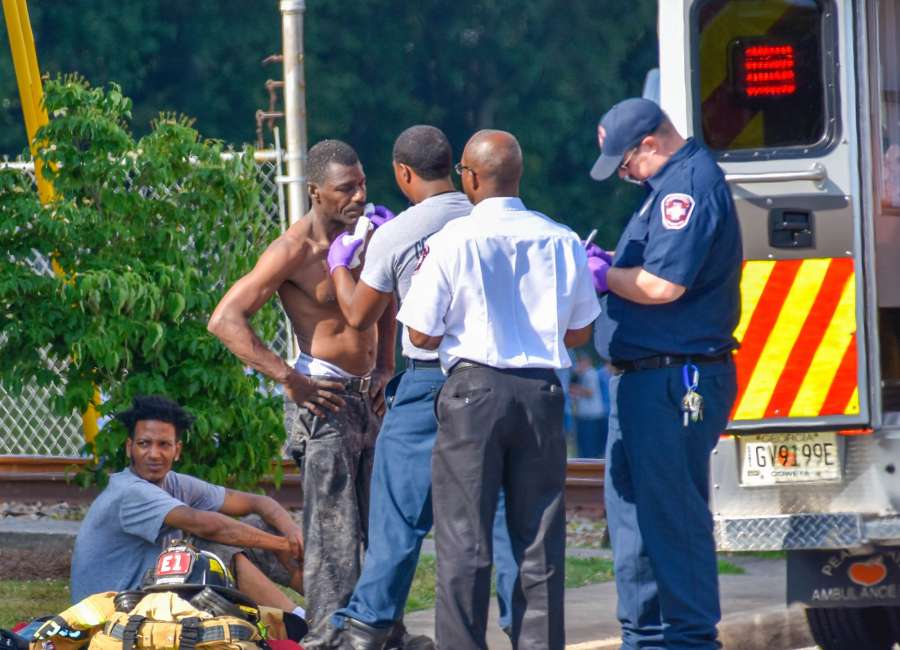
Bonnell Aluminum reported that of the five injured, one was airlifted to Atlanta Medical Center, two were transported to Piedmont Newnan Hospital, and two were treated on site.  


Five workers suffered injuries, some life-threatening, in a factory explosion this morning that blew molten aluminum and concrete at neighboring property and shook buildings miles away.

Witnesses speculated rainwater triggered the massive blast in the Bonnell Aluminum Plant’s casting operation.


According to an emergency medical technician at the scene, the seriousness of the injuries from the explosion ranged from immediate life-threatening injuries to walking-wounded injuries.

Immediate life-threatening injuries are ones that require the patients be seen Level I trauma center. Walking wounded patients are ones who can walk out and handle themselves. The EMT was not aware of the complete injuries in terms of burns.

Bonnell Aluminum reported that of the five injured, one was airlifted to Atlanta Medical Center, two were transported to Piedmont Newnan Hospital, and two were treated on site. It declined to release the names of those injured until families gave permission.

A staging area for people trying to connect with family following the explosion has been set up at Newnan Fire Station 3 on Temple Avenue.

Sgt. Chris Robinson of the Newnan Police Department posted information on the Newnan Police Department’s Facebook page notifying anyone “wishing to inquire about family members” from the plant that there is “a staging and family meeting area” at the fire station.

The explosion blew bits of concrete and aluminum a half-mile away into Temple Avenue, damaging a building at Sewell Marine and causing a small fire in a boat for sale on the lot which was easily extinguished.

“It’s just a big mess – got blown everywhere,” said Richard Sewell, owner of the boat dealership. “It knocked me out of my chair.”

The blast also shook buildings in downtown Newnan – nearly a mile away.

“At this time, it’s too early to speculate on what caused the accident, but we are working closely with local fire officials and others to conduct a thorough investigation,” a company statement read. “The safety of our employees is our No. 1 priority, so we have temporarily shut down our operations until we can access the situation.”


Bonnell melts raw aluminum in giant smelters to form what the industry calls billets that are 6 inches by 20-30 feet long. Those billets are forced under tremendous pressure through shaped dies in a process called extrusion to create parts for various industries. Often billets are sold directly to other companies that operate their own extrusion manufacturing.

One significant danger is in the remelting of scrap aluminum leftover from extrusion. The risk is that processed aluminum like a soft-drink can winds up in the scrap bin. That’s because it melts at a different rate and can trigger a massive explosion, according to former workers.

For that reason, the company enforces a policy prohibiting workers from even bringing a canned soda onto the property that might wind up in a scrap bin.

“As far as safety, they were pretty strict,” said Matthew Plotner, a one-time employee in Bonnell’s environmental department. “I’m actually fairly surprised by the explosion to be honest.”

The metal roof over the smelters requires periodic replacement because of the stress caused by the heat and acid.

The company has been diligent about that and other precautions, according to Sam Harkness, who retired from Bonnell in 2008 after working in every department but smelting.

“I would give them nothing but an A plus for safety,” he said. “It was almost impossible to hurt yourself there. You had to get through a locked gate and over guardrails even to get near anything that could harm you. There were always safeguards because of what happened in the 1950s.”

An explosion in December, 1956, killed two workers at the same plant.

The plant is closed while the investigation continues.

Bonnell is an aluminum extrusion company, which has been a major Coweta employer for decades. At one time, Bonnell was the county’s largest private employer.

Further details will be posted as the story develops.


=============================================


Newnan, Georgia Plant

Bonnell Aluminum
25 Bonnell Street
P.O. Box 428
Newnan, GA 30263
Tel: 770-253-2020
  • 500,000 square feet (11.9 acres under roof)
  • Cast house - 6", 7", 8", 9" diameter billet
  • Extrusion presses (4) - 1,550–2,750 ton rating;
    6", 7", 8", 9" containers
  • Wet paint
    • 24' maximum length vertical electrostatic
    • Meets or exceeds AAMA 2603 specifications
  • Acid Etch Anodizing
    • 26' maximum length anodize and hardcoat
    • 24' maximum length for Brite Dip
    • Anodize film thickness - .15–.80 mils
    • Architectural hardcoat film thickness - .70–1.20 mils
    • AAMA 611 compliant
  • Buffing
    • 24' maximum length
    • 9’6” minimum length
  • Fabrication
  • ISO 9001 : 2008 Registered 684 KB