MEC&F Expert Engineers

Friday, September 14, 2018

The NTSB is gravely concerned that the majority of the Nation’s railroads, particularly passenger railroads, required to install PTC will not have fully operational systems by the December 31, 2018, deadline


Testimony Before the Subcommittee on Railroads, Pipelines, and Hazardous Material Committee on Transportation & Infrastructure United States House of Representatives on The State of Positive Train Control Implementation in the United States
Robert L. Sumwalt
United States House of Representatives, Washington, DC
9/13/2018

Good morning, Chairman Denham, Ranking Member Capuano, and Members of the Subcommittee. Thank you for inviting the National Transportation Safety Board (NTSB) to testify before you today.

The NTSB is an independent federal agency charged by Congress with investigating every civil aviation accident and significant incidents in the United States, as well as significant accidents and incidents in other modes of transportation—railroad, highway, marine, and pipeline. We determine the probable cause of these accidents and other transportation events and issue safety recommendations aimed at preventing future accidents. In addition, we carry out special studies concerning transportation safety and coordinate the resources of the federal government and other organizations to assist victims and their family members who have been impacted by major transportation disasters.

On November 14, 2016, we announced our Most Wanted List of Transportation Safety Improvements for 2017–2018.[1] This list, based on safety issues we have identified in our investigations, highlights the 10 areas in transportation safety where we believe improvements are most critical. One issue area on this cycle’s Most Wanted List is “Increase Implementation of Collision Avoidance Technologies,” which addresses the need for positive train control (PTC) to reduce accidents, prevent injuries, and save lives.

The State of Positive Train Control Implementation

Yesterday marked the 10-year anniversary of the tragic accident in Chatsworth, California, in which a Metrolink commuter train and a Union Pacific freight train collided head-on, killing 25 people and injuring 102 others.[2] Our investigation concluded that the Metrolink engineer’s use of a personal electronic device to send text messages distracted him from his duties and that positive train control (PTC) could have prevented this accident. In the aftermath of that tragedy and a number of others that the NTSB investigated, Congress passed the Rail Safety Improvement Act of 2008 (RSIA), which required the implementation of a PTC system on each line over which intercity passenger or commuter service is operated or over which poison- or toxic-by-inhalation hazardous materials were transported, by December 31, 2015.[3] In October 2015, Congress extended this deadline to December 31, 2018, and included provisions for railroads to request an additional 24-month extension to December 31, 2020, if certain criteria are met.[4]

Now, 10 years later and nearly 3 years after the original deadline imposed by Congress, PTC is still not fully implemented in the United States. The NTSB strongly urges swift implementation of the congressional PTC mandate. However, it is important to note that even after that mandate is met, significant portions of the rail network will not have PTC. According to reports from railroads to the Federal Railroad Administration (FRA), only about 40 percent of the rail network – or 58,000 of 134,000 route miles – will have PTC. Significantly, Amtrak will have over 1,400 miles of track it currently operates on that will not have PTC. If Amtrak continues to operate on these segments, there will be a diminished level of safety for passengers and train crews traveling communities such as Topeka, Kansas; Grand Junction, Colorado; Portland, Maine; Memphis, Tennessee; New Orleans; St. Louis; and many others.

In other cases, under its regulations, the FRA has approved exceptions to the PTC requirement for other main line tracks on which not only freight, but also other intercity passenger and commuter railroads operate. Again, this means that there will a significantly decreased level of safety for those passengers and train crews that are traveling on those railroads.
 
NTSB Investigations of PTC-Related Accidents

Since the enactment of RSIA, there have been 22 accidents we have investigated or are currently investigating that could have been prevented by PTC. These accidents resulted in 29 deaths, over 500 injuries, and over $190 million in property damage. These include:
  • In September 2010, near Two Harbors, Minnesota, human error and fatigue contributed to the collision of two freight trains. Five crewmembers were injured.
  • In May 2011, in Hoboken, New Jersey, human error contributed to the collision of a train with the bumping post at the end of the track.
  • In June 2012, near Goodwell, Oklahoma, human inattentiveness contributed to the collision of two freight trains. Three crewmembers were killed.
  • In May 2013, near Chaffee, Missouri, inattentiveness and fatigue contributed to the collision of two freight trains. Two crewmembers were injured and a highway bridge collapsed.
  • In December 2013, in the Bronx, New York, fatigue contributed to the derailment of a passenger train. Four passengers were killed and 61 others were injured.
  • In May 2015, in Philadelphia, Pennsylvania, an Amtrak engineer’s acceleration to 106 miles per hour (mph) as he entered a curve with a 50 mph speed restriction, due to his loss of situational awareness, led to a derailment. Eight passengers were killed and 185 others were injured.
Two accidents currently under investigation occurred in DuPont, Washington and Cayce, South Carolina. Each of these accidents happened on tracks that were unprotected by PTC. While we are still investigating both, they are each a type of accident that a fully-operational PTC system is designed to prevent—overspeeds and misaligned switches.

Amtrak 501 Derailment—DuPont, Washington

On the morning of December 18, 2017, on its first regular passenger service trip, Amtrak passenger train 501 derailed as it traversed a curve near DuPont, Washington. The lead locomotive, the power car, and two passenger railcars derailed from an overpass onto Interstate 5. At the time of the accident, 77 passengers, 5 Amtrak employees, and a technician from the railcar manufacturer, Talgo Incorporated, were on the train. Of these individuals, 3 passengers were killed and 62 passengers and crewmembers were injured. Eight individuals in highway vehicles were also injured. Our investigation is ongoing, but on January 4, 2018, we issued a preliminary report regarding this derailment.[5]

Central Puget Sound Regional Transit Authority (Sound Transit), a public transit agency in the state of Washington, owns the Point Defiance Bypass tracks where the derailment occurred. Sound Transit reported that the PTC system on this line was not operational at the time of the accident. The authorized track speed decreases from 79 mph to 30 mph as the track approaches the curve. According to the lead locomotive’s event data recorder, the final recorded speed of the locomotive was 78 mph. In this accident, PTC would have notified the train engineer about the speed reduction for the curve, and if he did not take appropriate action to control the train’s speed, PTC would have applied the train brakes to maintain compliance with the speed restriction and to stop the train.

Amtrak 91 Collision with CSX Train—Cayce, South Carolina

In the early morning of February 4, 2018, an Amtrak passenger train unexpectedly entered a siding near Cayce, South Carolina, and collided with a stationary CSX freight train. Two of the crewmembers—the engineer and the conductor—were killed, and at least 92 passengers and crewmembers were transported to medical facilities. Our investigation is ongoing, but on February 28, 2018 we issued a preliminary report.[6]

At the time of the accident, a signal suspension was in place through the area, due to signal work being done, including upgrades to prepare for implementation of PTC. Trains were being directed through the area by a CSX dispatcher, who would issue warrants, or permissions, to use the main line.[7] The crew of the CSX train had completed work in the area, moved the train to the siding, and released their authority to use the main line back to the dispatcher. However, the switch on the main line was left open to the siding and locked. The Amtrak train, traveling at 57 mph, was diverted into the siding from the main and struck the CSX train.

This is the second accident that we are investigating involving a train being unexpectedly diverted onto a side track because of a switch left in the incorrect position in an area of track under “signal suspension” due to installation and testing of PTC. On December 5, 2017, we issued an accident brief regarding the collision of two Union Pacific Railroad freight trains that occurred on March 14, 2016, in Granger, Wyoming. One crew member received minor injuries.We determined that the probable cause of the accident was that the employee-in-charge incorrectly used information from a conversation with the train dispatcher as authorization to send a train into the signal suspension territory. 

Contributing to the accident was the failure of a crew member to check the switch position before authorizing the train to enter the signal suspension territory.[8]

In both the Granger and Cayce accidents, human decision making and actions likely played key roles. Safe movement of the trains through the signal suspension depended on proper switch alignment, which, in turn, relied on error-free manual work. The risk of error was not safeguarded, either by technology or supervision. The reliance on error-free human performance for safe train movement creates a single point-of-failure given the current operating practices and regulations. We concluded that additional measures are needed, such as restricted speed, to ensure safe operations during signal suspensions, especially during the movement of passenger trains, due to the likelihood of harm to the traveling public.

Therefore, on February 13, 2018, we issued an urgent safety recommendation to the FRA to issue an emergency order directing railroads to require that when signal suspensions are in effect and a switch has been reported relined for a main track, the next train or locomotive to pass the switch location must approach with a restricted speed. After verifying the switch position, the train crew would be required report to the dispatcher that the switch is correctly lined for the main track before trains would be permitted to operate at maximum-authorized speed.[9] We only issue urgent recommendations when we determine that the course of action requires immediate attention to avoid imminent loss due to a similar accident.

On April 23, 2018, the FRA published a notice of draft safety advisory in response to our urgent safety recommendation. The proposed safety advisory recommends that railroads adopt industry best safety practices regarding railroad operations under temporary signal suspensions. Because FRA’s proposal would not require adoption of such practices, as called for by our urgent safety recommendation, the NTSB has classified this urgent safety recommendation as “Open – Unacceptable Response.” Furthermore, it is noteworthy that FRA has not even published proposed industry best practices. We believe that the FRA must act now to prevent accidents like those in Granger or Cayce.

On July 10 and 11, 2018, we held a two-day investigative hearing to explore issues involved in the DuPont and Cayce accidents. The purpose of the hearing was to elicit additional factual information about the accidents as part of our ongoing investigations. The factors involved in these accidents are comprehensive and we are examining a multitude of aspects beyond PTC, including Amtrak operations on host railroads and safety management systems in passenger rail.

Conclusion

The NTSB is gravely concerned that the majority of the Nation’s railroads, particularly passenger railroads, required to install PTC will not have fully operational systems by the December 31, 2018, deadline. I appreciate the Committee holding another hearing this year on the importance of PTC, and I am here today to urge implementation of this lifesaving technology without further delay. For each day that goes by without PTC, we are at continued risk for another tragic accident.

Thank you for the opportunity to testify before you today. I look forward to responding to your questions.


1 NTSB, 2017–2018 Most Wanted List  (Washington, DC: NTSB, 2016).
3 Rail Safety Improvement Act of 2008, Pub. L. No. 110-432, § 104 (October 16, 2008).
4 Positive Train Control Enforcement and Implementation Act of 2015, Pub. L. No. 114-73, § 1302 (October 29, 2015).
5 NTSB, Preliminary Report, RRD18MR001 (January 4, 2018).
6 NTSB, Preliminary Report, RRD18MR003 (February 28, 2018)
7 Signal suspension means train control signals located alongside the track have been taken out of service, oftentimes for maintenance or system upgrades. When these signals are taken out of service, train movements are controlled by means such as absolute blocks or by track warrants.
8 NTSB, Collision of Two Union Pacific Railroad Freight Trains, Granger, Wyoming. Rpt. No. NTSB/RAB-17-10 (December 5, 2017).
9 NTSB, Safety Recommendation Report: Train Operation During Signal Suspension. Rec. No. R-18-005 (February 13, 2018)

NTSB Meeting to Determine Cause of Fatal, Concan, Texas, Bus Crash Scheduled. The crash killed 13 people and injured 2 others.


Meeting to Determine Cause of Fatal, Concan, Texas, Bus Crash Scheduled

The National Transportation Safety Board is scheduled to meet Oct. 16, 2018, to determine the probable cause of the fatal March 29, 2017, collision involving a pick-up truck and a 13-passenger bus near Concan, Texas.  

The bus driver and 12 of the 13 bus passengers were killed, and the truck driver and one bus passenger suffered serious injuries. 

Previously released information about the accident investigation is available at https://go.usa.gov/xPr79

WHAT:  NTSB Board Meeting
WHEN:  Tuesday, Oct. 16, 2018, 9:30 a.m. EDT
WHERE:  NTSB Boardroom and Conference Center, 420 10th St., SW, Washington DC
WHO:   NTSB board members and the Office of Highway Safety staff.
WEBCAST: A link to the webcast will be available shortly before the start of the meeting at http://ntsb.capitolconnection.org/.


Preliminary Report: Highway: HWY17MH011


Executive Summary


​The information in this report is preliminary and will be supplemented or corrected during the course of the investigation.

About 12:20 p.m. (local time) on Wednesday, March 29, 2017, a 2007 Dodge Ram 3500 pickup truck, occupied by a 20-year-old male driver, was traveling north on U.S. Highway 83 (US-83) in Uvalde County, near Concan, Texas. Meanwhile a 2004 Ford E350 cutaway chassis with a 13-passenger Turtle Top Vanterra medium-size bus body, occupied by a 67-year-old driver and 13 passengers, and being operated by the First Baptist Church of New Braunfels, was traveling southbound on US-83.

As the pickup truck approached the end of an approximate 4-degree righthand curve near milepost 553.4, it departed the northbound travel lane and crossed into the southbound travel lane, colliding with the front left corner of the medium-size bus. In the area of the crash, US-83 is a two-lane roadway with the north and southbound travel lanes divided by a double yellow centerline. There is an approximate 4% upgrade in the northbound direction, and the posted speed limit is 70 mph. The accident occurred in a posted work zone, but no active work was being performed and there was no construction equipment in the immediate area on the day of the crash.

As a result of the crash the bus driver and 12 passengers on the bus were fatally injured. The driver of the pickup truck and one bus passenger sustained serious injuries. The weather conditions were clear and dry.

Southbound view of accident vehicles at final rest. (Source: Texas Department of Public Safety)


Prior to the crash, two witnesses in a vehicle following behind the pickup truck recorded a 14-minute-long video of the motion of the pickup truck. The video ended just prior to the truck entering the curve where the crash occurred. The video shows the pickup departing the northbound travel lane to the east, crossing over the solid white edge line 37 times, and entering the grass roadside at least five times. The video also shows the pickup truck also departing the northbound travel lane to the west, crossing over the double yellow centerline into the opposite lane of travel 19 times, and at one point traveling completely onto the wrong side of the road prior to the crash. NTSB’s initial review of the video indicates that the speed of the pickup truck remained relatively constant throughout the 14 minutes, at about 67 to 71 mph. The witnesses called the local Sherriff to report the pickup truck, and law enforcement was in route at the time of the crash.

After the crash the pickup driver told the witnesses and the police that he had been texting. He also provided a statement during an NTSB interview that he was checking his phone for a text when the accident occurred. The NTSB has subpoenaed the driver’s cell phone records from his service provider and will review them over the coming weeks. The driver also told NTSB investigators he had been taking prescription medications prior to the crash. Several of those medications, as well as marijuana, were found in the pickup truck at the scene of the crash. Toxicology test results are pending.

Preliminary evidence indicates that all the occupants on the church bus were wearing their available restraints. The driver and front seat passenger were restrained with a lap/shoulder belt and a supplemental air bag system. The rear seated bus passengers were restrained with lap-only belts.

No mechanical defects were identified in the initial inspection of either vehicle. No vehicle-based devices capable of recording and transmitting event-related data have been successfully downloaded at this time. NTSB investigators will continue to collect and analyze data including all pertinent information in the areas of human performance, survival, highway, vehicle, and accident reconstruction.

All aspects of the crash remain under investigation as the NTSB determines the probable cause with the intent of issuing safety recommendations to prevent similar crashes. The NTSB is working alongside the Texas Department of Public Safety which is conducting a separate, parallel investigation.

HELL ON EARTH IN MASSACHUSETTS AFTER MASSIVE NATURAL GAS EXPLOSIONS AND DOZENS OF FIRES DUE TO OVER-PRESSURIZED NATURAL GAS PIPELINES OPERATED BY COLUMBIA GAS AND NISOURCE: Leonel Rondon, 18, was killed and at least 12 others were injured after one of the gas explosions sent a chimney crashing onto his car in LAWRENCE, Mass.


Leonel Rondon, 18, was killed and at least 12 others were injured after one of the gas explosions sent a chimney crashing onto his car in LAWRENCE, Mass.


NTSB Go Team expects to remain on scene for a least a week.

As is routine in NTSB investigations, a review of the emergency response of the operator and local first responders will be conducted.

Among issues being examined in NTSB investigation are design of pipeline system, any upgrades made to the system, and the operator’s management of the pipeline.

NTSB investigators are gathering perishable evidence from the accident site and gathering information from other federal, state, and local agencies, and Columbia Gas.


NTSB sending a Go-Team to pipeline explosion in Lawrence, Massachusetts. Team will travel this morning.

=====================================


1 killed, 12 injured in fires, explosions after suspected gas leak in LAWRENCE, Massachusetts.


NiSource Inc. is one of the largest fully regulated utility companies in the United States, serving approximately 3.5 million natural gas customers and 500,000 electric customers across seven states through its local Columbia Gas and NIPSCO brands. The company, based in Merrillville, Indiana, United States, has more than 8,000 employees. 
By JULIA JACOBO

Karma Allen Sep 14, 2018, 1:53 AM ET


WCVB/AP
Coming upMassachusetts firefighters battle flames from suspected gas explosions


  LAWRENCE, Mass.


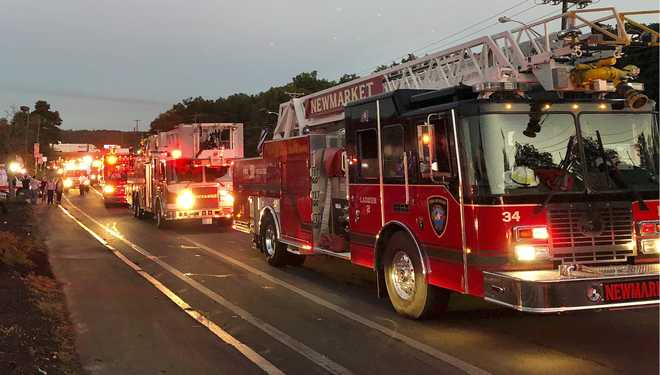
One person died and about a dozen others were injured in Massachusetts on Thursday as a series of gas-related fires and explosions tore through several communities, authorities said.

Eighteen-year-old Leonel Rondon was killed and at least 12 others were injured in Northern Massachusetts as fires and explosions tore the area, damaging at least two dozen homes and businesses, according to local authorities.

Rondon, a resident of Lawrence, was killed after one of the explosions sent a chimney crashing onto his car, Massachusetts State Police said.


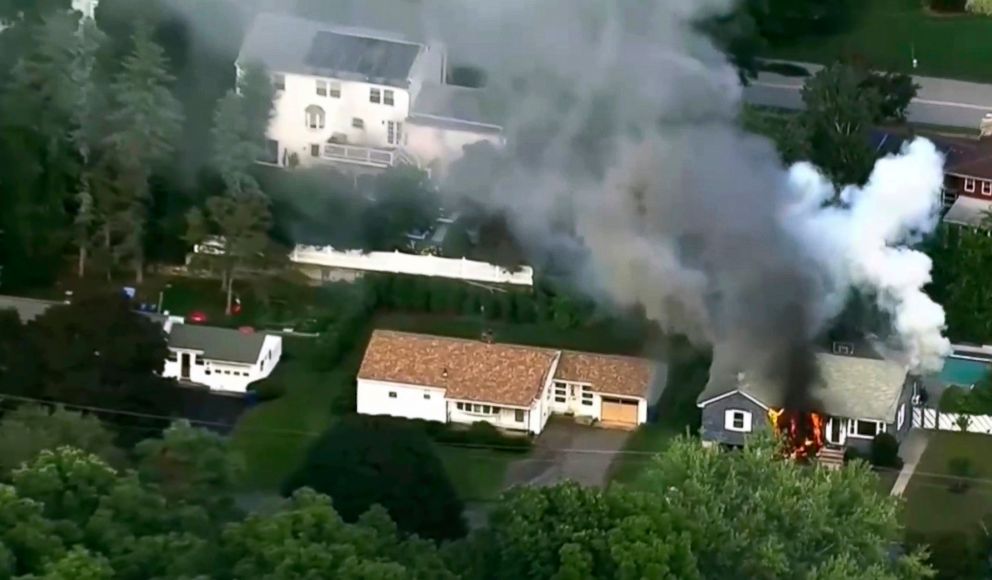
The Associated PressFirefighters battle a house fire, Thursday, Sept. 13, 2018, on Herrick Road in North Andover, Mass., one of multiple emergency crews responding to a series of gas explosions and fires triggered by a problem with a gas line that feeds homes


There had been at least three explosions and as many as 80 fires reported as of late Thursday night, authorities said, citing a suspected gas line leak as the cause.

Many residents, including those located in Lawrence, Andover and North Andover, were forced to evacuate.

At least 30 homes and businesses caught fire in Andover, and active fires were reported in Lawrence as of early Friday morning, several hours after initial reports surfaced, fire officials said.


“Our city has had a rough day today,” the city of Lawrence said in a statement early Friday morning. “We grieve for the loss ... and continue to support first responders."

The Massachusetts State Police Watch Center said it responded to explosions, fires and other gas-related reports at least 70 different addresses. The state’s governor said about 8,000 homes were affected.

Three victims in Andover included included a firefighter and two civilians, authorities said.

Evacuations were taking place in multiple neighborhoods where residents smelled gas, according to state police. Those who live south of the Merrimack River were told to evacuate, Lawrence Mayor Dan Rivera said at a press conference Thursday night.


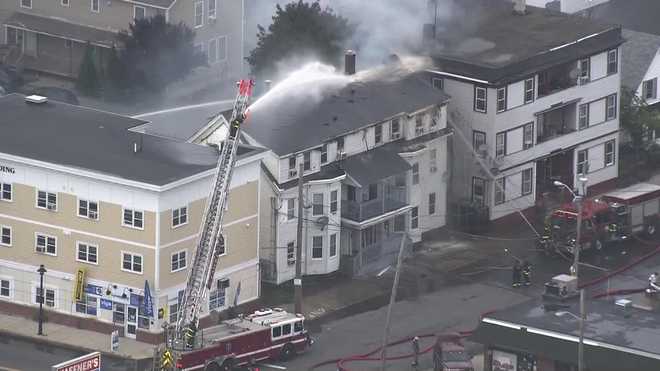
The Associated PressIn this image take from video provided by WCVB in Boston, firefighters battle a raging house fire in Lawrence, Mass, a suburb of Boston, Thursday, Sept. 13, 2018. Emergency crews are responding to what they believe is a series of gas explosions.


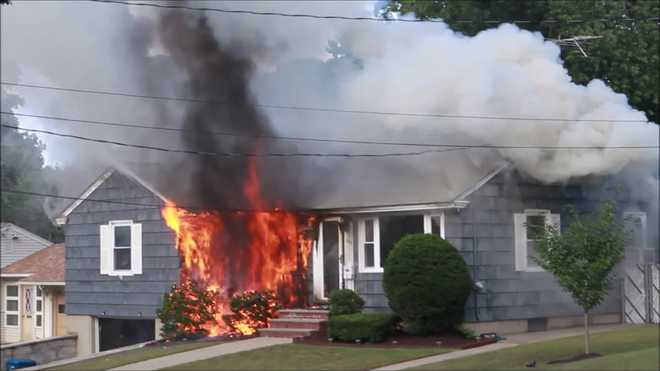
The Associated PressIn this image take from video provided by WCVB in Boston, flames consume the roof of a home in Lawrence, Mass, a suburb of Boston, Thursday, Sept. 13, 2018. Emergency crews are responding to what they believe is a series of gas explosions


Authorities also warned residents in the area who are served by Columbia Gas to "evacuate their homes immediately" as gas lines are being depressurized by the company.

Aerial footage taken by ABC Boston affiliate WCVB showed firefighters battling flames in a residential neighborhood that sent thick plumes of smoke into the air.


The Associated PressIn this image take from video provided by WCVB in Boston, flames consume a home in Lawrence, Mass, a suburb of Boston, Thursday, Sept. 13, 2018. Emergency crews are responding to what they believe is a series of gas explosions that have damaged homesmore +


WCVB/APFlames rise from a house in Lawrence, Mass., Sept. 13, 2018.



Residents in Andover were evacuated to a local senior center, while residents in North Andover were directed to a nearby middle school.


======================================


LAWRENCE, Mass. —

10:55 p.m.

Authorities say an 18-year-old man has died after a house exploded amid gas explosions north of Boston, sending a chimney crashing into his car.

Officials have identified the victim as Leonel Rondon, of Lawrence. They say he was rushed to Massachusetts General Hospital in Boston, where he died around 8:30 p.m. EDT of his injuries.

Gov. Charlie Baker says 10 other people were injured Thursday in a series of fires and explosions that authorities blame on over-pressurized natural gas lines.


------

9:15 p.m.

The company that owns Columbia Gas says its crews are performing safety checks after a series of fires and explosions erupted in three communities north of Boston, but did not explain what went wrong.

A statement from Indiana-based NiSource says its "thoughts are with everyone affected by today's incident" and that it appreciates the response from local emergency crews.


NiSource Inc. is one of the largest fully regulated utility companies in the United States, serving approximately 3.5 million natural gas customers and 500,000 electric customers across seven states through its local Columbia Gas and NIPSCO brands. The company, based in Merrillville, Indiana, United States, has more than 8,000 employees. 


State and local officials said at a news conference minutes earlier that they had still not heard from Columbia Gas following the fires in Lawrence, Andover and North Andover. Gov. Charlie Baker later clarified that he thought the company's response was "adequate."

Authorities are blaming over-pressurized gas lines and previously told all residents with Columbia Gas service in those areas to evacuate.

At least six people were injured in the fires and explosions, including two in critical condition.


___

8:20 p.m.

Officials say at least six people have been injured in a series of fires and explosions north of Boston that authorities blame on over-pressurized natural gas lines.

Lawrence General Hospital says it's treating six patients from the gas explosions including two in critical condition.

Officials in Andover previously said at least three people, including a firefighter, had been injured in the town. It was not immediately clear if those were separate from the victims treated at Lawrence General.

State Police say at least 39 fires erupted Thursday afternoon in the communities of Lawrence, Andover and North Andover.

Electricity is being cut to residents in all three communities as crews work to prevent further damage.

Officials in all three areas said school will be canceled on Friday.


Phil Marcelo

___

7:30 p.m.

Officials in Andover, Massachusetts, say at least three people, including a firefighter, have been injured in the town after a series of fires that authorities blame on a natural gas issue.

It was not immediately clear whether those injured were different from the four victims with fire-related injuries taken to Lawrence General Hospital.

Andover officials say in a statement that all 35 fires in the town have been extinguished.

At the peak of the situation, they say 18 fires were burning at the same time in Andover.

State Police say at least 39 fires erupted Thursday afternoon in the communities of Lawrence, Andover and North Andover.


-0:40


___

7:15 p.m.

A man whose neighborhood was among dozens that erupted in fire in communities north of Boston says he ran into his basement to find that the room was glowing.

Lawrence resident Ra Nam says he was in his yard when the smoke detector in his basement went off around 4:30 p.m. Thursday.

Nam says he ran downstairs and saw that his boiler was on fire. He says he quickly grabbed a fire extinguisher and put it out.

Minutes later, Nam says he heard a loud boom come from his neighbor's house and the ground shook. Nam said a woman and two kids had made it out of the house, but the basement was on fire.

Massachusetts State Police say officials will be shutting off power to all residents in Lawrence, Andover and North Andover.


___

6:55 p.m.

At least four people are being treated for injuries after a series of fires north of Boston that authorities blame on a natural gas issue.

Lawrence General Hospital says it has treated four victims with fire-related injuries but did not immediately release their conditions or the severity of the injuries.

State Police say at least 39 fires erupted Thursday afternoon in the communities of Lawrence, Andover and North Andover.

Residents in those areas with homes that are serviced by Columbia gas have been urged to evacuate.

State Police say Columbia Gas crews are working to depressurize gas lines in the area. A spokeswoman for the company did not immediately return calls.

The three communities house more than 146,000 residents and are located about 26 miles (42 kilometers) north of Boston.


-0:58


___
6:45 p.m.

Authorities in Massachusetts say a natural gas issue is to blame for at least 39 fires that erupted in homes across communities north of Boston.

A spokesman for the Andover Police Department says residents in Lawrence, North Andover and Andover whose homes are serviced by Columbia Gas were urged to evacuate on Thursday afternoon.

Massachusetts State Police say Columbia Gas is working to depressurize gas lines in the area. A company spokeswoman did not immediately provide comment.

State Police say they have confirmed fires at 39 locations but warn the number will grow.

The three communities house more than 146,000 residents and are located about 26 miles (42 kilometers) north of Boston.

Police Chief Joseph Solomon in nearby Methuen says there are so many fires "you can't even see the sky."

___

5:10 p.m.

Emergency crews are responding to what they believe is a series of gas explosions that have damaged homes across three communities north of Boston.

Methuen Police Chief Joseph Solomon says there are 20 to 25 homes on fire in Lawrence. Solomon, who's in Lawrence, says there are so many fires "you can't even see the sky."

The Eagle-Tribune newspaper in North Andover reports at least one home has been destroyed and several others have caught fire amid a problem with a gas line that feeds homes in Andover, North Andover and Lawrence.

Massachusetts State Police say troopers are responding to the area to help secure areas after "multiple suspected gas explosions."

Lawrence Police Chief Roy Vasque told The Eagle-Tribune that he's "never seen anything like this."

The newspaper reported that some neighborhoods were being evacuated.

It was not immediately clear whether there were any injuries.

FLORENCE ABOUT TO MAKE LANDFALL IN NORTH CAROLINA CAUSING LIFE-THREATENING STORM SURGES AND HURRICANE-FORCE WINDS. CATASTROPHIC FRESHWATER FLOODING EXPECTED OVER PORTIONS OF NORTH AND SOUTH CAROLINA


413 
WTNT31 KNHC 140841
TCPAT1

BULLETIN
Hurricane Florence Advisory Number  60
NWS National Hurricane Center Miami FL       AL062018
500 AM EDT Fri Sep 14 2018

FLORENCE ABOUT TO MAKE LANDFALL IN NORTH CAROLINA CAUSING LIFE-THREATENING STORM SURGES AND HURRICANE-FORCE
WINDS.  CATASTROPHIC FRESHWATER FLOODING EXPECTED OVER PORTIONS OF NORTH
AND SOUTH CAROLINA


SUMMARY OF 500 AM EDT...0900 UTC...INFORMATION
----------------------------------------------
LOCATION...34.2N 77.4W
ABOUT 25 MI...35 KM E OF WILMINGTON NORTH CAROLINA
ABOUT 55 MI...85 KM SW OF MOREHEAD CITY NORTH CAROLINA
MAXIMUM SUSTAINED WINDS...90 MPH...150 KM/H
PRESENT MOVEMENT...WNW OR 285 DEGREES AT 6 MPH...9 KM/H
MINIMUM CENTRAL PRESSURE...958 MB...28.29 INCHES


WATCHES AND WARNINGS
--------------------
CHANGES WITH THIS ADVISORY:

None.

SUMMARY OF WATCHES AND WARNINGS IN EFFECT:

A Storm Surge Warning is in effect for...
* South Santee River South Carolina to Duck North Carolina
* Albemarle and Pamlico Sounds, including the Neuse and Pamlico
Rivers

A Storm Surge Watch is in effect for...
* Edisto Beach South Carolina to South Santee River South Carolina

A Hurricane Warning is in effect for...
* South Santee River South Carolina to Duck North Carolina
* Albemarle and Pamlico Sounds

A Hurricane Watch is in effect for...
* Edisto Beach South Carolina to South Santee River South Carolina

A Tropical Storm Warning is in effect for...
* North of Duck North Carolina to Cape Charles Light Virginia
* Chesapeake Bay south of New Point Comfort
* Edisto Beach South Carolina to South Santee River South Carolina

Interests elsewhere in the southeastern and mid-Atlantic states
should monitor the progress of Florence.

A Storm Surge Warning means there is a danger of life-threatening
inundation, from rising water moving inland from the coastline. For
a depiction of areas at risk, please see the National Weather
Service Storm Surge Watch/Warning Graphic, available at
hurricanes.gov.

A Storm Surge Watch means there is a possibility of life-
threatening inundation, from rising water moving inland from the
coastline.

A Hurricane Warning means that hurricane conditions are expected
somewhere within the warning area, in this case within the next 24
hours.

A Hurricane Watch means that hurricane conditions are possible
within the watch area.

A Tropical Storm Warning means that tropical storm conditions are
expected somewhere within the warning area.

For storm information specific to your area, including possible
inland watches and warnings, please monitor products issued by your
local National Weather Service forecast office.


DISCUSSION AND OUTLOOK
----------------------
At 500 AM EDT (0900 UTC), the center of the eye of Hurricane
Florence was located by an Air Force Hurricane Hunter aircraft and
NOAA Doppler radar near latitude 34.2 North, longitude 77.4 West.
Florence is moving toward the west-northwest near 6 mph (9 km/h).  A
turn toward the west at a slow forward speed is expected today,
followed by a slow west-southwestward motion tonight and Saturday.
On the forecast track, the center of Florence is expected to move
inland across extreme southeastern North Carolina and extreme
eastern South Carolina today and Saturday.  Florence will then move
generally northward across the western Carolinas and the central
Appalachian Mountains early next week.

Maximum sustained winds remain near 90 mph (150 km/h) with higher
gusts.  Gradual weakening is forecast later today and tonight.
Significant weakening is expected over the weekend and into early
next week while Florence moves farther inland.

Hurricane-force winds extend outward up to 80 miles (130 km) from
the center and tropical-storm-force winds extend outward up to 195
miles (315 km).  A NOAA observing site at Cape Lookout, North
Carolina, recently reported a sustained wind of 72 mph (116 km/h)
and a gust of 90 mph (145 km/h).

The minimum central pressure estimated from Hurricane Hunter data is
958 mb (28.29 inches).


HAZARDS AFFECTING LAND
----------------------
STORM SURGE:  The combination of a dangerous storm surge and the
tide will cause normally dry areas near the coast to be flooded by
rising waters moving inland from the shoreline.  The water has the
potential to reach the following heights above ground...

Cape Fear NC to Cape Lookout NC...7-11 ft, with locally higher
amounts in the Neuse, Pamlico, Pungo, and Bay Rivers
Cape Lookout NC to Ocracoke Inlet NC...6-9 ft
South Santee River SC to Cape Fear NC...4-6 ft
Ocracoke Inlet NC to Salvo NC...4-6 ft
Salvo NC to Duck NC...2-4 ft
Edisto Beach SC to South Santee River SC...2-4 ft

The deepest water will occur along the immediate coast in areas of
onshore winds, where the surge will be accompanied by large and
destructive waves.  Surge-related flooding can vary greatly over
short distances.  For information specific to your area, please see
products issued by your local National Weather Service forecast
office.

RAINFALL: Florence is expected to produce heavy and excessive
rainfall in the following areas...

Southeastern coastal North Carolina into far northeastern South
Carolina...an additional 20 to 25 inches, with isolated storm totals
of 30 to 40 inches. This rainfall will produce catastrophic flash
flooding and prolonged significant river flooding.

Remainder of South Carolina and North Carolina into southwest
Virginia...5 to 10 inches, isolated 15 inches. This rainfall will
produce life-threatening flash flooding.

TORNADOES:  A few tornadoes are possible in eastern North Carolina
today.

SURF:  Swells generated by Florence are affecting Bermuda, portions
of the U.S. East Coast, and the northwestern and central Bahamas.
These swells are likely to cause life-threatening surf and rip
current conditions. Please consult products from your local weather
office.


NEXT ADVISORY
-------------
Next intermediate advisory at 800 AM EDT.
Next complete advisory at 1100 AM EDT.

Thursday, September 13, 2018

Careless smoking may have started the fire at 9321 Sienna Ridge Drive in Las Vegas that killed Noel Cohen, 51 and pet dog


SEPTEMBER 13, 2018


LAS VEGAS, NEVADA:


A woman found dead after a fatal house fire Wednesday afternoon in the west Las Vegas Valley has been identified.

Noel Cohen, 51, died in the blaze, according to the Clark County coroner’s office. Her cause and manner of death has not been released.

Firefighters think careless smoking may have started the fire at 9321 Sienna Ridge Drive, near Fort Apache Road and Charleston Boulevard, Las Vegas Fire Department spokesman Tim Szymanski said in a release. Szymanski said “smoking materials” were found in the rear bedroom of the home.

Neighbors reported the fire just after 3 p.m., Szymanski said. They tried knocking on the door but no one answered.

Firefighters found that the back patio door was blackened from smoke. They broke through it and entered the rear bedroom where they found an overstuffed chair and a mattress on fire.

They continued searching the home and found Cohen’s body in the hallway just outside the bedroom door, Szymanski said. They also found a dead pet dog inside the home.
 

Two other family members were not at home when the fire started, Szymanski said. Both were displaced.

Cohen’s death marks the fourth fatal fire the Fire Department has investigated this year. Szymanski said careless smoking is the most common cause of fire-related deaths in Las Vegas.