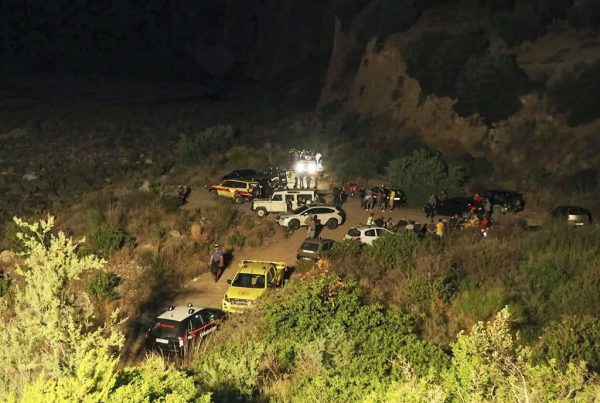
MEC&F Expert Engineers

Tuesday, August 21, 2018

Nine people were injured, one critically, when a natural gas explosion leveled a Denver apartment house in Colorado


People watch as emergency personnel work at a site where a natural gas explosion leveled an apartment building in Denver, Colorado, August 14, 2018, in this picture obtained from social media. Chelsea Sheehan/via REUTERS


DENVER, CO (Reuters) - 


Nine people were injured, one critically, on Tuesday when a natural gas explosion leveled a Denver apartment house, a fire department spokesman said.


First responders rescued two victims trapped inside the building, described as a “fourplex,” in Denver’s historic Baker neighborhood, said Denver Fire Captain Greg Pixley.

No one else was believed trapped in the rubble, alive or dead, Pixley said, but firefighters were conducting a thorough search to make sure.

“What we are using now is the cadaver dog ... to help us assure that we haven’t missed anything,” he said. “Our goal is not to find a victim, but to rule out that a victim is not there.”

Pixley said that arson investigators and a crime scene unit was on the scene as part of the investigation and that crews for Xcel Energy Inc (XEL.O), the Denver utility that supplied the building, had shut off all gas lines into the area.

Xcel Energy spokeswoman Michelle Aguayo said by phone the utility was working with the fire department to determine the cause of the blast.

Two people hurt in the explosion were transported to Denver Health Medical Center, said hospital spokesman Simon Crittle. One had severe traumatic injuries while the other’s injuries were not as severe, he said.

Seven other people who suffered minor injuries were treated at the scene, the Denver Fire Department said on Twitter.

A man who lives in the area told Denver television station FOX31 he smelled gas as he was walking to the store, before an explosion sent bricks flying into the street.

The fire department posted pictures of the apartment building on Twitter showing its roof collapsed in the explosion, which propelled wooden beams and other rubble cascading across the sidewalk.

FBI: The total cost of insurance fraud (non-health insurance) is estimated to be more than $40 billion per year. That means Insurance Fraud costs the average U.S. family between $400 and $700 per year in the form of increased premiums.


Insurance Fraud
A Basic Overview
The insurance industry consists of more than 7,000 companies that collect over $1 trillion in premiums each year. The massive size of the industry contributes significantly to the cost of insurance fraud by providing more opportunities and bigger incentives for committing illegal activities.
Costs of Fraud
The total cost of insurance fraud (non-health insurance) is estimated to be more than $40 billion per year. That means Insurance Fraud costs the average U.S. family between $400 and $700 per year in the form of increased premiums.
Common Schemes
Premium Diversion
  • Premium diversion is the embezzlement of insurance premiums.
  • It is the most common type of insurance fraud.
  • Generally, an insurance agent fails to send premiums to the underwriter and instead keeps the money for personal use.
  • Another common premium diversion scheme involves selling insurance without a license, collecting premiums and then not paying claims.
Fee Churning
  • In fee churning, a series of intermediaries take commissions through reinsurance agreements.
  • The initial premium is reduced by repeated commissions until there is no longer money to pay claims.
  • The company left to pay the claims is often a business the conspirators have set up to fail.
  • When viewed alone, each transaction appears to be legitimate—only after the cumulative effect is considered does fraud emerge.
Asset Diversion
  • Asset diversion is the theft of insurance company assets.
  • It occurs almost exclusively in the context of an acquisition or merger of an existing insurance company.
  • Asset diversion often involves acquiring control of an insurance company with borrowed funds. After making the purchase, the subject uses the assets of the acquired company to pay off the debt. The remaining assets can then be diverted to the subject.
Workers’ Compensation Fraud
  • Some entities purport to provide workers’ compensation insurance at a reduced cost and then misappropriate premium funds without ever providing insurance.
Scam SpotlightDisaster-Related Fraud: Hurricane Katrina
Massive Storm, Massive Cost
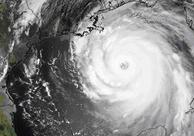
  • In late August 2005, Hurricane Katrina made landfall along America’s Gulf Coast.
  • The storm caused approximately $100 billion in economic damages.
  • Approximately 1.6 million insurance claims were filed, totaling $34.4 billion in insured losses.
  • Of the $80 billion in government funding appropriated for reconstruction, it is estimated that Insurance Fraud may have accounted for as much as $6 billion.
Disaster Fraud Schemes
  • False or exaggerated claims by policyholders.
  • Misclassification of flood damage as wind, fire, or theft.
  • Claims filed by individuals residing hundreds of miles outside the disaster-zone.
  • Bid-rigging by contractors, falsely inflating the cost of repairs.
  • Contractors requiring upfront payment for services, then failing to perform the agreed upon repairs.
  • Charity fraud scams designed to misappropriate funds donated for disaster relief.
The Government Response
  • On September 8, 2005, the Attorney General created the Hurricane Katrina Fraud Task Force (HKTF).
  • The HKTF was designed to deter, investigate, and prosecute disaster-related federal crimes.
  • The HKTF has a zero-tolerance policy for fraud related to Hurricane Katrina.
  • In one Katrina-Related fraud case alone, the FBI received more than 70 indictments and over 60 guilty pleas (as of March 2007).
Insurance Fraud Resources
For more information about Insurance Fraud or where to report it, contact the following organizations.
Fraud Bureaus
Check to see if your state sponsors a fraud bureau that investigates insurance fraud—most states do. You may even be eligible for a reward if you report a scam.
Insurance Companies
Go directly to the insurer you think is being defrauded. Some companies have systems in place for reporting fraud. If the company doesn’t have a reporting system or fraud hotline, call or write the company headquarters.
National Insurance Crime Bureau (NICB)
(800) 835-6422
The NICB is a non-profit organization that partners with insurance companies and law enforcement to help identify, detect, and prosecute insurance criminals. The NICB web site is an excellent source of information.
Coalition Against Insurance Fraud (CAIF)
www.insurancefraud.org
The CAIF is a national alliance of consumer groups, public interest organizations, government agencies, and insurers dedicated to preventing insurance fraud. The CAIF website offers a wealth of information for consumers.
National Association of Insurance Commissioners (NAIC)
www.naic.org
The NAIC assists state insurance regulators in serving the public interest and achieving regulatory goals. You can find numerous fraud resources on the NAIC website.
Individuals are always encouraged to report Insurance Frauds to their local FBI offices.

Flash flooding in Raganello Creek in the Calabria region of southern Italy has left at least 10 hikers dead, while others may be missing


Flash Flooding in Southern Italy Leaves at Least 10 Hikers Dead
A Dutch tourist described it as ‘a sudden avalanche of water’
By Jane Gray
Updated: August 21, 2018

Flash flooding in the Calabria region of southern Italy has left at least 10 hikers dead, while others may be missing, officials said. The hikers were hit by a sudden swell in a narrow gorge, resulting from heavy rains upstream.

The civil protection department said 23 people were rescued following the Aug. 20 flooding in Raganello Creek, part of the Pollino National Park; many of them were hospitalized.

Images carried on television show rescuers climbing down steep rocks to try to rescue the hikers from the devastating scene. The tragedy in the popular tourist spot is thought to have involved 36 hikers.

The death toll was revised down to 10 from 11, a number announced erroneously by the civil protection agency earlier on Aug. 21, according to officials.

“It is really difficult terrain, filled with obstacles because of the [geological] formation of the area,” said Eugenio Facciolla, the chief prosecutor of the provincial capital, Cosenza.


He said rescuers working under spotlights were trying to locate areas where some people may have survived, by ending up on small patches of shore or tiny islands in the creek. Rescuers are seen at the Raganello Gorge, a popular hiking spot in Civita, on Aug. 20, 2018. (Kontrolab/AFP/Getty Images)

‘A Sudden Avalanche’

The nationalities of those who have died and were injured weren’t known immediately, but some people caught up in the devastation have spoken to local reporters.

“A sudden avalanche of water came in. We did not have time to do anything, I was really lucky, incredible,” a Dutch tourist told local media. “I’m really speechless and I cry for the people who could not be saved.”

The main square in Civita, the closest town to the gorge, has become a center for aiding those caught up in the flood.

The Italian newspaper Corriere della Sera reported on a heartbreaking scene in the town, in which a woman shouted through tears: “Among the dead, there is a man without hair? … If there’s a man without hair, tell me, it’s my husband.” Rescuers and citizens wait in the central square of Civita, a village in the Italy’s southern Calabria region, on Aug. 20, 2018. (Kontrolab/AFP/Getty Images)

According to the newspaper, another woman told a rescuer she had heard a roar, and then water had come and swept people away.

“I managed to move and cling to a tree, but I saw bodies being dragged away with a crazy violence,” she said.

Those who were injured include an 8-year-old girl, who was found suffering from hypothermia, according to the Italian newspaper Repubblica. The girl, identified only as Chiara by the newspaper, was taken to a hospital in Cosenza.

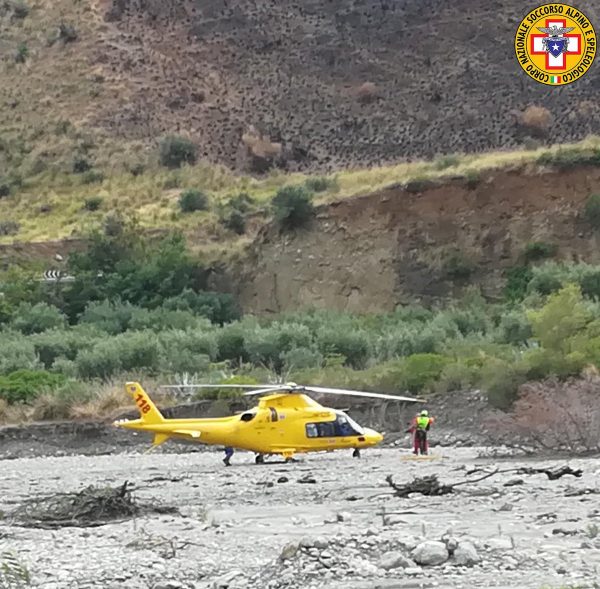
“I will never forget that tremor and her hand that touched ours while we hoisted her on board,” her rescuer, Pasquale Gagliardi, said in a Facebook post. A rescue helicopter is seen after several people were killed in a mountain gorge flooding, in the municipality of Civita, Calabria, Italy, on Aug. 20, 2018, in this image obtained from social media. (Corpo Nazionale Soccorso Alpino e Speleologico/Reuters)
‘Catapulted Out’

“This gorge filled up with water in a really short space of time and these people were catapulted out like bullets. They ended up some three kilometers (two miles) down the valley,” said Carlo Tansi, head of the civil protection department in Calabria.

Tansi said the gorge was only about four meters (13 feet) wide in some places, increasing the speed of the water and making the rescue more difficult.

He said that the rescue operations continued throughout the night.

The Public Prosecutor’s Office has opened an investigation into the tragedy.

Last week, a bridge collapsed in the Northern Italian city of Genoa, killing 43 people.

Reuters contributed to this report.

THE FATAL CRASH OF AERONCA 7AC AIRPLANE IN ALEXANDIA, MN THAT KILLED PILOT KENNETH JAMES RYAN, 64

 The pilot, identified as 64-year-old Kenneth James Ryan of Alexandria, was the only person in the plane. Authorities say the plane apparently struck a power pole before landing in a ditch.


Kenneth James Ryan of Alexandria passed away unexpectedly on July 28th while piloting his plane in LaGrand Township, rural Alexandria. Born July 18, 1954 to Jim and Elaine Ryan, Ken grew up in Lansing, IA, on the banks of the Mississippi River. He received a BS in chemistry from Loras College and his MD from the University of Iowa Medical School. He married Heidi Brown in 1984, and the couple lived together in Iowa City before moving to Alexandria in 1991, where they raised two children.

Ken was a lifelong learner, and will be remembered for his many talents and interests. He worked as a river barge deckhand, Air Force computer technician, physician, and manufacturing automation consultant; most recently he was an Anatomy and Physiology instructor at Alexandria Technical and Community College, where he could share his love of learning and passion for teaching.

Beyond his professional life, Ken enjoyed many hobbies, including flying, reading, woodworking, skydiving, scuba diving, gardening, and plane restoration. He had a special appreciation for natural beauty and enjoyed frequent hikes and runs in Minnesota parks. Ken served the Alexandria community for a number of years on the City Planning Commission, and volunteered regularly at Butterfly Hill Nature Preschool where he could reach a new generation of students.
====================

On July 28, 2018, about 1923 central daylight time, an Aeronca 7AC single-engine airplane,
N85506, impacted powerlines and terrain while maneuvering at a low altitude near Alexandria,
Minnesota. The pilot was fatally injured, and the airplane was substantially damaged. The airplane
was registered to a private individual and operated by the private pilot under the provisions of
Title 14 Code of Federal Regulations (CFR) Part 91 as a personal flight. Day   visual
meteorological conditions prevailed at the time of the accident. The local area flight departed
Chandler Field Airport (AXN), Alexandria, Minnesota, about 1918.

There were multiple witnesses who saw and/or heard the airplane flying at low altitude before the
accident. Two witnesses reported that the airplane had approached their cabin on the north shore of
Lake Latoka from the northeast and overflew their cabin at treetop level, which they estimated to
be about 50 ft above the ground. One witness stated that the airplane had "barely cleared the
trees" when the airplane overflew his cabin. The witnesses reported that the airplane then
descended below treetop level while flying south over Lake Latoka. The witnesses stated that they
observed the airplane complete at least two low passes over a house located at the southwest side
of the lake.

Another witness, who acknowledged being a friend of the pilot, owned the house located on the
southwest side of Lake Latoka. The witness was inside his house eating dinner when he heard an
airplane overfly his house. He reported that it was common for the pilot to overfly his house at a
low altitude. The witness stated that the airplane's engine sounded normal when it overflew his
house. He noted that he had a "very bad feeling" that the airplane had crashed when his house
lights flickered shortly after the airplane overflew his house. The accident site was located about
a mile north-northwest of his house.

Three additional witnesses reported seeing the airplane approach their position, about 1/4 mile
northeast of the accident site, at a low altitude and slow airspeed. These witnesses reported that
the airplane was flying toward the northwest when it descended behind a small ridge and collided
with powerlines. Two of the witnesses reported that they couldn't hear the engine as the airplane
approached their position; however, they noted they had music playing at the  time. The witnesses
reported that they heard an audible "thud" when the airplane impacted the
ground.


The accident site was located in a grass drainage ditch northwest of the intersection of Townhall
Road and 10th Avenue SW. There were multiple powerlines and a fractured power pole strung across
the road on a northwest heading. The main wreckage, which consisted of the entire airplane, was
found inverted in the drainage ditch facing south. There was no evidence of an inflight or
postimpact fire. Flight control cable continuity was established from each flight control surface
to its respective cockpit control. Both main landing gear oleo-struts and the propeller exhibited
damage consistent with an inflight wire impact. There was no evidence of a wire strike on either
wing or the empennage. The recording tachometer indicated 2,665.72 hours. The forward seat throttle
was positioned about 3/4 full travel. The airplane was not equipped with a mixture control. The
primer control was IN and secured. The magneto switch was on BOTH. The carburetor heat control was
OFF. The cabin heat control was OFF. The airplane was not equipped with an electric master switch,
but the single 10 ampere circuit breaker was not tripped. The single communication radio was
selected to the common traffic advisory frequency (123.0 megahertz). The airplane was not equipped
with a transponder. The fuel shutoff valve was ON. Fuel was recovered from the main/header tank and
both right and left auxiliary wing tanks. The fuel samples were blue in color and had an odor
consistent with 100 low-lead aviation fuel. The fuel caps were installed and secured on all fuel
tanks. The fuel selectors for the auxiliary wing tanks were in the OFF position. A functional test
of the fuel shutoff valve did not reveal any anomalies and confirmed fuel flow from the main/header
tank. The fuselage mounted gascolator had shattered during impact and fuel was observed flowing
from the fuel supply line. The postaccident examination did not reveal any anomalies that would
have precluded normal airplane operation during the flight.

The engine remained attached to the firewall. The propeller remained attached to the propeller
flange. One propeller blade was bent aft about midspan and exhibited chordwise scratching  and
leading-edge gouging that was consistent with an inflight wire strike. The other propeller blade
exhibited a slight aft bend, a single leading-edge gouge, and minor chordwise scratching near the
blade tip. Internal engine and valve train continuity were confirmed as the propeller was rotated.
Compression and suction were noted on all cylinders in conjunction with crankshaft rotation, and
acceptable cylinder pressures were measured using a differential pressure gauge. The induction
manifold and intake pipes exhibited signatures of normal operation, with no excessive fuel staining
observed. The upper spark plugs were removed and exhibited features consistent with normal engine
operation. A borescope inspection of each cylinder did not reveal any anomalies with the cylinders,
pistons, valves, valve seats, or lower spark plugs. The right magneto attached to its installation
point and provided spark on all  posts while the crankshaft was rotated. The left magneto remained
attached to the engine; however, the impulse coupling did not function as the crankshaft was
rotated. The left magneto was removed and provided a spark on all posts when rotated by hand. Right
magneto-to- engine timing was confirmed to be at top-dead-center on the number 1 cylinder. A full
teardown of the engine did not reveal any internal component failures. Adequate lubrication oil was
observed throughout the engine and there was no evidence of oil starvation or excessive       heat.
No metal material was observed after a magnet was passed through the engine sump. The oil filter
tube pickup and oil filter screen were free of metallic material. Throttle control cable continuity
was confirmed from the cockpit to the carburetor throttle arm. The carburetor mixture arm was
safety-wired in the full rich position. The carburetor bowl contained about   1/2 fluid ounce of
fuel; however, the airplane had been inverted for nearly 24 hours before being recovered. 


The carburetor bowl did not contain evidence of water or particulate contamination. Disassembly of the carburetor did not reveal any anomalies with the single- piece venturi, metal floats, or needle valve. The post-accident examination did not reveal any anomalies that would have precluded normal engine operation during the flight.

According to FAA records, the 64-year-old pilot held a private pilot certificate with single-
engine land airplane, single-engine sea airplane, and instrument airplane ratings. His most recent
FAA third-class medical certificate was issued on October 28, 2016, with a limitation for
corrective lenses. A search of FAA records showed no previous accidents, incidents, or enforcement
proceedings. A pilot logbook was not recovered during the on-scene investigation.

The 1946-model-year airplane, serial number 7AC-4246, was a high-wing monoplane of fabric- covered
steel tube and wood construction. The airplane was powered by a 90-horsepower, 4- cylinder,
Continental C90-8F reciprocating engine, serial number 47229-9-8. The engine provided thrust
through a fixed-pitch, two-blade, Sensenich 76AK-2-43 propeller, serial number 23704. The two-seat
airplane was equipped with a fixed conventional landing gear.
The airplane had a maximum allowable takeoff weight of 1,300 pounds. According to maintenance
documentation, the last annual inspection was completed on June 28, 2018, at 5,980 total airframe
hours. The airplane had accumulated 11.72 hours since the last annual inspection. The airframe had
accumulated a total service time of 5,991.72 hours when the accident occurred. The engine had
accumulated 791.72 hours since being overhauled on January 17, 1978. A postaccident review of the
maintenance records found no history of unresolved airworthiness issues.

A postaccident review of available meteorological data established that day visual meteorological
conditions prevailed at the accident site. The nearest aviation weather reporting station was
located at Chandler Field Airport (AXN) about 3 miles southeast of the accident site. At 1853,
about 30 minutes before the accident, the AXN automated surface observing system reported: wind
350° at 4 knots, 10 miles surface visibility, a clear sky, temperature
26°C, dew point 12°C, and an altimeter setting 30.13 inches of mercury.

Steel worker was crushed to death by a one-ton steel beam at Continental Steel Fabrication in Kansas City, MO


Steel worker dies after 2,000-pound beam falls at KC business
August 21, 2018


by Stephanie Graflage


A 2,000-pound steel beam fell on a worker Monday.

KANSAS CITY, Mo. — 


OSHA confirmed to FOX4 Tuesday that the Kansas City man injured Monday when a 2,000-pound steel beam fell on him has died.

The tragic incident happened at Continental Steel Fabrication near Dora and Highland at about 4:30 p.m.

Emergency crews took the man to the hospital after the incident, but he later died from his injuries.

Authorities have not yet released the victim’s identity or said what caused the steel beam to fall.

OSHA is on the scene talking to potential witnesses and the employer to determine if safety standards were followed. They are also working to determine the cause of the deadly incident.


Continental Steel has an over 125,000 square foot manufacturing facility, with overhead bridge cranes. It is located between the Northeast Industrial Bottoms and Downtown Kansas City. The two floor office area above the manufacturing plant is 30,000 square feet.