MEC&F Expert Engineers

Wednesday, August 1, 2018

Michael Meeks, 40, a private electrical contractor working for Vision Lighting, died after falling from a scissor lift at the Aramark Uniform Service plant in Toledo, Ohio.


Michael Meeks, 40, a private electrical contractor working for Vision Lighting, died after falling from a scissor lift at the Aramark Uniform Service plant in Toledo, Ohio.


Fatal scissor lift incident. 

Michael Meeks was apparently fell as he was working on light fixtures in the building
TOLEDO, OH

 July 31, 2018 

An electrician has died after falling from a scissor lift at a plant in Toledo, Ohio.

Michael Meeks, 40, a private electrical contractor working for Vision Lighting, was working on overhead lighting at the Aramark Uniform Service plant in the town, during the early hours of Thursday morning when he appears to have fallen over the guardrails.

His body was discovered by Aramark employees around 5:30 am which they say could have been up to an hour after he fell. The emergency services are looking at the possibility that he might have received an electric shock or been standing on the guardrails and slipped. The only official statement issued by the police stated that “Meeks was working on a scissor lift without a harness.” 


==========================

TOLEDO, OH (WTOL) - 

Employees at Aramark Uniform Service says a person is dead inside the north Toledo business Thursday morning.

Employees say one of them arrived to work around 5:30 a.m. and found an electrician dead inside. 

Police identified the victim as Michael Meeks, a private electrical contractor from Fort Wayne, Indiana. 

Police say he was working on a scissor lift without a harness.

Aramark employees said the man was seen working on top of the scissor lift about an hour before his body was found.

His exact cause of death is unknown at this time.

===================


TOLEDO, OH

A man died early Thursday morning inside Aramark Uniform Services in Toledo when he apparently fell as he was working on light fixtures in the building, said Steve Kahle, investigator with the Lucas County Coroner’s Office.

A 911 call came in at about 5:35 a.m., and Mr. Kahle said the man, identified as Michael Meeks of Fort Wayne, Ind., had fallen 10 to 15 minutes before the call. Nobody saw him fall, Mr. Kahle said, and the incident was reported when his body was found.

According to a Toledo police report, Mr. Meeks, a private electrical contractor, was working on a scissor lift without a harness.


A crawler crane operator working for Blattner Energy died as he was installing Vestas turbines for MidAmerican Energy at the North English wind farm in Poweshiek County, Iowa


Fatal crawler crane overturn

July 30, 2018


A crawler crane operator has died in an incident at a wind farm in Poweshiek County, Iowa over the weekend.

Blattner Energy, which is currently installing turbines for MidAmerican Energy at the North English wind farm in Poweshiek County– has confirmed that a
crawler crane operator died as a result of an incident on the project but has not released any details.

We understand however, that the crane was raising a long boom when the ground gave way under the tracks. The boom landed back on the ground with the impact causing the counterweights to crash into the operator’s cab. Although this has not been fully corroborated. We will update this as soon as we have more information that we can use.

The Poweshiek County Sheriff’s Office and OSHA are investigating. 


==========================
 (Montezuma, IA) -- 

An investigation is under way after a crane worker was killed on a wind farm in Poweshiek County. Blattner Energy confirmed that an accident Saturday claimed the life of a crane operator at a construction site. Blattner is building the wind turbines for MidAmerican Energy. The company is cooperating with local authorities and OSHA in the investigation. The victim's name was not immediately released.

===================================

North English


Where is the project?
Approximately 60 miles east of Des Moines, IA in the high-yielding corn and soybean farmlands of Poweshiek County, Iowa.

What transmission line does the project connect with?
Interconnecting to a 345 kV (MIDAM) line located in Poweshiek County.

What is the size of the project?
340 MW

What turbines are being used?
Vestas V110-2.0 MW

How many turbines are being used?
170

When will the project start operating?
North English is presently under construction.  The 1st phase (200 MW) is expected to operational in 2018 and the 2nd phase (140 MW) in 2019.

Who purchased the power?
MidAmerican Energy

Who developed the project?
North English Wind Project, LLC, a wholly-owned subsidiary of Tradewind Energy, Inc.

Who owns the project?
MidAmerican Energy
 =============================


North English Wind Project sold
Staff Reports, Powcr@registermedia.com 


November 7, 2017


Tradewind Energy

- one of the largest independent wind and solar project development companies in the U.S. – announced the sale of the Iowa-based North English Wind Project to MidAmerican Energy Company.

The North English Wind Project is located in Poweshiek County, Iowa. Construction has begun and will be comprised of up to170 Vestas 2.0 MW wind turbines, built on 36,000 acres of participating properties, and will interconnect to the existing Montezuma 345 kV substation. Once fully constructed, the project is expected to have a capacity of up to 340 megawatts (MW) of wind energy.

“We are thrilled to support Iowa’s continued leadership in wind energy through the development of the North English Wind Project,” said Jeff Hammond, senior development manager for Tradewind. “MidAmerican Energy Company has a vision to provide 100 percent renewable energy for its customers, and it’s exciting to partner with them toward achieving that goal.”

The North English Wind Project represents an approximate $500 million infrastructure investment. This investment brings high economic impact to local schools and county infrastructure. Over the next 40 years, the North English Wind Project is expected to pay approximately $137 million to Poweshiek County in property taxes, and approximately $114 million to landowners in the form of rent payments. Additional economic benefits include more than 100 temporary construction related jobs and 12 to 15 permanent local jobs.

Lenexa, Kansas Beta Chem Laboratory Owner, Ahmed el-Sherif, Convicted of Illegally Storing Hazardous Waste Lab Used Radioactive Material and Solvents. EPA’s Superfund program spent over $760,000 to remove and dispose of the hazardous waste.


Kansas City Area Laboratory Owner Convicted of Illegally Storing Hazardous Waste
Lab Used Radioactive Material and Solvents


Yesterday, a federal judge found Ahmed el-Sherif, the owner, operator, and radiation safety officer for Beta Chem Laboratory in Lenexa, Kansas, guilty of illegally storing hazardous waste in violation of the Resource Conservation and Recovery Act, announced Acting Assistant Attorney General Jeffrey H. Wood for the Justice Department’s Environment and Natural Resources Division, U.S. Attorney Stephen R. McAllister for the District of Kansas, and Jessica Taylor, Director of the Criminal Investigation Division of the U.S. Environmental Protection Agency (EPA).

The Honorable Julie A. Robinson issued a written verdict following the trial, which took place in February 2018. El-Sherif wanted, and was permitted, to waive his right to a jury trial and the case was heard by Judge Robinson in what is known as a “bench trial.”

El-Sherif, a trained chemist of Leawood, Kansas, started Beta Chem in the mid-1990s after having worked at several other radioactive synthesis laboratories. He used radioactive Carbon-14 and solvents in his operation, under license by the Kansas Department of Health and Environment (KDHE). KDHE has assumed regulatory authority for these purposes from the U.S. Nuclear Regulatory Commission under the Atomic Energy Act.

After Beta Chem was unable to provide KDHE with the required financial assurances regarding decommissioning the lab in the event that it was closed, KDHE inspected Beta Chem and discovered extensive radioactive contamination throughout the laboratory, including some parts of the lab with levels so high their instruments could not accurately read them. The radioactive contamination extended to the laboratory furniture, the equipment, including refrigerators, and containers of chemicals that were supposed to be non-radioactive. The next day, KDHE issued an Emergency Order of Suspension of License.

EPA conducted a hazardous waste inspection the same month, and subsequently notified el-Sherif of hazardous waste violations under the Resource Conservation and Recovery Act (RCRA). EPA also informed el-Sherif of his legal obligation to properly manage hazardous waste under RCRA. During the ensuing years, KDHE communicated with el-Sherif about the radioactive contamination at Beta Chem and they entered into a consent agreement in which he agreed to come up with a plan to remediate and dispose of the radioactive waste. While he engaged a number of consultants, el-Sherif never took any action to actually clean up the lab.

On October 4, 2013, after issuing an Emergency Order to Seize and Secure Radioactive Materials, KDHE took control of Beta Chem and secured the facility. EPA’s Criminal Investigation Division, assisted by the Federal Bureau of Investigation, executed a search warrant at Beta Chem on January 22, 2014, where agents discovered numerous containers containing hazardous wastes and contaminated with radiation. EPA determined there to be 1,138 containers at the lab, of which 886 had intact manufacturer labels with no handwriting, which showed many of those to be hazardous. The other containers were field tested for hazardous characteristics before being disposed of. In total, EPA determined there to be over two hundred pounds of hazardous waste, some of which was acute hazardous waste. All of the containers tested were radioactive, and forty-five percent of the contents tested were radioactive.

EPA’s Superfund program spent over $760,000 to remove and dispose of the hazardous waste.

“The public expects and deserves that those in the business of using dangerous radioactive materials do so in compliance with law,” said Acting Assistant Attorney General Jeffrey H. Wood for the Justice Department’s Environment and Natural Resources Division. “This defendant breached that trust, deliberately disobeyed the law, and ignored requests by KDHE and EPA to bring his laboratory into compliance with statutes and regulations designed to protect the public and the environment.”

“For years, the defendant knowingly stored hazardous waste with no regard to the serious public health and environmental dangers it posed,” said Special Agent in Charge of EPA’s criminal enforcement program for the EPA Regions covering Kansas Jeff Martinez. “Even when told to stop his dangerous practice, Mr. el-Sherif continued to ignore the risks. Yesterday’s guilty verdict should send a clear message that EPA will hold accountable those who willfully violate the law.”

Acting Assistant Attorney General Wood and U.S. Attorney McAllister thanked the U.S. EPA and the FBI for their work in this investigation. This case is being prosecuted by the Environmental Crimes Section of the Department of Justice. Senior Counsel Krishna S. Dighe and Trial Attorney John E. Arbab with the Department of Justice’s Environmental Crimes Section in Washington, D.C., aided by Assistant U.S. Attorney Anthony Mattivi, are in charge of the prosecution. 


==============================

Beta Chem Laboratory (State of Kansas)

This site description was provided by the cognizant Agreement State, and the U.S. Nuclear Regulatory Commission (NRC) makes no claim regarding the validity of the information provided. See our Site Disclaimer for more information.

1.0 Site Identification


Type of Site: Complex Materials
Location: Lenexa, KS
License No.: 25-C686-01
Docket No.:
License Status: Revoked

2.0 Site Status Summary

The site is located in Lenexa, KS in a unit of a multi-unit building in an industrial park. From 1993 to 2005 the licensee was authorized for and conducted synthesis of C-14 labeled compound as tracers for research. The site is an approximately 2000 square foot unit in a multi-unit building with an appliance store, an industrial machinery business and a toffee sales operation as adjacent tenants. The license was due for renewal in 2005 and after repeated attempts to obtain the required financial assurance and other information needed for the renewal failed, an inspection was performed. Extensive radioactive contamination was found during the inspection and an Emergency Order of Suspension of License was issued September 21, 2005. Between 2006 and 2012, KDHE attempted to compel the licensee to comply with the conditions of its license, the emergency order and consent agreements which the licensee had signed. The licensee continued to remain in non-compliance and on August 28, 2013, an "Emergency Order to Seize and Secure Radioactive Materials" was issued by KDHE to the licensee. Due to the presence of other hazardous materials in the laboratory materials and funding limitations, KDHE's Radiation Control Program seized the control of the building unit but did not conduct decontamination/decommissioning operations. On February 18, 2014, KDHE referred the Site to EPA's Superfund program to conduct a Site investigation and commence a time-critical response as appropriate to address the threat of release of wastes and abandoned chemicals currently in storage at the Site. Future actions by KDHE will be dependent on the completion of EPA's removal action.

3.0 Major Technical or Regulatory Issues

The major technical issue of this site is the extensive number (>1000) of labeled or unidentified hazardous chemical containers used in the synthesis of the licensee's product. Numerous containers are either unlabeled or the labels have been altered or defaced. Virtually all of them have some level of C-14 contamination of the containers.

==========================


Kansas Cops Shocked By Deadly Secret Muslim Leader Kept Hidden At Work
March 22, 2017 Mad World News Exclusive Content Religion, U.S. News

Pictured: Ahmed El Sherif, Founder of American Muslim Council of Greater Kansas City, (left & right).

A Muslim leader, who founded the American Muslim Council of Greater Kansas City, has been indicted. It is horrifying to think that he has worked in a Kansas industrial park for some time, and authorities just recently discovered the terrifying deadly secret he kept hidden at work.

Chemist and Muslim leader Ahmed El-Sherif ran a facility called Beta Chem Laboratory in Lenexa, Kansas. His lab is now closed, and El-Sherif indicted, as the facility has been identified as a hazard that will cost U.S. taxpayers more than $760,000 to clean up. However, the cost is not the only concern presented by El-Sherif and his laboratory.

As a Muslim leader and the founder of the American Muslim Council of Greater Kansas City, he has been illegally storing radioactive material in large quantities. Federal prosecutors have not specified where El-Sherif obtained isotope Carbon-14 and Radium-226, the radioactive elements allegedly used to process pharmaceutical compounds at the lab. The dangers presented by these elements, especially in the wrong hands, are frightening, to say the least.

According to Creeping Sharia:

Radioactive materials commonly are used in research to create and test new medicines, according to the U.S. Environmental Protection Agency’s website, which also notes research labs must follow strict rules when ordering, storing, using and disposing of radioactive material.

Radium that is swallowed or inhaled can accumulate in a person’s bones. Long-term exposure increases the risk of developing several diseases, such as lymphoma, bone cancer, and diseases that affect the formation of blood, the EPA says.

Court records reveal that El-Sherif illegally stored radioactive hazardous waste and obstructed the discovery of those wastes by filing bogus Beta Chem tax returns. The tax returns were meant to show El-Sherif’s ability to cover the sites cleanup costs.

At the site, numerous containers were found to hold hazardous waste that had been tainted with radiation. Of the 1,134 containers screened, “almost all of the containers had elevated levels of radiation,” according to the indictment. The indictment does not specify if people other than El-Sherif were able to access the lab and the materials.

Some sources report that El-Sherif has ties to the Muslim Brotherhood and has relationships with convicted Muslim terrorists and others who work to infiltrate politics at the local level. Those reports are still being investigated at this time.

Were El-Sherif’s crimes simply the result of carelessness or ineffective management? Few believe that. Was he trying to save money by storing the materials rather than properly dispose of them? Given the serious nature of the radioactive waste he was hiding, it is an issue worthy of the attention of federal authorities. Hopefully, they were able to put a lid on El-Sherif and Beta Chem before it was too late.

OSHA has cited Vigor Marine Inc. for 16 willful and serious violations following an inspection at the shipbuilder’s Portland, Oregon, facility. The company faces proposed penalties totaling $370,727.


July 31, 2018

U.S. Department of Labor Cites Oregon Shipbuilder
For Serious and Willful Safety Violations

PORTLAND, OR – 


The U.S. Department of Labor’s Occupational Safety and Health Administration (OSHA) has cited Vigor Marine Inc. for 16 willful and serious violations following an inspection at the shipbuilder’s Portland, Oregon, facility. The facility is located in Swan Island.  The company faces proposed penalties totaling $370,727.

OSHA investigated the facility after receiving employee complaints of workplace hazards while performing hot work in the engine room of a passenger ferry. Inspectors determined that the company allowed employees to work on energized circuit boxes; failed to conduct fit-testing and medical evaluations before providing respirators and implement an effective hearing conservation program; and failed to make sure employees wore seat belts when operating powered industrial trucks. Oregon and Alaska workplace safety and health agencies have also cited the company with similar violations at its facilities in those states.

“This employer’s failure to monitor work areas for the presence of hazards, and implement effective controls is putting their employees at risk for serious injuries,” said OSHA Seattle Area Office Director Cecil Tipton.

The company has 15 business days from receipt of the citations and penalties to comply, request an informal conference with OSHA’s area director, or contest the findings before the independent Occupational Safety and Health Review Commission.

Under the Occupational Safety and Health Act of 1970, employers are responsible for providing safe and healthful workplaces for their employees. OSHA’s role is to help ensure these conditions for America’s working men and women by setting and enforcing standards, and providing training, education, and assistance. For more information, visit www.osha.gov.


=========================

Our 60-acre Swan Island shipyard is one of largest and most capable shipyards on the West Coast. We offer the full range of all our Vigor services in this single yard.

About Vigor
 

With nine locations and approximately 2,300 workers Vigor is the leading provider of shipbuilding, ship repair and complex fabrication in the Pacific Northwest and Alaska.

We build fishing boats, tugs, ferries, barges, fireboats, high performance combatant crafts and a variety of aluminum workboats. Our shipbuilding experts live for the challenge of delivering new vessels on time and on budget.

If it floats, we repair it. From small fishing boats to the country’s largest catcher processors, from basic barges to state-of-the-art articulated tug and barge sets, from offshore supply vessels to floating drill rigs, and from aircraft carriers to cruise ships, Vigor’s ship repair teams can tackle any repair project, where our customers need us, when they need us.

We fabricate heavy, high complexity projects from structural bridge girders to nuclear containment devices, from dam lift gates to space launch complex towers. We love to build. The tighter tolerance and the more complex the better.

We're privately owned and publicly minded. We value training, hard work, and smart thinking. We hold every employee accountable for success: theirs, ours, and our customers. We minimize barriers and respond quickly to market conditions and customers' needs. We're serious about safety and environmental stewardship.

Our companies share a common goal: providing world-class maritime and industrial services to support our customers and strengthen the communities where we live and work.

Tuesday, July 31, 2018

OSHA has cited Patterson-UTI Drilling, Crescent Consulting LLC, and Skyline Directional Drilling LLC for exposing employees to fire and explosion hazards after five employees were killed on a Patterson-UTI drilling rig near Quinton, Oklahoma


The five men who died were found in the “dog house,” a control room located near the drilling platform. The Oklahoma Department of Emergency Management identified them as Roger Cunningham, 55, of Seminole; Josh Ray, 35, of Fort Worth, Texas; Cody Risk, 26, of Wellington, Colo.; Matt Smith, 29, of McAlester, and Parker Waldridge, 60, of Crescent.


July 30, 2018

U.S. Department of Labor Cites Three Companies in Oklahoma
After Five Employees Fatally Injured by Explosion and Fire

OKLAHOMA CITY, OK–

The U.S. Department of Labor’s Occupational Safety and Health Administration (OSHA) has cited Patterson-UTI Drilling, Crescent Consulting LLC, and Skyline Directional Drilling LLC for exposing employees to fire and explosion hazards after five employees suffered fatal injuries.

The explosion and fire occurred on a Patterson-UTI drilling rig near Quinton, Oklahoma. OSHA cited Patterson-UTI and Crescent Consulting for failing to maintain proper controls while drilling a well, inspect slow descent devices, and implement emergency response plans. OSHA cited all three companies for failing to ensure that heat lamps in use were approved for hazardous locations. The three companies face penalties totaling $118,643, the maximum allowed for violation of the OSHA standards.

“These employers failed to properly control hazards involved in oil and gas extraction activities, and the result was tragic,” said OSHA Oklahoma City Area Office Director David Bates. “Employers are required to monitor their operations to ensure workplace health and safety procedures are adequate and effective.”

The companies have 15 business days from receipt of the citations and penalties to comply, request an informal conference with OSHA’s area director, or contest the findings before the independent Occupational Safety and Health Review Commission. The citations can be viewed here, here, and here

Under the Occupational Safety and Health Act of 1970, employers are responsible for providing safe and healthful workplaces for their employees. OSHA’s role is to help ensure these conditions for America’s working men and women by setting and enforcing standards, and providing training, education and assistance. For more information, visit http://www.osha.gov.


=========================


January 25, 2018
Authorities Investigating Oklahoma Rig Explosion, Deadliest U.S. Drilling Accident In Years
Joe Wertz
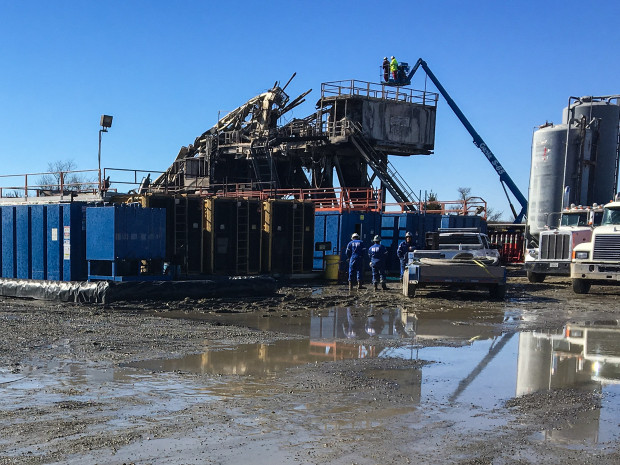

Oklahoma Corporation Commission

Inspectors and emergency crews surveying damage at Patterson-UTI's rig 219, which exploded and caught fire Jan. 22.

Federal and state authorities are investigating the cause of the deadly explosion and fire at a natural gas drilling rig in southeastern Oklahoma on Monday. Five workers died in what appears to be one of the country’s deadliest onshore drilling accidents.

The well site, located near the town of Quinton, 100 miles south of Tulsa, was operated by Oklahoma City-based Red Mountain Energy. Patterson-UTI Energy, of Houston, owns and operates the drilling rig, which exploded and caught fire about 8:45 a.m.

The cause of the explosion and fire is not yet known. The Occupational Safety and Health Administration and the Chemical Safety Board are investigating, as is the Oklahoma Corporation Commission, the state’s oil and gas regulator.

A day after the explosion, Oklahoma’s Supreme Court struck down a portion of the state’s workers compensation law, ruling 8-0 that oil and gas companies can be sued when workers are injured or killed. Oklahoma law holds operators responsible for well site safety, not contract drillers or oil-field service companies.

A preliminary report from a commission investigator found the fire that engulfed the rig was fed by an “uncontrolled gas release.” A rig worker attempted to activate a device known as a blowout preventer to shut off the well but was unable to, the inspector reported.

The fire at the wellhead kept emergency crews at bay for hours and created a black plume of smoke visible for miles. One worker who escaped with burns was taken by helicopter to a hospital and later released; sixteen other workers who fled the burning rig were uninjured.

“From what I was told from many of the survivors, there was an explosion, they heard a loud boom, they seen fire and they ran,” Pittsburg County Sheriff Chris Morris said. “Everybody was trying to survive.”

The five men who died were found in the “dog house,” a control room located near the drilling platform. The Oklahoma Department of Emergency Management identified them as Roger Cunningham, 55, of Seminole; Josh Ray, 35, of Fort Worth, Texas; Cody Risk, 26, of Wellington, Colo.; Matt Smith, 29, of McAlester, and Parker Waldridge, 60, of Crescent.

Tony Say, a founder of Red Mountain Energy, told reporters Tuesday the small energy company was “absolutely devastated” by the accident.

“Our thoughts are with those whose lives have been impacted beyond words by this tragedy. You’ll be in our prayers over the coming days and weeks,” he said. “Our priority, sincerely, is the people who have been affected and the safety of those who will be called upon to work the well site and investigate.”

In a statement, Patterson-UTI President and CEO Andy Hendricks said his employees were “deeply saddened” and pledged a thorough investigation of the accident.

“There is nothing more important to us than the safety of our employees and others we partner with in the field. Tonight, our thoughts and prayers go out to all those affected and their loved ones.”

Patterson-UTI has struggled for years with one of the worst safety records in the drilling industry, OSHA data show. A 2008 report from the U.S. Senate Health, Education, Labor and Pensions subcommittee identified 12 deaths at Patterson-UTI drilling sites in Texas alone. Inspections of drilling sites the company operates in Oklahoma and other states have turned up numerous violations, OSHA data show.

Drilling is a dangerous job. At least 60 workers in Oklahoma have died working for energy companies or on the job at oil and gas drilling sites from 2011-2016, data from the U.S. Bureau of Labor Statistics show. In 2012, a sharp rise in deadly oil-field accidents led to a voluntary statewide shutdown of drilling activity so rig work crews could review safety standards and procedures.