A welding fire set off a two-alarm blaze Tuesday afternoon that destroyed a central Pennsylvania truck shop and caused $1.2 million worth of damage.
More than 150 firefighters responded to Dutch Transport's facility at 154 Orlan Road in New Holland, Lancaster County, according to Garden Spot Fire Rescue.
Two tractor trailers, pallets of equipment, machinery and tools were destroyed in the fire, according to first responders.
The fire, which broke out around noon Tuesday, was under control by 2:05 p.m.
No injuries were reported, but two firefighters were treated and released for heat exhaustion, the fire company said.
===================
EAST EARL TOWNSHIP, Lancaster County -- UPDATE: No one was injured in Tuesday's fire at the Earl Township Warehouse, known as 'Dutch Transport,' according to fire officials.
The fire broke out toward the front side of the building, which is used as a mechanical shop where cars and trucks are worked on. That side is a total loss.
Two employees were inside when the building caught fire. They were able to get out safely.
Though, two firefighters had issues with the heat. Officials say they were checked out by EMS and are doing OK.
"These are typical metal buildings so when you have a fire inside it's basically inside your oven, it's hard to get at," Garden Spot Fire Rescue Chief Darryl Keiser said. "Also, it's hot ... the fire gets extremely intense before it breaks out of the building."
A cause of the fire has not yet been determined.
The fire is located at Orlan Road, according to Garden Spot Fire and Rescue.
It was first reported shortly after noon.
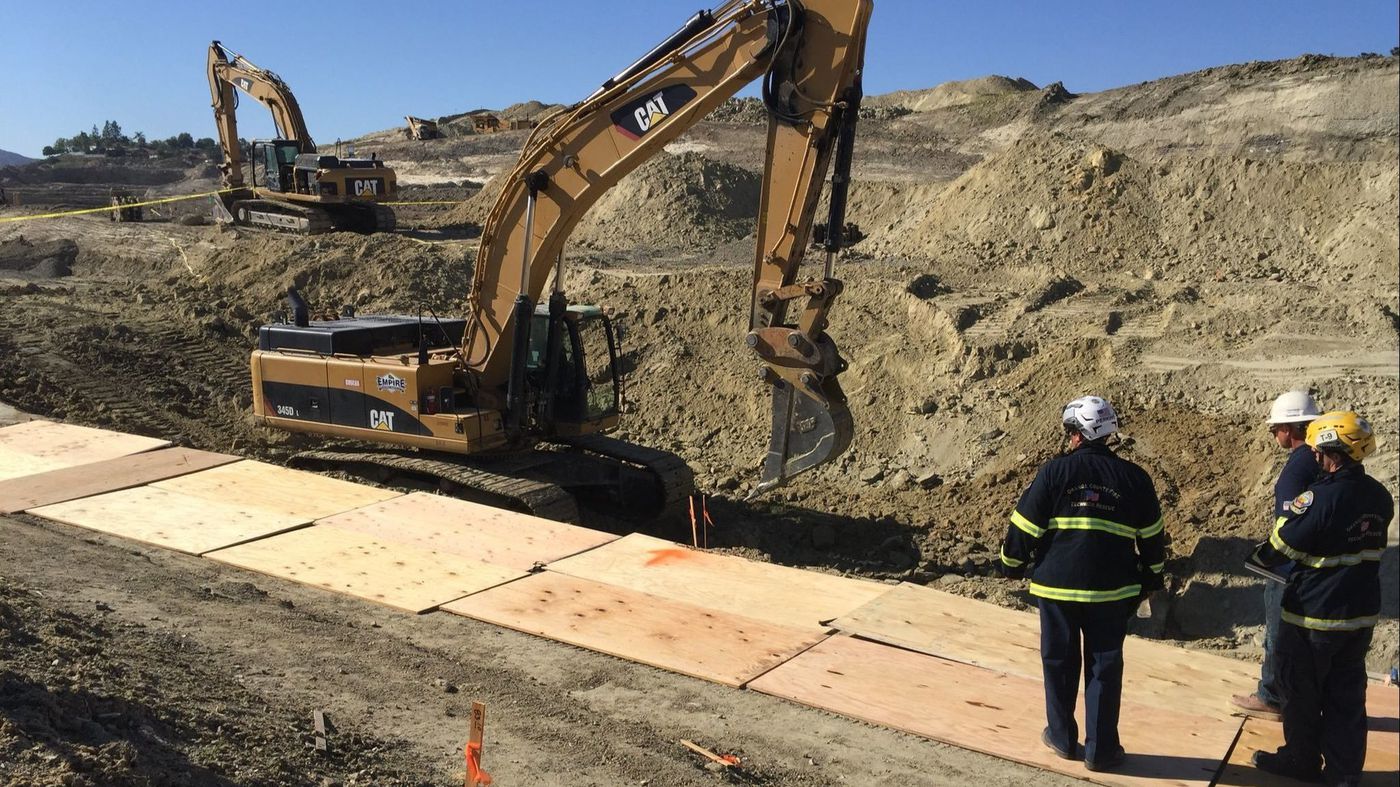
Orange County Fire Authority crews were searching Wednesday for the
body of a construction worker believed to have been buried during a
trench collapse at a Lake Forest construction site. (Courtesy of the
Orange County Fire Authority)
Worker’s body found after trench collapse at construction site in Lake Forest
By Jonathan Winslow | jwinslow@scng.com | Orange County Register
May 9, 2018
LAKE FOREST, CA
After several hours of digging, Orange County Fire Authority firefighters recovered the body of a worker who was buried in a construction site accident in Lake Forest on Wednesday, authorities said.
The worker was believed to have been buried at a construction site at the intersection of Glenn Ranch Road and Viejo Ridge when a trench on the site collapsed at 3 p.m., said OCFA Capt. Larry Kurtz. Backhoes were digging in the area when the ground caved in, he said.
At 5:30 p.m., OCFA crews and other assisting agencies were using heavy equipment to carefully clear and stabilize the trench, after which teams would move in and begin clearing the dirt by hand.
At 9:09 p.m., the body of a male construction worker was recovered from the dirt by crews, Kurtz said. The Orange County Sheriff’s Department and the Division of Occupational Safety and Health of California have launched an investigation in to what caused the trench to cave in, he said.
The worker’s name was not immediately released.
====================
A worker died Wednesday after a trench about 17 feet deep collapsed at a Lake Forest construction site, burying his body underneath dirt, authorities said.
Construction crews handling the grading for a tract home project were using an excavator to dig when a side of the trench gave way, said Capt. Larry Kurtz of the Orange County Fire Authority.
It's unclear if the worker, who was not identified, fell inside or was acting as a spotter in the trench, Kurtz said. Two or three dozen people were on-site working for a company called Empire Grading.
Fire officials were called to the development, near Viejo Ridge Drive and Glenn Ranch Road, about 3 p.m. They used powerful vacuum trucks and buckets to carefully remove the dirt around the body during the recovery, Kurtz said.
The California Division of Occupational Safety and Health and the Orange County Sheriff's Department were investigating the circumstances of the accident, he said.
=================
A construction worker is believed by Orange County fire officials to be dead after he was buried by dirt when a trench collapsed at a construction site in Lake Forest Wednesday afternoon, authorities said.
Firefighters have been working to recover the man's body at the site near Glenn Ranch Road and Viejo Ridge Drive. The incident happened at around 3 p.m.

Authorities respond to a construction site in Lake Forest where a worker was believed trapped in a collapsed trench on May 9, 2018. (Credit: KTLA)
At about 5 p.m., fire officials said they would be removing dirt from the trench "for several hours" as part of recovery efforts.
The trench is about 15 feet deep and 17 feet wide, officials said. Sky5 footage of the scene showed some splatters of blood inside the trench.
"To do this, they have to be safe," O.C. Fire Authority Capt. Larry Kurtz said of the firefighters trying to find the man's body.
Since the trench could collapse further, firefighters have to secure its edges with planks of wood "so they don't fall into the trench," Kurtz said.
A construction worker on scene told KTLA the man apparently killed was also a worker and good friend of his.
The incident occurred at the apparent site of a planned massive residential development called the Portola Center. The 195-acre project includes 930 homes, according to the city of Lake Forest's website.
No further information has been released by authorities.
=================
Portola Center
On November 5, 2013, the City Council approved the development of
Portola Center, located at the intersection of Saddleback Ranch Road and
Glenn Ranch Road. Surrounded by natural beauty and designed to
complement the existing Portola Hills community, initial grading for the
Portola Center development began in Summer 2015. Glenn Ranch Road and
Saddleback Ranch Road divide the project site into three different
Planning Areas, named the Northwest, Northeast, and South Planning
Areas. Questions regarding the Northwest and Northeast areas can be
directed to Nick Lee, Vice President, at nlee@baldwinsons.com,
or by phone at (619) 985-6425). The South Planning area will be
developed by Landsea and questions for this site can be directed to
Brian Frame at (949) 345-8095.
The 195-acre Portola Center site will include:
- 930 homes, including, 613 single-family homes and 317 multi-family units.
- 10,000 square feet of commercial area.
- A 5-acre public park with playgrounds, picnic areas, and sports fields.
- New trails with exercise stations.
- Three private neighborhood parks totaling more than ten acres, including one with a recreation center and swimming pool.
- 44-plus acres of open space, including a 1.5 mile Perimeter
Trail available to the public and adjacent private perimeter park with
trail connections to Whiting Ranch Regional Park.
Landscaping
In an effort to conserve and reuse water resources,
California-friendly trees and plants that require minimal maintenance
and thrive in low water conditions will be planted throughout Portola
Center. Sycamore, Mesquite, Western Redbud, Coast Live Oak trees, as
well as shrubs such as Spreading Acacia, Dwarf Coyote Brush, Penstemon,
and Rock Rose will be planted on project slopes and common areas such as
parks and trails. Furthermore, the project complies with the City’s
Water Efficient Landscape Ordinance to limit water usage, as well as
irrigates with reclaimed water to conserve and reuse water resources
whenever possible.
The Ninth Circuit on Wednesday refused to revive a Seattle apartment
complex owner’s bid to force its insurer to cover repair costs, saying a
lower court properly applied Washington Supreme Court precedent in
ruling that the building did not suffer a “collapse” as required for
coverage.
In a brief decision, a panel of the federal appellate
court said Chief U.S. District Judge Ricardo S. Martinez properly ruled
in July 2016 that American Economy Insurance Co. had no obligation to
cover CHL LLC's costs to fix damage to an apartment complex in Seattle.
=========================
In American Economy Ins. Co. v. CHL, LLC, an insured owned an apartment complex in Seattle. The insurer issued commercial property insurance for the building from 1999 to 2005. The policy provided coverage for losses caused by a “collapse.” The policies from 1999 to 2002 did not define “collapse.” However, the policies from 2002 to 2005 defined the term to mean “actual falling down of the building or part of the building.”
In 2014, while renovation work was being performed at the apartment complex, decay of the building’s rim joists was discovered. The insured began repairing the joists. The building remained occupied while the repairs were being made. The insured then submitted a claim to the insurer for damage to the building. The insurer denied the claim.
At issue was whether there was coverage for a “collapse” under the policies in effect from 1999 to 2002. The insurer asserted that the policies from all policy periods, even those that did not include a definition, required that the building actually fall down for there to be coverage for a “collapse.”
In examining the dispute, the court noted there was jurisdictional split on the definition of the term “collapse” as used in property insurance policies. While some states define “collapse” by requiring that all or part of a building actually fall down, other states have found that the actual falling down of a building is not necessary. In such instances, these states may require that the falling down of all or part of a building be imminent. Meanwhile, other states have a broader view and only require that the insured show that the building had a “substantial impairment of structural integrity.”
In reaching its conclusion, the court relied on Queen Anne Park Homeowners Assoc. v. State Farm Fire & Cas. Ins. Co. In that case, the 9th U.S. Circuit Court of Appeals certified a question to the Washington Supreme Court on how to define “collapse.”
In Queen Anne Park, the Washington Supreme Court held that “collapse” meant “substantial impairment of the structural integrity of all or part of a building that renders all or part of the building unfit for its function or unsafe and, in this case, means more than mere settling, cracking, shrinkage, bulging, or expansion.”
Under this definition, the CHL court found that the apartment complex at issue was not severely impaired enough such that the complex was unable to remain upright. The court reasoned that “[t]he building remained standing without renovation until 2014.”
Moreover, even as the decayed joists were being repaired, tenants still occupied the complex without any shoring put in place. Given this factual background, the court ruled that the insurer was entitled to judgment as a matter of law that the 1999 to 2002 policies did not provide the insured coverage for a “collapse.”
This opinion is instructive to the extent it demonstrates how a particular jurisdiction can impact the interpretation of the language in a first party property policy. For example, as discussed by the CHL court, three different courts have arrived at three different definitions of the term “collapse” when the policy itself is silent on the definition.
ALEXANDER CITY, Ala. — Alexander City police are investigating the death of a carnival worker after he died falling from a ride he was trying to fix.
The call came into police around 5:15 Wednesday evening. Police say the worker was a vendor of the “ring of fire” ride. He climbed up on the ride to correct an issue he observed.
The worker was advised to come down by the ride operator. That’s when the worker fell approximately 30 feet. The worker was transported to Russell Medical Center where he was pronounced dead.
The incident is still under investigation, and authorities will not release the name of the victim until family is notified.
=========================
TRAGEDY AT THE FAIR: Worker dies in fall at fair Wednesday
By Mitch Sneed
Published 6:38 pm Wednesday, April 25, 2018
An amusement company employee died Wednesday after falling off the Ring of Fire at the Kiwanis Fair at the Charles E. Bailey Sportplex, according to Tallapoosa County Coroner Mike Knox.
The name of the male victim had not been released as of 7 p.m. The accident occurred just before 5 p.m., just as the fair was preparing to open for the evening.
“A male ride operator from Belarus was operating a ride nearby and the operator of the Ring of Fire said that he thought he saw a wheel that looked funny,” Knox said. “This man said he would check it and climbed up, even though he wasn’t the one who usually did that. When the man who normally handles the maintenance came – he said for him to get down and he would check. When he started down, he lost his grip and fell to the ground.”
Scanner reports said that the victim was bleeding heavily as a result of the fall, but the investigation remained active and while Knox didn’t speculate on the cause of death, he said the man obviously suffered head trauma.
Knox said the 45-year old man, who had been in the business for “20 years or more,” was pronounced dead at the Russell Medical.
Because of the distance between the man and his family, a name was not released until notification of his next of kin could be made.
There were already people on the grounds and the accident was witnessed by several people. Witnesses said that screams could be heard and children were crying and being comforted by their parents.
The ride remained shut down, but the rest of the attractions were open Wednesday evening and the midway was crowded with fairgoers.
More details will be released as they become available.


BLOOMINGTON, Ind. -- The Monroe County Coroner released the identity Thursday of a construction worker who was killed in an accident on Indiana University's Bloomington campus.
Indiana University officials say a crew was working on a renovation project at Swain Hall on Wednesday when a construction worker was killed. No other injuries were reported as part of the accident.
The man was part of a private contracting company hired by the university to do renovation work on the building.
He has been identified as William M. Brown Jr., 35, of Bloomington. The coroner says Brown died of blunt force trauma to the chest.
She says Brown was part of a crew that was moving a very large piece of limestone that was to be used as a header above an entryway when the accident occurred.
===================
Construction Worker Dies On IU Campus
Updated April 26, 2018 7:19 AM
(BLOOMINGTON, IN) - A construction worker was killed after a large piece of limestone being installed above a doorway fell and killed him while working at Swain Hall West on Indiana University's campus on Wednesday afternoon.
Monroe County Coroner Joani Shields says 35-year-old William M. Brown Jr. of Bloomington was working with other crew members using equipment to lift a 6 foot long piece of limestone above an interior doorway on the north side of the building when it fell striking Brown in the head and chest.
Fellow construction workers began CPR and dialed 911 at 2:52 p.m.
An autopsy is been this morning in Terre Haute.
Finch Constructors and Pepper Construction has been working on the $36 million renovation, which includes building a new entryway, upgrading heating, cooling and other mechanical systems and cleaning and tuckpointing the exterior limestone walls.
===================
BLOOMINGTON, Ind. — Authorities say a construction worker died when a large chunk of limestone fell onto his head and chest at Indiana University's Bloomington campus.
Monroe County coroner Joani Shields says 35-year-old William M. Brown Jr., of Bloomington, was killed Wednesday afternoon at Swain Hall West. An autopsy is scheduled for Thursday morning.
Brown was an employee for a contractor hired by the university for a $36 million renovation of the building. He was helping to install a limestone header above an interior second-floor doorway when the block fell as it was being lofted it into place.
Sgt. Brandon Hudson of the Bloomington Fire Department tells The Herald-Times that the stone was about 6 feet (1.8 meters) long and that it struck Brown in the head and chest.
Indiana University sent the following statement regarding the incident:
“An workplace accident this afternoon has resulted in the death of a worker for the contractor on the renovation of Swain Hall, located on 3rd street. The accident killed an adult male in an isolated part of Swain Hall at around 2:50 p.m. There were no other injuries.
"We offer our sympathy to the victim’s family, friends, and co-workers on the project.”
==========================================
No work on Swain Hall project Thursday after man's death
By Michael Reschke 812-331-4370 | mreschke@heraldt.com
April 27, 2018
Swain Hall West was the site of a fatal construction accident Wednesday on the Indiana University campus in Bloomington. Jeremy Hogan | Herald-Times
Work on a $36 million renovation project at Indiana University was canceled for Thursday following the death of a Bloomington man at the construction site Wednesday afternoon.
The Indiana Occupational Safety and Health Administration is conducting an investigation into the fatal incident, said Chuck Carney, IU spokesman. He did not know Thursday when work on Swain Hall, located 727 E. Third St., would resume.
William M. Brown Jr., 35, was hit in the head and chest with a piece of limestone estimated to be about 6 feet long.
A preliminary autopsy conducted Thursday identified blunt force trauma to the chest as the cause of death. Results of a toxicology report are expected in about three weeks, said Joani Shields, Monroe County coroner.
A crew working on the building's second floor called 911 at 2:52 p.m. Wednesday. Workers had been using equipment to lift and place a piece of limestone above an interior doorway when the rock fell, preliminary reports said.
Carney said Brown was not an IU employee, but he was unsure about what company employed Brown. IU contracted with Pepper Construction for the project, but Brown may have worked for a subcontractor.
Work on the campus project included upgrades to mechanical systems, such as heating, ventilation and cooling. The most visible change involved tearing down a windowless concrete tower and creating a new entryway that matches the surrounding architecture.
Swain Hall has been expanded multiple times since it was first built in 1910. The original building is now referred to as Swain Hall East. Swain Hall West was built in 1938.A southern addition, which included the windowless tower, was built in 1972. The tower was supposed to one day become part of a walkway over Third Street. At the time, university leaders thought the campus would expand south, but that never happened.
The heights of floors in Swain Hall East and West did not match. Renovation plans called for an elevator to be built at the back of an atrium attached to the new entryway. The elevator, with doors on two sides, would provide access to all floors within the building.
The project was broken up into three phases, with work starting on the southwestern portion of the building shortly after people started moving out of that area in August 2016. Parts of the building were still in use during the renovation project. Earlier this month, university officials expected the project to be substantially completed in May.
No classes in Swain Hall have been canceled because of the incident, Carney said.
================
Swain West


Campus:
IU Bloomington
Completion Date
August 1, 2014
Project Type:
Renovation
Primary Use:
Academic
Architect:
arcDESIGN
Team Leader:
Payne
Project Budget
Internal funding: $1200000
Total budget: $1200000
Project Description
Indiana University proposes to proceed with the renovation of approximately 3,102 gross square feet (gsf) of lecture space and associated entries within Rooms 119 and 120 of Swain Hall West on the IU Bloomington campus.
=============================
The Swain Hall East and West complex renovation offers a new environment for students and faculty while remaining true to the historic Bloomington campus.
The facility houses physics and autonomy departments and will provide a distinguishable main entrance to the building while connecting the building to the campus and the University’s iconic 20-acre Dunns Woods. Due to multiple past additions, students, faculty and visitors have not been utilizing the building as much as the University would like. The most recent 1972 addition left the building without an identifiable “front door” and greatly obscures and diminishes the surrounding historic buildings on site.
BSA LifeStructures’ renovation plan entails multiple phases allowing the facility to remain in operation while under construction. The proposed solution will trim the structure so that historic buildings are revealed. An easily identifiable main entrance will also be added; leading guests into internal commons and building center. The exterior walls, windows and roof will also undergo restoration or replacement all while retaining the existing historical character of the building.