Fatal Falls Overboard in Commercial Fishing
Posted on April 26, 2018 by Samantha Case, MPH
 April 28th is Workers’ Memorial Day where we remember those who have lost their lives while trying to make a living. The current issue of the Centers for Disease Control and Prevention’s Morbidity and Mortality Weekly Report (MMWR) includes workplace fatality, injury and illness data; a QuickStats which demonstrates differences among employment categories in influenza vaccination; and the article summarized in this blog, “Fatal Falls Overboard in Commercial Fishing — United States, 2000–2016.” Commercial fishing is one of the most dangerous jobs in the United States, with a work-related fatality rate 23 times higher than for all workers in 2016 1. Falling from a fishing vessel is a serious hazard responsible for the second highest number of fatalities in the industry after vessel sinking events 2, 3. The National Institute for Occupational Safety and Health (NIOSH) analyzed data on unintentional fatal falls overboard in the US commercial fishing industry to identify gaps in the use of prevention strategies. NIOSH researchers examined each fall overboard to determine the circumstances of the fall, including worker activity, primary cause, and contributing factors. Recovery attempts were also considered, noting any use of survival or rescue equipment and administration of medical treatment.
Results
During 2000-2016, 204 commercial fishermen died from unintentionally falling overboard. The study found that fatalities occurred most frequently on the East Coast (30%), followed by the Gulf of Mexico (29%), Alaska (25%), and the West Coast (13%). The remaining five deaths occurred off Hawaii. The type of fishing operations with the highest number of fall overboard deaths were: Gulf of Mexico shrimp (34), East Coast lobster (18), Alaska salmon drift gillnet (16), and East Coast scallop (10).
 Many falls occurred while crewmembers were working on deck with fishing gear, including 35 falls while setting gear and 20 falls while hauling gear onboard. Thirty-four falls also occurred while crewmembers were on deck while off duty. The leading causes of falls were losing balance (32%), tripping or slipping (32%), and becoming entangled in gear (21%). The most commonly identified contributing factors included working alone (49%), alcohol and/or drug involvement (18%), and inclement weather (12%).
None of the victims wore a personal flotation device (PFD) when they died. A life ring was used in 19 events but most often did not result in a successful recovery of the person in the water. A man-overboard alarm was only reportedly used in one event. The majority of falls were not witnessed, and most of these fishermen were not found in the ensuing search. Of the 30 total crewmembers who were recovered from the water within an hour, CPR was attempted on 21 to no avail.
Prevention and Next Steps
Preventing falls overboard is a priority area in fishing safety. A variety of strategies can be implemented to prevent crewmembers from falling from a vessel, including: creating enclosed workspaces; raising the gunnels on the vessel; and using lifelines and tethers where possible. Because fishing operations differ, workers in some fisheries are more exposed to entanglement hazards than others, especially if they work with lines while setting gear. Engineering controls, such as line bins, can help control hazards by reducing the amount of line on deck. In addition, enforcing drug and alcohol-free policies on vessels might reduce the likelihood of crewmembers unintentionally falling overboard.
A striking finding from this study is that none of the victims were wearing a PFD when they died. Without flotation, victims can drown within minutes after immersion in cold water from cold-shock responses and limited swimming ability. Although regulations mandate commercial fishing vessels carry a PFD for each crewmember, there are no requirements for fishermen to wear them while working Many fishermen recognize the effectiveness of PFDs to prevent drownings, yet concerns regarding discomfort, cost, work interference, and potential for entanglement hinder widespread adoption throughout the industry . Comfortable and workable PFDs are available that can alleviate these concerns, and one manufacturer has even developed a flotation vest based on feedback from fishermen. See the NIOSH campaign “Live to be Salty” which encourages PFD usage.
The majority of fatal falls overboard in this study were not observed, likely resulting in search and rescue delays and reducing the chances of a successful recovery. A man-overboard alarm worn by a worker that relays to the remaining crewmembers or even nearby vessels that a fall overboard occurred, can enable prompt rescue efforts. Use of this technology has not been widely adopted by the fishing industry, despite its potential to save lives and be incorporated into work gear.
The difficulty of retrieving a person from the water was underscored in this study. Although rescue attempts were made within one hour for 69 victims, over half were unsuccessful. Effective recovery devices, such as lifting slings, can provide additional flotation and help hoist the person back onto the vessel. By participating in marine safety training and drills, crewmembers will be prepared to respond to a man overboard event. Fishermen who work alone face additional challenges and should have ladders and engine shutoff devices available to facilitate re-boarding.
Timely treatment of a fall overboard victim, including performing CPR, preventing further heat loss, and rewarming the victim, is a priority. None of the 30 crewmembers who were recovered back onboard within one hour were revived. Successful treatment might be more likely if professional medical assistance is obtained as soon as possible. However, this is a challenge for much of the fishing industry when operating in remote locations.
On average, the number of falls overboard decreased by 3.9% annually from 2000-2016. While this overall decline is encouraging, these events remain a leading contributor to commercial fishing deaths and are largely preventable. The implementation of prevention strategies by vessel owners as discussed above could likely continue this positive trend and enable these workers to stay safe while working at sea.
We would like to hear from you. Tell us how you have encouraged the use of PFDs on commercial fishing vessels.
Samantha Case, MPH, is an epidemiologist in the NIOSH Western States Division.
For More Information:
The NIOSH Commercial Fishing Safety Topic Page
Fishing Safety Success Story: My Life Vest Saved Me
A Story of Impact: PFD Manufacturer Adopts NIOSH Research into Product Development Process
Assessment of Safety in the Bering Sea/Aleutian Island Crab Fleet
Reducing Winch Entanglements with Auxiliary-stop Device
Reducing Winch Entanglements with Stationary Guarding
References
Bureau of Labor Statistics. Injuries, illnesses, and fatalities: Census of Fatal Occupational Injuries (CFOI) – current and revised data. Washington, DC: US Department of Labor, Bureau of Labor Statistics; 2017. https://www.bls.gov/iif/oshcfoi1.htm.
Lincoln JM, Lucas DL. Occupational fatalities in the United States commercial fishing industry, 2000-2009. J Agromedicine. 2010 Oct;15(4):343-50.
Lucas DL, Case SL. Work-related mortality in the US fishing industry during 2000-2014: New findings based on improved workforce exposure estimates. Am J Ind Med. 2018 Jan;61(1):21-31.
===================================
Fatal Falls Overboard in Commercial Fishing — United States, 2000–2016
Weekly / April 27, 2018 / 67(16);465–469
Summary
What is already known about this topic?
Commercial fishermen experience fatalities at a rate much higher than
that of all U.S. workers, partially driven by falls overboard, a
leading cause of work-related deaths in the industry.
What is added by this report?
During 2000–2016, 204 commercial fishermen died from unintentional
falls overboard. Fifty-nine percent of falls were not witnessed, and
89.3% of these victims were not found. Among 83 witnessed falls, 22
victims were recovered but not resuscitated. None wore a personal
flotation device (PFD).
What are the implications for public health practice?
Prevention strategies can be implemented to prevent future
fatalities, including reducing fall hazards; using PFDs, man-overboard
alarms, and recovery devices; and training crewmembers on resuscitation
and treatment.
Commercial fishing is one of the most
dangerous jobs in the United States, with a 2016 work-related fatality
rate (86.0 deaths per 100,000 full-time equivalent workers) 23 times
higher than that for all U.S. workers (3.6) (1). Sinking vessels
cause the most fatalities in the industry; however, falling from a
fishing vessel is a serious hazard responsible for the second highest
number of commercial fishing–associated fatalities (2,3).
CDC’s National Institute for Occupational Safety and Health (NIOSH)
analyzed data on unintentional fatal falls overboard in the U.S.
commercial fishing industry to identify gaps in the use of primary,
secondary, and tertiary prevention strategies. During 2000–2016, a total
of 204 commercial fishermen died after unintentionally falling
overboard. The majority of falls (121; 59.3%) were not witnessed, and
108 (89.3%) of these victims were not found. Among 83 witnessed falls
overboard, 56 rescue attempts were made; 22 victims were recovered but
were not successfully resuscitated. The circumstances, rescue attempts,
and limited use of lifesaving and recovery equipment indicate that
efforts to reduce these preventable fatalities are needed during
pre-event, event, and post-event sequences of falls overboard. Vessel
owners could consider strategies to prevent future fatalities, including
lifeline tethers, line management, personal flotation devices (PFDs),
man-overboard alarms, recovery devices, and rescue training.
A case of commercial fishing–associated overboard fall fatality was
defined as a fatal traumatic injury resulting from an unintentional fall
from a commercial fishing vessel in United States waters during
2000–2016. Fishermen often live on their vessels when working and are
exposed to hazards while off duty; therefore, victims were considered to
be at work for the entire time they were at sea. Cases were identified
from NIOSH’s Commercial Fishing Incident Database, a national
surveillance system that collects detailed information on all
work-related fatalities in the fishing industry; data sources include
U.S. Coast Guard investigative reports, local law enforcement reports,
medical examiner documents, and news media. Records for each fall
overboard were reviewed to determine the circumstances of the fall,
including time in water, any use of survival or rescue equipment,
recovery attempts, and administration of medical treatment. A
descriptive analysis of event and decedent characteristics, including
year, geographic region, fishery,* victim demographics, worker activity,
primary cause of the fall, and contributing factors, was conducted. The
trend in the number of fatal falls overboard over the course of the
study period was evaluated using Poisson regression.
During 2000–2016, unintentional falls overboard resulted in 204
fatalities, representing 27.0% of all work-related deaths in the
industry. Fall-overboard fatalities ranged from a high of 20 in 2003 to a
low of five in 2016 (Figure 1). On average, the number of falls overboard decreased by 3.9% annually (incidence rate ratio = 0.961; p = 0.006).
Fatalities occurred most frequently on the East Coast (62; 30.4%),
followed by the Gulf of Mexico (60; 29.4%), Alaska (51; 25.0%), and the
West Coast (26; 12.8%). Five deaths occurred off the Hawaiian Coast. The
Gulf of Mexico shrimp fishery had the highest number of fall-overboard
deaths (34; 16.7%), followed by East Coast lobster (18; 8.8%), Alaska
salmon drift gillnet (16; 7.8%), and East Coast scallop (10; 4.9%).
Among 187 (91.7%) decedents with information available on age, the
median age was 43 years (range = 16–77 years). Overall, 202 (99.0%)
decedents were male (Table).
The majority of victims were employed as deckhands (120; 58.8%), and
among 94 (46.1%) with information on years of experience, victims had a
median of 16 years of experience in the fishing industry (range = 0–65
years). Nine victims (4.4%) were confirmed to have taken formal marine
safety training.
Among 152 (74.5%) fatalities for which information on victim activity
preceding the fall was available, half (77; 50.7%) occurred while the
victims were working with fishing gear, including setting gear (35;
23.0%), hauling gear onboard (20; 13.2%), and handling gear on deck (12;
7.9%). Falls also occurred while crewmembers were on deck while off
duty (34; 22.4%). Among 149 (73.0%) cases where the cause of the fall
was known, the leading causes were losing balance (48; 32.2%), tripping
or slipping (47; 31.5%), and becoming entangled in gear (31; 20.8%). Of
all 204 falls, the most commonly identified contributing factors
included working alone (99; 48.5%), alcohol and drug use (37; 18.1%),
and inclement weather (24; 11.8%).
The majority of falls (121; 59.3%) were unwitnessed, and most of
these victims (108; 89.3%) were not located within an hour of the fall (Figure 2).
For the 83 witnessed falls overboard, 56 (67.5%) rescue attempts were
made, with 22 victims recovered but none successfully resuscitated.
In all instances, none of the victims was wearing a PFD at the time of death. Among 19 (9.3%) events in which use of a life ring†
was noted, recovery attempts failed in most cases (14; 73.7%). A
man-overboard alarm was only reportedly used in one event. Among the 30
crewmembers who were recovered from the water within an hour,
cardiopulmonary resuscitation (CPR) was attempted on 21 (70.0%), but
none could be resuscitated.
Discussion
Preventing falls overboard is a priority area in fishing safety (2–4). Primary prevention strategies include creating enclosed workspaces, raising the gunnels§
on the vessel, and using lifelines and tethers where possible; vessel
modifications should be conducted in consultation with a naval architect
or engineer. Because of differences in fishing methods, workers in some
fisheries are more exposed to entanglement hazards than are others,
especially those who work with lines while setting gear (e.g., East
Coast lobstermen). Engineering controls, such as line bins that catch
excess line while hauling gear, can control hazards by reducing the
amount of line on deck. In addition, enforcing drug- and alcohol-free
policies on vessels might reduce the likelihood of crewmembers
unintentionally falling from a vessel.
Without flotation, victims can drown within minutes after immersion
in cold water through cold-shock responses, including hyperventilation
and aspiration, as well as the deterioration of muscle function from
lowered temperature, impeding swim efforts (5). Although federal regulations¶
mandate that commercial fishing vessels carry a PFD for each
crewmember, there are no requirements for fishermen to wear them while
working.
Lack of PFD use is associated with workers’ negative
perceptions and attitudes toward PFDs. Many fishermen recognize the
effectiveness of PFDs to prevent drownings, but concerns regarding
discomfort, cost, work interference, and potential for entanglement
hinder widespread adoption throughout the industry (6,7).
In 2008, NIOSH conducted a study in which participants in several
Alaskan fisheries wore and evaluated various PFD types. Although
preferences differed by fishery, each identified favorable PFDs that
were acceptable to work in (8). On the basis of this research,
one manufacturer worked collaboratively with the fishing industry and
developed an innovative PFD that was responsive to workers’ concerns (9).
Additional PFD evaluations have been conducted in the Pacific
Northwest, Gulf of Mexico, and New England. Attempts to increase PFD use
should continue, particularly given the increased commercial
availability of comfortable and workable PFDs.
The majority of fatal falls overboard in this study were not
observed. An unwitnessed fall overboard results in search and rescue
delays and reduces the chances of a successful recovery. A man-overboard
alarm is a small device worn by a worker that, in the event of water
immersion, relays a signal to a receiver on the vessel and sounds an
alarm to enable prompt rescue efforts. Use of this technology has not
been widely adopted by the fishing industry despite its potential to
save lives and be incorporated into work gear.
Although rescue attempts were made within 1 hour for 69 victims, over
half (39; 56.5%) were unable to be recovered from the water,
underscoring the difficulty of retrieving an overboard fall victim.
Effective recovery devices, such as lifting slings, can provide
additional flotation and help hoist the victim onto the vessel.
Participation in marine safety training and drills can prepare
crewmembers in man-overboard response and recovery. For fishermen who
work alone, a reboarding ladder should be available on the vessel for
self-rescue. Some man-overboard alarms include engine shutoff features
that would keep the vessel nearby to facilitate reboarding.
None of the 30 crewmembers who were recovered onboard within 1 hour
could be resuscitated. Successful treatment might be more likely if
professional medical assistance were possible, a challenge when
operating in remote locations. Having first-aid trained crewmembers
administer CPR, prevent further heat loss, and rewarm the victim is a
priority (5).
The findings in this report are subject to at least three
limitations. First, the level of missing data varied among cases, and
for at least one variable (years of experience), exceeded 50%. This
circumstance might have introduced bias by underestimating certain fall
or decedent characteristics when variables with missing data were
analyzed. Second, denominator data were unavailable to enable
calculation of fatality rates. A decreasing trend in the number of falls
overboard was observed, but it is unclear if risk similarly declined.
Finally, data were not available on nonfatal falls overboard. Comparison
of fatal and nonfatal events might help identify factors associated
with the successful rescue of crewmembers from the water.
Although the overall decline in the number of fatal falls overboard
is encouraging, these largely preventable events remain a leading
contributor to commercial fishing deaths. Implementation of prevention
strategies discussed in this report by vessel owners could continue this
positive trend and result in substantial safety improvements within the
industry. Future research can include activities to understand barriers
to adoption of these prevention strategies, particularly in fisheries
where these events occur frequently, and evaluate the efficacy of
interventions, as supported by the NIOSH strategic plan (10).
Corresponding author: Samantha Case, scase@cdc.gov, 907-271-1569.
1Western States Division, National Institute for Occupational Safety and Health, CDC.
References
- Bureau of Labor Statistics. Injuries, illnesses, and fatalities:
census of fatal occupational injuries (CFOI)—current and revised data.
Washington, DC: US Department of Labor, Bureau of Labor Statistics;
2017. https://www.bls.gov/iif/oshcfoi1.htm
- Lincoln JM, Lucas DL. Occupational fatalities in the United States
commercial fishing industry, 2000–2009. J Agromed 2010;15:343–50. CrossRef PubMed
- Lucas DL, Case SL. Work-related mortality in the US fishing industry
during 2000–2014: new findings based on improved workforce exposure
estimates. Am J Ind Med 2018;61:21–31. CrossRef PubMed
- Lucas DL, Lincoln JM. Fatal falls overboard on commercial fishing vessels in Alaska. Am J Ind Med 2007;50:962–8. CrossRef PubMed
- Golden FS, Tipton MJ, Scott RC. Immersion, near-drowning and drowning. Br J Anaesth 1997;79:214–25. CrossRef PubMed
- Lucas DL, Lincoln JM, Carozza SE, et al. Predictors of personal
flotation device (PFD) use among workers in the Alaska commercial
fishing industry. Saf Sci 2013;53:177–85. CrossRef
- Weil R, Pinto K, Lincoln J, Hall-Arber M, Sorensen J. The use of
personal flotation devices in the northeast lobster fishing industry: an
examination of the decision-making process. Am J Ind Med
2016;59:73–80. CrossRef PubMed
- Lucas D, Lincoln J, Somervell P, Teske T. Worker satisfaction with
personal flotation devices (PFDs) in the fishing industry: evaluations
in actual use. Appl Ergon 2012;43:747–52. CrossRef PubMed
- National Institute for Occupational Safety and Health. A story of
impact: PFD manufacturer adopts NIOSH research into product development
process. DHHS (NIOSH) publication no. 2015–119. Anchorage, AK: US
Department of Health and Human Services, CDC, National Institute for
Occupational Safety and Health; 2014. https://www.cdc.gov/niosh/docs/2015-119/pdfs/2015-119.pdf
- CDC. NIOSH strategic plan: FYs 2019–2023. Atlanta, GA: US Department of Health and Human Services, CDC; 2018. https://www.cdc.gov/niosh/about/strategicplan/
 FIGURE 1. Number
and trend* of unintentional fatal falls overboard (N = 204) in the
commercial fishing industry, by year — United States, 2000–2016
FIGURE 1. Number
and trend* of unintentional fatal falls overboard (N = 204) in the
commercial fishing industry, by year — United States, 2000–2016
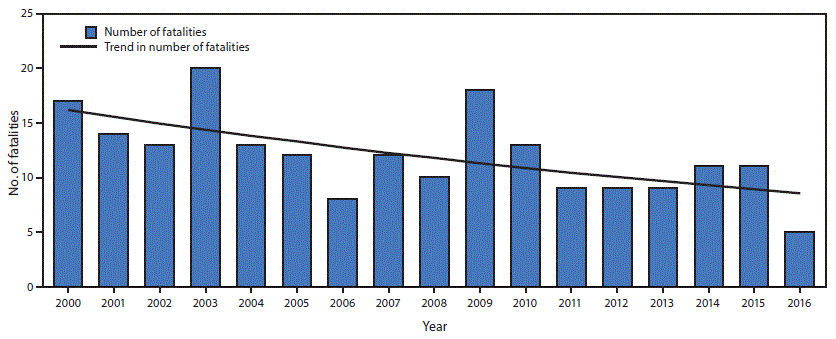 *
Significant decrease in the number of fatalities during 2000–2016
(Poisson regression, no exposure; incidence rate ratio = 0.961, p =
0.006).
The figure above is a combination bar and line graph showing the
number and trend of unintentional fatal falls overboard (N = 204) in the
commercial fishing industry, by year, in the United States during
2000–2016.
*
Significant decrease in the number of fatalities during 2000–2016
(Poisson regression, no exposure; incidence rate ratio = 0.961, p =
0.006).
The figure above is a combination bar and line graph showing the
number and trend of unintentional fatal falls overboard (N = 204) in the
commercial fishing industry, by year, in the United States during
2000–2016.
TABLE. Characteristics of 204 unintentional fatal falls overboard in the commercial fishing industry — United States, 2000–2016
| Characteristic (no. [%] known) |
No. (% of known) |
|---|
| Age group, yrs (187 [91.7]) |
| ≤24 |
17 (9.1) |
| 25–44 |
84 (44.9) |
| 45–64 |
79 (42.2) |
| ≥65 |
7 (3.7) |
| Unknown (% of total) |
17 (8.3) |
| Gender (204 [100.0]) |
| Male |
202 (99.0) |
| Female |
2 (1.0) |
| Race/Ethnicity (144 [70.6]) |
| Non-Hispanic |
| White |
72 (50.0) |
| Asian |
29 (20.1) |
| American Indian/Alaska Native |
16 (11.1) |
| Black/African American |
8 (5.6) |
| Other |
3 (2.1) |
| Hispanic |
16 (11.1) |
| Unknown (% of total) |
60 (29.4) |
| Position (204 [100.0]) |
| Operator |
79 (38.7) |
| Deckhand |
120 (58.8) |
| Other |
5 (2.5) |
| Experience, yrs (94 [46.1]) |
| ≤1 |
11 (11.7) |
| 2–5 |
14 (14.9) |
| 6–10 |
14 (14.9) |
| 11–20 |
28 (29.8) |
| ≥21 |
27 (28.7) |
| Unknown (% of total) |
110 (53.9) |
| Worker activity before fall (152 [74.5]) |
| Traffic onboard |
11 (7.2) |
| On watch |
11 (7.2) |
| Working with fishing gear |
| Preparing gear |
10 (6.6) |
| Setting gear |
35 (23.0) |
| Hauling gear |
20 (13.2) |
| Handling gear on deck |
12 (7.9) |
| Working with the catch |
7 (4.6) |
| Off duty |
34 (22.4) |
| Other |
12 (7.9) |
| Unknown (% of total) |
52 (25.5) |
| Cause of fall (149 [73.0]) |
| Lost balance |
48 (32.2) |
| Trip/Slip |
47 (31.5) |
| Gear entanglement |
31 (20.8) |
| Struck by gear/object |
14 (9.4) |
| Washed overboard |
9 (6.0) |
| Unknown (% of total) |
55 (27.0) |
FIGURE 2. Recovery
status of unintentional fatal fall overboard victims (N = 204) and
associated prevention strategies — United States, 2000–2016
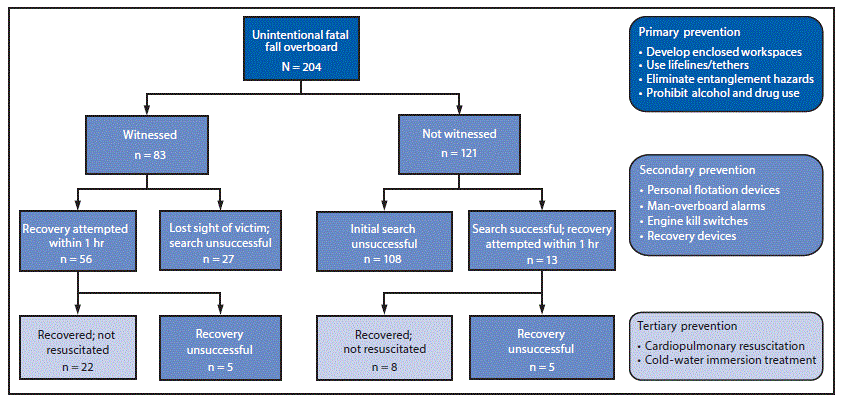 The
figure above is a chart showing the recovery status of unintentional
fatal fall overboard victims (N = 204) in the United States during
2000–2016 and associated prevention strategies.
The
figure above is a chart showing the recovery status of unintentional
fatal fall overboard victims (N = 204) in the United States during
2000–2016 and associated prevention strategies.