MEC&F Expert Engineers

Saturday, December 2, 2017

U.S. Department of Labor's OSHA Cites Tampa Electric Co. and Critical Intervention Services, a security services provider, for $43,458 in total proposed penalties, following Hazardous Chemical Release of anhydrous ammonia – a chemical refrigerant – at its Gibsonton facility.


Nov. 17, 2017

U.S. Department of Labor Cites Tampa Electric Co.
And Critical Intervention Services Following Hazardous Chemical Release

GIBSONTON, FL – The U.S. Department of Labor’s Occupational Safety and Health Administration (OSHA) has cited Tampa Electric Co. and Critical Intervention Services, a security services provider, for $43,458 in total proposed penalties, following a release of anhydrous ammonia – a chemical refrigerant – at its Gibsonton facility.

On May 23, 2017, OSHA responded to the incident and determined that the ammonia release occurred when a relief valve activated after a pipeline became over pressurized. As a result, four workers were taken to the hospital for observation and released.

OSHA issued Tampa Electric two serious citations for failing to include all the minimum requirements in their emergency response plan and not ensuring employees exposed to hazardous substances wore appropriate respiratory protection. The Agency also issued the power company a Hazard Alert Letter with recommendations to mitigate asphyxiation hazards.

The investigation also led to citations for Critical Intervention Services, which received two serious violations for not developing or implementing a written hazard communication program, and failing to provide information and training on hazardous chemicals in the workplace.

“When there is a potential hazardous chemical exposure, the emergency response plan must include all of the minimum safety and health requirements, including appropriate respiratory protection for employees,” said OSHA Area Director Les Grove, in Tampa.

The company has 15 business days from receipt of its citations and proposed penalties to comply, request an informal conference with OSHA’s area director, or contest the findings before the independent Occupational Safety and Health Review Commission.

Under the Occupational Safety and Health Act of 1970, employers are responsible for providing safe and healthful workplaces for their employees. OSHA’s role is to ensure these conditions for America’s working men and women by setting and enforcing standards, and providing training, education, and assistance. For more information, visit http://www.osha.gov.

Wayne A. George, d/b/a A Rooter Man of Pittsburgh, LLC, Pleads Guilty to Violating OSHA Regulation that Caused the Death 21-year-old Rooter Man employee, Jacob Casher, was killed when the trench he was working in collapsed at a worksite in Penn Township, Butler County


Jacob James Casher, 21, of Clearfield died on Monday, September 28, 2015.

Beaver County Man Pleads Guilty to Violating OSHA Regulation that Caused an Employee’s Death


PITTSBURGH, PA- A resident in Beaver County, Pennsylvania, pleaded guilty in federal court to a charge of Willful Violation of an OSHA Regulation Causing the Death of an Employee, Acting United States Attorney Soo C. Song announced today.

Wayne A. George, d/b/a A Rooter Man of Pittsburgh, LLC, pleaded guilty yesterday to one count before United States Magistrate Judge Cynthia R. Eddy.

In connection with the guilty plea, the court was told that Wayne A. George, d/b/a A Rooter Man of Pittsburgh, LLC, employed an individual who died as a result of willful violation of standards promulgated which requires employers to take protective measures against cave-ins before permitting their employees to work in trenches.

On September 28, 2015, a 21-year-old Rooter Man employee, Jacob Casher, was killed when the trench he was working in collapsed at a worksite in Penn Township, Butler County. Mr. Casher was helping to replace a sewer line 11 feet below the surface in unstable soil with no cave-in protection, at the direction of his supervisor, Wayne George.

Judge Eddy scheduled sentencing for February 21, 2018. The law provides for a maximum total sentence of six months in prison, a fine of $250,000 or both. Under the Federal Sentencing Guidelines, the actual sentence imposed would be based upon the seriousness of the offenses and the prior criminal history, if any, of the defendant.

Assistant United States Attorney Nelson P. Cohen is prosecuting this case on behalf of the government.

The U.S. Department of Labor, Office of the Regional Solicitor, conducted the investigation leading to the information in this case.

 ==============================


PENN TWP., PA — Jacob Casher’s work day for a Clearfield County sewage system maintenance company was finished Monday afternoon when he jumped into a deep trench to retrieve a shovel left behind.

Moments later, the nearly 12-foot walls of soil gave way and buried Casher at a work site behind the Shelbourne Personal Care home on Dinnerbell Road.

His co-workers immediately leaped in and dug away at the dirt, frantically trying to save their colleague and friend.

It would be too late by the time they reached him. Casher, who just celebrated his 21st birthday earlier this month, was dead.

“I think he died shortly after the cave in,“ said Butler County Chief Deputy Coroner John Hanovick, who pronounced the young man dead about 6 p.m. when trench rescue specialists recovered the body — four hours after the accident.

The federal Occupational Safety and Health Administration is investigating to determine what happened.

Casher was part of a four-man crew with a Hookstown-based company — A Rooter Man — that was relocating sewer lines at the personal care home complex, said Penn Township Patrolman Jack Ripper.

The employees were done digging the trench and were getting ready to leave the site shortly before 2 p.m. when Casher apparently spotted a shovel that the crew inadvertently forgot.

He decided to go back in and get it, despite his co-workers’ suggestion to let it be.

Suddenly, the dirt collapsed in on Casher.

“(The workers) jumped in and tried to get him uncovered,” said Ripper, who was the first emergency responder at the scene.

“I got there and they were still in the hole trying to get him out,” the officer said. “I told them to get out, for their own safety.”

The other workers had managed to clear away enough soil to expose Casher’s head and chest but could not get him out of the heavy, wet soil.

Members of the Southern Butler County Technical Rescue Team soon descended upon the site. The team specializes in trench rescue.

Later, similar rescue teams from Beaver and Mercer counties arrived.

They inserted 4-foot-by-4-foot wooden boards to shore up the walls and wedged hydraulic jacks between the boards.

Then rescue workers were able to eventually pulled him out. 
=================================
 

Unshored Trench Claims Life of Pennsylvania Plumber

  • By Ed Wodalski
  • October 15, 2015
  •  

Despite warning from boss and co-workers, Rooter-Man employee went back to retrieve shovel left in hole


An “unprotected” trench claimed the life of a Rooter-Man employee last month when he went back to pick up a shovel. OSHA said the 10- or 11-foot trench had no shoring or benching with no metal inside. 

Jacob Casher was part of a four-man crew relocating sewer lines at a nursing home in Butler, Pennsylvania, when the accident occurred. 

Employees of the locally owned plumbing and drain cleaning company, which does not have a history of OSHA violations, were preparing to leave the site when Casher spotted a shovel left in the trench. Despite warnings from his boss and co-workers, Casher decided to go back when the walls collapsed on him.

Workers managed to clear away enough dirt to expose Casher’s head and chest but could not get him out of the heavy, wet soil, according to the Butler Eagle.
“I got there and they were still in the hole trying to get him out. I told them to get out for their own safety,” Penn Township police officer Jack Ripper told the newspaper. 
 
Members of the Southern Butler County Technical Rescue Team, specializing in trench rescue, were joined by rescue teams from Beaver and Mercer counties. They inserted 4-foot by 4-foot wooden boards to shore up the walls and wedged hydraulic jacks between the boards, the newspaper reported.
It took rescue workers several hours to recover the body.

Casher, a 2013 Clearfield High School high honors graduate, earned a welding degree from Penn Tech and was working for his uncle Jim English at Rooter-Man Plumbing of Hookstown, Pennsylvania, at the time of the accident.
The victim enjoyed hunting and reading, but mostly loved to fish. He was 21.

Excavation hazards

Excavation and trenching are among the most hazardous construction operations. OSHA defines an excavation as any man-made cut, cavity, trench or depression in the earth’s surface formed by earth removal. A trench is defined as a narrow underground excavation that is deeper than it is wide, and is no wider than 15 feet.

Cave-ins pose the greatest risk and are more likely than other excavation-related accidents to result in worker fatalities. Other potential hazards include falls, falling loads, hazardous atmospheres and incidents involving mobile equipment. Trench collapses cause dozens of fatalities and hundreds of injuries each year.

OSHA standards require trenches 5 feet deep or greater to have a protective system in place, unless the excavation is made entirely in stable rock. Trenches 20 feet deep or greater require that the protective system be designed by a registered professional engineer or be based on tabulated data prepared and/or approved by a registered professional engineer.


Protective systems
There are different types of protective systems. Sloping involves cutting back the trench wall at an angle inclined away from the excavation. Shoring requires installing aluminum hydraulic or other types of supports to prevent soil movement and cave-ins. Shielding protects workers by using trench boxes or other types of supports to prevent soil cave-ins. Designing a protective system can be complex because you must consider many factors: soil classification, depth of cut, water content of soil, changes due to weather or climate, surcharge loads (e.g., spoil, other materials to be used in the trench) and other operations in the vicinity.

Competent person
OSHA standards require that trenches be inspected daily and as conditions change by a competent person prior to worker entry to ensure elimination of excavation hazards. A competent person is an individual who is capable of identifying existing and predictable hazards or working conditions that are hazardous, unsanitary or dangerous to employees, and who is authorized to take prompt corrective measures to eliminate or control these hazards and conditions.

Access and egress
OSHA requires safe access and egress to all excavations, including ladders, steps, ramps or other safe means of exit for employees working in trench excavations 4 feet or deeper. These devices must be located within 25 feet of all workers.

General trenching and excavation rules

  • Keep heavy equipment away from trench edges
  • Keep surcharge loads at least 2 feet from trench edges
  • Know where underground utilities are located
  • Test for low oxygen, hazardous fumes and toxic gases
  • Inspect trenches at the start of each shift
  • Inspect trenches following a rainstorm
  • Do not work under raised loads
Additional information
For more information, visit OSHA’s Trenching and Excavation Web page.


 =================================

Obituary for Jacob James Casher

Jacob James Casher Jacob James Casher, 21, of Clearfield died on Monday, September 28, 2015.

He was born on September 2, 1994 in Clearfield, a son of the Ted Casher of Clearfield and Tonya English-Bloom of Woodland.

Jacob was a 2013 Clearfield High School high honors graduate. He then attended Penn Tech and graduated with a degree in welding. Currently, he was working for his Uncle Jim at Rooterman Plumbing. 


He was Christian by faith. He enjoyed hunting and reading, but he mostly loved to fish. He relished time spent with his family, friends and girlfriend Erica Cowder.

In addition to his parents, he is survived by two sisters, Kearston Casher of Woodland and Ivy Mae Casher of Clearfield; a nephew, Zayden Martin; paternal grandparents, William 'Buck' and wife Carol Casher of Clearfield; maternal grandparents, James English, Jr. and Cindy Stephens of Woodland; maternal great grandfather, James English, Sr. of Woodland; these aunts and uncles as well as their spouses; Mag Viceroy, Charlene Schultz, Billzy Casher, Jason Casher, Jeremy Casher, James English III and Tony English.

Funeral services will be held at the Kevin A Beardsley Funeral Home, Clearfield on Saturday at 11:00 AM. Interment will follow in the Bradford Cemetery, Woodland.

Friends will be received at the funeral home on Friday from 4-8 PM and Saturday from 10-11 am.

The family suggests that memorial contributions be made to charity of one's choice.

OSHA Warns of Hazards When Using Roof Tarping in Hurricane Recovery Work


OSHA Warns of Hazards When Using Roof Tarping in Hurricane Recovery Work


Reinforced plastic tarps, commonly called “Blue Roofs,” provide temporary protection for the roofs of homes and other buildings damaged during severe weather such as a hurricane or tornado. When employees access roofs to install these tarps, they are at risk of falls, electrocutions, and other hazards. In a new fact sheet, OSHA recommends steps that employers can follow to help keep workers safe.


Roof Tarping (Blue Roof) Safety

Reinforced plastic tarps, commonly called “Blue Roofs,” provide temporary protection for the roofs of homes and other buildings damaged during severe weather such as a hurricane or tornado. When employees access roofs to install these tarps, they are at risk of falls, electrocutions, and other hazards. OSHA
recommends the following steps to help keep workers safe.


Identify the Hazards

ALWAYS avoid electrical hazards!

•   Look for downed overhead power lines; treat all power lines as “live.”
{ WARNING: Generator use can cause “backfeed” — energizing lines that are no longer receiving power from the electrical grid.
•   Contact the utility company to ensure lines are de-energized.
•  Do not use a metal ladder near power lines or in close proximity to energized electrical equipment.
 

ASSESS the roof condition/stability prior to allowing employees to start work.

•   Do not allow employees to work on top of a damaged roof until after the strength and structural integrity of the roof has been determined.
 

SELECT the fall protection system(s) employees will use while installing the tarp.

•   Low-slope roofs (a roof with a slope of less than or equal to 4 inches of vertical rise for every 12 inches horizontal length) use conventional fall protection (fall arrest, guardrails, or safety nets) with or without a warning line system; a warning line system with a monitor; or a monitor alone on small roofs (50 ft. or less in width).
•  Steep roofs (greater than 4 in 12 vertical to horizontal) do not stand on a steep roof without
using conventional fall protection systems.
Note: Using a rope grab as part of a fall protection system is one example, among others, of equipment that can be used to reduce the risk of falling. All components of the system, including the harness, rope and rope grab, any connectors, and the anchor point must meet applicable OSHA requirements.
 

Installing the Tarp

•   Never install a tarp during a storm while it is windy or raining.
•   Use proper protective equipment such as hard hats and eye protection and/or other control measures such as chutes and barricaded areas when removing roof debris. This ensures employees on the ground are not exposed to hazards from falling objects.
• Remove roof debris using a roof rake or brush from ground level. If using a ladder, ensure the use of proper safety techniques to prevent falls.
•   Whenever possible, avoid getting on the roof when tasks can be done from ladders or other stable platforms.
•  When accessing the roof, lean the ladder at a safe angle that is at a 4:1 ratio (one foot away from the building at the bottom for each four feet of ladder length to the roof eave), and make sure the ladder extends three feet above the roof edge.
•   Watch for tripping hazards including vent stacks, satellite dishes, lightning arresting components and cables, and cleats holding down the tarp.

•  Do not walk on a tarp. A tarped roof will be very slippery, especially when wet.
•   Watch your step — skylights and other openings that have been tarped over will not be obvious  to someone walking on the roof.
 

Workers’ Rights

Workers have the right to:

•   Working conditions that do not pose a risk of serious harm.
•   Receive information and training (in a language and vocabulary the worker understands) about workplace hazards, methods to prevent them, and the OSHA standards that apply to their workplace.
•   Review records of work-related injuries and illnesses.
•   File a complaint asking OSHA to inspect their workplace if they believe there is a serious hazard or that their employer is not following OSHA’s rules. OSHA will keep all identities confidential.
•   Exercise their rights under the law without retaliation, including reporting an injury or raising health and safety concerns with their  employer or OSHA. If a worker has been retaliated against for using their rights, they must file a
complaint with OSHA as soon as possible, but no later than 30 days.
 

For additional information, see OSHA’s Workers page.

How to Contact OSHA

Under the Occupational Safety and Health Act of 1970, employers are responsible for providing safe and healthful workplaces for their employees. OSHA’s role is to ensure these conditions for America’s working men and women by setting and enforcing standards, and providing training, education and assistance. For more information, visit www.osha.gov or call OSHA at 1-800-321-OSHA (6742), TTY 1-877-889-5627.

U.S. Department of Labor’s OSHA Extends Compliance Date for Electronically Submitting Injury, Illness Reports to December 15, 2017


November 22, 2017

U.S. Department of Labor’s OSHA Extends Compliance Date for
Electronically Submitting Injury, Illness Reports to December 15, 2017

WASHINGTON, DC – To allow affected employers additional time to become familiar with a new electronic reporting system launched on August 1, 2017, the U.S. Department of Labor’s Occupational Safety and Health Administration (OSHA) has extended the date by which employers must electronically report injury and illness data through the Injury Tracking Application (ITA) to December 15, 2017.

OSHA’s final rule to Improve Tracking of Workplace Injuries and Illnesses sets December 15, 2017, as the date for compliance (a two-week extension from the December 1, 2017, compliance date in the proposed rule). The rule requires certain employers to electronically submit injury and illness information they are already required to keep under existing OSHA regulations.

Unless an employer is under federal jurisdiction, the following OSHA-approved State Plans have not yet adopted the requirement to submit injury and illness reports electronically: California, Maryland, Minnesota, South Carolina, Utah, Washington, and Wyoming. Establishments in these states are not currently required to submit their summary data through the ITA. Similarly, state and local government establishments in Illinois, Maine, New Jersey, and New York are not currently required to submit their data through the ITA.

OSHA is currently reviewing the other provisions of its final rule to Improve Tracking of Workplace Injuries and Illnesses, and intends to publish a notice of proposed rulemaking to reconsider, revise, or remove portions of that rule in 2018.

Under the Occupational Safety and Health Act of 1970, employers are responsible for providing safe and healthful workplaces for their employees. OSHA’s role is to ensure these conditions for America’s working men and women by setting and enforcing standards, and providing training, education and assistance. For more information, visit www.osha.gov.

Friday, December 1, 2017

Linden Bulk Transportation, LLC worker Tenio Settimio Paone, 43, died inside a tanker trailer at 4200 Tremley Point Road in Linden, NJ


Trucking company employee killed in tanker accident identified , 
The man was identified as Tengo Paone, 43, of the Fords section of Woodbridge.

November 30, 2017

By Taylor Tiamoyo Harris


NJ Advance Media for NJ.com

The victim of Wednesday afternoon's fatal tanker incident has been identified as 43-year-old Fords resident Tengo Paone according to police in Linden.

While police do not suspect foul play, the circumstances surrounding the death of Paone are still under investigation.

The company where Paone worked and was found, Linden Bulk Transportation LLC, released a statement Thursday confirming they were conducting an internal investigation. The trucking company also offered condolences to Paone's family.

Wednesday, around 2 p.m., police received reports of an unconscious man inside a tanker. Paone was discovered after Linden fire and police units, Union County Hazmat and the Elizabeth Fire Department responded. 

======================


Tenio Settimio Paone
Obituary Condolences Flowers


Tenio Settimio Paone

Fords - Tenio Settimio Paone 43 of Fords, entered into eternal rest, November 29, 2017. He was born in Perth Amboy and has resided in Fords for the past 25 years.

Tenio was employed by Linden Bulk Transportation Co. in Linden, for the past 20 years. He was a communicant of Holy Rosary R C Church in Hopelawn.

Tenio was predeceased by his father Settimio in July of this year. He is survived by his mother Frediana Paone of Fords, his brother Antonio and his wife Yesenia of Fords, his nephews and niece Antonio, Christopher, and Brianna.

Funeral services will be held on Monday at 9 am at the Flynn and Son Funeral Home 23 Ford Avenue, Fords followed by a 9:30 am Funeral Liturgy at Holy Rosary Church. Entombment will be in Woodbridge Memorial Gardens. Visitation is Sunday from 3 to 6 pm. FOR DIRECTIONS OR TO SEND CONDOLENCE MESSAGES, VISIT OUR WEB SITE www.flynnfuneral.com
Published in Home News Tribune on Dec. 1, 2017

===============


Man found unconscious in tanker trailer dies
November 30, 2017


By Taylor Tiamoyo Harris

NJ Advance Media for NJ.com

A man was pronounced dead after he was found unconscious inside a tanker trailer Wednesday afternoon, Linden police said.

Police said they received reports of an unconscious man inside a tanker at 4200 Tremley Point Road around 2 p.m.

Lt. Christopher Guenther confirmed the man was employed by Linden Bulk Transportation, where he was found. The company is headquartered in Linden.

Linden fire and police units, as well as Union County Hazmat and the Elizabeth Fire Department, helped with the rescue effort.

Police did not identify the man and said no further information was available.

The police department's detective bureau and the Occupational Safety and Health Administration (OSHA) are investigating the incident.
=========================


LINDEN, NJ - A worker died Wednesday after being confined inside a tanker trailer at 4200 Tremley Point Road.  This is the address for Linden Bulk Transportation, LLC.


About Linden Bulk Transportation LLC

Linden Bulk Transportation (LBT), established in 1982, provides safe, reliable bulk truck and intermodal transport across North America. Headquartered in Linden, New Jersey, Linden Bulk Transportation has over 350 power units, 675 trailers, and 150 ISO container chassis with lift kits. In addition to its Linden, NJ headquarters, Linden Bulk has facilities in Pennsylvania, Texas, and Louisiana.

Around 2 p.m. Linden police and firefighters responded to 4200 Tremley Point Road for a report of an unconscious man inside a tanker trailer.


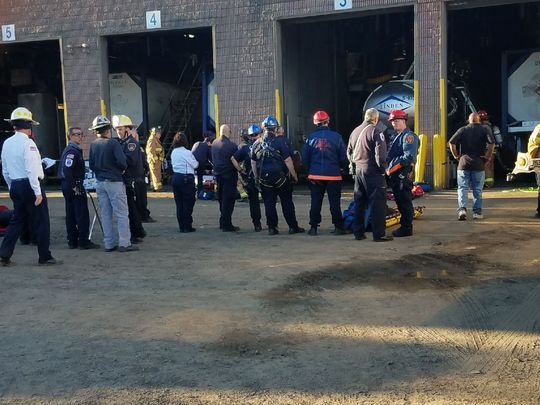
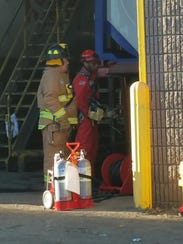
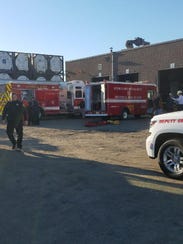
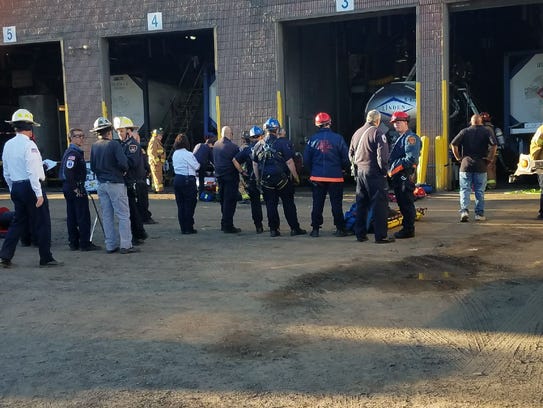
Emergency personnel respond to a confined space rescue in Linden. (Photo: Courtesy of Linden Fire Department)


Members of the Linden Fire Department, assisted by Union County Hazmat and the Elizabeth Fire Department, performed confined space rescue efforts and were able to reach the man, but he was pronounced dead at the scene, police said.


Most likely the worker was inspecting or cleaning or repairing the tanker trailer tank (an intermodal container) and was overcome by hazardous fumes.  This is an unfortunate and typical situation when the employer fails to provide the appropriate safety harness for the worker and/or fails to train the worker.  The lack of oxygen and/or the deadly gases will kill the worker.  Most of these transportation companies are known "cheap-skaters".  Cutting safety corners to the detriment of the workers.


Emergency personnel respond to a confined space rescue in Linden. (Photo: Courtesy of Linden Fire Department)

A police monitoring service indicated the tanker trailer was inside a warehouse.

The circumstances surrounding this incident are under investigation by the Linden Police Detective Bureau and the Occupational Safety and Health Administration (OSHA).


Emergency personnel worked to rescue a man trapped in a confined space in Linden. (Photo: Courtesy of Linden Fire Department)

In nearby Woodbridge a police monitoring service reported around 4:12 p.m that a worker was trapped in a construction trench and the Middlesex County Urban Search and Rescue Team was called to the scene.

John Hagerty, township spokesman, said he understands a private contractor was working in the Colonia section. The site was not a township construction site. The trench collapsed for some unknown reason, trapping a worker. Extrication work was underway.

Members of the Colonia Fire Department and Township EMS on site, Hagerty said.


Linden Bulk Transportation LLC: Bulk Tank Intermodal


In June of 1989, Linden Bulk Transportation diversified its operation by adding a tank container depot to facilitate its expanding intermodal business. Linden recognized that the industry needed a full service depot to consolidate all domestic intermodal business. Linden positioned itself as an ISO Tank Depot & Drayage servicing the NY/NJ port in order to provide all of the service needs for intermodal transportation.

Linden Capabilities and Services Include:


  • Full Time Manager
  • Full Time Equipment Coordinator
  • Full Time Dispatch Coordinator
  • Customer Training Program
  • 4 Loaded and 4 Empty Lifts
    • Equipment:
      • 4 heavy lifts
      • 4 light lifts
      • ISO Container Chassis with Lift Kits
  • Loaded Container Storage With Spill Containment
  • Computerized Heating: Electric, Steam, and Hot Water Circulating
  • Auto E-Mail Inventory Reports
  • Internal and External Cleaning
  • Passivation System
  • Manifested Residual Disposal
  • Major and Minor Repairs
  • 3 – 50 Foot Repair Bays
  • Sufficient Parts Inventory
  • Testing: 2 1/2 Year & 5 Year

Training:

The world of ISO containers is truly unique and Linden Bulk Transportation provides an opportunity for its customers to visit and learn about the business. This 1/2 day session provides a good foundation for those involved in the coordination and logistics of tank container movement, repair and inspection.
The Linden Training Program provides a working, hands on knowledge base of:

  • Valves
  • Fittings
  • Gaskets
  • Tank Designs
  • Testing Procedures
  • Loading & Unloading Instruction