MEC&F Expert Engineers

Sunday, May 14, 2017

Speeding Sheriff's Deputy Jason Garner, 41, and community service officer Raschel Johnson, 42, killed when their car caught fire after failed to negotiate a curve and crashed into an auto wreckage business in Modesto, CA


Deputy Sheriff Jason Garner (left) and Community Service Officer Raschel Johnson (right) were killed in a fiery crash Saturday morning in Modesto. 


Speeding Sheriff's Deputy Jason Garner, 41, and community service officer Raschel Johnson, 42, killed when their car caught fire after failed to negotiate a curve and crashed into an auto wreckage business in Modesto, CA


Courtesy: Stanislaus County Sheriff's Department

MODESTO, Calif. (KCRA) —

A Stanislaus County sheriff’s deputy and community service officer were killed Saturday morning in a fiery crash in Modesto.


Deputy Jason Garner, 41, and community service officer Raschel Johnson, 42, were killed after their car crashed near Crows Landing Road and Seventh Street, the California Highway Patrol said.

Speeding Sheriff's Deputy Jason Garner, 41, and community service officer Raschel Johnson, 42, killed when their car caught fire after failed to negotiate a curve and crashed into an auto wreckage business in Modesto, CA


The pair were responding to a prior burglary call about 8:19 a.m. that was not in progress when for an “unknown reason the vehicle left the roadway and crashed into a building,” the Stanislaus County Sheriff's Department said.

Their car caught fire after hitting an auto wreckage business, the CHP said.

Garner worked with the Stanislaus Sheriff’s Department for nine years and six months. He is survived by his wife and four children.


Johnson worked with the department for 15 years and five months. She was a community service officer for eight years. She is survived by her mother, father and three children.

“We are a big department, but we are still small enough where all know each other. So, it’s definitely – it’s hard. You know, we had a deputy killed just six months ago and it seems like we’re still healing from that tragic loss. And now, we’re dealing with another, in this case, two. So, it’s definitely hard. It’s still probably a shock, I think, to a lot of us,” Deputy Royjindar Singh said.


"Our hearts are broken and we pray for Deputy Garner's family, Community Service Officer Johnson's family, and all the members of our department who are dealing with another tragic loss," the department said on their Facebook page.  Of course they should not be speeding; they failed to do that and it costed their lives.


Gov. Jerry Brown released a statement Saturday afternoon extending condolences.

"Anne and I were deeply saddened to learn of the collision that resulted in the tragic deaths of Deputy Garner and Community Service Officer Johnson this morning. Both were dedicated public servants who devoted their careers to keeping the people of Stanislaus County safe. We extend our deepest condolences to their families, friends and coworkers," Brown said.  Of course, the Californians love the speeding cars and that is why they have one of the highest death and injury rates in the nation.

Brown said the Capitol flags will be flown at half-staff in honor of Deputy Garner and Community Service Officer Johnson.

Six months ago Saturday, the Sheriff's Department was mourning the death of Deputy Dennis Wallace who was shot and killed.

Stanislaus County Sheriff's Lt. Marc Nuno was in Washington at the National Law Enforcement Officers Memorial honoring Wallace when he learned about the deadly crash.

"I'm here to remember Deputy Dennis Wallace who lost his life on Nov. 13, 2016, and I'm also here unfortunately because today we lost another deputy while being here in a vehicle accident. That would be Jason Garner, and a CSO that was also with him, Raschel Johnson, so it's even twice as tragic for us right now," Nuno said.The crash is being investigated by the CHP's Multidisciplinary Accident Investigation Team from Fresno.


It is obvious that the SUV was speeding and failed to negotiate the curve in front of the auto wrecker's building.  It end up crashing and bursting into flames, killing both of them.

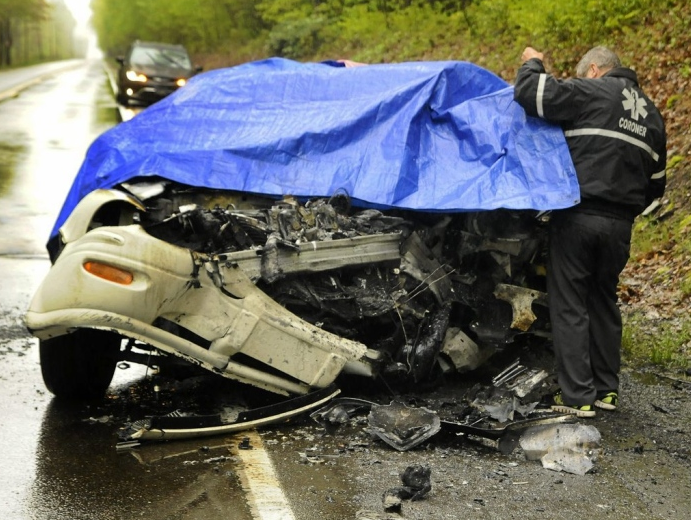
A driver died when the Buick car he was driving crashed head-on into an SUV and caught fire in Rush Township, PA


LAKE HAUTO, PA — A man died Saturday when the car he was driving crashed into another vehicle and caught fire in Rush Township.

The crash occurred just after 3 p.m. on Route 54, about a mile east of the entrance to Lake Hauto to the west and near the Schuylkill-Carbon county line to the east.

The driver of the Buick was pronounced dead at the scene at 3:41 p.m. by Schuylkill County Deputy Coroner Edward Smith, Tamaqua.

Smith said the identity of the victim was not being released until his next of kin are notified.

Rescuers from Tamaqua, Hometown and surrounding communities worked to free two people from inside the other vehicle, a white SUV, that came to a stop over an embankment alongside the westbound lane.

It took firefighters about 35 minutes to remove the occupants from the SUV and get them into awaiting ambulances.

Both the driver and passenger were taken to area hospitals by ambulance for treatment of what officials said were non-life-threatening injuries.

The Buick came to a stop partially off the eastbound lane, facing west.

State police at Frackville are investigating the crash with the assistance of their Collision Analysis Reconstruction Section division.

The crash and subsequent investigation forced investigators to close Route 54 east at the Hometown Nursing and Rehabilitation Center and west just past the Carbon County line.

The road was closed for more than five hours with fire police from Hometown, Quakake and Tamaqua directing drivers onto alternate routes.

EMS units from Tamaqua, McAdoo and Lehighton treated the injured while Quakake and Nesquehoning firefighters assisted at the scene.

Police said that additional information on the crash will be made available as the investigation continues.

27 Workers a Day Suffer Amputation or Hospitalization: General medical and surgical hospitals topped the list, followed by support activities of oil and gas operations


Study of severe injury data finds poultry and meat workers at high risk

May 4, 2017


New York – Every day, 27 workers suffer on-the-job amputations or injuries that require hospitalization, according to a recent report from the National Employment Law Project.

The advocacy group’s report examined data from OSHA on reports of severe injuries that occurred from January 2015 to September 2016 in 29 states. (States with OSHA-approved reporting plans were excluded.) According to the data, employers reported 17,533 severe injuries during the study period.

Although the highest number of severe injuries were reported by some of the nation’s largest employers, two “much smaller” companies in the poultry and meat processing industry ranked fourth and sixth, respectively, among the more than 14,000 companies reporting.

“OSHA’s severe injury data shines a light on the severe toll of preventable workplace injuries, especially in the U.S. poultry industry,” Debbie Berkowitz, NELP senior fellow and lead report author, said in an April 27 press release. “The workers who put food on our tables should not have to sacrifice their health for a paycheck.”

The report also cites Bureau of Labor Statistics data that shows poultry workers are 1.6 times more likely to suffer work-related injuries and illnesses. Meatpacking workers are twice as likely to be injured on the job.

“The poultry industry has the resources to implement required safety measures, provide the required safety training in a manner that workers can understand, provide access to prompt and adequate medical care for workers injured on the job, and increase staffing to ensure that relief workers are available to allow for line-worker bathroom breaks and to ensure that lines are fully staffed,” the report states.

Overall, the poultry industry had the 12th-highest number of reported severe injuries. General medical and surgical hospitals topped the list, followed by support activities of oil and gas operations, and commercial and institutional building construction. 


Curran v. Long Island Railroad Co.: Long Island Railroad was negligent when it put signal worker Daniel Curran into a “work hardening” physical therapy program he claimed exacerbated an on-the-job back injury


Jury Sticks LIRR With $911K Bill For Signal Worker's Injury

By Pete Brush Law360, 


New York (May 11, 2017, 5:48 PM EDT) -- 

A Manhattan jury hit the Long Island Railroad with a $991,000 damages verdict Thursday, finding that the railroad was negligent when it put signal worker Daniel Curran into a “work hardening” physical therapy program he claimed exacerbated an on-the-job back injury. 

The jury of seven men and one woman needed about four hours to make its decision after a three-day trial before U.S. District Judge Edgardo Ramos, who denied the railroad's motion for summary judgment against plaintiff Daniel Curran last year.

The jury declined to find the railroad negligent for a July 2012 rail-buckling problem called a heat kink — Curran claims he was injured during an emergency repair mission to fix that issue — but it held that the LIRR shouldn't have pushed Curran in October of that year to do physical therapy that was beyond his limits.

Curran's counsel, Marc Wietzke of Flynn & Wietzke PC, told the jury during morning closing arguments that the “work hardening” therapy derailed his recovery.

“There was no timeline for him to be out of therapy,” Wietzke said. “Why push him so hard?”

After the verdict LIRR counsel John A. Bonventre of Landman Corsi Ballaine & Ford PC asked to make post-trial motions — a clear indication that the railroad will continue to contest Curran's allegations.

Bonventre sharply challenged the negligence allegations during morning closings, suggesting that Curran's story did not pass the “smell test.”

“Is Mr. Curran telling the truth? We know he has reason to exaggerate” Bonventre said, suggesting the plaintiff was out for an easy payday.

Bonventre rejected Curran's assertion that the railroad threatened him with termination if he did not enroll in the work hardening program, calling it a fanciful claim akin to “an offer he could not refuse” from “The Godfather.”

Curran testified earlier in the week that a supervisor from the LIRR back-to-work therapy program pressured him to join.

“It could be insubordination. You could be out on the street,” Curran testified he was told.

Curran has been paid about $360,000 during the time he has not been working. The railroad will be able to offset any damages he ultimately recovers by that amount.

Counsel for both sides declined comment after the verdict.

Curran is represented by Marc Wietzke of Flynn & Wietzke PC.

The railroad is represented by John A. Bonventre and Andrew J. Kornblau of Landman Corsi Ballaine & Ford PC.

The case is Curran v. Long Island Railroad Co., case number 1:13-cv-08452, in the U.S. District Court for the Southern District of New York.

Asbestos was widely used in B.C. as a building material until the early 1990s, and it can be present in many areas of older buildings


Asbestos

Exposure to asbestos can cause serious long-term health issues and even death. Asbestos was widely used in B.C. as a building material until the early 1990s, and it can be present in many areas of older buildings. If you suspect asbestos is present, do not touch or move it. Only qualified professionals can remove asbestos.

How workers are exposed

Anyone who repairs, renovates, or demolishes older buildings in B.C. is at risk of inhaling asbestos fibres. Found in dozens of items in older buildings, asbestos breaks down into small fibres as it ages or when it is disturbed. Touching or moving it releases the fibres into the air, where they can linger for hours.
Workers with the highest risk of breathing the fibres include:
  • Demolition and renovation contractors
  • Carpenters, plumbers, and electricians
  • Building owners, home inspectors, insurance adjusters, and real estate agents

The risks

Breathing in asbestos fibres damages your lungs, causing serious health problems. These include:
  • Asbestosis
  • Lung cancer
  • Mesothelioma (a cancer)
  • Pleural thickening (a lung disease)
People exposed to asbestos won't develop illnesses right away. It takes years for your health to suffer. Research shows that smokers who inhale asbestos fibres greatly increase their risk of lung cancer.

Never assume a building material is free of asbestos. You can't tell just by looking at it. If you suspect asbestos is present, stop work immediately and have a qualified asbestos professional complete an asbestos survey. 

If asbestos is found, the law requires employers to hire a qualified abatement contractor to remove it. A qualified person must also certify that the worksite air is safe, following the completion of the asbestos removal work. A notice of project must be submitted to WorkSafeBC for all asbestos work. 

How to reduce the risks

To reduce the potential for injury or disease, you need to control the risks and hazards in your workplace. 

The most effective way to manage the risk of exposure to asbestos is to eliminate the source of exposure. If that's not possible, there are other risk controls to use. When choosing risk controls, start by asking yourself the questions in the following steps, listed in order of effectiveness. See our resources for more information.

  1. Elimination or substitution

    Eliminating the asbestos hazard by substituting a safer material, where possible, is the most effective control. For example:
    • Can you replace asbestos containing products such as brakes, clutches, or gaskets with non-asbestos substitutes?

  2. Engineering controls

    Making physical modifications to facilities, equipment, and processes can reduce exposure. Some questions to consider:
    • Can asbestos containing materials be encapsulated or enclosed
    • How can asbestos removal work areas be enclosed and the air filtered to prevent the escape of asbestos fibres?
    • How will worker exposure to asbestos be monitored?
    • How will asbestos waste be properly contained and disposed of?

  3. Administrative controls

    Changing work practices and work policies, awareness tools, and training can limit the risk of asbestos exposure. Some questions to consider:
    • Have you developed a written exposure control plan for asbestos?
    • How can warning signs be effectively posted to warn unprotected workers?
    • Where can written safe work procedures be posted?
    • How will you train workers regarding the hazards of asbestos and how to protect themselves?

  4. Personal protective equipment

    This is the least effective control. It must always be used in addition to at least one other control. Personal protective equipment must always be used when working with asbestos. Some questions to consider: