MEC&F Expert Engineers

Wednesday, January 4, 2017

LIRR Train Crash: preliminary information indicates the train was going too fast as it entered Atlantic Terminal and struck the bumper at the end of the track.


Excessive speed eyed in LIRR crash as investigation gets underway


Eyewitness News
Updated 2 hrs 48 mins ago
BROOKLYN, New York (WABC) -- The investigation is underway into the LIRR crash in Brooklyn Tuesday morning that left scores of people injured, and sources tell Eyewitness News that the preliminary information indicates the train was going too fast as it entered Atlantic Terminal and struck the bumper at the end of the track.

MTA Chairman Tom Prendergast said the train struck the bumping block at the end of the track and went up over that block, with the first car derailing. More than 100 people were hurt, but none of the injuries is life threatening.

Governor Andrew Cuomo said most of the victims were able to leave the train under there own power and that the situation could have been much, much worse. There were approximately 430 riders on board at the time.

"The response to the accident was fantastic, and I want to thank all the first responders, the MTA, the NYPD, the Fire Department," Cuomo said. "They really did a great job of getting on site."


It is unclear at this point what happened with the operator, but he or she is expected to be a focal point of the investigation. The data recorder, better known as the black box, will tell investigators whether the brakes failed or the train engineer failed to use them.

"It's primarily the locomotive engineer's responsibility to control the train," Prendergast said. "There's a signal system that controls it coming in at limited speeds, but when you're getting to the end, it's the locomotive engineer's responsibility.

In a similar accident last October, the data recorder revealed the engineer of a New Jersey Transit train was going twice the 10-mile-per-hour speed limit seconds before slamming into the bumper stop at the Hoboken Station.

"(Brake failure) is a possibility, but unlikely," rail safety expert James Sottile said. "It appears he failed to stop the train in time."

Sottile insists that both the Brooklyn and Hoboken crashes were preventable.

"They have not installed electronic capability to stop a train as it approaches a station to override the engineer's capability," he said.
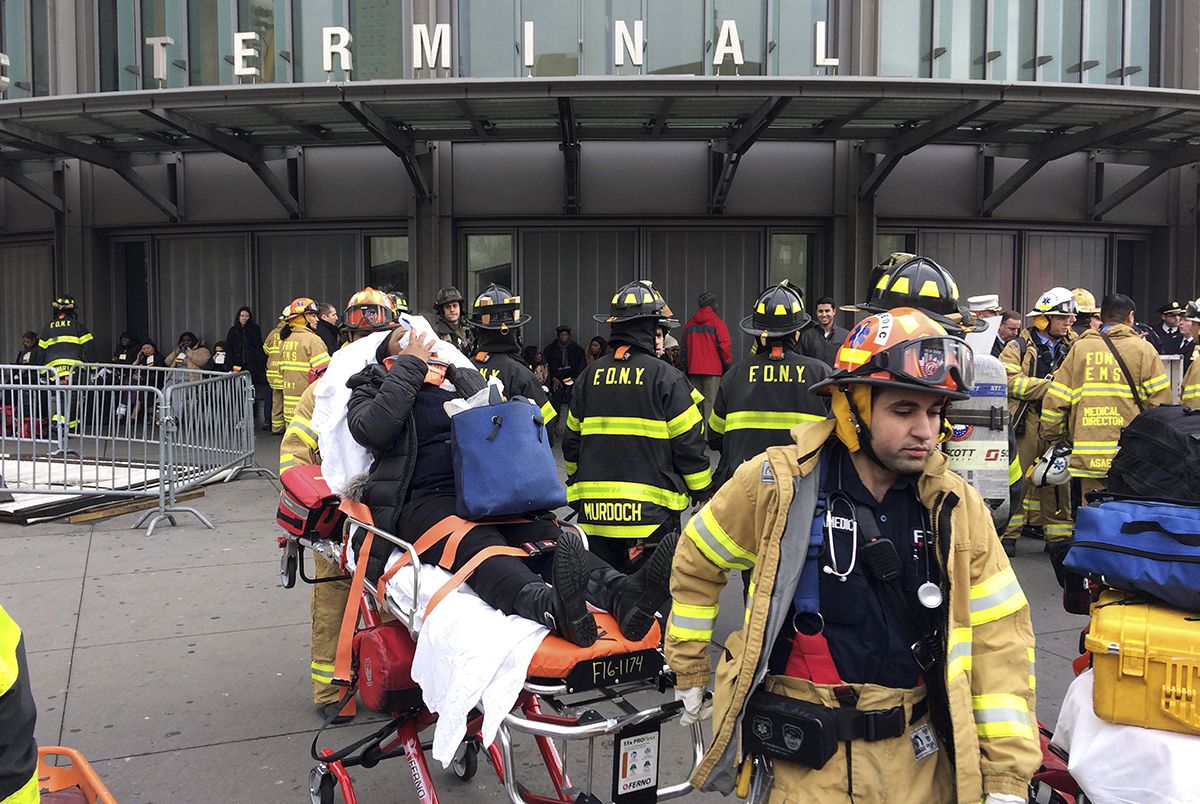


(Photo/@sophieaka via Instagram)
It's too early to tell if the Brooklyn crash was mechanical or operator error, but in the Hoboken crash, black box data suggested the engineer accelerated the train for unknown reasons before slamming on the brakes too late. He blamed sleep apnea, the disorder played a major role in a 2013 Metro North derailment that left four dead and more than 70 injured.

That crash led to the screening of all 438 Metro North engineers, and Eyewitness News has learned that 12 percent of them tested positive and are being treated. Few, if any, LIRR engineers have been screened for the sleep disorder, but we've been told testing is being expanded to include them.

While screening improves safety, Sottile said installing existing decades-old technology that would automatically stop trains would provide far better protection.

Every year an estimated 21,000 Americans die from lung cancer due to radon exposure.


Help Protect Your Family from Lung Cancer: Test and Know Your Home’s Radon Level
01/04/2017
Contact Information:
Tricia Lynn (lynn.tricia@epa.gov)
(202) 564-2615

WASHINGTON – January is National Radon Action Month, when the U.S. Environmental Protection Agency (EPA) joins with state, tribal and local public health agencies to encourage all Americans to test their homes for radon. Exposure to radon in indoor air is the second leading cause of lung cancer. Test your home and make 2017 a safer and healthier year.

“January is the time when we remind everyone to ‘test, fix and save a life.’ That’s because lung cancer due to radon can be prevented by testing, and if needed, fixing your home. It’s a simple and important way to help safeguard your family’s health,” said Jon Edwards, Director of EPA’s Office of Radiation and Indoor Air. “Testing is inexpensive and test kits are readily available and easy to use. Reducing your family’s exposure to radon provides peace of mind, knowing that you’re doing the right thing to help avoid the toll taken by radon-induced lung cancer.”

Every year an estimated 21,000 Americans die from lung cancer due to radon exposure. There’s only one way to know whether your home has an elevated radon level: testing for it. If the radon level is 4 picocuries per liter (pCi/L) of air or more, the U.S. Surgeon General and EPA recommend taking action to fix your home. With a test result of 4 pCi/L or more, you should contact a qualified radon mitigation contractor.

Easy to use do-it-yourself radon test kits are affordable and available online and at many home improvement and hardware stores. You can also hire a qualified radon professional. Testing may show your home to have a high radon level. If so, a professionally installed radon reduction system, using a vent pipe and exhaust fan, will help prevent the radon from entering your home and will discharge it outside. When compared with risk of lung cancer, these systems are very affordable, generally in the price range of many common home improvements.

Reducing your exposure to radon is a long-term investment in your health and your home. A mitigation system in good working order is a positive selling point when placing your home on the market; in many areas radon testing is a routine part of a home sale. Are you buying a new home? Ask the seller if the home has been tested recently. If the results are high, the costs to fix it can be factored into the sale. Thinking of building a new home? Work with your builder to include radon-resistant construction techniques.

Strategies to reduce radon exposure, like those above, are included in the National Radon Action Plan. The Plan was launched in November 2015 by EPA, the Department of Housing and Urban Development, the Department of Health and Human Services, and nine national non-governmental organizations. This national partnership coordinates radon reduction efforts and resources. The Plan’s goal is to prevent 3,200 lung cancer deaths annually by 2020.


To learn more about testing or obtaining a radon test kit, contact your state radon office at 1-800-SOS-RADON. Visit https://www.epa.gov/radon to find a qualified radon professional, or learn more about the National Radon Action Plan partnership.

Roofing contractor Robert Barringer III exposes roofers to potentially deadly fall hazards; he is fined $215K


Jan. 04, 2017

OSHA finds Illinois contractor, Robert Barringer III
exposes roofers to potentially deadly fall hazards

BELLEVILLE, Ill. - Federal investigators proposed penalties of $214,782 to an Illinois roofing contractor after a recent inspection at a home construction site in Troy found workers exposed to fall hazards. Statistics show falls cause four of every 10 deaths in the construction industry.

On Jan. 3, 2017, OSHA issued four willful and two serious safety violations to Robert Barringer III which operates as Barringer Brothers Roofing after observing roofers working at heights greater than six feet without adequate fall protection on July 1, 2016.


As the construction industry continues to grow, falls continue to be the leading cause of death. Source: http://www.bls.gov

"Robert Barringer exposed employees to fall hazards, and failed to comply with federal safety requirements to protect workers on the job putting them at serious risk of injury or worse," said Aaron Priddy, OSHA's area director in Fairview Heights. "Fall protection is required whenever employees work at heights greater than 6 feet."

Because Barringer has a history of violations, OSHA placed the company in its Severe Violator Enforcement Program. The agency has cited Robert Barringer III previously doing business under different variations of the name Barringer Brothers.

Inspectors also noted other hazards in July, including employees without eye protection using nail guns, and failure to initiate and maintain an accident prevention program.

View current citations here.

OSHA offers a Stop Falls online resource with detailed information in English and Spanish on fall protection standards. The page provides fact sheets, posters and videos that illustrate various fall hazards and appropriate preventive measures. OSHA standards require that an effective form of fall protection be in use when workers perform construction activities 6 feet or more above the next lower level.

The agency's Fall Prevention Campaign was developed in partnership with the National Institute for Occupational Safety and Health and NIOSH's National Occupational Research Agenda program. Begun in 2012, the campaign provides employers with lifesaving information and educational materials on how to prevent falls, provide the right equipment for workers and train employees to use gear properly.

The agency's Fall Prevention Campaign was developed in partnership with the National Institute for Occupational Safety and Health and NIOSH's National Occupational Research Agenda program. Begun in 2012, the campaign provides employers with lifesaving information and educational materials on how to prevent falls, provide the right equipment for workers and train employees to use gear properly.

Barringer Brothers Roofing has 15 business days from receipt of its citations and penalties to comply, request an informal conference with OSHA's area director, or contest the findings before the independent Occupational Safety and Health Review Commission.

To ask questions, obtain compliance assistance, file a complaint, or report amputations, eye loss, workplace hospitalizations, fatalities or situations posing imminent danger to workers, the public should call OSHA's toll-free hotline at 800-321-OSHA (6742) or the agency's Fairview Heights office at 618-632-8612.

Under the Occupational Safety and Health Act of 1970, employers are responsible for providing safe and healthful workplaces for their employees. OSHA's role is to ensure these conditions for America's working men and women by setting and enforcing standards, and providing training, education and assistance. For more information, visit http://www.osha.gov.

# # #

Tuesday, January 3, 2017

THE INSURERS CANNOT GET THEIR ACT TOGETHER: Asbestos and environmental exposures have generated adverse loss reserve development over time


The Hartford Signs $1.5 Billion Reinsurance Deal Covering Asbestos Liability
January 3, 2017


The Hartford has signed a reinsurance agreement effective Dec. 31, 2016 with National Indemnity Co. (NICO), a subsidiary of Berkshire Hathaway Inc., for a $1.5 billion aggregate excess of loss reinsurance agreement covering certain of The Hartford’s asbestos and environmental liability exposures. The company said the reinsurance premium for this agreement is $650 million.

The agreement covers potential adverse development on The Hartford’s existing asbestos and environmental reserves as of Dec. 31, 2016, excluding those held by the company’s U.K. property/casualty run-off subsidiaries, which the company is under contract to sell to Catalina Holdings Ltd. and currently expects to close in first quarter 2017.

The agreement provides up to $1.5 billion of reinsurance for adverse net loss reserve development above estimated net loss reserves of $1.7 billion as of Dec. 31, 2016.

The Hartford said it will continue to handle claims, subject to certain conditions, and will retain the risk of recoveries under third-party reinsurance contracts for these exposures.

“Our asbestos and environmental exposures have generated adverse loss reserve development over time, creating uncertainty for investors and others about the ultimate cost of these policy liabilities, most of which were underwritten prior to 1985,” said Chief Financial Officer Beth Bombara.

He said the agreement “reduces uncertainty about potential adverse development” while allowing The Hartford to continue to handle both claims and reinsurance recoveries, which it believes will enable it to “achieve the best possible resolution for these long-tail exposures.”

The agreement will be accounted for as a retroactive reinsurance agreement, resulting in a charge of approximately $423 million, after-tax, against fourth quarter 2016 net income. The reinsurance premium is expected to have a slightly negative impact on 2017 P/C net investment income.

Mayer Brown represented The Hartford in the agreement.

Last year the insurer said a review of asbestos and environmental policies showed that the company needed to add to reserves because of higher-than-expected legal costs. In July the insurer announced a deal in which Catalina Holdings Ltd. agreed to take on its book of asbestos-related liabilities in the U.K.

Catalina Holdings UK Ltd. agreed to buy the insurer’s Downlands Liability Management Ltd. (DLM) and Hartford Financial Products International Ltd. (HFPI), which is U.K. business that has been largely in runoff since 1993. As of March 31, DLM and HFPI had total assets of about $1 billion, undiscounted gross reserves of $686 million, undiscounted reserves net of reinsurance of $516 milion, and shareholders’ equity of $321 million, all on a U.S. GAAP basis.

Mark A. Cox, a Texas Clinic Owner, Pleads Guilty to $1M Insurance Fraud and was sentenced to 10 years deferred probation and ordered to pay $1 million in restitution.

Mark A. Cox, a Texas Clinic Owner, Pleads Guilty to $1M Insurance Fraud
and was sentenced to 10 years deferred probation and ordered to pay $1 million in restitution.

January 3, 2017


A Gainesville, Texas, clinic owner has pleaded guilty to insurance fraud and was ordered to repay $1 million after an investigation by the Texas Department of Insurance found that he billed for chiropractic services without having a licensed chiropractor on staff.

“In a case like this, we’re able to reduce fraudulent claims and improve the quality of care people get,” TDI Fraud Director Chris Davis said in the department’s announcement. “Insurance fraud is never a victimless crime, but the problem is magnified when someone puts patients at risk.”

Mark A. Cox entered a guilty plea to first degree felony insurance fraud in December and was sentenced to 10 years deferred probation and ordered to pay $1 million in restitution.

The TDI investigation found that Cox had submitted billings for chiropractic services from 2010 through 2015 but wasn’t a licensed chiropractor. The restitution is equal to the amount he received in insurance payments for the services.

“The Cooke County District Attorney’s Office was a great partner in this case,” said TDI investigator Donald McWhorter. “John Warren helped us get a search warrant and a resolution that’s good for insurance consumers across the state.”

TDI investigators are certified peace officers and work closely with law enforcement authorities around the state when investigating fraud cases.