MEC&F Expert Engineers

Tuesday, May 5, 2015

Shale Boom Bubble Burst: The meteoric rise in U.S. oil production has ended, easing a global glut and driving a rebound in crude prices from below $50 a barrel


Published in Oil Industry News on Monday, 4 May 2015

Graphic for Shale Boom Bubble Burst in Oil and Gas News
The meteoric rise in U.S. oil production has ended, easing a global glut and driving a rebound in crude prices from below $50 a barrel, according to crude trader and hedge fund manager Andrew J. Hall.

Oil production from Texas to North Dakota peaked at almost 10 million barrels a day in February and has been falling since then, Hall said in a letter Friday to investors in Astenbeck Capital Management LLC, his commodities hedge fund. 

A drastic reduction in drilling rigs is starting to shrink U.S. oil output, according to U.S. government data cited by Hall.

That’s helped drive a 36 percent rally in the past six weeks, and prices will continue to rise because it will be harder for producers to ramp up than it was to cut back, Hall said in his letter. Lower crude prices have also boosted demand, while the risk of supply disruptions across the Middle East is growing amid sectarian tensions.

“We have now reached a turning point,” Hall wrote. Growing demand and supply pullbacks “rendered all the doomsday forecasts self-defeating.”

West Texas Intermediate, the U.S. benchmark crude, settled at $59.15 a barrel Friday, marking a 3.5 percent rise for the week. It rose 7 cents on Monday to $59.22 a barrel.

Astenbeck funds were up more than 10 percent through April, and gained 10 percent in 2014 even as oil fell by more than half, according to people familiar with its performance, who declined to be identified because the information was not public.

$100 Million

Known for making aggressive bets on rising oil prices, Hall became renowned in 2009 after being paid about $100 million while at Citigroup Inc., a bank that received government assistance during the financial crisis. For more than two decades he led Phibro LLC, a commodities trading company bought from Citigroup by Occidental Petroleum Corp.

Phibro is in the process of being shuttered by Occidental. Hall separated from Phibro last year and is now exclusively focused on Astenbeck. Founded in 2010, Astenbeck manages a total of about $3 billion.

Hall’s production estimate is based on weekly data from the U.S. Energy Information Administration. The EIA’s numbers have been closely watched by the market for signs that a record pullback in the number of rigs drilling for oil since October has begun to reduce output.

The EIA has predicted that oil output from major shale plays would begin to decline in April. Total average daily U.S. production will peak this year in the second quarter before falling by 210,000 barrels in the third quarter, the agency said in a report last month.

Oil Adjustments
Hall says the EIA data is derived from estimates at state agencies that generally lags months behind, making it “essentially an artifice.”

A more accurate gauge of U.S. output is an “adjustment” the agency uses, which, in addition to the weekly number, adds up changes to how much oil is in storage, how much was used in refineries and how much was imported and exported, Hall said.

Paul Sankey, an energy analyst at Wolfe Research, also noted the trend in a report Thursday to investors. The amount of production that isn’t accounted for has fallen “dramatically” in the last two weeks, suggesting U.S. daily output may have fallen by as much as 200,000 to 300,000 barrels in April, he said.

“That number seems high to us, but it does support the notion that U.S. production is rolling over at present,” said Sankey, a former analyst at the Paris-based International Energy Agency.

Buy Hate
Imports, refinery demand and storage level data all come from surveys the EIA conducts with oil companies. Export data comes from the U.S. Census Bureau. Production data comes from a variety of sources, including state and federal regulatory agencies.

In a perfect world, the supply and disposition would equal each other, said Mike Conner, a petroleum analyst at the EIA. But they often don’t, so the EIA uses the adjustment figure to balance it out.

“All we really know for sure is the supply components are not enough to make up for the volume on the disposition side,” Conner said. “We don’t know if the error is in field production, imports, refinery inputs or what have you. Different analysts are going to have different interpretations.”

Hall, who said earlier this year that he planned to invest in the shares of U.S. shale producers, believing they would rally, said it is now better to bet on oil.

“Many years ago we were told by a veteran of the commodities business that the secret to making money was to ‘buy it when they hate it and sell it when they love it,’” he wrote. “We do not base our decisions on nostrums but there is a certain logic to this old saw. The market is forward-looking. If the consensus is universally bearish then that view will already be reflected in the price.”
Source: www.bloomberg.com

Hedge Fund Profiteers Trashing the Motherfrackers: Shale Oil Drillers Plunge After Einhorn Slams Fracking Costs


Published in Oil Industry News on Tuesday, 5 May 2015

Graphic for Shale Oil Drillers Plunge After Einhorn Slams Fracking Costs in Oil and Gas News
Money manager David Einhorn (aka I Aint-a-Hore) slammed the shale drilling industry that ushered in a new era of U.S. oil production as wasteful, expensive and a terrible investment.  

Of course this guy promotes "green technologies" that are equally unprofitable and also kill millions of animals and birds every single year.  Do you ever wonder where all these birds and bats gone?  Answer: got killed by the blades of wind turbines promoted by these profiteers.

Shale explorers including Pioneer Natural Resources Co. and EOG Resources Inc. plunged as investors heeded Einhorn’s remarks at the Sohn Investment Conference in New York on Monday.

Einhorn, who manages $12 billion as president of Greenlight Capital, said investors who are bullish on oil prices should avoid buying stock in producers and instead invest in the commodity itself. He singled out Irving, Texas-based Pioneer for special attention.

“Pioneer burns cash and isn’t growing,” said the 46-year-old Einhorn. “Why is the market paying $27 billion for this company?”

Pioneer fell as much as 5.3 percent for the biggest intraday decline since Feb. 11. EOG had been up as much as 2.5 percent before Einhorn’s comments triggered a sell-off that wiped out most of Monday’s gains. Both companies recovered some of those declines later: Pioneer closed 1.9 percent lower at $168.33, and EOG was up 0.5 percent.

Tadd Owens, a spokesman for Pioneer, didn’t immediately respond to a voicemail seeking comment. EOG spokeswoman K. Leonard also didn’t immediately respond.

On Monday, Einhorn also singled out Concho Resources Inc., Whiting Petroleum Corp. and Continental Resources Inc. as examples of shale explorers that spend too much and generate too little cash. A Concho spokeswoman said she wasn’t immediately able to comment; spokespersons for Whiting and Continental didn’t immediately respond to requests for comment.

Mixed Record
Shale explorers revolutionized North American oil and natural gas production with sideways drilling and hydraulic fracturing techniques honed in Texas, Oklahoma and North Dakota. As a result, U.S. crude output almost doubled in the past eight years to more than 9.3 million barrels a day, more than every member of OPEC except Saudi Arabia.

Einhorn has a long history of betting against companies within his New York-based hedge fund firm. He’s also a frequent speaker at the annual Sohn conference where he explains his rationale. The strategy has had mixed success.

In May 2008, he told investors they should bet against Lehman Brothers Holdings Inc. because it needed more capital to recover from credit-market losses. Lehman Brothers filed for bankruptcy that September.

At the Sohn conference last year, Einhorn said he was betting software company Athenahealth Inc. could fall as much as 80 percent. The prediction has yet to come true: the Watertown, Massachusetts-based company has fallen 7.6 percent since Einhorn’s pronouncement and was never down more than 16 percent during the intervening 12 months.

In 2014, he also criticized “cool kid” companies in the technology sector that he faulted for using buzz words in their financial documents to lure venture capital.
Source: www.bloomberg.com

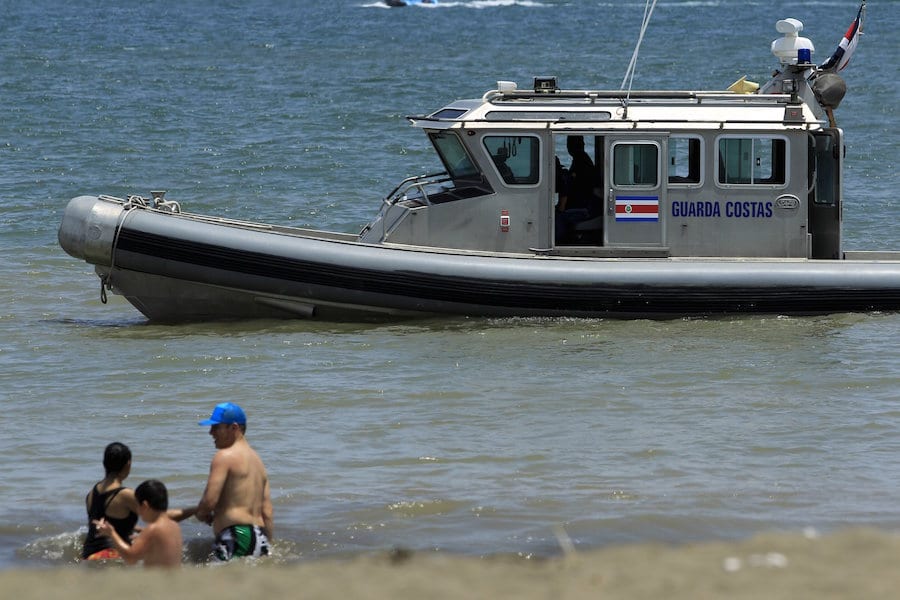
Public Health Emergency Posted by Coast Guard After Barge Carrying 180 Tons of Ammonium Nitrate Sinks Off Puntarenas, Costa Rica

A Coast Guard boat warns bathers of the dangers of swimming in the sea in Puntarenas May 3, 2015.
A Coast Guard boat warns bathers of the dangers of swimming in the sea in Puntarenas May 3, 2015. REUTERS/Juan Carlos Ulate

A public health emergency was declared in Costa Rica this weekend after a barge carrying ammonium nitrate sank off the country’s Pacific coast.

Costa Rica’s National Emergency Commission issued a ‘Red Alert’ for approximately 100 miles of coastline after the barge carrying 180 tons of ammonium nitrate sank in rough seas off the coast of Puntarenas on Saturday at approximately 2:30 p.m. Two crewmembers were rescued safely.

The initial alert was considered a precautionary measure to warn people of possible health hazards from swimming and fishing in the area.

As of Monday morning, the alert was downgraded to ‘Yellow’ after tests showed minimal risk to human health, but a ban on fishing remains in place. The alert will stay in effect until Wednesday as additional testing is carried out.

Authorities are now looking into salvaging the sunken vessel.

Ammonium nitrate is a chemical compound generally used as a fertilizer or as an additive in explosives. It is said to be very soluble in water

Blue whales haven’t developed behavioral responses to avoiding collision with ships

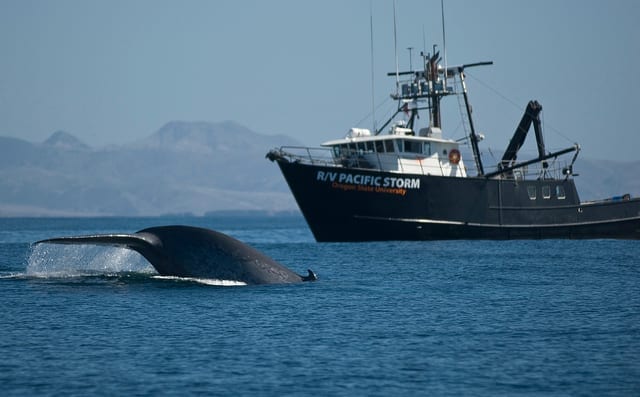
blue whale research ship
Researchers on the Pacific Storm, a research vessel operated by Oregon State University, tagged blue whales near the Channel Islands of California in 2006. The work was part of a 10-year study of apex predators in the Pacific Ocean. (Photo by Craig Hayslip, courtesy of OSU Marine Mammal Institute)

BY BJORN CAREY, Stanford University
For millions of years, blue whales have cruised the world’s oceans with hardly a care, their sheer size making them largely free from predator attacks. The downside to being the largest animals in history, however, is that the species was never pressured to evolve defensive behaviors.

Now, the first direct observations of blue whales attempting to avoid cargo ships suggest that this lack of an evasive response might make the whales particularly susceptible to deadly collisions.

“It’s not part of their evolutionary history to have cargo ships killing them, so they haven’t developed behavioral responses to this threat,” said Jeremy Goldbogen, an assistant professor of biology at Stanford’s Hopkins Marine Station, and the senior author on the study. “They simply have no compelling response to avoiding these dangerous ships.”

The study, published in Endangered Species Research, could help improve methods to protect blue whales and other marine animals from deadly ship collisions.

Collisions with ships are a major threat to whales and pose a significant threat to the recovery of some endangered populations. Efforts to reduce collisions have mostly involved placing speed limits on ships passing through busy whale habitats or rerouting shipping channels around these areas altogether.

However, a critical piece of information needed to make these decisions and evaluate their effectiveness is currently lacking: direct knowledge of how whales behave once they sense an oncoming ship.

To fill that gap, Goldbogen and colleagues from several academic institutions headed to Long Beach, California, home of one of the busiest shipping ports in the world and also a hotspot for blue whales. Just a few miles offshore, the continental shelf drops off and there is a huge upwelling of nutrients that attract krill, a favorite food of blue whales.

The scientists used suction cups to adhere GPS (global positioning system) and dive-logging units to blue whales, and then tracked their movements for 24-hour periods. The scientists then cross-referenced this data with boat traffic, including the tonnage and speeds of ships passing through the area.

In this first run of the experiment, the researchers observed 20 ship passages with nine individual whales, at distances ranging from 60 meters to more than 3 kilometers. In each of these instances, the whales exhibited behavior similar to the “startle response” that scientists observe during the tagging process, in which the whales essentially “play dead.”

“Blue whales have a subtle and not very convincing ability to get out of the way of oncoming ships,” said Goldbogen. “Instead of diving, where the animal kicks tail up and goes down vertically, they just sink horizontally. This results in a slow dive and leaves them susceptible to ship strikes.”

A whale must dive 30 meters below the surface to escape the suction created by a ship’s propeller. In the study, the whales sank at about a half a meter per second and showed no evidence for swimming laterally to avoid the ship. In most cases, this was barely fast enough to get out of the ship’s way.

This is just the first step in figuring out the behavior of whales in the context of heavy shipping traffic, Goldbogen said. The research team is already planning a second round of tests in which the GPS units will remain attached to the whales for several weeks, and will extend to species such as humpback whales. With more data about both whale behavior and the frequency of near misses, Goldbogen hopes to be able to make a compelling recommendation to pleasure boaters and the shipping industry for how to minimize the risk of collisions.

Ship Losses Reach 10 Year Low

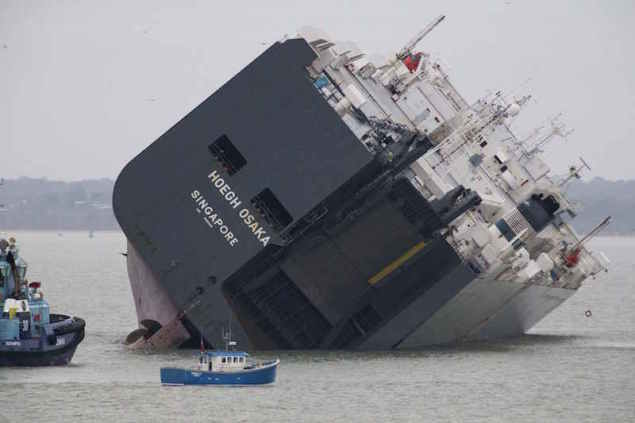
The cargo ship <a href=
Hoegh Osaka lies on its side after being deliberately ran aground on the Bramble Bank in the Solent estuary, near Southampton in southern England January 5, 2015. REUTERS/Peter Nicholls” width=”635″ height=”423″ /> The cargo ship Hoegh Osaka lies on its side after being deliberately ran aground on the Bramble Bank in the Solent estuary, near Southampton in southern England January 5, 2015. REUTERS/Peter Nicholls


Martime disasters including high profile incidents – such as the Costa Concordia disaster, Sewol ferry sinking and Norman Atlantic ferry fire – have made banner headlines in recent years but, interestingly, the overall number of ships lost at sea is declining. Back in 2007, 170 large vessels were lost and this fell to just 75 in 2014, according to a new report by Allianz Global Corporate and Specialty.
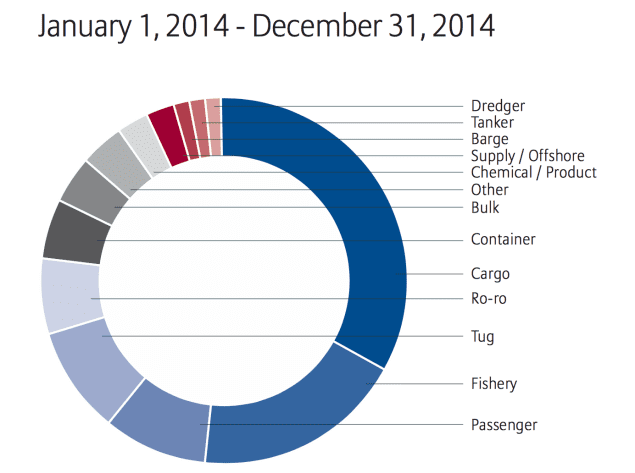
Losses by vessel type January 1, 2014 - December 31, 2014. Data by Allianz Global Corporate & Specialty
Losses by vessel type January 1, 2014 – December 31, 2014. Data by Allianz Global Corporate & Specialty


22 percent of all losses between 2009 and 2013 can be attributed to machine damage/breakdown with fire accounting for 16 percent. Hull damage and collision made up 9 percent of all losses each while 8 percent were due to storms. Even though the declining number of sinkings/losses may seem like good news for insurance companies, the increasing size of container ships may actually lead to bigger losses. The Mediterranean Shipping Co’s MSC Oscar became the largest container vessel in the world this year. Almost as long as four football fields and with a 19,224 teu capacity, a serious mishap involving a vessel like this could cost upwards of $1 billion.

Infographic: Large Ship Losses Reach Lowest Point In A Decade | Statista


Other interesting points from the report include:
• There were 2,773 casualties (incidents) during 2014 with the East Mediterranean & Black Sea region the hotspot (490), up 5% year-on-year.
• 75 large ships lost worldwide in 2014, down 32% year-on-year
• South China and South East Asian waters top loss hotspots
• East Mediterranean and British Isles top locations for incidents
• Cargo and fishing vessels account for over 50% of all losses
• Ship size growth raises risk management concerns. Industry should prepare for $1bn+ loss
• Lessons not learned from overreliance on e-navigation. Cyber protection a major concern
• December is the worst month for losses in the Northern Hemisphere (110) over the past decade with a 64% increase compared with the quietest month (May)