MEC&F Expert Engineers

Saturday, April 11, 2015

TRUCK FUEL TANK SPILLS DO ADD UP TO SEVERAL MILLIONS OF GALLONS OF SPILLED FUEL OIL PER YEAR. TIME TO MAKE SPILL-PROOF TRUCK FUEL TANKS.


APRIL 10, 2015

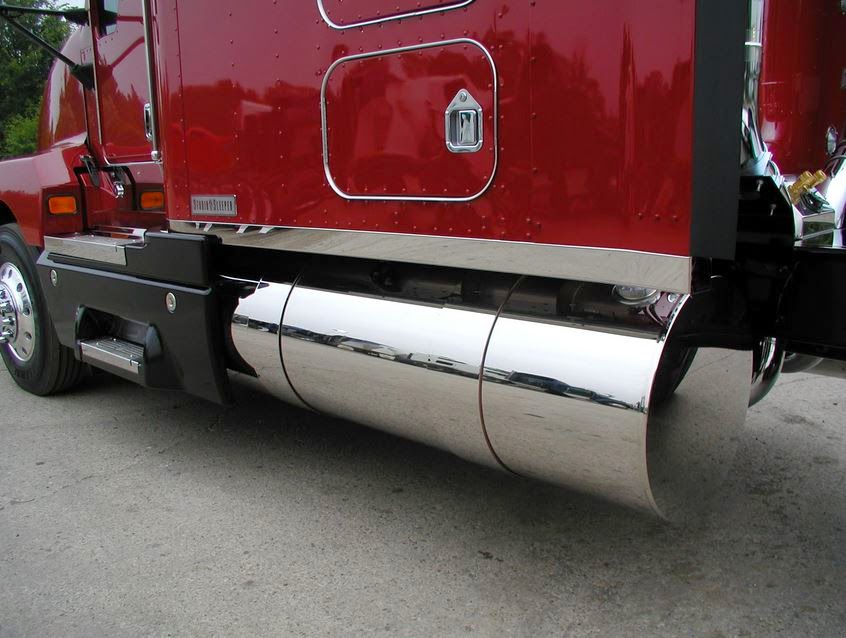
The two fuel tanks of a long-haul truck (located on each side of the tractor) can carry between 100 and more than 140 gallons of fuel oil, each.  This is between 200 and 280 gallons of diesel fuel.  The crankcase holds 11 -15+ gallons or so of lubricant oil.  The radiator holds 6-12 gallons of antifreeze fluid.  

The fuel tanks are also located in an accident and leak prone position in the front right and left of the truck.  Even a simple jackknifing of the truck can cause the tank to spill its contents.  Jack-knifing in which an instability often associated with an empty, or low-weight trailer being towed on a slippery road leads to catastrophic articulation of the joint between tractor and trailer.
Jack-knifing is one of the most significant problems facing truck drivers and a major cause of traffic pile-ups and other multiple-vehicle accidents on major roads.

The regulations require side-mounted fuel tanks to survive a 30 foot drop test, while non side-mounted fuel tanks must survive a 10 foot drop test. Clear specifications are given as to what constitutes a successful drop test and how to conduct the test. 

The regulations also require, among other things, that fuel tanks pass a leakage test and a flame test.  However, the regs do not include a pierce test.  

The majority of diesel tanks manufactured today are made of steel; however truck operators may elect to choose aluminum fuel tanks when replacing older tanks on their vehicles.  Aluminum offers advantages of lighter weight and resistance to corrosion, but they are the ones that are prone to piercing during crashes and other collisions with fire hydrants, road debris, and other protruding objects.

Fuel tanks are safer if they are located in a protected zone forward of the rear axle, and also by using anti-puncture shields and internal tough-skin fuel cell bladders, and by eliminating the sharp bolts, brackets, and edges of the "hostile environment" around the fuel tank.  However, as most people can attest to, the 200 gallon aluminum tanks and other fuel tanks are most of time not protected by anti-puncture shields.

Considering that there are few thousands spills from trucks during crashes, jackknifing or other incidents, it can be easily seen that we have several million gallons of fuel being released into the roads and the environment every year.

HYDROGEN CHLORIDE GAS ALERT AT WATER PLANT IN WESLACO, TX, PEOPLE EVACUATED AFTER HUMAN ERROR THAT CAUSED THE MIXING OF TWO INCOMPATIBLE CHEMICALS, SODIUM HYPOCHLORITE AND SODIUM CHLORIDE


APRIL 10, 2015

WESLACO, TEXAS

Emergency crews responded to a call of a chemical spill at a Weslaco water plant Friday afternoon, but officials said no chemicals actually spilled or emitted gas into the air.

An accidental mixture of two chemicals — sodium hypochlorite and sodium chloride — prompted officials to call emergency crews to the plant as a precautionary measure, said David Salinas, the city’s public utilities director.

Fire, emergency and hazardous materials personnel from Weslaco, McAllen, Edinburg and Pharr responded about 1:45 p.m. to the water plant at the intersection of Texas Boulevard and Sugar Cane Drive. Officials with the Texas Commission on Environmental Quality also responded, and Weslaco Mayor David Suarez said U.S. Environmental Protection Agency authorities were in communication via telephone.

Just before 5 p.m. Salinas and fire officials gave the all clear at the water plant and all closed roads in the area were opened.

Weslaco Fire Chief Antonio Lopez said the people in a daycare located north of the plant and one nearby residence were evacuated and people were moved about 1,000 feet away from the area. No injuries were reported in the incident.
Precinct 1 deputies of the Hidalgo County Constable’s Office were assisting with diverting traffic away from the scene. Constable Celestino Avila Jr. said motorists and individuals who resided or worked nearby cooperated with the evacuation without incident.

Lopez said plant officials followed the proper steps given the circumstances.
Salinas said the chemical mixture was contained to a storage area of the plant.
Suarez said the shipment was supposed to be for sodium hypochlorite, and officials feared the mixture of the sodium chloride with the sodium hypochlorite, of which there was already 3,000 gallons inside a 6,000-gallon tank, could have the potential of producing a reaction that officials on the scene described as “bleach on steroids.”

Suarez said the driver of a truck carrying the chemical shipment was unaware that he was carrying sodium chloride.

“This was just the driver the chemical company sends,” Suarez said. “It was not a city driver.”

The mayor did not know the name of the chemical company that employs the driver, but he did say that representatives of the company were present at the scene of the incident on Friday.

Salinas said the two chemicals alone wouldn’t elicit a chemical reaction but officials erring on the side of caution called fire crews, as is standard protocol in a chemical spill situation. The utilities director said the water supply was never in danger and that the plant was operating just fine.

On the one side, good catch before anyone got hurt. On the other, how did the chemicals make it to the mixing before figured out?  Unless the chemical was mislabeled, in which case there is a real problem with the suppliers or the driver was clueless.

Source: the monitor.com
//-----------------------------------------//

Firefighters and hazmat crews are responding to a chemical leak of a poisonous gas at a water plant in Weslaco, Texas, local news reports. Buildings within 250 feet north and west of the facility are being evacuated.

The incident at the Weslaco Water Treatment Plant began when one chemical was poured into a tank full of other chemicals, which created hydrogen chloride, Weslaco Emergency Management Coordinator George Garrett told KRGV. 

A hose was hooked up to the wrong tank, causing the two chemicals to be mixed together at the wrong concentration, Weslaco Public Utilities Director David Salinas told KGBT. 

There are no water quality issues at this time, he added.
TX BLVD blocked from Delmita St to Sugar Cane as crews work chemical spill at Weslaco Water plant @krgv pic.twitter.com/f42CwzyuiO
— Leslie Aguilar (@KRGV_Leslie) April 10, 2015 

Firefighters from Weslaco were joined by hazmat crews from McAllen, Texas; Hidalgo County Emergency Management officials; and Hidalgo County Precinct 1 constables, KRGV reported. 

There is no threat to the area surrounding the water plant, and the chemicals have been contained, Weslaco Fire Chief Antonio Lopez told reporters during a briefing. 

There are no reported injuries at this time, according to KRGV. 

Weslaco is a city of 35,000 people in the southern tip of Texas. 

Hydrogen chloride is a colorless, corrosive, nonflammable gas that fumes in air.  It has a characteristic pungent odor.  It is heavier than air and may accumulate in low-lying areas.

Hydrogen chloride is not absorbed through the skin, but when hydrogen chloride gas comes in contact with moisture, it forms hydrochloric acid, which is corrosive and can cause irritation and burns. 

Inhalationis an important route of exposure to hydrogen chloride.  Its odor and highly irritating properties generally provideadequate warning for acute, high-level exposures. However,only 50% of exposed persons can perceive hydrogen chloride’s odor at the OSHA permissible exposure limit (5 ppm), and odor may not provide adequate warning in the workplace. Hydrogen chloride vapor is heavier than air and may causeasphyxiation in enclosed, poorly ventilated, or low-lying areas.

39 RAIL CARS OF A NORFOLK SOUTHERN TRAIN DERAILED IN EDGEFIELD COUNTY, SC FRIDAY NIGHT, SPILLING AMMONIUM NITRATE AND PROMPTING AN EVACUATION FOR PEOPLE LIVING IN THE AREA.


APRIL 11, 2015

EDGEFIELD COUNTY, SC (WLTX)

Authorities say an evacuation order has been lifted for all but four homes following a 39-car train derailment in rural South Carolina.  

Derrick Becker, public information officer for the South Carolina Emergency Management Division, tells The Associated Press that no one was injured following the crash about 8:30 p.m. Friday in Trenton. He says four homes closest to the wooded crash scene remain evacuated Saturday as a precaution.

It is confirmed that a total of 39 cars derailed when the train hit a tree that fell across the tracks in a storm.

A Norfolk Southern train derailed in Edgefield County Friday night, prompting an evacuation for people living in the area.

The derailment took place just after 8:30 p.m.. at Salters Pond Road and Highway 121 near the town of Trenton.

South Carolina Emergency Management Division officials say 39 cars derailed, including one carrying anhydrous ammonia. It appears that car did not leak, but another carrying ammonium nitrate did spill.

Officials say there is no danger to the public at this time.

Both products are used as a fertilizer. Ammonium nitrate is not typically hazardous to people's health, but it is potentially explosive.

Thirty people were evacuated as a precaution. Local officials activated a civil emergency message telling people living within a 1.5 mile radius to move to Mount Canaan Baptist Church on Highway 25.

By early Saturday morning, all residents except those living on Salter Pond Road were allowed to return home.

Emergency officials say it could take well into the day Saturday to clean up the spill.

South Carolina is no stranger to train derailments.  In November 2013, an Amtrak passenger train derailed about six miles southwest of Spartanburg, S.C. – although no cars overturned and none of the 218 passengers and crew were injured.

A little over a decade ago – at 2:40 a.m. on  January 6, 2005 – a Norfolk Southern train was mistakenly diverted onto the wrong track in Graniteville, S.C., causing it to crash into a parked rail car full of chlorine.  All told 11,500 gallons of chlorine leaked out.

That crash left nine people dead and more than 250 injured.

We have a sense that a big-impact train derailment is coming.  We have our fingers-crossed as this is the only thing we can do right now other than informing the public of the risks.

//-----------------------------------//

BREAKING ON 6: +++ UPDATED+++ TRAIN DERAILMENT SCENE TURNED OVER TO NORFOLK SOUTHERN
APRIL 10, 2015

Update from SC Emergency Management Department:
All residents evacuated except for those living in 4 homes in the area of the train derailment have been allowed to return home.  The scene has been turned over to Norfolk Southern Railroad.  It is confirmed that a total of 39 cars derailed when the train hit a tree that fell across the tracks in a storm.  No hazardous materials spilled in the accident, though there was a spill of Ammonium Nitrate which is a chemical with a "salt like" consistency commonly used in fertilizer. 


Update from SC Emergency Management Department, Derrick Becker: 

There is no word on when those families who were evacuated will be allowed to return to their homes.  If anyone has any questions regarding the derailment and evacuation updates please call the Edgefield County EMA Hotline at:  803-637-2627

++++++++++++++++UPDATED AT 1:01am ++++++++++++

Emergency responders believe the scene is stable but they will continue to monitor overnight.  There is currently no plan to expand the evacuation area.  This according to SC State Senator Shane Massey

++++UPDATED at 12:38am ++++++

This is the latest from the SC Emergency Management Division:  30 people  have been evacuated as a precaution but there is no danger to residents at this time. The chemicals being carried on the 15 cars that derailed were anhydrous ammonia (no leak) and ammonium nitrate. Continue to follow WJBF News Channel 6 for updates.


*** UPDATED at 11:36 P.M. on Friday, April 10th*** 

South Carolina Emergency Management Division, Norfolk Southern, and Aiken Hazmat Teams are on the scene.

State Senator Shane Massey said in a tweet minutes ago that the train apparently hit a tree that had fallen onto the tracks - 2 locomotives and 12 cars jumped the tracks.

If you live within a mile and a half of the intersection of Salters Pond Road and Highway 121 in Trenton, you need to evacuate to Mount Cannon Church on Highway 25 in Edgefield.

Emergency Management Director Suzy Spurgeon cannot confirm the chemicals that were on the train, but a substance is leaking and that's why the evacuation has been ordered.

Follow us on wjbf.com, Facebook and Twitter for the latest details as they become available.

--------------------------------------------------------------------------------

*** UPDATED at 11:28 P.M. on Friday, April 10th***

We have confirmed that this train derailment involved a Norfolk Southern train, and it occurred around 8:40 p.m. Friday night.

-------------------------------------------------------------------------------

*** UPDATED at 10:12 P.M. on Friday, April 10th***

Residents living in a mile and a half radius of the Salters Pond Road & Highway 121 intersection in Trenton, South Carolina are asked to evacuate immediately to Mount Cannon Church on Highway 25 in Edgefield County.

-------------------------------------------------------------------------------

*** UPDATED at 9:55 P.M. on Friday, April 10th***

The Edgefield County Sheriff's Office is confirming a train derailment near Salters Pond Road, which is off of Highway 121.

Several train cars were involved and there is an unknown substance leaking from the train. A mile and a half evacuation from the scene is happening right now.

There is no word on what the substance is, or if anyone was hurt. We have crews at the scene and we are working to bring you the latest information as this story develops.
Source: www.wjbf.com