MEC&F Expert Engineers

Tuesday, March 10, 2015

FEMA VOWS CLOSER WATCH ON FLOOD INSURERS, ENGINEERING FIRMS. FEMA WILL NOT FUND OR APPROVE WORK WITH ANY ENGINEERING FIRMS THAT ARE KNOWN TO HAVE VALUES THAT DIFFER FROM FEMA’S SURVIVOR-CENTRIC APPROACH


MARCH 10, 2015 

Federal disaster relief officials are keeping a closer eye on companies that help it provide flood insurance, following allegations by Hurricane Sandy victims that claims were denied or underpaid based on manipulated engineering reports.
A spokesman for the Federal Emergency Management Agency said Monday the agency is notifying insurers it will more closely monitor engineering firms hired to help inspect homes and funds paid to cover their expenses.

Dozens of private insurers participate in a program to help the agency provide flood insurance. The federal government ultimately pays damages and expenses associated with handling claims.

Rafael Lemaitre, a spokesman for the agency, said in an e- mailed statement that “pending further guidance” FEMA will review and approve all proposed engineering costs from insurers. The goal is to ensure that the companies are “fulfilling their role by guaranteeing that taxpayer funds are being appropriately expended and their work is consistent with putting policyholders first,” he said.

FEMA will “not fund or approve work with any engineering firms that are known to have values that differ from FEMA’s survivor-centric approach,” Lemaitre said.


FEMA’s Action

The agency last week asked insurers to step aside in settlement talks over more than 1,000 outstanding disputes primarily in New York and New Jersey. The talks involve claims from the October 2012 storm, which caused massive coastal flooding in the Northeast.

The agency said it would take charge of the discussions in an effort to speed up the resolution of claims, which have been mired in controversy over allegations reports were rigged to avoid insurance payouts.

The issue came to light in a case over an insurance claim for a Long Beach, New York, house which owners said was severely damaged by flooding during the hurricane.  An insurer rejected part of the claim, citing a report which attributed much of the damage to long-term problems.  A judge found that an earlier draft of the report, not initially disclosed to the homeowners, had been rewritten to change the conclusion.

Insurers have denied using manipulated reports, saying they have no reason to cheat homeowners because FEMA pays the claims.  Engineering firms say there’s nothing suspicious about peer- reviewed revisions to their first-draft damage reports.

The case is Ramey v. U.S. Forensic LLC, 2:14-cv-06861, U.S. District Court, Eastern District of New York (Central Islip).
Source: www.claimsjournal.com

FEMA SETTLES 160 SUPERSTORM SANDY CLAIMS, BUT 200 MORE SURFACE


MARCH 3, 2015

The Federal Emergency Management Agency has tentatively settled insurance claims with 160 Superstorm Sandy victims, who allege engineering firms altered damage estimates. Meanwhile, lawyers say roughly 200 new policyholders say their reports were also changed.

FEMA manages the National Flood Insurance Program which, allows people to buy flood insurance from the federal government.

Over the last several months, FEMA has been responding to complaints that private insurance companies contracted by the National Flood Insurance Program changed engineering reports to show homes were not damaged by the 2012 storm.

Talks between FEMA and Superstorm Sandy Victims are being moderated by a panel of federal magistrates in New York.

The homeowners who have submitted settlement agreements to the court represent about a tenth of all the policyholders in litigation. Lawyers said those settlements are the most egregious examples of engineering companies fabricating reports to show little to no damage.

But they add most homeowners don't even know they were shortchanged.
"I think there are thousands of people out there who need to pull out their engineer's reports, look at the claims documents, and see if their claims were either lowballed or denied," said Bill Kelly, a lawyer representing roughly 700 Sandy homeowners.

Kelly and others are in talks with FEMA to reach a global agreement to reopen anywhere from 10,000 to 140,000 Sandy claims.

Insurance companies deny all wrongdoing and say they were merely following FEMA's rules.

//----------------------------------------//


TALKS STALL BETWEEN SUPERSTORM SANDY VICTIMS AND FEMA

MARCH 1, 2015

Investigators from the New York state attorney general's office remove boxes of documents seized from a search warrant at the Long Island offices of GEB HiRise in Uniondale, N.Y., on Wednesday, Feb. 18, 2015. The company has been accused in civil lawsuits of submitting bogus inspection reports involving homes damaged in Superstorm Sandy.

Negotiators for Superstorm Sandy victims in New York and New Jersey said talks with the Federal Emergency Management Agency have stalled.

FEMA manages the National Flood Insurance Program, which allows people to buy flood insurance from the federal government. FEMA contracts with regular insurance companies to process the claims. Homeowners claim engineers hired by insurance companies allegedly falsified damage estimates and that homeowners aren't being repaid for the actual damage that Sandy caused.
Two weeks ago, FEMA vowed to resolve all claims with questionable engineering reports that reduced insurance payouts to homeowners following the 2012 storm.

Last week, lawyers for Sandy victims gave FEMA a settlement package that would repay some 10,000 homeowners the full value of their insurance policies, $250,000 each. The proposal also asked FEMA to increase the amount it paid to all policy holders for building materials to accommodate New York's higher prices. The homeowners' lead lawyer, Steve Mostyn, said all together, he wants FEMA to pay out an additional $3-4 billion, or about half of the $7.7 billion that the flood program has paid out already.

"The concerning thing is, the initial response I got is that they can't reopen that many claims, it's just too many," Mostyn said.

The National Flood Insurance Program is currently $23 billion in debt to the U.S. Treasury.

Meanwhile, elected officials in the region have begun pressuring FEMA to reopen questionable claims and they're asking New York Attorney General Eric Schneiderman to monitor. Assemblyman Phil Goldfeder of Queens wants New York to create its own flood insurance program, overseen by the state Department of Financial Services.

"It's about time we start making decisions for ourselves and not be controlled by a broken FEMA-NFIP system," Goldfeder said.

FEMA declined comment but earlier statements say they want to regain the trust of flood policy holders. Insurance companies and their subcontracted engineering firms have denied all wrongdoing. They said they followed the rules Congress and FEMA established.


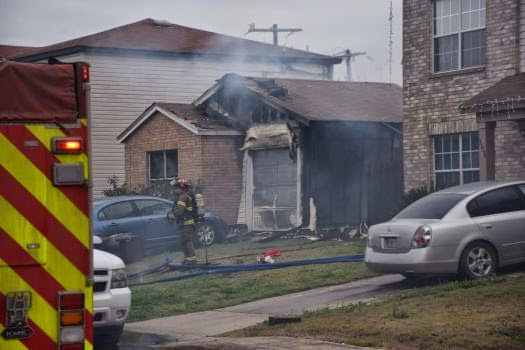
EXPLOSION AND SUBSEQUENT FIRE THAT DAMAGED 3 SAN ANTONIO-AREA HOMES MAY HAVE BEEN CAUSED BY MAN COOKING METH


MARCH 10, 2015 

SAN ANTONIO, TEXAS

A man who was badly burned in a fire Monday morning is suspected of sparking the blaze at his home in East Bexar County. 

At least four fire departments responded to the blaze, which completely gutted one home and significantly damaged two others, just before 9 a.m. in the 3600 block of Candlehill.

The 28-year-old man, who was blown into his neighbors yard by an explosion that sparked the fire, told authorities he had lit two cans of gasoline on fire before the blaze, said Bexar County spokeswoman Laura Jesse.

Neighbors told investigators the man, who has not yet been identified, may have been cooking meth, Jesse said.

Two men were able to pull the man away from the house as flames ripped through it, but the man was taken to the San Antonio Military Medical Center for treatment.

Myron Doern, a former first responder, had left his nearby house to go to a gas station just before the fire broke out, he said. On way his back, he saw flames in the area and drove down Candlehill.

When Doern arrived, another man approached him and told him there was a man inside the burning home.

"When I got out of the car, (the neighbor) told me (the man) was still in the house, and I could hear him screaming," Doern said. "My first thought was... I was going to go in the house."

Neighbors warned Doern to not go into the burning home and said they could hear the man in the back yard, Doern said. 

The man and Doern broke down a fence and were able to get to the victim and get him away from the fire safely, he said.
Source:www.mysanantonio.com

NEARLY 1.7K GALLONS OF OILFIELD BRINE SPILL IN A CREEK IN WILLIAMS COUNTY, NORTH DAKOTA


MARCH 10, 2015 


BISMARCK, N.D.


The North Dakota Department of Health says it was notified that about 1,680 gallons of salt water have spilled in Williams County.


The department announced Monday that the brine spill was the result of a truck overflow about seven miles west of Williston.  The spill affected a nearby creek, and the impact of its water quality is still being investigated.


The department says it’s working on a remediation plan with Golden Eagle Trucking, which is responsible for the spill.


In related news, Nearly 19,000 gallons of saltwater spills north of Tioga.

Source: The Associated Press


//----------------------------------------//

NEARLY 19,000 GALLONS OF SALTWATER SPILLS NORTH OF TIOGA


MARCH 6, 2015 


BISMARCK, N.D. (AP)

The state Department of Health says a pipeline has leaked nearly 19,000 gallons of saltwater in northwest North Dakota.


The pipeline owned by Continental Resources ruptured after it was struck by equipment excavating at the site about 16 miles north of Tioga.


The 450-barrel saltwater, or brine, spill was contained to the excavated area near the pipeline. The department says it has not impacted any waterways and is not a threat to public health at this time.


Brine is an unwanted byproduct of oil production and is considered an environmental hazard by the state. It is many times saltier than sea water and can easily kill vegetation exposed to it.


The Department of Health and the North Dakota Oil and Gas Division have responded and say cleanup is underway.


In related news, ND bill might require more monitoring on saltwater pipelines.

//----------------------------------------------//


ND BILL MIGHT REQUIRE MORE MONITORING ON SALTWATER PIPELINES


FEBRUARY 6, 2015


BISMARCK, N.D.


Bipartisan legislation that would require additional monitoring and safeguards for North Dakota pipelines that carry briny oilfield wastewater has been amended to allow regulators to make the decision on an individual basis.


No one spoke against the changes to the proposed legislation Thursday.

The measure was filed in the wake of a recent 3-million gallon leak near Williston in western North Dakota. It’s been called the largest saltwater spill of North Dakota’s current oil boom.


Senate Republican Majority Leader Rich Wardner is the primary sponsor of the bill. It originally sought to require flow meters and leak-detection devices on pipelines that carry oilfield wastewater.


Wardner’s amendment would allow the state Industrial Commission to decide whether the equipment is needed.

Source:bakken.com