MEC&F Expert Engineers

Tuesday, February 3, 2015

THE PEDESTRIAN CASUALTIES ARE ON THE RISE: ANOTHER PEDESTRIAN WAS HIT BY CAR IN VIRGINIA BEACH, VIRGINIA


 THE PEDESTRIAN CASUALTIES ARE ON THE RISE: ANOTHER PEDESTRIAN WAS HIT BY CAR IN VIRGINIA BEACH, VIRGINIA


February 3, 2015


VIRGINIA BEACH, Va. (WAVY) — Virginia Beach police confirm an auto-pedestrian crash with serious injuries Tuesday evening.


Public Affairs Officer Tonya Borman said the incident happened in the 3200 block of Holland Road around 5 p.m. A man was injured and transported to a local hospital.


While Borman said the pedestrian’s condition was serious. The Virginia Beach Police Department’s fatal crash team responded to the scene, according to police dispatch.


Southbound Holland Road between Lynnhaven Parkway and Shipps Corner was closed, but has since reopened.


No further information has been released. Stay with WAVY.com for updates on this developing story.

HIGHWAY 79 CLOSED AFTER BIG RIG HAULING BEES CRASHES IN LAMBS CANYON IN CALIFORNIA. 40 GALLONS OF DIESEL LEAKED.


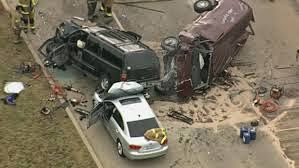
 PHOTO: A truck carrying honey bees crashed with a small Toyota early Feb. 3, 2015

HIGHWAY 79 CLOSED AFTER BIG RIG HAULING BEES CRASHES IN LAMBS CANYON IN CALIFORNIA. 40 GALLONS OF DIESEL LEAKED.


February 3, 2015
 
All lanes were temporarily closed Tuesday morning on SR-79.

Early morning commuters between Beaumont and Hemet faced a roadblock at Lambs Canyon, due to a major traffic crash Tuesday morning.

All lanes of State Route 79 through the canyon were temporarily closed, after a small car and a semi truck crash blocked the roadway, CHP reports.

The crash was first reported at 6:12 a.m. on the southbound side of the highway, near County Landfill Road, according to California Highway Patrol incident logs.

According to the CHP and fire department, a woman was briefly pinned inside her small Toyota, but she was able to free herself without firefighter assistance. However, she was taken to the hospital, in an unknown condition.

The truck was hauling honey bees, according to Riverside County Fire Department Spokeswoman Jody Hagemann. It’s not clear if any bees escaped, but about 40 gallons of diesel fuel did leak out, she said.

Because of the crash and spill, CHP reports that all lanes were closed. As of 8:30 a.m., all lanes were back open, except for the number one lanes in each direction at the site of the crash, CHP logs indicate.

This is the second crash in as many days which involved a bee truck.

6 DEAD, AT LEAST 12 INJURED AFTER METRO-NORTH COMMUTER TRAIN COLLIDES WITH 2 CARS IN VALHALLA, NEW YORK


6 DEAD, AT LEAST 12 INJURED AFTER METRO-NORTH COMMUTER TRAIN COLLIDES WITH 2 CARS IN VALHALLA, NEW YORK

 February 3, 2015

VALHALLA, NY (Lohud.com) — At least six people were killed Tuesday after a Metro-North commuter train struck two cars just north of the train station, emergency responders said.

As many as 12 others were said to be injured in the crash.
The crash, which occurred about 6:30 p.m. near the Commerce Street crossing, caused an explosion that ignited both the cars and the Harlem Line train.
Numerous police and fire departments are responding for a "mass-casualty" incident. Authorities could not yet say how serious the injuries are or if anyone is believed to have been killed.

David Billig, director of media relations at Westchester County Medical Center, could not confirm any of the injuries, but said that officials at the hospital, one of the only Level 1 trauma centers in the area, were readying for patients from the crash.

Aaron Donovan, a spokesman for the MTA said the express train left Grand Central Terminal at 5:45 p.m. and was headed northbound to make its first stop at Chappaqua when it struck the two cars.
Riders on the train who unharmed were evacuated through the rear train car and taken to The Cliffs, a nearby sports club, where they awaited a bus that would allow them to continue their ride.
Angela Murphy of Briarcliff, came by the North White Plains state to pick up her husband Dan, a stockbroker.

Murphy said, "He called me and said there was an announcement that the last stop would be in North White Plains."
So she drove down from Briarcliff to pick him up.
"It's terrible. I hope no one was killed," she said. She heard about the crash on the radio.

The Valhalla, Hawthorne, Elmsford and North White Plains fire departments are responding to the scene. Police units from the MTA, Mount Pleasant and the Westchester County Department of Public Safety also responded. New York state troopers were assisting with traffic control.
Service on the Harlem Line is suspended between North White Plains and Pleasantville.

A large emergency response team had already been in the area responding to a head-on crash on the Taconic State Parkway. The parkway is now closed to northbound and southbound traffic and is expected to remain so for several hours.
An MTA spokeswoman said there is likely to be a press conference later tonight at the crash site.


///_________________________________________________///


VALHALLA — At least six people were killed Tuesday after a Metro-North commuter train struck a Jeep just north of the train station, officials said.

Aaron Donovan, a spokesman for the Metropolitan Transportation Authority, said the victims included the driver of the car, a woman who was outside of her vehicle when the crash occurred, and five people on board the train.
At least 12 others were injured, he said.

The fiery scene began to unfold about 6:30 p.m. when the Harlem Line train out of Grand Central Terminal struck the black Jeep Cherokee at the narrow, two-lane Commerce Street crossing, causing an explosion that ignited both the car and the train.

"The gates came down on top of the vehicle, which was stopped on the tracks," he said in a statement. "The driver got out to look at the rear of the car, then she got back in and drove forward and was stuck."

Donovan said the force from the impact pushed the Cherokee about 10 train car lengths north of the crossing.
The train involved was a 5:44 p.m. train from Grand Central Terminal, due in Southeast at 7:08 p.m.
Numerous police and fire departments responded to what was quickly labeled a "mass-casualty" incident.
David Billig, director of media relations at Westchester County Medical Center, could not confirm any of the injuries, but he said that officials at the hospital, one of the only Level 1 trauma centers in the area, were readying for patients from the crash.

Donovan said the train had been expected to make its first stop at Chappaqua.
About 400 riders, the "walking wounded" who were unharmed, were evacuated through the rear train car and taken to The Cliffs at Valhalla, a nearby sports club.
Mount Pleasant Police Chief Michael McGuinn said the club is being used as a staging area to evaluate the injured and to transport others to a point where they can continue their trip.
Ryan Cottrell, the gym's assistant director, said the injured had already been taken to ambulances. The mood inside, he said, was quiet.
"We have hot food and all that good stuff, so everyone's fine," he said.
Buses were also being brought in to bridge the gap in service between North White Plains and Pleasantville. Normal train service is continuing between Grand Central and North White Plains, and shuttle trains are operating north of Pleasantville.


Alex Bernier, 26, of Mahopac, was aboard the train when the crash occurred and said he felt the jolt as the train came to an extremely abrupt stop.
"My first thought was that it was a signal error. There was a bit of confusion on the train. We all kind of shuffled to the back," he said. "People just started opening windows (to get out)."

Bernier said the conductor made an announcement moments later, informing the passengers that a car had been struck.
At the North White Plains train station, an orange-vested customer service representative directed people to a parking lot where she said buses would take them on to their final destination. Northbound trains, according to the video monitors at the station, were running 18 to 67 minutes behind schedule.
Angela Murphy of Briarcliff, went by the North White Plains state to pick up her husband Dan, a stockbroker.

Murphy said, "He called me and said there was an announcement that the last stop would be in North White Plains."
She heard about the crash on the radio while she was en route to get him.
"For once, I'm glad I worked late," said Alfred Cottrell, a stock broker who was trying to get home to Chappaqua. "I could have been on that train."
The Valhalla, Hawthorne, Elmsford and North White Plains fire departments are responding to the scene. Police units from the MTA, Mount Pleasant and the Westchester County Department of Public Safety also responded. New York state troopers were assisting with traffic control.

About five hours before the crash, security consultant Peter Moreno heard on the police scanner that the railroad crossing gates at Virginia Road in North White Plains were not working properly. He tweeted the information "to let people know to be careful."
The crossing, he said, is about one mile south of Commerce Street.
"I don't know that there's a connection," Moreno told The Journal News. "I do know that the police were dispatched earlier today for a problems with the gates. I have no way of knowing if those problems were founded or if, in fact, they were connected. I find it coincidental. And it's something that bears investigation at the very least."
Moreno, a Westchester resident who owns KH Security Solutions, said he hoped the two were unrelated because Metro-North has had "their share of trouble lately."

"It's just a terrible thing," said Moreno, a retired New York Police Department captain and a former volunteer with the North White Plains Fire Department. "You want to hope you're safe on the trains."

At the time of the train crash, a large emergency response team had already been in the area to deal with a head-on crash on the Taconic State Parkway. State police closed the parkway to both directions of traffic after the train crash. The road remained closed for several hours.
Staff reporter Khurram Saeed contributed to this report.

TEXAS LEADS THE NATION IN WRONG-WAY CRASHES. HOWEVER, TEXAS IS SLOWER TO ADOPT WRONG-WAY CRASH PREVENTION METHODS USED ELSEWHERE.


TEXAS LEADS THE NATION IN WRONG-WAY CRASHES.  HOWEVER, TEXAS IS SLOWER TO ADOPT WRONG-WAY CRASH PREVENTION METHODS USED ELSEWHERE.  

 February 2, 2015

Despite years of detailed recommendations to prevent wrong-way crashes, an NBC 5 investigation has found the Texas Department of Transportation has yet to implement many of those safety measures on North Texas roads.
Meanwhile other states and even local toll road operators have taken steps that appear to be reducing the number of wrong-way incidents.

Texas leads the nation is wrong-way crashes. Using TxDOT data, NBC 5 Investigates has learned there have been almost 3,500 wrong-way crashes in just four years. Most are caused by drunken drivers who blow past warning signs and then slam head-on into other drivers.
NBC 5 uncovered videos wrong-way drivers, including one from April 2012 that showed a truck driving the wrong way down the Margaret Hunt-Hill Bridge in Dallas.

Last August, another video from the North Texas Tollway Authority shows a wrong-way driver cruising up an exit ramp. In the video you can see the driver realizing their mistake and turning around just in time.

All too often wrong-way driving ends in disaster.

Wrong Way Crashes in Texas Are on the Rise


An exclusive NBC 5 investigation reveals just how often wrong-way drivers kill and injure people on Texas highways. (Published Sunday, Feb 1, 2015)
“Less than 10 seconds. To this day, I still don’t know how I got away,” recalled St. Clair Williams who survived a wrong way crash when a drunken driver sideswiped his car and then hit a semi on Interstate 20 in Arlington.
“All the firemen and the police were saying you need to walk with us. You got angels around you,” said Williams.

The National Transportation Safety Board studied that 2011 crash involving Williams as part of a nationwide report on stopping wrong-way drivers.
Deborah Hersman led the NTSB at the time of the study.
“Anything we can to redirect people to go the right way instead of entering a high-speed interstate going the wrong way will save lives and prevent injuries,” said Hersman.

The NTSB report is one of many in recent years suggesting changes to freeway ramps including better pavement markings, red reflectors, bright red sign posts and warning signs mounted closer to the ground.

In fact, as long as 10 years ago, researchers at the Texas Transpiration Institute suggested Texas should “consider the use of lowered DO NOT ENTER and WRONG WAY signs … to address alcohol and nighttime problem locations.”
“They’re not looking seven or eight feet in the air,” said Don Peritz, NBC 5’s law enforcement expert who responded to wrong-way crashes as a commander with the Dallas County Sheriff’s Department.


Peritz said lower signs may even get the attention of drunken drivers who tend to look down because they’re worried about staying in their lane.
“They’ll drive with their head down, looking at the speedometer instead of up on the roadway where they should be,” said Peritz.
California has used lowered signs since the 1970s. Today they’re standard on freeway exit ramps in that state.

When California first lowered the signs they set up an experiment at problem ramps using cameras. What they found was stunning. The lower signs eliminated wrong way entries to the road at the majority of those ramps.
But in Texas, hardly any highways have lowered signs.
The only place you’ll see them in North Texas is on some tollway ramps. NTTA installed them as part of a test project that already seems to be working.
NTTA director of maintenance, Eric Hemphill, thinks some of the changes they’ve made on the tollway has saved lives.


Using road sensors and cameras, NTTA monitored ramps with lowered signs for four years.
On the Dallas North Tollway, the number of wrong-way drivers on ramps with lower signs has come down from 14 per year three years ago to just five last year.
“It’s been really good that we’ve seen a reduction. We’ve seen this make a difference,” said Hemphill.

But TxDOT is still not convinced.

In a statement, the agency in charge of Texas highways told NBC 5 Investigates, “The bottom line here is there is not enough conclusive data to suggest that wrong-way driving signs should be lowered.”
TxDot supports NTTA’s study but wants more research to prove lowered signs won’t pose any added danger to drivers if they crash into them.
“I think the average person is saying, you know, wait a minute. You had to have a 10 year debate about whether you could lower a sign down to three feet,” said Brigham McCown, former US DOT administrator.


He said states and the federal government need to move aggressively from studying the problem to making changes.
The federal government actually approved three-foot high signs on roads almost six years ago, but TxDOT is still studying the issue. They’ve been crash testing a two-foot pole believing it may be a better height than three feet.

McCown thinks it’s taking too long.
TxDOT refused multiple requests to be interviewed for this story.
In a statement, the agency said, “safety is our top priority … we will always take new methods/changes into consideration …”

TxDOT is testing new technology in San Antonio, including flashing warning signs and radar to detect wrong way drivers. But here in North Texas most ramps still have standard signs, no flashing lights, no red pavement reflectors, and nothing to detect a wrong way driver entering the road. That includes the ramp on Business Texas 287 where a wrong-way driver entered the road in 2011 and put the life of St. Clair Williams, and the lives of an untold number of other drivers, in jeopardy.


“I think our government needs to step in and do something. If it’s worked for one state, who said it wouldn’t work over here?” questions Williams.
And with hundreds dead, thousands injured in wrong-way crashes in Texas alone, safety advocates agree, talk of change needs to turn to action.

“Now that we have some of those best practices the focus has got to be on implementation and aggressive adoption to prevent these fatalities,” Hersman.
NTTA is currently using roadway sensors to detect wrong-way drivers on local toll roads and then alert police. Installing road sensors on other North Texas roads would be expensive. But lower signs are not. NTTA said lowering the signs cost only $200 or $300 per ramp.

It’s important to remember, most of these crashes are drunken driving crashes so highway safety experts also believe more efforts to attack that problem would also help reduce wrong way crashes.