MEC&F Expert Engineers

Thursday, January 1, 2015

THE BATTLES ABOUT TRUCK TRAFFIC AND SAFETY: NOBODY WANTS THEM IN THEIR TOWN CENTERS DUE TO THE ACCIDENTS THEY CAUSE, BUT NOT ENOUGH MONEY TO REDIRECT TRAFFIC


THE BATTLES ABOUT TRUCK TRAFFIC AND SAFETY: NOBODY WANTS THEM IN THEIR TOWN CENTERS DUE TO THE ACCIDENTS THEY CAUSE, BUT NOT ENOUGH MONEY TO REDIRECT TRAFFIC
 
Groveland, Florida officials disappointed FDOT didn't make SR 50 project a priority


FDOT does not include SR 50 realignment project in five-year plan


A semi turns onto State Road 19 from State Road 50 through Groveland causing traffic to stop short of the light.


Posted: Thursday, January 1, 2015 6:00 am 


City of Groveland officials were discouraged recently to learn the Florida Department of Transportation’s tentative five-year work plan does not include the State Road 50 realignment project.


Officials hoped the project would help detour heavy truck traffic from the downtown area and spur economic development.


As a result, they have launched a letter-writing campaign in hopes residents will convince the FDOT to change its mind.


Meanwhile, Lake-Sumter Metropolitan Planning Organization’s Executive Director T.J. Fish remains hopeful the project, which has already been funded in its design phase, will be completed. Right of way and construction costs still remain an issue.


“The Lake-Sumter MPO has been extremely successful in working with the FDOT to get things programmed,” he said.


The problem is funding, he said, citing a statute that requires the FDOT to distribute funds to counties based on population.


“Lake County is very well allocated and receiving a little bit more,” he said.


A portion of that funding has been allocated to the Wekiva Parkway Project, a planned 25-mile state toll road beginning at State Road 429 and ending near Mount Dora. It is designed to complete the beltway around northwest central Florida and reduce congestion on U.S. Highway 441, SR. 46 and other area roads.


The large project has resulted in other road projects being put on hold, Fish said.


Similar issues are occurring in Seminole and Orange counties, where the Wekiva Parkway is also listed as a project.


Jen Horton, public information specialist for the FDOT, said because of a lack of funding “no right of way was programmed this (annual) cycle.”


If delayed, the project would affect the city’s Downtown Master Plan focused on “creating a pedestrian friendly setting; encouraging intense commercial development and redevelopment; and providing additional residential options so people may live and work downtown,” according to the FDOT.


SR 50 and SR 19/SR 33, which runs north-south through downtown Groveland, both have heavy truck traffic. That is a challenge to creating a pedestrian friendly environment, state officials say.


“We are experiencing 600 to 700 truck trips per day right through our downtown area,” Groveland Mayor Tim Loucks said. “It has caused a substantial number of accidents in the downtown area”.


City Manager Redmond Jones wrote in a letter to FDOT that the city “had already experienced an incident of a pedestrian killed by downtown traffic.”


Groveland Deputy Police Chief John Flinn agrees that the area is prone to accidents.


“A lot of our population is increasing exponentially, including transient traffic,” he said.


In 2014, there were 113 accidents in the area, which represents half the crashes in the city, according to Flinn.


Flinn said police were working another semi-truck and car accident downtown Tuesday.


The project would realign SR 50 to the north of downtown. Specifically, the project’s limits are from County Road 565 (Villa City Road) to Brown Street, a distance of approximately 1.6 miles.


The changes are also needed to help enhance economic development, Loucks said.


“The state would turn Broad and Orange Streets over to the city of Groveland to become city streets,” he said. “We could go ahead and have plans to have angled parking on two one-way pair of streets and a roundabout at the entry way of Groveland.”


Because of traffic congestion, Loucks said parking downtown is impeded.


“The traffic congestion during certain times of the day prevents people from shopping or doing anything in the downtown area,” he said.


Jones wrote in his letter to the FDOT he would “sternly oppose any plan that doesn’t include this critical project.”


Even so, several downtown business owners welcomed the delay. They worry the project will result in a loss of business in the downtown area.


“There is no doubt there are some safety issues and there needs to be a different option in the long run,” said Tod Howard, owner of Howard Chiropractic & Massage in downtown Groveland. “To pretend we need a six-lane highway in the middle of Groveland is absurd. It will absolutely paralyze downtown Groveland. There is no doubt in my mind it will turn downtown Groveland into a ghost town.”


Howard said he would have preferred the city do a large roundabout at SR 19 and SR 50 as opposed to the realignment.


“It is going to destroy the property values,” he said. “Unfortunately, the city leaders have a myopic view and I am not sure they are seeing the bigger picture.”


Dr. Ronald Stone, owner of Veterinary Trauma Center Animal Hospital in downtown Groveland, said the project would destroy downtown Groveland.


“This has happened in other towns as well,” he said. “Once they put in SR 50 and bypassed it, it was history. No one goes to historic downtown Clermont.”
New OSHA injury reporting rules begin 1/1/15; workplace fatalities down

New OSHA injury reporting rules begin 1/1/15; workplace fatalities down


On the day that the Bureau of Labor Statistics (BLS) announced the preliminary count of workplace fatalities in 2013, OSHA also revealed changes in injury reporting that will begin in less than four months. 
OSHA has changed the circumstances when companies have to report injuries and the industries that are exempt from routinely reporting injury and illness records.
Starting Jan. 1, 2015, employers will be required to notify OSHA of:
  • fatalities within eight hours
  • in-patient hospitalization of one or more workers within 24 hours, and
  • amputations or losses of an eye within 24 hours.
Currently, companies only need to report when there are three or more hospitalizations, and the requirements for amputations and eye loss don’t exist.
Soon, companies will be able to report these incidents electronically via a web portal under development by OSHA. No word on exactly when the web portal will be ready.
OSHA’s list of industries with relatively low injury and illness rates that are exempt from routine reporting of injury records now uses the North American Industry Classification System (NAICS). Previously, the Standard Industrial Classification (SIC) system was used. The latest list is also based on more recent injury and illness data from BLS.
The exemption for any employer with 10 or fewer employees remains.

Fewer fatalities, but count isn’t final

BLS reports a preliminary total of 4,405 workplace fatalities in the U.S. in 2013, compared to the final count of 4,628 for 2012.
The preliminary figure is a 6% decrease compared to final total for the previous year. However, the increase in the number of fatalities counted has risen an average of 165 cases over the last five years. Last year, 245 deaths were added to the preliminary figure. Therefore, the potential exists for the number of fatalities to remain about the same from 2012 to 2013, once BLS finalizes the 2013 report which is expected in late spring 2015.
The preliminary 2013 fatality rate is 3.2 workers per 100,000.
Some other findings from the BLS report:
  • 734 of the deceased workers were identified as contractors, more than the 715 reported in 2012. This represents 17% of all the fatalities in 2013.
  • Fatalities involving workers under age 16 were substantially lower in 2013.
  • Transportation incidents account for 40% of the deaths; violence and other injuries by people or animals, 17%; contact with objects and equipment, 16%; falls, slips, trips, 16%; exposure to harmful substances or environments, 7%; fire and explosions 3%.
  • Construction was the industry with the highest number of fatalities, 796; transportation and warehousing, 687; agriculture, forestry, fishing and hunting, 479; government, 476.
  • The occupation with the highest number of fatalities was drivers, including sales workers and truck drivers, 748.
BLS will release reports on non-fatal workplace injuries later in the fall of 2014
 

Data point to 'unbelievably' steep climb before AirAsia crash: source

Data point to 'unbelievably' steep climb before AirAsia crash: source


SURABAYA, Indonesia (Reuters) - Radar data being examined by investigators appeared to show that AirAsia Flight QZ8501 made an "unbelievably" steep climb before it crashed, possibly pushing it beyond the Airbus A320's limits, said a source familiar with the probe's initial findings.
The data was transmitted before the aircraft disappeared from the screens of air traffic controllers in Jakarta on Sunday, added the source, who declined to be identified.
"So far, the numbers taken by the radar are unbelievably high. This rate of climb is very high, too high. It appears to be beyond the performance envelope of the aircraft," he said.
The source added that the data on which those assumptions had been made were incomplete. Colleagues and friends of the Indonesian captain on board have described him as an experienced and professional pilot.
The preliminary findings sharpen the focus on the role bad weather and the crew's reaction to storms and clouds in the area had to play in the plane's crash into the Java Sea which killed all 162 people on board.
Finding the six-year-old plane's cockpit voice recorder (CVR) and flight data recorder (FDR), more commonly known as black boxes, was vital to complement the radar data already available.
"With the CVR and FDR, we can establish what went on in the cockpit and what was going on with the aircraft. We can conclude if the radar information is accurate," added the source.
CLIMBING TOO SLOWLY?
At 6.12 a.m. on Sunday, 36 minutes after taking off from Surabaya's Juanda Airport on a flight to Singapore, the pilot asked for permission to climb to 38,000ft from 32,000ft and deviate to the left to avoid bad weather.
Two minutes later, Jakarta responded by asking QZ8501 to go left seven miles and climb to 34,000ft. There was no response from the cockpit. The aircraft was still detected by the ATC's radar before disappearing at 6.18 a.m.
An image that was reportedly leaked from AirNav Indonesia, which manages the country's air space, and shared on several websites, appeared to show QZ8501 at an altitude of 36,300ft and climbing at a speed of 353 knots.
The source declined to confirm if that image was accurate. Officials from AirNav Indonesia declined to comment.
Two veteran pilots told Reuters that, if accurate, the image and information released so far pointed to the fact that the aircraft may have climbed suddenly and then lost speed.
This can result in the aircraft stalling in mid-air before plunging to the sea, they said.
One pilot explained that an A320 would cruise at a speed of around Mach 0.78 while at an altitude of 32,000ft. That translates into roughly 516 knots.
"If you encounter turbulence, you go slower at what we call the turbulence penetration speed to get through it. If you climb to avoid turbulence, you slow down to have a better climb rate. That could be around Mach 0.76," he said. "But if you climb suddenly and start to lose speed, you will stall."
The source close to the probe said other aircraft in the area at the time of the crash were flying at higher altitudes. Aircraft tracking website flightradar24.com said that they were at between 34,000 and 39,000 feet.
"We know that there was severe local weather and big clouds. But they (the other planes) were higher and did not appear to encounter any major problems. We want to look into that too," added the source.
Industry sources told Reuters that there could be parallels between this incident and the crash of Air France flight AF447 in 2009.
The investigation into that Airbus A330 showed that the co-pilot lost speed readings due to icing on the airframe.
His panic reaction meant that he kept trying to climb despite repeated stall warnings, and the crew failed to recognize the situation, eventually sending the aircraft plunging into the Atlantic.
Incidents like these show that the margin for error at higher altitudes is smaller than at takeoff or lower down, say industry experts.
They add that the A320's systems usually prevent pilots from doing anything outside usual safe flight parameters. But these protections can be disabled in some circumstances, handing control to the pilots and leaving it to manual flying skills.

Fire damages Mitchell Street home, Klamath County, Oregon displaces family

Fire damages Mitchell Street home in Klamath County, Oregon, displaces family

Family loses home

Family loses home

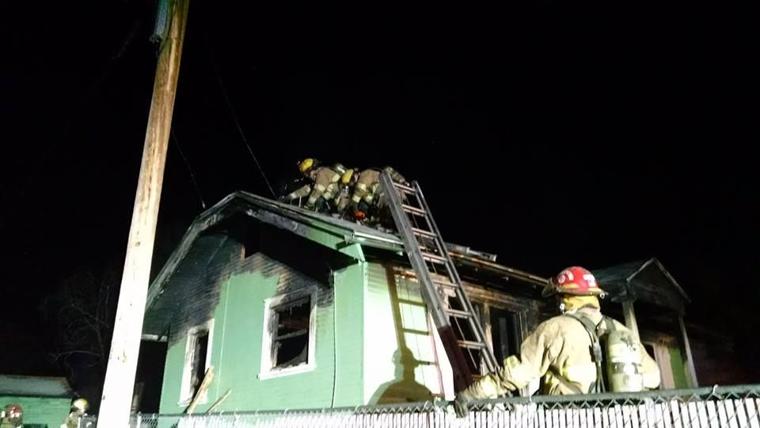
This structure in the 600 block of Mitchell Street was badly damaged in a Tuesday night fire. The cause was found to be accidental in nature.

Wyoming town burns in subzero temps


Wyoming town burns in subzero temps


 (AP Photo/Kate Wiltshire). This Wednesday, Dec. 31, 2014 photo provided by Kate Wiltshire shows the frozen remains of building after a raging fire that swept through Dubois, Wyo. on Tuesday night. Huge flames ripped through the historic buildings in th...


 (AP Photo/Kate Wiltshire). In this Tuesday, Dec. 30, 2014 photo provided by Kate Wiltshire, firefighters attack a raging fire in Dubois, Wyo. Huge flames ripped through historic buildings in the picturesque western Wyoming town as firefighters contende...


 (AP Photo/Kate Wiltshire). This Tuesday, Dec. 30, 2014 photo provided by Kate Wiltshire shows firefighters attack a raging fire in Dubois, Wyo. Huge flames ripped through historic buildings in the picturesque western Wyoming town as firefighters conte...

CHEYENNE, Wyo. (AP) - Huge flames ripped through historic buildings in the picturesque western Wyoming town of Dubois as firefighters contended with subzero temperatures that froze their hoses and other equipment.
Four buildings containing more than a dozen businesses were destroyed, but Mayor Twila Blakeman credited firefighters with keeping the flames from spreading even further.
"It was horrendous for them. They were, as usual, heroes," Blakeman said.
One destroyed building contained about 10 businesses. Also burned were a fly fishing shop and a gallery in the town of 1,000 that's tucked between the Wind River and Absaroka mountain ranges.
Christmas lights glowed cheerfully on businesses against a dramatic backdrop of flames leaping dozens of feet into the sky after the fire was reported around 8:30 p.m. Tuesday. Firefighters had to contend not only with the fire's brutal heat but nail-biting cold: Temperatures overnight got down to 25 below zero.
Residents of the town banded together to help business owners salvage what they could from shops in the flames' path, according to witness Kate Wiltshire, 45.

Wiltshire, the co-owner of the Turtle Ranch outside of town, said it was amazing to watch the town work together and the firefighters cope with the harsh conditions.
"It was a struggle for firefighters because their equipment was freezing up," Wiltshire said.

Firefighters became covered in ice as the water from their hoses froze, she said.
They had the flames under control by 5 a.m. Wednesday. The cause remained unknown and damage was still being assessed a
s firefighters mopped up the smoldering ruins Wednesday, Blakeman said.
Dubois is midway between Riverton and Jackson Hole in western Wyoming. The town is known as a gateway to western Wyoming's scenic wildernesses including Grand Teton and Yellowstone national parks.