MEC&F Expert Engineers

Monday, March 8, 2021

C&O Investigations: Buckled, Crowned or Cupped Hardwood FLOOR Claims


By Metropolitan Engineering, Consulting & Forensics

This past winter we had a lot of assignments dealing with damaged hardwood floors.  The insureds claimed that water from the winter storms caused the damages to the wooden floors. Cupping, buckling, and crowning are three common problems encountered in wood flooring damage claims. They are all caused by moisture changes in the wooden floor and the subfloor, assuming the floor was properly installed.  Incorrect expansion gaps and lack of vapor barrier are also very common reasons of hardwood floor buckling.

Wood will lose or gain moisture until it is in balance with this surrounding environment. Higher relative humidity (RH) usually causes the expansion of wood, because the wood absorbs the increased water moisture vapors from the air; lower RH usually causes wood to shrink as it releases the excessive water moisture vapors back into the air. Acclimation of hardwood floors to the jobsite, proper testing and control, before, during, and after the installation plays a very important role in the behavior of the hardwood floor. Many hardwood manufacturers suggest keeping the relative humidity of the home in the range of 40-55% after the installation to maintain the floor's original appearance. Not doing so will cause shrinkage, swelling (buckling) or other unpleasant surprises.

Cupping occurs when the edges of a board are higher than its center.  See schematic below.


Assuming the flooring has been properly installed, cupping can occur due to excessive moisture which causes the wood flooring to swell, crushing the boards together and deforming them at the edges. The board edges then “cup” due to excessive moisture content (MC) in the flooring. Once the cause of the moisture is identified and controlled, cupping can possibly be reversed.

Crowning is the opposite; the center of a board is higher than its edges. See sketch below.


This can occur when the surface of the floor encounters moisture or is left in wet or humid conditions for an extended period of time. Crowning may also occur due to previous floor cupping problems. If the floor is cupped, the floor should be given ample time to dry. If the floor is sanded while the boards remain cupped and moisture is still present, the sanding process can sand off the top edges of the board and thus, the edges are lower than the rest of the board when it returns to a normal MC.

Buckling occurs when wood flooring actually pulls away from its sub-floor, lifting up to several inches in one or more places.


Figure 1.  Buckled floor.  Here, our C&O investigation discovered significant moisture issues in the basement, mold growth throughout the basement and past water impacts.  We also determined that no vapor barrier was installed between the concrete floor and wooden floor and that the expansion gaps were insufficient for the size of the hardwood flooring, causing it buckle in several areas.  We opined that the recent winter storms did not cause the floors to buckle.

In addition to incorrect installation (e.g., inadequate expansion gaps), the most common reason that buckling occurs is excessive moisture or after a floor has been flooded for a period of time. Other causes on nailed floors might be insufficient nailing, incorrect nails or incorrect subfloor construction. On glued floors, use of incorrect or insufficient mastics to an inadequate mastic transfer, a subfloor separation or a subfloor contamination can cause buckling.

Improper Installation

Often times we see improper expansion gaps in hardwood floors.  Many installers use one quarter inch gaps for expansion at the walls; the 1/4" recommendation can sometimes cause problems for both hardwood and laminate floors. Expansion gaps are spaces left around the perimeter of rooms, against fixed objects such as columns, thresholds, hearths, baseboard, and other stationary items built or secured into the framing structure of the home. Even though wood flooring used is no longer living and breathing, it still reacts to moisture changes in the environment. The cells in the hardwood will take on or absorb moisture when the relative humidity is high, or when exposed to water. Expansion takes place across the grain or width of the plank. Conversely, when air moisture levels decrease, moisture content evaporates, shrinkage occurs.

Solid hardwoods by far, will expand and contract more than engineered products. How much will depend on the layout involved, seasonal change in relative humidity, specie selection, and type of hardwood cut. For smaller areas such as 10' x 12' rooms, leaving 3/8" expansion would be satisfactory. However getting into larger layouts over a few thousand square feet it would be wise to stay within the age old guideline of at least 3/4" on the perimeter.  At other times we see no vapor retarder between a concrete slab and wood flooring, as is recommended by the National Wood Flooring Association.  See NWFA Technical Publication No. C200, Problems, Causes and Cures of Hardwood Floors, 2002.

Based on the above discussion, there are quite a few causes of wooden floor damage: The home owner turning the air conditioning off and the RH rises to greater than 55%; the floor supplier delivering wet wood. The contractor / sub-contractor / installer not checking the concrete slab or the sub floor, contractor not acclimating the floor long enough, not installing the floor properly, and so on.

The C&O Investigation

After determining the facts regarding the history of the hardwood floor installation and maintenance, the next step of a C&O investigation is to identify the moisture source: high indoor RH, site drainage issues, crawlspace or basement moisture issues, a water spill, a leak from a dishwasher hose or a plumbing leak, etc.  Most insureds fail to recognize the importance of the moisture content in the actual subfloor. Without paying attention to it, an imbalance between the subfloor and wood flooring can cause unsightly effects with the most common being cupping. Both wood and concrete subfloors should not be exposed to excessive moisture. However, this is easier said than done, as we always observe significant issues with the moisture management around the building.  The main moisture “culprits” are listed below:

Culprit #1: Rain Gutters and Downspouts Discharging next to the Building Foundation

Improperly constructed and maintained rain gutters and downspouts are one of the leading problems of moisture intrusion into the building. Clogged gutters and downspouts from leaves and disconnected downspouts, are all factors that could allow water to discharge immediately next to the foundation. A downspout extension that delivers water away from the perimeter of the home is a simple form of moisture prevention.


Figure 2.  View of the rain gutter discharging immediately next to the crawl space, contributing to the moisture problem.

Culprit #2: Unventilated Crawl Spaces and Basements

A crawl space is an area below a wood subfloor or below the floor joists. The crawl spaces and high humidity basements account for a large number of wood floor problems. Proper water drainage and air ventilation must be available and the area be protected with thick plastic film to minimize air vapor affecting the sub base. Covering is one requirement, keeping moisture from collecting or forming in puddles on top is another. Excessive moisture in this area can also lead to mold growth on surrounding framing members. Poor drainage has been known to seep into crawl spaces as well. Another problem area with the crawl spaces is that many leaking utilities exist there, with the insured almost never inspecting the crawl space (out of sight, out of mind). On many occasions, the insured improperly discharges the dryer vent into this space, causing significant moisture problems (See Figure 3).

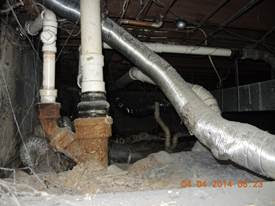


Figure 3:  View of an unventilated crawl space and the dryer vent pipe running through it.  Note the lack of a vapor barrier.  Also note the moisture impacts on the walls and bottom of the crawl space.  The damaged wooden floor is located immediately above this high moisture area.

Culprit #3: Improper Drainage

Many homes that are built on sloping surface face drainage issues, as the upgradient water is moving towards their home. Most modern homes and their developments take drainage into account when they are built. The problem arises when the insureds expand their homes, without taking site drainage into account.  On some occasions, the subsurface drains have been damaged by new construction or are clogged, and so on.  Thus, diversion of the water away from the building is not possible, leading into moisture problems inside the home.

Lack of diverting ground water away from the foundation creates a wick effect. Any standing or subsurface water has to go somewhere. If you find your home falls into this category after heavy rains or major snow melt, corrective measures should be taken. Depending on the circumstances it may be as simple as digging a few trenches or more complex, by installing a drain system.


Figure 4.  View of a rainwater accumulation area immediately outside the crawl space.  Note the settlement gap that also allowed rainwater to enter the crawlspace. This and several other areas around the building contributed to the moisture problem inside the crawlspace.

Many other areas of moisture intrusion into the building exist: sprinklers that deliver too much water close to the building, window wells receiving rain water, unsealed foundation walls, settlement around the building, and so on.  Unless these moisture sources are checked, they can enter the building basement or crawlspace and adversely affect the subfloor and the wooden floor.

Metropolitan Engineering, Consulting & Forensics (MECF)

Providing Competent, Expert and Objective Investigative Engineering and Consulting Services

P.O. Box 520

Tenafly, NJ 07670-0520

Tel.: (201)293-6064

E-mail: metroforensics@gmail.com

Web pages:  https://sites.google.com/site/metropolitanenvironmental/

To unsubscribe from future technical blogs and announcements, please reply to this email with the word “unsubscribe” in the subject line.


Metropolitan appreciates your business.

Feel free to recommend our services to your friends and colleagues.

We know you need to process damage claims quickly and knowing the facts is now faster than ever – within 24 hours of site visit.  Our Pegasos Forensic Investigation Services (PFIS) feature:

·                 Expert Forensic Investigators on-site.

·                 Defensible, Readable, Conclusive Reports.

·                 Fixed-Prices starting at $499 per chimney or roof inspection (volume discounts are also available).  Flood loss assessments start at $999.0.  HVAC equipment only inspections start at $299 for local (within one hour one-way drive) assignments.

·                 10-State Coverage Area.

Metropolitan has extensive experience assisting in the evaluation of environmental factors. Our Certified Industrial Hygienists and Registered Professional Engineers have performed IAQ testing, mold testing, Chinese drywall corrosion investigations, water source evaluation and remediation design and oversight.

We perform Property Condition Assessments, Indoor Air Quality Evaluations and Environmental Site Assessments, including Indoor Air Quality

C&O INVESTIGATIONS: LIGHTNING OR POWER SURGE DAMAGE TO HVAC AND OTHER EQUIPMENT, Part II


This time of the year we are often being asked to provide forensic investigations regarding the cause and origin of damages to HVAC system or individual component(s).  This is Part II of the HVAC damage claims blog; it addresses the typical causes of damage associated with HVAC systems.  Claims dealing with theft of the copper wiring of these units as well as excessive replacement costs are certainly on the rise. 

There are a number of components in an HVAC system that can fail, including the compressor, the condenser fan, the air handler blower, the refrigerant copper piping, the air filter, the evaporator coils, and so on.  When it comes to damages caused by an insured peril such as lightning, the most common damage we have seen is damage to the electronics and the air compressor.

Typical Problems

We often see problems associated with contamination of the refrigerant, especially the mixing of the R22 with the R410 refrigerants.  Other problems include, but are not limited to, corroded or loose terminal connections, high refrigerant pressure, refrigerant leaks, failed electronic controls and sensors, worn out internal components of the compressor, bad electric and mechanical installation, failed fans, a short to ground in the fan motor or a short to ground in the fan motor wires that lead to the motor, and so on.  Over time, low refrigerant levels can cause overheating and premature failure of the compressor, often requiring complete replacement of the compressor or the entire condensing unit.  The electronic controls and sensor that cause the air conditioner, fan and condenser to kick off and on properly, are often the first components to go.  Sometimes these sensors are merely knocked out of position causing the air conditioner to cycle constantly or behave erratically.

The Refrigerant Charge Problem Is Widespread

In a recent study, for Arizona Public Service, heat pump or air conditioner systems were tested for their refrigerant level.  The study results are indicated in the graph below.  Only eighteen (18%) percent of all the units were properly charged (green bar).  Seventy-eight (78%) percent of the units were under charged (yellow-red bars).  While four (4%) percent were over charged (red).  These results are consistent with previous industry research, from new home construction studies in California, Long Island and elsewhere.


The heart of the HVAC unit is the compressor, which is cooled by the refrigerant.  Over time, low refrigerant levels can cause overheating and premature failure of the compressor, often requiring complete replacement of the compressor or the entire condensing unit.

__________________________________________________________________

Did you know that most air conditioning compressor failures are caused by loss of lubricant and/or refrigerant?  Older systems, especially before 2006 were connected with mechanical flare fittings that can rattle loose due to vibration of the system with leaks resulting.  Most new units are welded at their connection points, reducing the chance for leaks to occur.

__________________________________________________________________

Misconceptions about Cause of Failure

During the first step of our investigation we interview the insured and any witnesses to the damage.  Witnesses typically tell us that they heard a sound and that they saw sparks and smoke coming out of the equipment; at other times they state that the compressor worked just before the storm and then it stopped working.  Even the HVAC repair technicians many times state that the oil was black or that the insulation was burned or the terminal was blown.  They then assume that a lightning hit the unit without performing an investigation into the actual mode of failure.

An electric failure does not necessarily cause mechanical failure of the equipment.  On the other hand, a mechanical failure (a broken valve, worn bearing, blocked coils, rusty terminals, etc.) may have been the cause of an electrical failure.  Thus, if the motor windings are electrically sound, then the compressor was not damaged by a surge voltage or lightning stroke.

The often heard statement “the blackened acidic oil indicates the motor was damaged by a lightning stroke” is also false.  The compressor oil will blacken and form an acid only when the oil is exposed to excessive heat for an extended period of time.  Overheating of the motor-compressor unit is the most frequent symptom of system problems.  The heating and charring of motor winding insulation causes a chemical breakdown that combines with the oil.  This will then blacken the oil and form an acid.  When a motor fails as a result of a surge voltage or lightning stroke, the oil is normally in a like-new condition.  A surge voltage or lightning strike occurs in an extremely short period of time which does not allow enough time for the oil to blacken and turn acidic.  Thus, if the refrigerant oil is burnt or acidic there is a good chance that the damage is not lightning/power surge related.  It should also be noted that burnt or acidic refrigerant oil does not require the replacement of the entire system as is commonly stated.

Another misconception about lightning is that it can damage a motor-compressor unit even if the equipment is turned off during a storm.  If a surge voltage or lightning stroke has enough voltage to gap the open contacts on the main contactor, then there will be damage to various other components in the air-conditioner and possibly to the building’s entire electrical system.  Therefore, the insulation melts and could possibly start a fire before the air-conditioner is damaged.

Dirty Condenser Coils or Fan will lead to Premature Failure

Air Conditioner or Heat Pump Condenser Coils, if are not cleaned regularly, can get plugged up by dust, dirt, pollen, grass, and other foreign debris.  See Figure 1.


Figure 1.  Dirty condenser coil that led to seizure of the fan and compressor.  Power surge was not the cause of this loss.  It was caused by lack of regular maintenance.

Sometimes these obstructions to the flow of air are not seen by just looking at the condenser; the interior of the condenser must be opened up and examined very carefully.  Problems caused by this condition:

·       Unit loses the ability to remove heat from the system.

·       Results in higher pressures in the condenser which causes the compressor to pull higher amps.

·       Higher amp draw means more stress on the motors, overheating of the motor, and potentially leading to premature failure.

·       At other times we observe that the outdoor fan is not running; this could be caused by a damaged capacitor, bent fan blades of fan motor failure.  Wear & tear is the most common reason for a failing exterior fan.  Another common reason for failure is the accumulation of dirt and debris on the fan blades, and loose or corroded terminals and contactors, i.e., lack of regular maintenance.

·       Lack of adequate air flow through the condenser causes the condenser fan motor to run hotter than normal and the compressor to run hotter because of the higher load conditions; all these lead to premature failure of these components.  Most of the time, the HVAC tech will state that power surge caused the damage to the equipment.

Loose or Corroded Terminal Problems will also lead to Failure

Problems with loose or rusted terminal pins are also a common cause of AC compressor failure.   See Figure 2.  If the terminal pins are loose or “blown” on a compressor, then the compressor will need to be replaced.  However, pin failure does not indicate damage by a surge voltage or lightning stroke.  The most likely cause of a burned electrical terminal on a compressor is a loose electrical connection.  This loose connection causes a buildup of heat and results in a burned terminal. 

Rusty terminal connections also create the same low voltage condition as loose terminal pins.  When a low voltage condition occurs, the motor will slowly fail.  This low voltage condition also causes even higher heat to develop at the terminal pin connection causing even greater rust.  This results in additional disintegration of the connection and causes low voltage to be supplied to the motor which eventually causes the motor to fail or the terminal pin(s) to become dislodged.

________________________________________________________________________

Did you know that repeat compressor failures are usually due to system ­contamination (sludge or metallic particles from a previous compressor failure)?

________________________________________________________________________

It is possible to have damaged pins due a lightning strike, but this is limited to situations where the lighting strike damage is severe.  In these cases there is a lot of other evidence of a lightning strike.  The condenser fan motor or other electrical components of the system will have been damaged.  The wires are burnt and there is evidence of arc marks to the cabinet where the wires run close to the cabinet.  There is also considerable damage to other motors and appliances as well as to the electric panel.


Figure 2.  Burned compressor plug due to defective (loose) connection to the compressor.  Initially the HVAC techs claimed that this was caused by power surge.  However, there was no other evidence (storms, lightning, utility reports, etc.) to support that claim.  A power surge big enough to do that damage to the compressor plug would have damaged the whole control section, capacitor, contactor and most of the wiring.  No such evidence was observed during our investigation.

In case of any equipment or HVAC compressor-related problem, it is important to identify the root cause, without jumping to the conclusion that the equipment was damaged by lightning or power surge.  If the compressor is replaced without attending to the root cause, the replaced compressor surely will also fail.

Metropolitan Engineering, Consulting & Forensics (MECF)

Providing Competent, Expert and Objective Investigative Engineering and Consulting Services

P.O. Box 520

Tenafly, NJ 07670-0520

Tel: (201)293-6064

E-mail: metroforensics@gmail.com

Web pages:  https://sites.google.com/site/metropolitanenvironmental/

To unsubscribe from future technical blogs and announcements, please reply to this email with the word “unsubscribe” in the subject line.


Metropolitan appreciates your business.

Feel free to recommend our services to your friends and colleagues.

We know you need to process damage claims quickly and knowing the facts is now faster than ever – within 24 hours of site visit.  Our Pegasos Forensic Investigation Services (PFIS) feature:

·       Expert Forensic Investigators on-site.

·       Defensible, Readable, Conclusive Reports.

·       Fixed-Prices starting at $499 per chimney or roof inspection (volume discounts are also available).  Flood loss assessments start at $999.0.  HVAC equipment only inspections start at $299 for local (within one hour one-way drive) assignments.

·       10-State Coverage Area.

Metropolitan has extensive experience assisting in the evaluation of environmental factors. Our Certified Industrial Hygienists and Registered Professional Engineers have performed IAQ testing, mold testing, Chinese drywall corrosion investigations, water source evaluation and remediation design and oversight.

We perform Property Condition Assessments, Indoor Air Quality Evaluations and Environmental Site Assessments, including Indoor Air Quality

Saturday, March 6, 2021

THOUSANDS MORE SPEEDING DRIVERS DIE AND KILL OTHER DRIVERS DURING THE PANDEMIC


Early Estimate of Motor Vehicle Traffic Fatalities for the First 9 Months (Jan–Sep) of 2020

A statistical projection of traffic fatalities for the first 9 months of 2020 shows that an estimated 28,190 people died in motor vehicle traffic crashes. This represents an increase of about 4.6 percent as compared to 26,941 fatalities reported to have occurred in the first 9 months of 2019, as shown in Table 1. Preliminary data reported by the Federal Highway Administration (FHWA) shows that vehicle miles traveled (VMT) in the first 9 months of 2020 decreased by about 355.5 billion miles, or about a 14.5-percent decrease. Also shown in Table 1 are the fatality rates per 100 million VMT, by quarter. The fatality rate for the first 9 months of 2020 increased to 1.35 fatalities per 100 million VMT, up from the 1.10 fatalities per 100 million VMT in the first 9 months of 2019. The counts for 2019 and 2020 and the ensuing per-centage change from 2019 to 2020 will be further revised as the final FARS files for 2019 are available next year. These estimates may be further refined when the projections for the whole of 2020 are released in late April 2021

The number of people killed on the nation’s highways rose 4.6% in the first nine months of 2020 despite coronavirus lockdowns that curtailed driving early in the year.

The National Highway Traffic Safety Administration estimates that 28,190 people died in traffic crashes from January through September of last year, up from 26,941 in the same period of 2019. Final statistics for the full year won’t come out until fall.


Authorities blamed the increase on risky driving behavior that developed when there were few vehicles on the road early in the pandemic.

“Preliminary data tells us that during the national health emergency, fewer Americans drove, but those who did took more risks and had more fatal crashes,” the safety agency said in a letter addressed to the nation’s drivers.

Traffic deaths rose 0.6% during the first-quarter of 2020, but they fell 1.1% in the second quarter as coronavirus lockdowns restricted movement. Fatalities spiked 13.1% from July through September, the agency said.

“We think the big culprit is speeding,” said Jonathan Adkins, executive director of the Governors Highway Safety Association. Early in the pandemic, drivers found open roads and drove faster. The behavior continued even as traffic volumes recovered, Adkins said.

“A big factor here is the lack of enforcement. We are hearing from many states that traffic stops have declined during COVID-19. Drivers feel like they can speed and get away with it,” he said.

NHTSA said recent reports show a 22% increase in vehicle speeds in several metropolitan areas over pre-pandemic numbers. Also, a study found that 65% of drivers treated at trauma centers who were hurt in serious crashes had drugs or alcohol in their systems last year. It was 50.6% before the pandemic, NHTSA said. The agency also said fewer people are wearing seat belts.

The agency is telling people not to drive under the influence of drugs or alcohol, to wear seat belts and to reduce their speeds in order to stay safe. It also says people should make sure their children are in the proper car seat for their size.