The information in this report is preliminary and will be supplemented or corrected during the course of the investigation.
On Thursday, March 15, 2018, about 1:47 p.m. eastern daylight time, a
partially constructed pedestrian bridge crossing SW 8th Street—an
eight-lane roadway—in Miami, Florida, experienced a structural
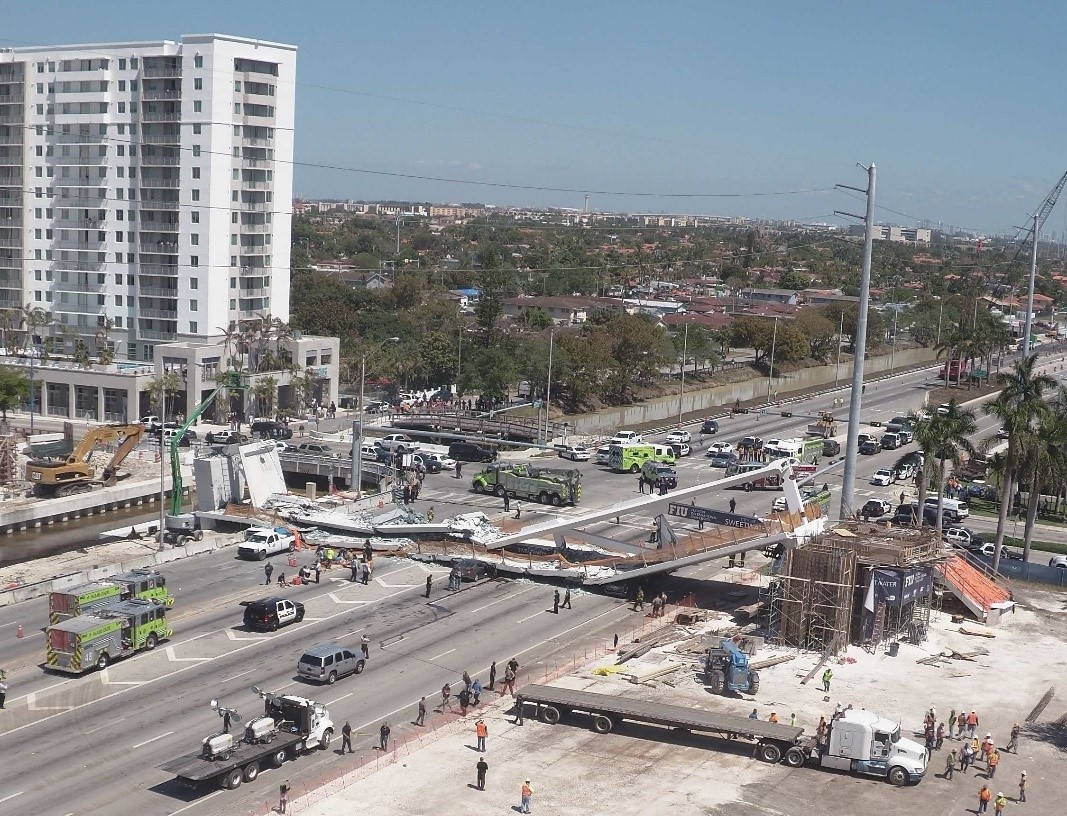
failure.[1] As a result, the 174-foot-long bridge fell about 18.5 feet
onto SW 8th Street (figure 1). Eight vehicles that were stopped below
the bridge at the time of the collapse were fully or partially crushed;
seven of those vehicles were occupied. As a result of the bridge
collapse, one bridge worker and five vehicle occupants died. Four bridge
workers and four other people were injured.
Figure 1. View of collapsed pedestrian bridge. (Source: Florida International University)
The bridge was to be completed by early 2019 and was built using an
accelerated bridge construction method—a technique intended to minimize
disruption of traffic. On March 10, 2018, the walkway, diagonals, and
canopy comprising the bridge, which had been built in a lot adjacent to
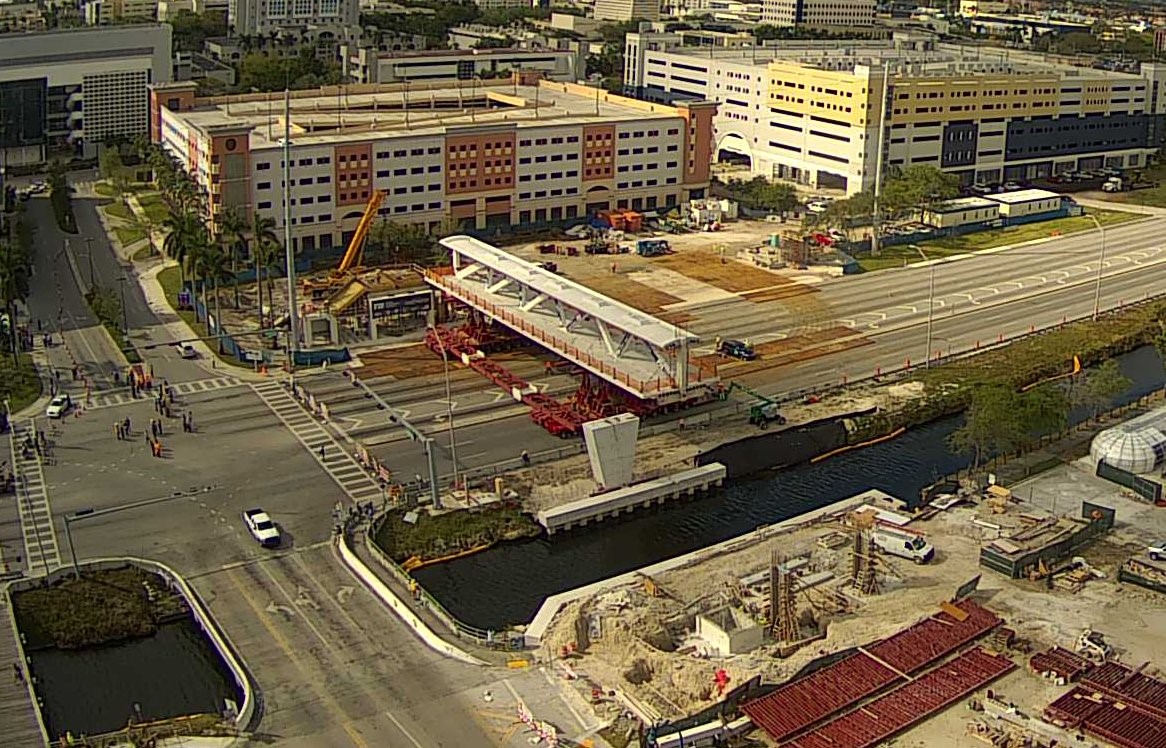
SW 8th Street, was moved from the lot, using transporters, into position
across the roadway and then lowered onto bridge piers on either side of
the roadway (figure 2).[2] Traffic on SW 8th Street was detoured
during the installation period, and the entire roadway was closed to
facilitate movement of the structure.
Figure 2. View of transporters moving the pedestrian bridge into place on the bridge piers.
(Source: Florida International University)
On March 10 per the bridge design plans, construction crew members
de-tensioned the bridge diagonal members on the north and south ends of
the bridge. When the collapse occurred on March 15, a construction crew
was positioned on the structure working on re-tensioning the number 11
diagonal member connecting the canopy and the deck at the north end of
the bridge. Because a crane was being used for this work, two of the
three westbound lanes below the north end of the bridge were closed to
traffic; however, the five eastbound lanes remained open, and eastbound
traffic was not detoured.
The NTSB is evaluating the bridge design, the construction process,
and the construction materials. In addition, the NTSB is evaluating the
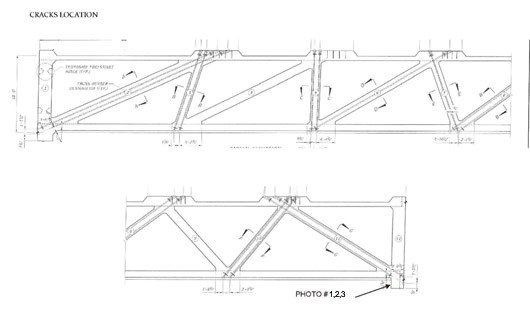
emergence of cracks in the region of diagonal members 2 (south end of
the bridge) and 11 (north end of bridge), see figure 3, and the
propagation of cracks in the region of diagonal member 11. Photographic
documentation from February 24, 2018 shows cracks in the region of
diagonal member 11 (figure 4).
Figure 3. Elevation view of the pedestrian bridge.
(Source: Bolton-Perez and Associates Consulting Engineers)
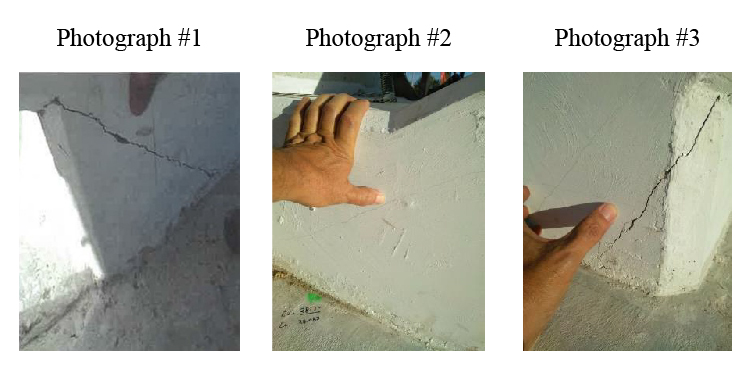
Figure 4. Photographic documentation of the crack in the region of bridge diagonal 11.
(Source: Bolton-Perez and Associates Consulting Engineers)
In the next month, the NTSB will be conducting additional forensic
examination of several bridge structural components and destructive
testing of multiple core and steel samples. All aspects of the collapse
remain under investigation while the NTSB determines the probable cause,
with the intent of issuing safety recommendations to prevent similar
events.
Assisting in the NTSB investigation are the following Party Members;
- Federal Highway Administration (FHWA)
- FHWA - Turner Fairbank Highway Research Center (TFHRC
- Occupational Health and Safety Administration (OSHA)
- Department of Transportation Office of the Inspector General (OIG)
- Florida Department of Transportation (FDOT)
- Miami-Dade Police Department (MDPD)
- Florida Highway Patrol (FHP)
- Florida International University (FIU)
- City of Sweetwater (CS)
- FIGG Bridge Engineers, Inc. (FIGG)
- Munilla Construction Management (MCM)
- Structural Technologies, LLC (VSL)
- Barnhart Crane & Rigging (BCR)
1. The eight-lane roadway consisted of four through travel lanes and
one left turn lane in the eastbound direction, and three through travel
lanes in the westbound direction.
2. “Transporters” are devices designed to move the structure into place.