MEC&F Expert Engineers

Friday, November 3, 2017

Jersey City police officers, Lt. Leith Ludwig, MD Khan, Eric Kosinski and Francisco Rodriguez have been indicted, including two for attempted murder, after they were caught on camera kicking innocent driver Miguel Feliz on fire as he crawled from the burning wreckage of a crash involving a pursuit suspect


JERSEY CITY, N.J. — A group of New Jersey police officers have been indicted, including two for attempted murder, after they were caught on camera kicking a bystander as he crawled from the burning wreckage of a crash involving a pursuit suspect, the Hudson County prosecutor announced Thursday.
The officers face a slew of charges each:
  • Lt. Leith Ludwig has been charged with two counts of aggravated assault and one count of official misconduct.
  • MD Khan has been charged with 13 counts, including attempted murder, aggravated assault, official misconduct and possession of a weapon for an unlawful purpose.
  • Officer Eric Kosinski has been charged with five counts, including attempted murder, aggravated assault and official misconduct.
  • Officer Francisco Rodriguez has been charged with four counts, including aggravated assault, official misconduct and possession of a weapon for an unlawful purpose.
Prosecutors say the officers began chasing Leo Pinkston shortly after 11 p.m. on June 4 near Ocean and Cator avenues in Jersey City after the driver failed to stop for them.

During the pursuit, Pinkston, 48, tried to drive between two lanes of traffic and hit several cars. Officers fired multiple shots at his car, prosecutors said.
Pinkston crashed into another car then collided with a utility pole on Tonnelle Avenue, sparking a fire and hurting the other driver.

That's when the second driver, on fire, crawled away from the wreckage -- and was kicked by the officers, cellphone video shows.

At the time, Jersey City Mayor Steve Fulop called for the officers' termination.
On Thursday, Fulop released this statement:
"As we stated at the outset, the actions taken that night required serious investigation. We took immediate and appropriate action and will now abide the judicial process. Our internal investigation will now begin into all the actions or inactions of department members that night. We want the community to continue to have full confidence in the Jersey City Police Department and its officers."
Pinkston, the driver who police were chasing, was indicted on Aug. 23.
He faces multiple charges, including aggravated assault while eluding and aggravated assault by auto, prosecutors said. He's expected to be in court again on Dec. 11.

==================


Four Jersey City police officers have been indicted on charges ranging from aggravated assault to attempted murder, prosecutors said Thursday, months after shocking video emerged showing them kicking and dragging a flaming bystander following a car chase and fiery crash.

Hudson County Prosecutor Esther Suarez said that a grand jury had returned an indictment against Lt. Keith Ludwig, MD Khan and officers Eric Kosinski and Francisco Rodriguez in the case of the June 4 beatdown.

All are charged with aggravated assault and official misconduct. All but Ludwig are accused of possessing a weapon for an unlawful purpose, and Kosinski and Khan face charges of attempted murder.

Officers had been trying to stop a vehicle near Ocean and Cator avenues in Jersey City late that night; the driver, Leo Pinkston, fled and the cops gave chase. Pinkston was involved in a number of crashes during the pursuit, and multiple shots were fired. Eventually, he crashed into a vehicle on Tonnelle Avenue, leading to a collision with a utility pole that sparked a major fire and injured the driver of the other vehicle, bystander Miguel Feliz.


When Feliz got out of his car, the four Jersey City officers descended on him, kicking and dragging him in apparent belief he was the man they had been chasing. The June 4 video showed Miguel Feliz, on fire, exiting his car before being kicked by the officers. Feliz was hospitalized in critical condition with severe burns and broken ribs after the encounter, his family said.

The four officers were suspended in late June, then had their jobs reinstated, though they were on administrative duty, not active patrol. Jersey City spokeswoman Jennifer Morrill told NorthJersey.com at the time that federal investigators had asked the department not to bring departmental charges against the men pending a federal investigation.

Attorney information for the officers wasn't immediately available. Previously, a union representative had said they were trying to put the flames out and pull Feliz to safety. At the time, Jersey City Mayor Steven Fulop said the video appeared to contradict that claim and demanded he be fired.

Pinkston also faces a number of charges in connection with the pursuit.


Under California law, if it turns out that any PG&E equipment provided a spark, the company can be responsible for damages -- even if it did everything by the book. Negligence isn’t required.


The 911 calls began before midnight, with reports of downed power lines and exploding transformers. What would swiftly grow into the deadliest wildfires in California history were ablaze -- and fingers were soon pointing at PG&E Corp.
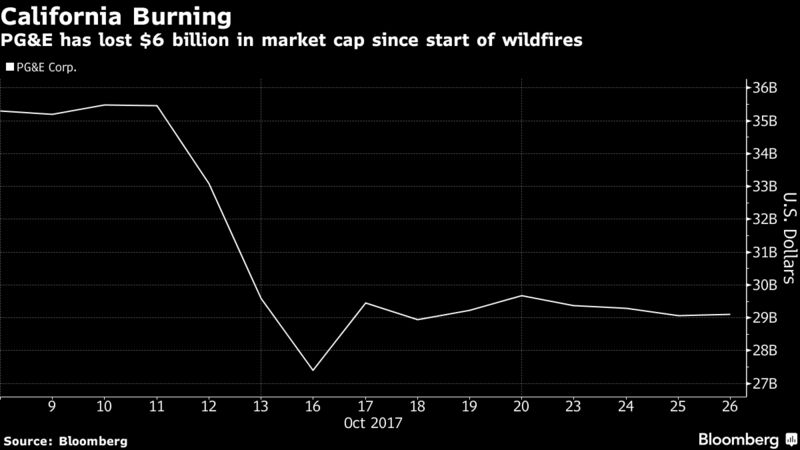
Investigators may never be able to determine what ignited the wine country fires, but PG&E, one of the nation’s largest utilities, is struggling to fend off catastrophe anyway. The mere suggestion its equipment might be to blame was enough to send shares tumbling, wiping out about $6 billion in value. The stock was trading at $57.06 Friday, down 17 percent since Oct. 9, the first trading day after the fires started.
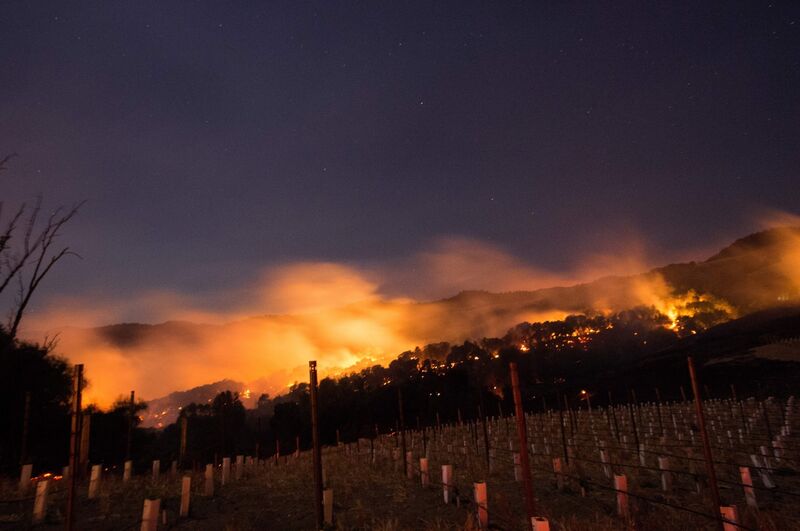
Fire glows on a hillside in Napa, California on Oct. 9.
Photographer: Josh Edelson/AFP via Getty Images
One reason: Under California law, if it turns out that any PG&E gear provided a spark, the company can be responsible for damages -- even if it did everything by the book. Negligence isn’t required.

Investors are spooked, said Deutsche Bank Securities Inc. analyst Jonathan Arnold. “Why would they continue providing capital to a private utility if that utility could be held liable for property damage in a major catastrophe regardless of finding of fault in their operations?”

And if PG&E is found to be directly at fault? Bad blood between the state and its largest power provider runs deep, with the utility cited in previous wildfires and still under review for a 2010 natural-gas pipeline explosion that killed eight people. One legislator has already demanded regulators disband it if its carelessness or neglect is discovered to be the culprit.

“The patience level of California is very low” with PG&E, said Shahriar Pourreza, a Guggenheim Securities analyst. “It’s not outside the realm of reason to see a situation where the utility is broken up, sold or taken private.”

Investors began dumping the San Francisco-based company’s stock on Oct. 12. The first lawsuit came five days later, filed by a Santa Rosa couple who lost their home and contend PG&E failed to maintain and inspect transmission lines.

‘Extreme Gusts’

The suit claims PG&E equipment “came in contact with vegetation and caused a wildfire,” without specifying when or where.

The trigger is what the California Public Utilities Commission and the California Department of Forestry and Fire Prevention, known as Cal Fire, are probing. The PUC on Wednesday expanded to eight counties from three the scope of its directive that PG&E “preserve all evidence” in the fires’ paths, and increased the number of wildfires to 15 from seven.
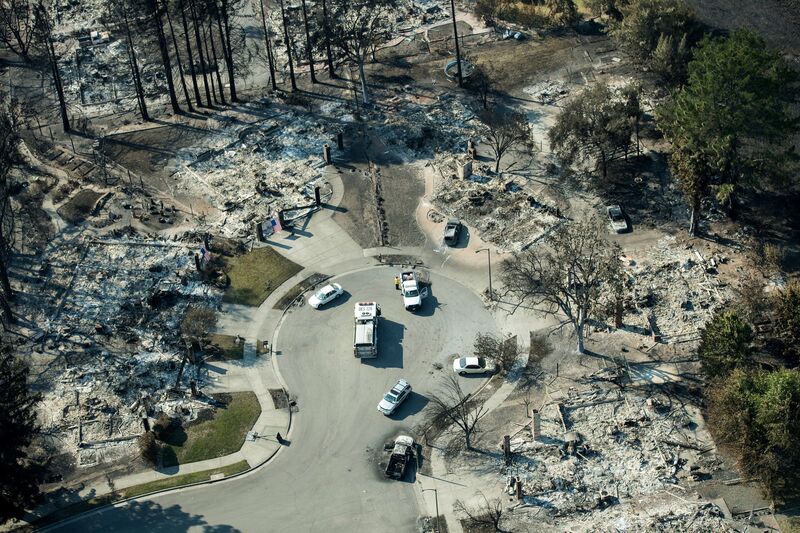
Homes destroyed by wildfires in Santa Rosa on Oct. 12.
Photographer: David Paul Morris/Bloomberg
While investigators are looking at power-line failures as a possible agent, “they may never sort it out,” Michael Picker, the PUC president, said last week. There may simply not be enough evidence left in the wake of ferocious flames that consumed more than 245,000 acres and claimed 42 lives.

PG&E has said it won’t speculate about what set the multiple conflagrations off. “What caused them? The simple answer is we don’t know yet,” Chief Executive Officer Geisha Williams wrote in an op-ed for the San Francisco Chronicle. She did note, though, that there were “extreme gusts” of wind in Northern California and quoted a Cal Fire official who said winds contributed to the worst “fire event” in his 30-year career.

The company said Friday it was making some billing changes to help support fire victims, waiving deposits for those seeking to re-establish service and suspending collections.
PG&E equipment has been implicated in previous wildfires. Two weeks ago, Cal Fire sued the utility to recover $3.9 million spent containing a 670-acre blaze near Hollister in 2015 that was allegedly ignited when an insulator with a live line broke off a power pole.

The company was found guilty of criminal negligence in a 1994 blaze in the Sierra Nevada, for failing to trim trees near power lines. It was fined $8.3 million for not maintaining a line that sparked the Butte Fire in 2015, which killed two people; a judge in a lawsuit in that fire said the utility couldn’t escape responsibility for damages because of the inherent danger of transmitting electric power near trees, and it didn’t matter how much effort PG&E put into vegetation management.

But the disaster most damaging to PG&E’s reputation in California was no doubt the deadly pipeline explosion in San Bruno seven years ago. Regulators imposed fines of $1.6 billion, and PG&E was found guilty in federal court of safety violations. When the state was weighing an even larger $2.25 billion penalty, then-CEO Tony Earley warned that such a cost could push the company to the brink of bankruptcy.

Now with the wine country fires, Pourreza said, “they are facing a situation here that could turn out to be worse than San Bruno.”

==================


PG&E shares plunge on concern its power lines may have started California wildfires


The California Public Utilities Commission sent a letter on Thursday to PG&E reminding them to preserve "all evidence with respect to the Northern California wildfires in Napa, Sonoma and Solano Counties," according to multiple reports.
The commission was investigating whether electrical lines that were knocked down by a windstorm on Sunday played a role in sparking the most lethal wildfire event in the state's history.


October 2017 CNBC.com


Eric Risberg | AP
A Pacific Gas and Electric crew works at restoring power along the Old Redwood Highway Wednesday, Oct. 11, 2017, in Santa Rosa, Calif.

Shares of electric utility company PG&E plunged 7.7 percent Friday on concerns its power lines may have started the massive wildfires that have ravaged California recently.

The stock was also on track for its worst day since September 2010.


The California Public Utilities Commission sent a letter on Thursday to PG&E — California's largest electrical utility company — reminding them to preserve "all evidence with respect to the Northern California wildfires in Napa, Sonoma and Solano Counties," according to multiple reports.

The commission was investigating whether electrical lines that were knocked down by a windstorm on Sunday played a role in sparking the most lethal wildfire event in the state's history.

"Safety is our top priority," said Donald Cutler, a spokesperson for PG&E. "Our customers are our neighbors and friends and we're doing everything we can to help out."

Unfortunately, California has a history of power company lines becoming the sources of fires. It is still not clear if PG&E was to blame for the fires, but it has been found guilty before of negligence in fires.

Past fires where PG&E was faulted include the deadly Butte Fire in California's Amador County in 2015. Cal Fire investigated the fire, which destroyed 549 homes, and ended up sending a bill to PG&E for about $90 million to cover firefighting expenses.

In 2007, the Malibu fires that burned more than a dozen structures were caused by Southern California Edison utility poles that fell during heavy winds; they paid $63.5 million in fines. Also, San Diego Gas & Electric power lines started three major fires the same year and paid nearly $700 million to insurers to settle claims.

PG&E shares are down 13 percent this week.

The drop in the stock "reflects the following assumptions: 1) the fire was caused by PCG's negligence, 2) insurance coverage for 3rd party liabilities will be very limited, 3) damage costs per acre far larger than those for the 2015 Butte fire and 4) material fines and penalties will be assessed," Christopher Turnure, an analyst at JPMorgan, said in a note Thursday. "We appreciate the severity of the fires and the legal challenges of operating in California, but estimate this loss of value as approaching a worst-case scenario for PCG shares."

PCG is the stock ticker for PG&E.

Turnure is maintaining his overweight rating on the stock on the notion these fears are overblown.

The wildfire has killed at least 31 people in Northern California and has left hundreds missing in the heart of wine country. The toll from the more than 20 fires raging across eight counties could climb, with more than 400 people in Sonoma County alone still listed as missing.

The Coast Guard reminds commercial fishing vessel operators to be aware of the dangers of icing and vessel stability as the winter fishing season gets underway across Alaska.


Coast Guard reminds icing dangers, vessel stability for winter fishing season in Alaska
November 2nd, 2017


Coast Guard file photo showing fishing vessel Mar-Gun grounded on the north end of St. George Island. North winds and below freezing temperatures caused icing on the vessel. (photo by MST2 Gerald Holle)

JUNEAU, Alaska –The Coast Guard reminds commercial fishing vessel operators to be aware of the dangers of icing and vessel stability as the winter fishing season gets underway across Alaska.

A vessel’s center of gravity can rapidly rise when freezing spray accumulates high above the main deck. Icing conditions exceeding 1.3 inches increase the risk of capsizing and sinking.

Operators should use all available resources to determine if icing and freezing spray is forecast in their location for the next 48 to 72-hour time window. If icing conditions are forecast or present, operators should seek shelter, reduce speed, change course and manually remove ice. Operators should also consider reducing the amount of bait, gear and pots onboard the vessel prior to departure.

Vessel owners, operators and crews are advised to give special consideration to vessel stability concerns after multiple fatalities and complete loss of the fishing vessel Destination occurred in the Bering Sea Feb. 11, 2017.

“The amount of ice can change in an instant depending on a number of variables such as loaded condition and freezing spray,” said Anthony Wilwert, Fishing Vessel Safety Coordinator for the 17th Coast Guard District. “Some ways to mitigate ice build up on a vessel include slowing speed, changing heading and tarping deck loads to shed water. Boaters should also remain diligent about monitoring weather forecasts and staying out of icing conditions in the first place.”

Operators and crew should seek out opportunities to further their knowledge of stability with courses, training, workshops and visits from naval architects. They should also take advantage of other initiatives, both mandatory and voluntary, to discuss and complete a vessel’s current Stability Instructions to the actual load condition prior to departing port. An independent review of a vessel’s loaded condition, equipment and operations can often provide important insights.

Operators should confirm the accuracy of their SI whenever a vessel undergoes any of the following actions:

Major conversions or substantial alterations (See 46 CFR 28.50 and 28.501);

Changes to a vessel’s rigging, deck or fishing equipment, including pots;

Changes in principal dimensions, cargo hold or tank capacities;

Circumstances of weight creep, which is the accumulation of extra gear, equipment and parts carried aboard the vessel, and any other weight change variations that may occur.

Thursday, November 2, 2017

Worker Derek Mesenbring, 31, died after he was exposed to methyl bromide at Industrial Fumigant Co., a Chicago Ridge chemical plant


Bourbonnais Man Dies From Possible Pesticide Exposure In Chicago Ridge

Chicago Ridge police and OSHA investigating chemical company after Bourbonnais man dies of possible exposure to methyl bromide.
 

By Lorraine Swanson (Patch Staff) - 

Updated Oct 26, 2017 12:26 am ET


CHICAGO RIDGE, IL -- A Bourbonnais man died after he was exposed to methyl bromide at a Chicago Ridge chemical plant. Derek Mesenbring, 31, was at work when he began feeling ill on Monday afternoon. He was taken to Palos Community Hospital, where he passed away early the next morning. An autopsy is pending at the Cook County Medical Examiner's office.

Around 4:32 p.m. Monday, Mesenbring's wife called the Chicago Ridge Police Department and asked them to check up on her husband at Industrial Fumigant Co., a company that provides pest management and sanitation solution services. Police said the wife had spoken to her husband earlier, who complained he wasn't feeling well.

When officers arrived at 6663 99th St, Chicago Ridge, they saw Mesenbring's car parked in the lot. The building was also secured. Officers were able to get into the building, where they found Mesenbring in distress, police said in a news release. The man was taken to Palos Community Hospital in Palos Hills,

The hospital went on a hazmat watch after learning that the Bourbonnais man had been exposed to insecticide. Chicago Ridge's police officers and fire personnel were sent back to the hospital for evaluations for the possible exposure to the chemical. Police said the first responders did not show any signs of toxic exposure.

Methyl bromide is an airborne toxicant. Once ventilated, it no longer poses a threat. The Chicago Ridge Fire Department ventilated the building and it returned to a safe level. Chicago Ridge police are cooperating with OSHA in an ongoing investigation.

Demolition workers without proper fire-safety training started and accidentally spread the fire that raged for several hours at an abandoned Georgia-Pacific plywood mill in south Arkansas this weekend


Fire at plywood mill blamed on errors

By Emily Walkenhorst

Posted: November 2, 2017 at 1:01 a.m.


Demolition workers without proper fire-safety training started and accidentally spread the fire that raged for several hours at an abandoned plywood mill in south Arkansas this weekend, Crossett Fire Chief Bo Higginbotham said Tuesday.

Debris from the fire, which included insulation from the mill’s roof, remained spread across parts of Crossett on Tuesday afternoon, three days after the blaze.

Crews have been picking up insulation since Saturday afternoon, said Jennifer King, a spokesman for Georgia-Pacific, which owns the mill. Much of the insulation was caught in trees and has been blown by the wind onto the ground, she said.

The fire started about 9:30 a.m. Saturday before being contained by 4 p.m. and then put out, according to a report from the Crossett Fire Department. The fire prompted a response from numerous departments, the closure of U.S. 82 and the evacuation of nearby businesses.

On Tuesday, officials ended their investigation of the cause of the fire at the mill, which has not been in operation since 2011 and was being torn down.

On Saturday morning, workers for Houston-based GSD Cos., Georgia-Pacific’s demolition contractor, were using cutting torches and ignited a pile of wood debris, Higginbotham said. They then took a 500-gallon water tank that was on site and sprayed directly at the fire, extinguishing the flames that were directly hit with the water but pushing away the flames that were not, Higginbotham said.

“Usually if you spray directly into the fire, just a straight shot, it’ll put what you hit out, but kind of like wind, it will blow the rest of away,” he said.

That spread the fire toward old mill equipment with residual hydraulic fluid on it, he said. That’s an oily fluid, which caused the fire to spread onto roof timbers, he said.

GSD officials did not return phone messages Tuesday afternoon.

King said Georgia-Pacific began its own investigation of the fire Tuesday morning and that the company was not reconsidering its partnership with GSD.

Employees were inside the mill and exposed to the flames for about a minute before they exited the building and called the Fire Department, Higginbotham said.

The workers were untrained in fire safety, Higginbotham said, which is why they did not know not to spray water directly on a fire. Management also failed to acknowledge the hazards of using torches and grinders, which spark, in a wood-frame structure, he said.

Before the fire, Higginbotham learned that GSD had shut off access to water in the facility as a part of the demolition process. He said he asked company officials to turn the water back on, but they declined. He said he was assured that workers would be able to turn the water back on in the event of an emergency, but they were not, he said.

Higginbotham did not know why they were unable to, but he said having water in the building would have reduced the severity of the accident.

“It would have put the fire out right away, because they had sprinkler systems out there,” he said.

On social media, people in the Crossett area reported having trouble breathing during the fire and seeing debris end up on their lawns.

The Crossett Fire Department warned residents the fire was toxic, which Higginbotham said was a reference to the general toxicity of all fires.

The U.S. Department of Labor’s Occupational Safety and Health Administration said Monday that it had opened an inquiry into the fire, looking for anything that might have contaminated workers.

On Tuesday, OSHA area director Carlos Reynolds said he had asked GSD to conduct the investigation.

When asked whether companies investigating themselves was standard procedure, an OSHA spokesman referred the Arkansas Democrat-Gazette to a description of work-site incident investigations on OSHA’s website.

During an investigation, a company would look at what procedures were and weren’t followed and why, according to the description. Internal investigations enable “employers and workers to identify and implement the corrective actions necessary to prevent future incidents.”

The inquiry was the result of a nonformal complaint, which in this case was OSHA officials seeing a report of the fire in the Arkansas Democrat-Gazette. A formal complaint is when an employee reports the incident to OSHA.

The Arkansas Department of Environmental Quality and the U.S. Environmental Protection Agency sent workers to the site.

The Department of Environmental Quality did not send air monitors to the site to gauge pollution because the mill was not a chemical plant, said Stuart Spencer, associate director in charge of the office of air quality.

The EPA did not return a phone message left at the agency Tuesday afternoon.

The fire prompted a response from numerous departments, the closure of U.S. 82 and the evacuation of nearby businesses.