MEC&F Expert Engineers

Friday, October 27, 2017

Storm cleanup worker Brian Keith Wilmoth, 31, of Wilkes County, an employee of Asplundh Tree Expert Co. and Energy United, died as he was cutting a tree that had fallen on power lines when the lines sprang up and threw the tree back on top of him.


There is clearly no God, as he took the life of this preacher and left his wife and 3 children without a father.  God sucks.


ELLENDALE, NC – The first reported fatality related to Monday’s severe weather occurred Wednesday after a man was killed by a tree in Alexander County.


Brian Keith Wilmoth, 31, of Wilkes County, was cutting a tree that had fallen on power lines when the lines sprang up and threw the tree back on top of him.


Wilmoth was an employee of Asplundh Tree Expert Co. and Energy United. The incident occurred near the Ellendale community in Alexander County.


The accident occurred just before 4:30 a.m. at an intersection west of Taylorsville, according to an Associated Press report.


Severe storm slams Catawba Valley

Severe weather impacted the area late Monday afternoon causing about 40,000 power outages in Burke, Catawba, Caldwell and Alexander counties.

Gov. Roy Cooper responded to Wilmoth’s death in a press release sent by his office regarding storm damage and recovery efforts.


“We are all saddened by this tragic death, and it reminds us to be thankful to workers who handle difficult cleanup work after storms, especially around downed power lines, trees and other hazards,” Cooper said via the release.


“Communities are still picking up the pieces from these strong storms and our state experts are on the ground to help.”


Local governments are continuing their efforts to assess damage from the storm.


Catawba County Communications and Marketing Director Amy McCauley said in a phone interview that county officials had looked at 63 of the 69 homes where they received reports of damage Wednesday.


“About a dozen secondary roads” were still closed in four counties, including Catawba and Caldwell counties, according the governor’s office release.


Two days after the storms, local organizations are still providing help to those affected.


The Blue Ridge Piedmont Chapter of the American Red Cross has opened a shelter at the Valdese Recreation Center.


Emergency management officials requested the shelter be opened, according to a Red Cross press release.


The shelter that the Blue Ridge Piedmont Chapter of the American Red Cross was running at South Caldwell High School closed Wednesday morning, Red Cross Regional Communications Officer Jerri Jameson said in a phone interview.


Four people stayed at the Caldwell County shelter Monday night and only one stayed Tuesday night, Jameson said via a text message.


The Hickory Foundation YMCA is allowing people to take showers and charge electronics in their facilities through the end of business Friday, YMCA Membership Director Meghan Lawton said in a phone interview.


Many people were still without power heading into Wednesday night, even as the number of outages is decreasing.


There were 12,218 outages in Catawba, Burke, Caldwell and Alexander counties late Wednesday afternoon, with 4,909 outages in Catawba County alone.


Duke Energy projects that power in these counties will be restored by 11:45 p.m. Thursday.


The National Weather Service is working to confirm whether or not a tornado or tornadoes touched down in the area.


Officials have been surveying for “probable tornadoes” in Catawba, Burke, Alexander and Caldwell counties, according to an NWS update Wednesday morning.


The results of that investigation were expected Wednesday night.


================


ALEXANDER COUNTY, NC - The wife of a man who was killed after a tree-cutting accident said, her husband “loved climbing trees.”

Brian “Keith” Wilmoth, 31, from Wilkes County, died Wednesday after a tree he was cutting fell on him after it hit power lines.


His wife, Karla said, “I don’t know what we’ll do, I don’t know” as the couple has three young children together.

She said, “He loved our kids equally. All three.”

Family and friends gathered Wednesday night at Charity Hill Baptist Church to remember Keith.

Pastor Brian Cardwell said, “It’s overwhelming you know to find out that it was actually real, it was actually him. The church is in shock.”

Karla said she’s leaning on her faith, “I’ve had an overwhelming amount of grace surrounding me. God has given me that today.”

Wilmoth works for the Asplundh Tree Expert Company and was working in the area of Dover Church and Mountain Ridge Church Roads.

The Alexander County Sheriff’s Office said the tree was resting on power lines and launched upward hitting him after it was cut.

Parts of western North Carolina suffered significant damage Monday from strong storms.

==========


Life Legacy


Preacher Brian Keith Wilmoth, age 31, passed away Monday, October 25, 2017. Keith was born August 4, 1986 in Surry County to Alvin Eugene and Mary Candance Groce Wilmoth.

Preacher Wilmoth was a member of Charity Hill Baptist Church, previously he served as pastor of New Bethel Baptist Church and was a past member of Gid Branch Baptist Church.

Keith was preceded in death by his paternal grandfather, Eugene Wilmoth; and his maternal grandparents, Ben and Mary Groce.

Survivors include: wife, Karla Wilmoth; two sons, Alan Wilmoth and Benjamin Wilmoth; daughter, Merriam Wilmoth all of the home; parents, Alvin and Candy Wilmoth of Thurmond; paternal grandmother, Betty Wilmoth of Thurmond; special loving extended family members and many special friends.

A funeral service will be conducted Saturday, October 28, 2017 at Charity Hill Baptist Church at 11:00 a.m. with Pastor Brian Cardwell, Preacher Scott Sherrod and Preacher Bobby Lyles officiating. Burial will follow in the church cemetery. The family will receive friends Friday night from 6:00 – 8:00 p.m. at the church.


===============

Asplundh Tree Experts Company Pleads Guilty to Hiring Illegal Aliens, Will Pay Massive Fines


Asplundh Tree Experts is one of the largest privately held companies in the United States. The company specializes in removing tree branches to make way for power and gas lines, and in clearing downed trees that have destroyed those lines. This big company had a dirty little secret though, and they were just forced to pay the consequences for it.


The company, headquartered in Philadelphia, has pleaded guilty to hiring illegal aliens who were not authorized to work in the United States, and for maintaining a willfully-blind structure of hierarchy to create plausible deniability. Unfortunately for them, the top executives were unable to wriggle their way out, and the U.S. Attorney for the Eastern District of Pennsylvania announced the guilty plea on Thursday.

Following the guilty plea hearing today, the Honorable John R. Padova sentenced the company to pay a forfeiture money judgment in the amount of $80,000,000.00 and abide by an Administrative Compliance Agreement, as set forth by U.S. Immigration and Customs Enforcement (ICE) Homeland Security Investigations (HSI) Philadelphia. Pursuant to a separate Civil Settlement Agreement, Asplundh will pay an additional $15,000,000.00 to satisfy civil claims arising out of their failure to comply with immigration law.

The $95,000,000.00 recovery, including $80,000,000.00 criminal forfeiture money judgment and $15,000,000.00 in civil payment, represents the largest payment ever levied in an immigration case.


According to court documents, from 2010 until December 2014, Asplundh, an industry leader in tree trimming and brush clearance for power and gas lines, hired and rehired employees in many regions in the United States accepting identification documents it knew to be false and fraudulent. A six-year HSI audit and investigation revealed that the company decentralized its hiring so Sponsors (the highest levels of management) could remain willfully blind while Supervisors and General Foremen (2nd and 3rd level supervisors) hired ineligible workers, including unauthorized aliens, in the field. Hiring was by word of mouth referrals rather than through any systematic application process. This manner of hiring enabled Supervisors and General Foremen to hire a work force that was readily available and at their disposal.

By using a highly decentralized system, the company was able to find and exploit those here illegally, hiring and rehiring them over a period of about 4 years according to the investigation. The tactic enabled the company to get a leg-up on the competition, and that advantage enabled them to dominate the market.

While using a decentralized process is usually a good thing for a large company or for a government (especially a government), using that process to violate immigration and employment law is not something we should accept. The laws must be equally applied and not created in such a way that wealthy and/or well-connected individuals or companies can exploit the process at the expense of everyone else.

There’s nothing wrong with hiring immigrants to work for one’s company, but there are immigration laws that need to be respected. When companies engage in this kind of illicit hiring, it attracts people to come to the States illicitly (that, along with the welfare state, and the unduly burdensome process of legal migration).

ICE Acting Director Thomas Homan stated that “Today’s judgment sends a strong, clear message to employers who scheme to hire and retain a workforce of illegal immigrants: we will find you and hold you accountable. Violators who manipulate hiring laws are a pull factor for illegal immigration, and we will continue to take action to remove this magnet.”


This is one good step, but in order to further curb illicit entry, many other reforms in the immigration system are needed, and that goes way beyond just a border wall.

OSHA is investigating the death of worker Brett Morrow with Benchmark Construction who was trapped 25 feet inside a sewer pipe in Streamwood, Illinois


Lots of sorrow as there is no tomorrow for Brett Morrow of Gurnee, Illinois


Intro

Laborer at Benchmark Construction
Former Bagger at Woodman's - Kenosha, WI
Studied Fire and Safety at Eastern Kentucky University
Went to St. Joseph High School
Went to St. Joseph's catholic acadamy
Lives in Gurnee, Illinois
From Gurnee, Illinois

The U.S. Occupational Safety and Health Administration is investigating the death of a man who was trapped in a sewer pipe in Streamwood on Wednesday, officials said.

The man, 22-year-old Brett Morrow of Gurnee, was installing a liner to prevent leaks when he got stuck in the 24-inch-diameter horizontal pipe, Streamwood Fire Chief Chris Clark said. Morrow was able to communicate with fellow workers at first, but was unresponsive when firefighters arrived about 6:18 p.m., Clark said.

Morrow was roughly 25 feet into the pipe, and rescuers were unable to reach him immediately because the liner had crumpled and hardened, blocking the way, Clark said. Specialists in confined space rescue had to cut away the liner in order to pull Morrow out, finally succeeding after 10 p.m.

“We were certainly hopeful that he would be viable,” Clark said. “We operated as if it would be a rescue the entire time. It wasn’t until we had him removed that we were able to determine he was deceased.”

A spokeswoman for the Cook County medical examiner’s office said the cause of Morrow’s death was pending further study.

Streamwood village manager Sharon Caddigan said the project, intended to extend the life of the town’s sewer pipes, has been going on for several weeks. The contractor on the job is Benchmark Construction of Bartlett, which was under contract for $527,150, Caddigan said. The company did not immediately return a call for comment.

OHSA records show that Benchmark has been fined for the violation of several safety regulations since 2008, including standards dealing with respiratory protection, protective systems, aerial lifts and excavation requirements.

OSHA spokesman Scott Allen said the agency’s investigation could take up to six months.

“OSHA does have compliance officers at the scene, interviewing witnesses, talking to the employer and looking over safety records, trying to find out whether they were following proper procedures,” he said.

Morrow’s family was not immediately available for comment.

His teammates on the Kenosha Mammoths Rugby Football Club in Wisconsin were shocked and saddened by the news of the accident. They offered condolences and tributes, describing how nice Morrow was and how tough he was on the playing field.

“Brett was one of the best kids I've ever met. Always smiling and having a great time,” fellow rugby player Ryan Joseph said in an email. “He took a big part in my life and mentored my little brother. Truly one of my best friends. He loved what he did, his job, his friends, playing rugby. A truly wonderful person.”

Joseph said he met Morrow when they both attended St. Joseph Catholic Academy in Kenosha and played on the football team together.

“So many great memories through our eight years of friendship from rugby to wrestling to having epic nights going out or just chilling in one of our basements,” Joseph said, “He was a loving son, caring brother and a truly amazing friend.”

He said his friend enjoyed fishing and “the kid was tough as nails.”

Another rugby player who messaged through Facebook, Joseph Giorno, said Morrow was truly a great guy.

“I first met Brett when he started playing with the Kenosha Vultures Rugby Club," Giorno said.

The Vultures was started in 2006 to bring high school rugby to the Kenosha area, according to its website.

“He was one of the most underrated rugby players I've had the pleasure of playing with,” Giorno said. “Most people looked at his slim stature and underestimated his ability. He swiftly proved them wrong by being one of the most tenacious players to come through Kenosha rugby.”

“On and off the field, Brett was always in good spirits and everyone loved him,” he said.

Cherney and Keilman are Tribune reporters. Abderholden is a reporter for the News-Sun.

California's Division of Workers’ Compensation Suspends Three Medical Providers for Fraud: Byong Chun “David” Min of Irvine, Sujan Thyagaraj of Roswell, New Mexico and Rhonda Singleton of Los Angeles


California's Division of Workers’ Compensation Suspends Three Medical Providers for Fraud

The Division of Workers’ Compensation (DWC) has suspended three more medical providers from participating in California’s workers’ compensation system, bringing the total number of providers suspended this year to 52.

DWC Administrative Director George Parisotto issued Orders of Suspension against the following providers:
  • Byong Chun “David” Min of Irvine pled guilty on April 20, 2016 to health care fraud and illegal kickbacks. Min, co-owner and operator of Glory Rehab Team, Inc., which also operated as Dream Hospital and Daesung Clinic in Orange County, was involved in an illegal kickback scheme referring Medicare beneficiaries to co-schemers Marlon Songco, Joseff Sales and Danniel Goyena, knowing that they would bill Medicare for services that were never provided.
  • Sujan Thyagaraj of Roswell, New Mexico, a physician whose medical license was summarily suspended in New Mexico in March 2016 after criminal charges were filed against him for sexual assault on a patient. The Medical Board of California revoked his physician and surgeon’s license on September 23, 2016. Thyagaraj was suspended from the Medi-Cal program on August 29, 2017.
  • Rhonda Singleton of Los Angeles, owner of substance abuse treatment facility Singleton Housing Project, pled no contest in Los Angeles County Superior Court on January 25, 2017 to grand theft of the California Health Care Deposit Fund.  Singleton was suspended from Medi-Cal on August 15, 2017.
AB 1244 (Gray and Daly), which went into effect January 1, introduced new changes to the workers’ compensation system and requires the division’s Administrative Director to suspend any medical provider, physician or practitioner from participating in the workers’ compensation system in cases in which one or more of the following is true:
  • The provider has been convicted of a felony or misdemeanor involving fraud or abuse of the Medi-Cal or Medicare programs or the workers’ compensation system, fraud or abuse of a patient, or related types of misconduct;
  • The provider has been suspended due to fraud or abuse from the Medicare or Medicaid (including Medi-Cal) programs; or
  • The provider’s license or certificate to provide health care has been surrendered or revoked.
The Department of Industrial Relation’s (DIR’s) fraud prevention efforts are posted online, including frequently updated lists for physicians, practitioners, and providers who have been issued notices of suspension, and those who have been suspended pursuant to Labor Code §139.21(a)(1). The department recently added a new web page with information on lien consolidations and the Special Adjudication Unit.
DIR protects and improves the health, safety and economic well-being of over 18 million wage earners, and helps their employers comply with state labor laws. DIR’s Division of Workers’ Compensation monitors the administration of workers' compensation claims, and provides administrative and judicial services to assist in resolving disputes that arise in connection with claims for workers' compensation benefits. 

================


Brea Man Who Operated Physical Therapy Clinics Sentenced to Over 10 Years in Federal Prison in $3 Million Medicare Fraud Scheme

            SANTA ANA, California – A Brea man who operated rehabilitation clinics in Walnut, Torrance and Los Angeles and defrauded Medicare out of approximately $3 million by billing for unneeded or unnecessary services has been sentenced to 121 months in federal prison.
            Simon Hong (who is also known as Seong Wook Hong), 55, was sentenced yesterday afternoon by United States District Judge David O. Carter. At the conclusion of the sentencing hearing, Judge Carter ordered Hong remanded into custody.
            Hong was found guilty in October of eight counts of healthcare fraud, nine counts of illegal kickbacks related to healthcare referrals and two counts of aggravated identity theft.
            Hong owned physical therapy clinics operated by companies called Hong’s Medical Management, Inc., CMH Practice Solution, and HK Practice and Solution, Inc. As part of the scheme, Hong recruited Medicare beneficiaries and provided uncovered services like massage and acupuncture for them. Even though the beneficiaries did not receive actual physical therapy, Hong’s co-conspirators billed Medicare for physical therapy, and then funneled 56 percent of the reimbursement funds back to Hong.
            Through this scheme Hong and his co-conspirators billed Medicare from the spring of 2009 until November 2013 and received approximately $2,929,775 in reimbursements, of which Hong received approximately $1,640,674. During today’s sentencing hearing, Judge Carter ordered Hong to pay $2,929,775 in restitution.
            “This defendant stole nearly $3 million in federal money earmarked for those with serious medical needs,” said United States Attorney Eileen M. Decker. “This lengthy sentence accurately reflects the scope of the harm caused by the defendant to American taxpayers and legitimate Medicare beneficiaries. My office will continue to bring prosecutions against criminals causing harm to federal programs.”
            Hong is one of 10 defendants who were charged in 2015 and early 2016 for healthcare fraud related to physical therapy. Eight others have pled guilty, and one, David Y. Kim, 54, of Los Angeles, remains a fugitive. Those previously convicted in the investigation are:
  • Joseff Sales, 39, of Buena Park, a co-owner and operator of Rehab Dynamics, who pleaded guilty to one count of healthcare fraud and one count of illegal kickbacks, and was sentenced last year to 51 months in prison;
  • Danniel Goyena, 39, of Buena Park, a co-owner and operator of Rehab Dynamics, who pleaded guilty to two counts of healthcare fraud and was sentenced last year to 51 months in prison;
  • Marlon Sonco, 39, of Sylmar, who pleaded guilty in June 2015 to conspiracy and is scheduled to be sentenced on January 23;
  • Eddieson Legaspi, 40, of Lomita, an employee of Rehab Dynamics, pleaded guilty to conspiracy to commit healthcare fraud and also was sentenced yesterday to 15 months;
  • Ohun Kwon, 50, of Fullerton, the owner/operator of E.K. Medical Management, which referred patients to Rehab Dynamics, pleaded guilty to conspiracy to commit healthcare fraud and was sentenced last year to 27 months in federal prison;
  • Leovigildo Sayat, 39, of Torrance, an employee of RSG Rehab, pleaded guilty to conspiracy to commit health care fraud and was sentenced last year to two years in prison;
  • Byong Chun “David” Min, 68, of Irvine, co-owner/operator of Glory Rehab Team, which operated as Dream Hospital in Orange County, who pleaded guilty to healthcare fraud and illegal kickbacks, also was sentenced yesterday to 45 months in prison; and
  • Jason S. Min, 35, of Irvine, David Min’s son, who was the other owner/operator of Glory Rehab, pleaded guilty last year to obstruction of justice and is scheduled to be sentenced on February 6.
            “Mr. Hong and his co-defendants spent years defrauding the Medicare system at the expense of taxpayers and legitimate healthcare recipients,” said Deirdre Fike, the Assistant Director in Charge of the FBI’s Los Angeles Field Office. “Agents and prosecutors worked very diligently on this case to identify and charge multiple defendants in order to hold them responsible for their actions.”
            “Medicare provides legitimate health care services for millions of older Americans,” said Christian J. Schrank, HHS OIG Special Agent in Charge of the U.S. Department of Health and Human Services’ Office of Inspector General (HHS-OIG). “Fraudulently billing the program for therapies never provided will cost Mr. Hong years in prison. As this sentencing shows, not just providers, but business owners who are partners in these schemes, will pay a price. Together with our law enforcement partners, we will pursue all those involved in stealing from the Medicare trust fund.”
            In a separate case, Hong pleaded guilty last month to conspiracy to commit health care fraud in another scheme involving occupational and physical therapy services that were never provided to Medicare beneficiaries. Medicare suffered losses of approximately $2.4 million in relation to this scheme. Hong is scheduled to be sentenced in this case in Los Angeles federal court by United States District Judge George Wu on March 6.
            “For almost six years since May 2009, [Hong] participated in or orchestrated schemes to defraud Medicare that led to at least $5.3 million in actual losses to Medicare and potentially over $20 million in intended losses to Medicare, a program that can hardly afford them,” prosecutors wrote in a sentencing memorandum filed in relation to today’s sentencing. “He directed numerous others in executing the schemes, perverting the legitimate physical therapy services process at every turn, from patient enrollment to billing to record keeping.”
            The investigation in these cases was conducted by the FBI and HHS-OIG. The prosecutions are being handled by Assistant United States Attorneys Byron J. McLain and Sarah Heidel of the Major Frauds Section.


People can get leptospirosis when they have contact with soil or water containing urine from infected animals, or direct contact with urine from infected animals.


Leptospirosis is a bacterial disease spread by urine from infected animals, which can include many different types of animals such as rodents, dogs, livestock and wildlife. People can get leptospirosis when they have contact with soil or water containing urine from infected animals, or direct contact with urine from infected animals. Some activities that increase a person’s risk of getting sick include:
  • Drinking from untreated water sources that are contaminated (including floodwater, streams, rivers, contaminated tap water)
  • Bathing, wading, or swimming in contaminated water, especially when putting their head under water or when a person has an open wound or scratch.
  • Eating food that’s been exposed to contaminated water or has been eaten or potentially urinated on by rodents.
Symptoms can develop between 2 and 30 days but usually between 5 and 14 days after someone is exposed to the bacteria. In most cases, the illness involves flu-like symptoms (fever, chills, muscle aches, and headaches). Other symptoms may include: conjunctivitis (red eyes), vomiting, diarrhea, stomach pain, jaundice (yellowing of the skin and eyes), and skin rash. Anyone with symptoms of leptospirosis should see a doctor as soon as possible. Early treatment with antibiotics may help prevent more severe illness and decrease the length of the illness


Infection

Image of someone working the soil.
The bacteria that cause leptospirosis are spread through the urine of infected animals, which can get into water or soil and can survive there for weeks to months. Many different kinds of wild and domestic animals carry the bacterium.
These can include, but are not limited to:
  • Cattle
  • Pigs
  • Horses
  • Dogs
  • Rodents
  • Wild animals
When these animals are infected, they may have no symptoms of the disease.
Infected animals may continue to excrete the bacteria into the environment continuously or every once in a while for a few months up to several years.
Humans can become infected through:
  • Contact with urine (or other body fluids, except saliva) from infected animals.
  • Contact with water, soil, or food contaminated with the urine of infected animals.
The bacteria can enter the body through skin or mucous membranes (eyes, nose, or mouth), especially if the skin is broken from a cut or scratch. Drinking contaminated water can also cause infection. Outbreaks of leptospirosis are usually caused by exposure to contaminated water, such as floodwaters. Person to person transmission is rare.

Signs and Symptoms

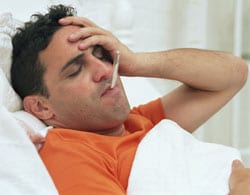
Image of a person sick.
In humans, Leptospirosis can cause a wide range of symptoms, including:
  • High fever
  • Headache
  • Chills
  • Muscle aches
  • Vomiting
  • Jaundice (yellow skin and eyes)
  • Red eyes
  • Abdominal pain
  • Diarrhea
  • Rash
Many of these symptoms can be mistaken for other diseases. In addition, some infected persons may have no symptoms at all.
The time between a person's exposure to a contaminated source and becoming sick is 2 days to 4 weeks. Illness usually begins abruptly with fever and other symptoms. Leptospirosis may occur in two phases:
  • After the first phase (with fever, chills, headache, muscle aches, vomiting, or diarrhea) the patient may recover for a time but become ill again.
  • If a second phase occurs, it is more severe; the person may have kidney or liver failure or meningitis. This phase is also called Weil's disease.
The illness lasts from a few days to 3 weeks or longer. Without treatment, recovery may take several months.


Risk of Exposure

Image of work boots.
Leptospirosis occurs worldwide, but is most common in temperate or tropical climates. It is an occupational hazard for many people who work outdoors or with animals, such as:
  • Farmers
  • Mine workers
  • Sewer workers
  • Slaughterhouse workers
  • Veterinarians and animal caretakers
  • Fish workers
  • Dairy farmers
  • Military personnel
The disease has also been associated with swimming, wading, kayaking, and rafting in contaminated lakes and rivers. As such, it is a recreational hazard for campers or those who participate in outdoor sports. The risk is likely greater for those who participate in these activities in tropical or temperate climates.
In addition, incidence of Leptospirosis infection among urban children appears to be increasing.

Treatment

Image of pills in bottle.
Leptospirosis is treated with antibiotics, such as doxycycline or penicillin, which should be given early in the course of the disease.
Intravenous antibiotics may be required for persons with more severe symptoms. Persons with symptoms suggestive of leptospirosis should contact a health care provider.


Prevention

The risk of acquiring leptospirosis can be greatly reduced by not swimming or wading in water that might be contaminated with animal urine, or eliminating contact with potentially infected animals.
Protective clothing or footwear should be worn by those exposed to contaminated water or soil because of their job or recreational activities.


Health Care Workers

Technical Information

Clinical Features

Symptoms include fever, headache, chills, muscle aches, vomiting, jaundice, anemia, and sometimes a rash. The incubation period is usually 7 days, with a range of 2-29 days. If not treated, the patient could develop kidney damage, meningitis, liver failure, and respiratory distress. In rare cases, death occurs.

Etiologic Agent

Leptospires are long, thin, motile spirochetes. They may be free-living or associated with animal hosts and survive well in fresh water, soil, and mud in tropical areas. Organisms are antigenically complex, with over 200 known pathogenic serologic variants. Although certain geographic regions contain specific leptospiral serovars and species, the serologic characterization of an isolate is not an absolute predictor of its species designation.

Sequelae

Clinical course is highly variable. The serious icteric form (Weil’s disease) is not common, but hemorrhage, hepatomegaly, pulmonary hemorrhage, ARDS, and jaundice are among the severe features. Case fatality rate is 1 to 5%.

Surveillance

Leptospirosis has been reinstated as a nationally notifiable disease as of January 2013. Read the updated 2013 case definition. Until CDC can receive case data via the Nationally Notifiable Disease Surveillance System, please send case notifications on the case report form[PDF – 1 MB].

Incidence and Trends

  • It is estimated that 100-200 Leptospirosis cases are identified annually in the United States. About 50% of cases occur in Hawaii.
  • The largest recorded U.S. outbreak occurred in 1998, when 775 people were exposed to the disease. Of these, 110 became infected.
  • Although incidence in the United States is relatively low, leptospirosis is considered to be the most widespread zoonotic disease in the world.
  • Significant increases in incidence have been reported from Peru and Ecuador following heavy rainfall and flooding in the spring of 1998. Thailand has also reported a rapid increase in incidence between 1995 and 2000.

Avoid Wound Infections: Emergency Wound Care After a Natural Disaster

Emergency Wound Care After a Natural Disaster


Woman putting a bandaid[NOTE: Health professionals should see Emergency Wound Management for Healthcare Professionals.]
The risk for injury during and after a hurricane and other natural disasters is high. Prompt first aid can help heal small wounds and prevent infection. Tetanus, other bacterial infections, and fungal infections are potential health threats for persons who have open wounds.
Seek medical attention as soon as possible if:
  • There is a foreign object (soil, wood, metal, or other objects) embedded in the wound;
  • The wound is at special risk of infection (such as a dog bite or a puncture by a dirty object);
  • An old wound shows signs of becoming infected (increased pain and soreness, swelling, redness, draining, or you develop a fever).

How to Care for Minor Wounds

  • Wash your hands thoroughly with soap and clean water if possible.
  • Avoid touching the wound with your fingers while treating it (if possible, use disposable, latex gloves).
  • Remove obstructive jewelry and clothing from the injured body part.
  • Apply direct pressure to any bleeding wound to control bleeding.
  • Clean the wound after bleeding has stopped.
    • Examine wounds for dirt and foreign objects.
    • Gently flood the wound with bottled water or clean running water (if available, saline solution is preferred).
    • Gently clean around the wound with soap and clean water.
    • Pat dry and apply an adhesive bandage or dry clean cloth.
  • Leave unclean wounds, bites, and punctures open. Wounds that are not cleaned correctly can trap bacteria and result in infection.
  • Provide pain relievers when possible.

Other Considerations

  • Expect a variety of infection types from wounds exposed to standing water, sea life, and ocean water.
  • Wounds in contact with soil and sand can become infected.
  • Puncture wounds can carry bits of clothing and dirt into wounds and result in infection.
  • Crush injuries are more likely to become infected than wounds from cuts.
  • Take steps to prevent tetanus
If you have wounds, you should be evaluated for a tetanus immunization. If you receive a puncture wound or a wound contaminated with feces, soil, or saliva, have a health care professional determine whether a tetanus booster is necessary based on individual records.

References

  • Krohmer, J.R., Rapp M.T. & American College of Emergency Physicians.(2001). First aid manual: A comprehensive guide to treating emergency victims of all ages in any situation. (3 rd ed.) New York : Dorling Kindersley Limited.
  • Tintinalli, J.E., Kelen, G.D., Stapczynski, J.S., & American College of Emergency Physicians. (2004). Emergency medicine: A comprehensive guide. (6th ed.) New York : McGraw-Hill.