Can Drones Make Construction Safer?
 Unmanned aerial vehicles (UAVs) often called drones are increasingly
used for military, recreational, public, and commercial purposes. UAVs
have the potential to prevent injury and death in the construction
industry where nearly 1,000 workers died in 2015. Advancements in UAV
technology could help reduce construction-related injury and death from
falls, toxic chemical exposures, electrical hazards, or traumatic injury
from vehicle and equipment collisions.
As is the case with other emerging technologies, occupational safety
assessments of UAVs lag behind technological advancements. UAVs may
create new workplace hazards that need to be evaluated and managed to
ensure their safe operation around human workers.
A recent paper from
the National Institute for Occupational Safety and Health (NIOSH) in the
American Journal of Industrial Medicine “Unmanned Aerial Vehicles in Construction and Worker Safety”
describes the four major uses of UAVs, including their use in
construction, the potential risks of their use to workers, approaches
for risk mitigation, and the important role that safety and health
professionals can play in ensuring safe approaches to their use in the
workplace.
While the article provides a wealth of information on the major uses
of UAVs, this blog focuses on UAV use in construction. The commercial
segment of the $100 billion UAV market is predicted to be the fastest
growing between 2016 and 2020, with the construction industry accounting
for the largest share of the growth.1 By 2025, the U.S. commercial UAV sector is forecast to surpass five billion dollars in investments.2
The emerging uses of UAVs in the construction industry range from
aiding with construction project planning by aerial mapping of the
construction site3 to extending to the actual building of structures.4,5 The most common UAV uses in construction are described below.
Monitoring: Monitoring a large construction site is a
challenge for construction management. A UAV can be deployed to send
video footage of site conditions to construction management faster and
more efficiently than can on-the-ground personnel. Video can be
converted into a three-dimensional picture of the site and then compared
to computerized architectural plans to show how accurately the project
is progressing.6
Monitoring information obtained by a UAV also serves as a useful input
in the preparation of periodic construction progress reports. UAVs can
be equipped with far and near infrared cameras, radar or laser-based
range finders which can greatly enhance their surveillance and
monitoring capabilities at a construction site.7 In addition, tracking moving objects on construction sites such as people, equipment, and material are being developed,8 as well as equipping UAVs with the capability of mapping indoor construction environments.9
Inspection: Often, UAVs can inspect a large worksite
more efficiently through aerial photography than on-the-ground
personnel can. UAV detection of hazardous conditions, materials and
dangerous structures can aid in construction site hazard identification
without placing a worker at risk.10,11
Real-time UAV systems performing remote site inspections and violation
detection at construction sites may be more efficient, safer and less
costly than present construction site inspection methods.7,12
UAV inspection of awkward locations on and under bridges and along
highway can not only reduce the cost of personnel inspecting the entire
expanse of a highway road or structure, but also reduce the risk of
working along a busy highway or erecting equipment close to the flow of
traffic. Government inspections of construction sites could also be
performed by a UAV. Because inspection of the site would be quicker than
an individual government inspector walking an extensive construction
site, UAVs could increase the scope and frequency of inspections of
construction projects by federal, state and local government agencies.13
Once potential violations were identified by aerial imaging, then
inspectors could focus their investigation on sites where the potential
violations were imaged.
Maintenance: Using UAVs in carrying out planned or
reactive maintenance inspections of tall structures, such as
skyscrapers, bridges, and towers where access can be costly and pose a
risk to workers of falling from a great height, appears to be a clear
benefit for construction workers and managers.14
New FAA rules permitting the commercial use of UAVs has prompted new
guidelines for operating UAVs around vertical communications
infrastructure.15
Other Uses: UAVs have been proposed as material handling vehicles, transporting tools, equipment and materials at construction sites16 or used to spray paint or waterproof a structural component.17 UAVs can also be used to capture unique views of a structure for promotional photographic purposes.14
Unmanned aerial vehicles (UAVs) often called drones are increasingly
used for military, recreational, public, and commercial purposes. UAVs
have the potential to prevent injury and death in the construction
industry where nearly 1,000 workers died in 2015. Advancements in UAV
technology could help reduce construction-related injury and death from
falls, toxic chemical exposures, electrical hazards, or traumatic injury
from vehicle and equipment collisions.
As is the case with other emerging technologies, occupational safety
assessments of UAVs lag behind technological advancements. UAVs may
create new workplace hazards that need to be evaluated and managed to
ensure their safe operation around human workers.
A recent paper from
the National Institute for Occupational Safety and Health (NIOSH) in the
American Journal of Industrial Medicine “Unmanned Aerial Vehicles in Construction and Worker Safety”
describes the four major uses of UAVs, including their use in
construction, the potential risks of their use to workers, approaches
for risk mitigation, and the important role that safety and health
professionals can play in ensuring safe approaches to their use in the
workplace.
While the article provides a wealth of information on the major uses
of UAVs, this blog focuses on UAV use in construction. The commercial
segment of the $100 billion UAV market is predicted to be the fastest
growing between 2016 and 2020, with the construction industry accounting
for the largest share of the growth.1 By 2025, the U.S. commercial UAV sector is forecast to surpass five billion dollars in investments.2
The emerging uses of UAVs in the construction industry range from
aiding with construction project planning by aerial mapping of the
construction site3 to extending to the actual building of structures.4,5 The most common UAV uses in construction are described below.
Monitoring: Monitoring a large construction site is a
challenge for construction management. A UAV can be deployed to send
video footage of site conditions to construction management faster and
more efficiently than can on-the-ground personnel. Video can be
converted into a three-dimensional picture of the site and then compared
to computerized architectural plans to show how accurately the project
is progressing.6
Monitoring information obtained by a UAV also serves as a useful input
in the preparation of periodic construction progress reports. UAVs can
be equipped with far and near infrared cameras, radar or laser-based
range finders which can greatly enhance their surveillance and
monitoring capabilities at a construction site.7 In addition, tracking moving objects on construction sites such as people, equipment, and material are being developed,8 as well as equipping UAVs with the capability of mapping indoor construction environments.9
Inspection: Often, UAVs can inspect a large worksite
more efficiently through aerial photography than on-the-ground
personnel can. UAV detection of hazardous conditions, materials and
dangerous structures can aid in construction site hazard identification
without placing a worker at risk.10,11
Real-time UAV systems performing remote site inspections and violation
detection at construction sites may be more efficient, safer and less
costly than present construction site inspection methods.7,12
UAV inspection of awkward locations on and under bridges and along
highway can not only reduce the cost of personnel inspecting the entire
expanse of a highway road or structure, but also reduce the risk of
working along a busy highway or erecting equipment close to the flow of
traffic. Government inspections of construction sites could also be
performed by a UAV. Because inspection of the site would be quicker than
an individual government inspector walking an extensive construction
site, UAVs could increase the scope and frequency of inspections of
construction projects by federal, state and local government agencies.13
Once potential violations were identified by aerial imaging, then
inspectors could focus their investigation on sites where the potential
violations were imaged.
Maintenance: Using UAVs in carrying out planned or
reactive maintenance inspections of tall structures, such as
skyscrapers, bridges, and towers where access can be costly and pose a
risk to workers of falling from a great height, appears to be a clear
benefit for construction workers and managers.14
New FAA rules permitting the commercial use of UAVs has prompted new
guidelines for operating UAVs around vertical communications
infrastructure.15
Other Uses: UAVs have been proposed as material handling vehicles, transporting tools, equipment and materials at construction sites16 or used to spray paint or waterproof a structural component.17 UAVs can also be used to capture unique views of a structure for promotional photographic purposes.14
Safety
While there are many benefits to using UAVs in construction, the
potential risks must be carefully studied. The presence of a UAV flying
in close proximity to a human worker can create new hazards at a
construction site, although data supporting the hazard potential of UAVs
for workers are scarce. Safety professionals need to be aware of these
new hazards, assess the risks arising from them, and apply controls to
reduce the risks. There has been little published about the safety and
health risks associated with the public or commercial use of UAVs. The
military has begun to assess the adverse health effects among remote
pilots operating UAVs over conflict areas and has reported stress
reactions in military personnel arising from their work as UAV
operators.18,19
About 30 incidents of near-misses or crashes leading to human injury
have been reported associated with the use of recreational UAVs.20
Unstable flying conditions, operator errors, and faulty equipment may
represent potential hazards to nearby workers from the commercial use of
UAVs. Adding to the uncertainty about the hazards to workers from the
emerging use of UAVs in construction and other industries, the arrival
of autonomous or semi-autonomous UAVs may introduce new hazards arising
from the absence of human control.
It is important to develop hazard identification, risk
characterization and mitigation approaches to ensure the safe operation
of commercial UAVs as the use of UAVs promises significant benefits for
industry. These approaches might incorporate prevention-through design
concepts such as lightweight manipulators, passive compliant systems,
safe actuators, and passive robotic systems. Navigation and collision
avoidance systems can be included in the design of commercial UAVs as a
proactive safety measure. Collision avoidance in the three-dimensional
environment is a main area of UAV design research.21
Structural designs should consider stiffness and pliability factors
that can reduce the impact force during collisions. Tools for the
evaluation of UAV safety during the design22 and certification stages23 are being developed.
Adequate training of operators is essential to ensure the safe
operation of the UAV. A competent UAV operator is a person capable of
identifying any potential hazard of operating a UAV in the particular
construction site surroundings, especially any UAV operating condition
that poses a hazard to workers on the ground. The competent UAV operator
should be authorized by the construction manager to take prompt
corrective measures to eliminate any hazard associated with operation of
the UAV.
Next Steps
As the use of public and commercial UAVs gain in popularity, it will
be important to review their uses to ensure that hazards and risks to
workers are identified and controlled. Collecting and analyzing
objective data about negative safety outcomes in the future will also be
important. There are several potential sources of information about
injuries to workers from UAVs that may be useful including:
- The FAA database of injuries caused by commercial UAVs, collected under Part 107 requirements,
- The BLS Survey of Occupational Injuries and Illnesses (SOII) and the
Census of Fatal Occupational Injuries (CFOI) modified to facilitate
identification of injuries caused by UAVs,
- Accident investigations by OSHA and Fatality Assessment and Control
Evaluation Program (FACE) investigations by the National Institute for
Occupational Safety and Health.
Occupational safety and health professional organizations should
invite speakers on UAV workplace applications to further increase
awareness among their members. Safety professionals, organizations and
government should adopt a proactive approach to the integration of UAV
technology and work collaboratively to develop best safety practices
that can promote the beneficial use of this promising new technology in
construction and other industries while at the same time ensuring the
safety and health of workers working with, nearby, and “below” these new
workplace tools.
If you are using UAVs in your workplace, please share your experiences in the comment section below.
John Howard, MD; Vladimir Murashov, PhD; and Christine Branche, PhD, FACE
Dr. Howard is the Director of the National Institute for Occupational Safety and Health.
Dr. Murashov is a Senior Scientist in the NIOSH Office of the Director.
Dr. Branche is the Principal Associate Director of NIOSH and the Director of the Office of Construction Safety and Health.
Related blogs:
A Robot May Not Injure a Worker: Working safely with robots
Exoskeletons in Construction: Will they reduce or create hazards?
References
[1] Goldman Sachs. Drones reporting for work. 2016. Goldman Sachs. Drones reporting for work. 2016. http://www.goldmansachs.com/ourthinking/technology-driving-innovation/drones/. Accessed July 8, 2017.
[2] McCarthy N. The commercial drone sector is set to contribute billions to the U.S. economy. Forbes. October 19, 2015. https://www.forbes.com/sites/niallmccarthy/2015/10/19/the-commercial-dronesector-is-set-to-contribute-billions-to-the-u-s-economy-infographic/#343f12632bdd.
Accessed July 6, 2017.
[3]
Jenkins D, Vasigh B. 2013. The economic impact of unmanned aircraft
systems integration in the United States. Association for Unmanned
Vehicle Systems International.
http://higherlogicdownload.s3.amazonaws.com/AUVSI/958c920a-7f9b-4ad2-9807-f9a4e95d1ef1/UploadedImages/New_Economic%20Report%202013%20Full.pdf.
Accessed June 30, 2017.
[4]
Molitch-Hou M. Ai build to bring artificial intelligence to additive
construction. Engineering.com. October 26, 2016.
http://www.engineering.com/3DPrinting/3DPrintingArticles/ArticleID/13512/Ai-Build-to-Bring-Artificial-Intelligence-to-Additive-Construction.aspx.
Accessed July 8, 2017.
[5]
Borgobello B. Flying robots to build a 6-meter tower. New Atlas.
November 28, 2011.
http://newatlas.com/flying-robots-to-build-6-meter-tower/20639/.
Accessed June 30, 2017.
[6]
Knight W. New boss on construction sites is a drone. MIT Technology
Review. August 25, 2015.
https://www.technologyreview.com/s/540836/new-boss-on-construction-sites-is-a-drone/.
Accessed July 4, 2017.
[7]
Irizarry J, Costa DB. Exploratory study of potential applications of
unmanned aerial systems for construction management tasks. J Manage Eng.
2016;32:05016001.
[8]
Fang Y, Chen J, Cho YK, Zhang P. A point cloud-vision hybrid approach
for 3D location tracking of mobile construction assets. 33rd
International Symposium on Automation and Robotics in Construction
(ISARC 2016). Proceedings of the International Symposiumon Automation
and Robotics in Construction 2016 (Jan);33:1–7.
http://rical.ce.gatech.edu/Papers/ISARC2016-Paper115.pdf. Accessed July
5, 2017.
[9]
Chirtel E, Knoll R, Le C, Mason B, Peck N, Robarge J, Lewin GC.
Designing a spatially aware, autonomous quadcopter using the android
control sensor system. In Systems and Information Engineering Design
Symposium (SIEDS), April, 2015 (pp. 35–40). IEEE.
http://ieeexplore.ieee.org/document/7117003/. Accessed June 30, 2017.
[10]
Irizarry J,Gheisari M,Walker BN.Usability assessment of drone
technology as safety inspection tools. J Inform Technol Construct
2012;17:194–212.
[11]
Gheisari M, Esmaeili B. 2016. Unmanned aerial systems (UAS) for
construction safety applications. Construction Research Congress 2016:
Old and New Construction Technologies Converge in Historic San Juan −
Proceedings of the 2016 Construction Research Congress,CRC 2016, pp.
2642-2650. http://ascelibrary.org/doi/pdf/10.1061/9780784479827.263.
Accessed July 5, 2017.
[12]
Ashour R, Taha T, Mohamed F, Habeel E, Abu Kheil Y, Elsalamouny M,et
al. Site inspection drone: A solution for inspecting and regulating
construction sites. In Circuits and Systems (MWSCAS), 2016 IEEE 59th International Midwest Symposium (pp. 1-4). IEEE. http://ieeexplore.ieee.org/document/7870116/? reload = true. Accessed June 30, 2017.
[13]
Hosier F. Could OSHA use drones for safety inspections? Safety News
Alert. August 3, 2015.
http://www.safetynewsalert.com/could-oshause-drones-for-safety-inspections/.
Accessed July 8, 2017.
[14] Watson M. 10 ways to use drones in construction! BIM News. June 28, 2016. http://construct-digital.uk/latest/10-ways-use-dronesconstruction/. Accessed July 3, 2017.
[15]
National Association of Tower Erectors. National Association of Tower
Erectors. 2017 January. Unmanned aerial systems operations around
vertical communications infrastructure. 2nd Edition.
https://natehome.com/wp-content/uploads/2016/05/UAS-Operations-Document-2nd-Edition-Jan-2017-E-FILE.pdf.Accessed
July 9, 2017.
[16] Kumar VRP, Balasubramanian M, Raj SJ. Robotics in construction industry. Ind J Sci Tech. 2016 9:1–12.
[17]
Dahlstrom RL, inventor; Working Drones, Inc., assignee. 2015 June 3.
United States patent US 9,611,038. Mobile computing device-based
guidance navigation and control for unmanned aerial vehicles and robotic
systems. http://patft.uspto.gov/netacgi/nph-Parser?Sect2=PTO1&Sect2=HITOFF&p=1&u=/netahtml/PTO/search-bool.html&r=1&f=G&l=50&d=PALL&RefSrch=yes&Query=PN/9611038. Accessed July 8, 2017.
[18]
Jaffe G. The watchers: Airmen who surveil the Islamic State never get
to look away. Washington Post. July 6, 2017.
https://www.washingtonpost.com/world/national-security/the-watchers-airmenwho-surveil-the-islamic-state-never-get-to-look-away/2017/07/06/d80c37de-585f-11e7-ba90-f5875b7d1876_story.html?utm_term=.0acda2a1c075.
Accessed July 7, 2017.
[19]
Bumiller E. Air Force done operators report high levels of stress. New
York Times. December 18, 2011.
http://www.nytimes.com/2011/12/19/world/asia/air-force-drone-operators-show-high-levels-ofstress.html.
Accessed June 30, 2017.
[20]
Michel AH, Gettinger D. Drone incidents: A survey of legal cases.
Annandale-on-the-Hudson, NY: Bard College Center for Study of the Drone;
April, 2017. http://dronecenter.bard.edu/drone-incidents/. Accessed July 4, 1027.
[21]
Budiyono A, Lee G, Kim GB, Park J, Kang T, Yoon KJ. Control system
design of a quad-rotor with collision detection. Aircr Eng Aerosp
Tec.2015;87:59–66.
[22]
Uhlig D, Bhamidipati K, Neogi N. 2006. Safety and reliability within
UAV construction. Proceedings of the 2006 AIAA/IEEE 25th Digital
Avionics Systems Conference: 5B2-1-5B2-9.
http://ieeexplore.ieee.org/stamp/stamp.jsp?tp=&arnumber=4106317.
Accessed July 8,2017
[23] Denney E, Pai G. Automating the assembly of aviation safety cases. IEEE Trans Reliab. 2014;63:830–849.


DURHAM, Calif. - CAL FIRE has released its findings for the investigation into the two fires that burned Westgate Hardwoods in Durham.
CAL FIRE, Butte County Fire investigators, and the Bureau of Alcohol, Tobacco & Firearms reported that the cause of the fires were both accidental and caused by spontaneous combustion.
The fire was first reported on September 25, at 5:52 p.m. Fire crews arrived to find smoke coming from a portion of the building that was used for cabinet finishing.
Officials reported that the fire was partially extinguished by the fire sprinkler system and crews were able to quickly contain the fire.
The second fire was reported the next day at 1:46 a.m. The fire destroyed 75 percent of the large wood-framed building that was used for the finishing process, but a portion of the large building as well as another large building housing the facilities fabrication process, was saved.
===============
A fire early Tuesday morning burned down a large portion of a hardwood and cabinet-making business in Durham, and firefighters say it is too early say what caused the blaze.
Cal Fire-Butte County firefighters responded about 1:45 a.m. to a report of a fire at Westgate Hardwoods in the 9000 block of Midway, between Brown Street and Turntree Court, said Mary Ann Aldrich, a spokesperson for the fire agency.
The roughly 10,000-square-foot woodworking building was gutted by flames, with about 75 percent of the structure lost to fire, Aldrich said.
Firefighters and investigators remained at the scene throughout Tuesday morning, putting out hot spots and sifting through and removing debris.
“It’s a slow process,” she said, adding the firefighters will likely remain at the fire scene throughout the day.
Aldrich said investigators still must determine where the fire started in the building, which was described as older with a wooden frame and a metal roof and siding.
The cause of the fire remained under investigation.
Firefighters had responded earlier Monday to a fire at the same business where employees were performing finishing work as part of normal business operations, Aldrich said.
That fire broke out around 6 p.m. Monday, and when firefighters arrived they found a small fire in the building and “quickly” knocked it down and contained it, she said.
Aldrich said firefighters remained on the scene for a period and returned to the business throughout the day “many, many times” to check on the building.
Firefighters, she said, were at the facility about 45 minutes before the second fire was reported by a passerby about 1:45 a.m Tuesday.
The fires at the business Monday and early Tuesday morning are being investigated as two separate fires, Aldrich said. The causes of both fires remained under investigation.
It wasn’t clear where each fire started.
Aldrich said it was too early in the investigations to speculate on what the causes could be, adding that there are “many things” that could have caused the fires.
No injuries were reported.
Tow truck driver dies after bus rolls over him on I-475 ramp
Updated on October 23, 2017 a
By Dominic Adams
MT. MORRIS TWP., MI - A 60-year-old man died Monday when a bus he was preparing to tow rolled on top of him.
The 20-year employee of George's Towing Company was preparing to tow a disabled Mass Transportation Authority bus at about 9 a.m. Oct. 23 on the southbound exit ramp of Interstate 475 at Saginaw Street, Mt. Morris Township police Chief Terence Green said.
The man's name has not yet been released because his family had not been notified.
Police said the man was underneath the bus when it rolled backward off of two support blocks.
"Basically, the bus fell on top of him causing fatal injuries," Green said.
There was no one on the bus at the time of the incident, Green said.
The bus continued to roll backward after falling off the blocks and the man was not breathing when police arrived.
He was taken to Hurley Medical Center and pronounced dead, Green said.
The man had just turned 60 last week, police said, and was described by the towing company as a great employee.
==================
MOUNT MORRIS TOWNSHIP, Mich. (AP) – Police say a towing company worker has died after a bus he was preparing for a tow rolled on top of him.
Mount Morris Township Police Chief Terence Green says the accident occurred about 9 a.m. Monday on a ramp of Interstate 475 north of Flint.
Green says said the 60-year-old employee of George’s Towing Company was underneath the Mass Transportation Authority bus when it rolled backward off of two support blocks.
He tells The Flint Journal no one was on the bus at the time.
The man’s name was being withheld pending notification of relatives.


STARK COUNTY, OH (WOIO) -
An explosion during repairs at a gas transmission pipeline site killed a worker Monday.
It happened in the 8400 block of Beth Avenue SW. in Bethlehem Township near Navarre, Ohio.
60-year-old Wesley J. Johnson, of Wooster, and an employee of TransCanada was found dead at the scene. He had reportedly been working on equipment in the area when the accident occurred.
Deputies assisted several responding fire departments to evacuate people from the surrounding area until the gas could be turned off.
Given the volatility of gas, it is odd this doesn't happen more often, but remember gas has to be at just the right pressure, and have just the right ignition source to catch fire of explode.
Obviously those conditions were met today.
It is difficult to see exactly where the explosion happened, but an entry road was flanked by trucks from the Columbia Transmission company.
That company is now owned by Trans Canada, a company working on the controversial gas transmission line in this part of the state.
No word on exactly what happened, but a long section of pipeline and access road leads to the spot.
Jeff France doesn't live too far away and describes his experience and said, "I heard a large whistle noise, we don't live too far from Akron Canton Airport and it sounded like a low flying plane. It kept getting louder and louder and louder then there was a gigantic explosion. I made it down the road here to the sportsman's club and I saw the black smoke in the air and, you could smell gas."
A release late Monday afternoon calls the area the Columbia Gas Transmission system meter station.
It is unremarkable in such a remote area, until something goes wrong.
The cause of the gas leak remains under investigation.
Metering stations measure natural gas flow within a pipeline system.
They reduce gas pressure and also meter the gas for transfer to and from other
pipelines and to transfer custody to anchor shippers. Anchor shippers are energy retailers that have signed
up for capacity along the pipeline system.
A meter/regulator station typically includes meter and regulator equipment,
a filter separator, odorant equipment, and a control building housed within a fenced perimeter.
According to info submitted to the Federal Energy Regulatory Commission:
"Meter stations are built for the purposes of measuring continuous natural gas flow entering and exiting a pipeline system. Meter stations also possess regulating components which regulate the pressure and delivery volumes of natural gas into and out of the pipeline system. The construction and modification of custody transfer meters is to meet the specific needs of Project Shippers contracting for firm transportation service on the Project. Metering facilities will include the installation of tap, metering, regulation, heating, flow control, and overpressure protection, as necessary unless specified otherwise."
=================
Columbia Gas Transmission pipeline worker killed Monday morning on Beth Avenue SW in Bethlehem Twp.
BETHLEHEM TWP., OHIO: A pipeline worker died following an incident Monday morning that caused a massive natural gas leak and prompted authorities to evacuate a neighborhood.
Wesley J. Johnson, 60, of Wooster, died at the scene, according to the Stark County Sheriff’s Office. Officials believe a cap on the end of a pipeline gave way, killing him.
A second worker was evaluated at the scene but refused medical treatment, Erie Valley Fire & Rescue Assistant Chief Tom Bragg said. The worker was able to guide firefighters to turn off the valves to the pipeline.
Reports of an explosion in the 8400 block of Beth Avenue SW came in around 10:15 a.m., and the odor of natural gas soon drifted over Navarre more than 4 miles away.
The incident happened during maintenance work at a metering station on part of the Columbia Gas Transmission System, but the cause is unknown, according to the owner, TransCanada.
“Tragically, we can confirm that one employee was fatally injured,” TransCanada spokesman David Dodson wrote in an email. “We are working with local responders to ensure family members are properly notified. Our thoughts and prayers are with the family, friends and colleagues.”
The Public Utilities Commission of Ohio will investigate the incident and forward findings to the U.S. Department of Transportation, which will decide what action to take.
John Williams, director of PUCO’s service monitoring and enforcement department, said he didn’t know how long the investigation would require.
“It’s always hard to tell,” Williams said. “All of these are very unique from one to another.”
Neighbors evacuated
A loud hissing noise could be heard from the incident scene, which emergency personnel blocked off. Thick black smoke was visible for miles. The smoke was caused by oil, used to lubricate the pipeline, mixing with the natural gas, and not a fire, Bragg said.
While crews worked to turn off the gas, emergency personnel evacuated neighbors in about a three-quarter-mile radius around the scene to the Navarre Civic Center on Canal Street W, Stark County Sheriff’s Maj. C.J. Stantz said. The majority of those evacuated were able to return to their homes about 45 minutes later.
Neighbor Betty Rice heard an explosion through the open windows of her home in the 5100 block of Hudson Drive SW. Her 24 acres of land abut a mining area next to the metering station. She was not ordered to evacuate.
“I thought they were blasting,” she said. “It was just a boom. Then we heard what sounded like equipment running.”
Rice later realized it was the natural gas escaping from the pipe.
Another neighbor, Dave Stoffer, heard what sounded like a jet.
“I looked outside to see if there was a jet real close to the roof tops,” said Stoffer, a Seeman Street SW resident. “I thought it was going to land, but it just kept going. I thought maybe a farmer was running machinery.”
Columbia Gas Transmission is a 12,000-mile interstate network that transports natural gas through Ohio and nine other states.
Calgary-based TransCanada acquired the Columbia system last year in a $13 billion deal. TransCanada probably is best known as the company behind the controversial Keystone XL crude oil pipeline.


Norfolk Southern: Train derailment scene cleared, new track expected to be completed
WATE 6 On Your Side staff Published: October 21, 2017, 10:49 pm Updated: October 22, 2017, 6:18 pm
KNOXVILLE, Tenn. (WATE) – After a train derailed in North Knoxville over the weekend, crews are laying down a new railroad track.
A Norfolk Southern train derailed near Inskip Drive on Saturday night around 10 p.m., spilling shipping containers and damaging buildings.
The train was not carrying hazardous materials and no one was injured.
Norfolk Southern Director of Public Relations Susan Terpay says a total of 19 cars left the track. Eighteen of those cars were carrying shipping containers. The 19th car carried automobiles. The train was made up of three locomotives and 68 rail cars.
Some rail cars struck nearby buildings, at least two of which were damaged. Gerdau Construction Products, a steel manufacturer, was struck by the derailed cars and appears to have sustained significant damage.
Knoxville police say there were many rail cars hanging precariously off the track.
Norfolk Southern along with Knoxville police and fire crews monitored the derailment and checked for any potential hazards overnight. No evacuations were needed.
Knoxville police say any unauthorized people who get on the tracks will be taken to jail.
Nearby residents recall hearing a loud screeching sound before the derailment happened.
Inskip Drive will be closed to all traffic between Coster Road and Fennel Road.
Inskip Drive could be closed for up to a week. Drivers should seek alternate routes through the area and expect heavy delays.
Police say Norfolk Southern will head up the investigation into why the train derailed. Stay with WATE 6 On Your Side for continuing coverage of the derailment.
=================
UPDATE: Norfolk Southern has completed removing the rail cars and containers from the tracks, and has finished laying the new track, according to spokeswoman Susan Terpay. Rail service is expected to resume early Monday with trains operating at reduced speeds, she said.
PREVIOUS STORY:
A Norfolk Southern Railway train derailed in the Inskip neighborhood of Knoxville about 10 p.m. Saturday, damaging two industrial buildings housing local businesses.
The derailment took place near the intersection of East Inskip Drive and Fennel Road. A total of 19 shipping containers were derailed, according to Norfolk Southern Director of Public Relations Susan Terpay.
The crash sent train cars colliding into two buildings owned by Morton Properties, which has five buildings total in the area and rents the space out to small businesses, according to Sharon Morton, who owns the company with her husband, Robert.
A total of 18 businesses are housed in the properties and Morton estimated that about five were damaged, including a boat repair business.
No one was in the buildings at the time and no injuries were reported, according to Lt. Chris Baldwin of the Knoxville Police Department.
"There is a boat repair business, heating and air, all kinds of small businesses," Morton said. "It's unfortunate because it's their livelihood."
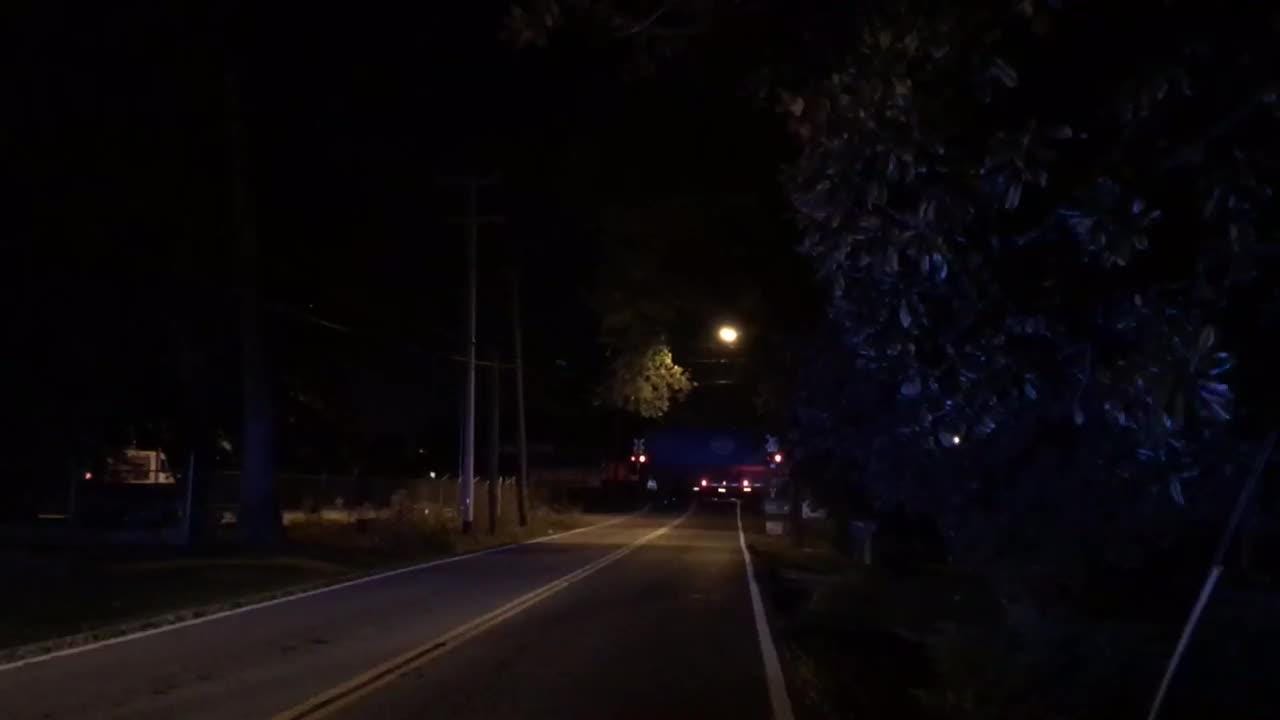
Several cars derailed from a train in North Knoxville, according to police.
No details on the cause of the crash were available Saturday night. The investigation will be handled by Norfolk Southern, Baldwin said. He did not have information on the contents of the shipping cars and only said that they did not contain hazardous material.
Nonetheless, KPD warned people to avoid the area while officers assessed the scene for "potential hazards." They are also warning people about traffic delays in the coming days.
Cedar Lane was reopened Sunday morning but Inskip Drive "probably will be closed several days" for cleanup and repair of the tracks, Baldwin said.
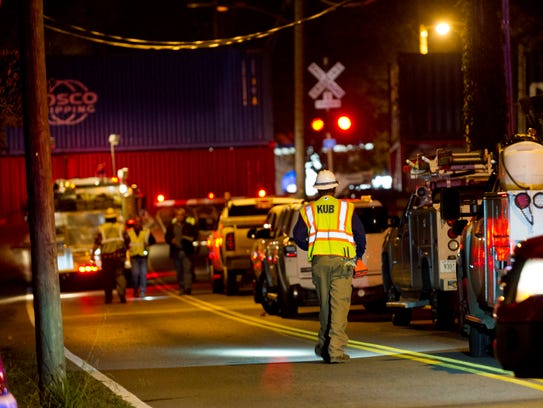
KUB workers arrive at the scene of a 50-car train derailment in North Knoxville, Tennessee on Sunday, October 22, 2017; Knoxville, TN; Mandatory Credit: Calvin Mattheis/Knoxville News Sentinel via USA TODAY NETWORK (Photo: Calvin Mattheis, Knoxville News Sentinel-USA TODAY NETWORK)
Terpay said Sunday that crews from Norfolk Southern worked through the night.
As of Sunday afternoon, all of the damaged cars and containers had been removed, and crews were working to repair the tracks between East Inskip Drive and one of the collision sites at Gerdau Construction Products on Coster Road. The train consisted of three locomotives and 68 rail cars.
The derailment was blocking one highway-rail grade crossing at Inskip Road. Sections of the tracks were moved nearly 15 feet from their original location during the derailment, and double-stacked shipping containers had been severely disfigured and were leaning at perilous angles over what was left of the chain-link fence around the tracks.
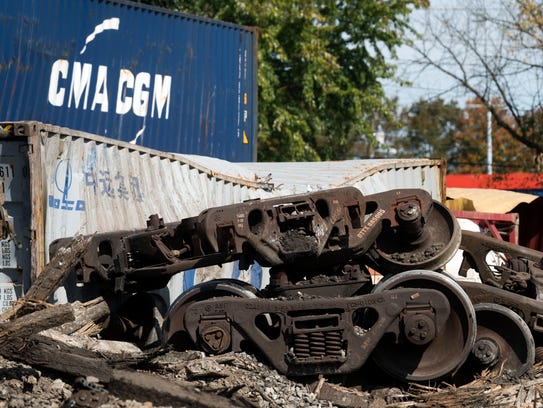
Damaged shipping containers and debris from the train derailment at the intersection of East Inskip Drive and Fennel Road. (Photo: SAUL YOUNG/NEWS SENTINEL)
One of the businesses damaged by the derailment was Fiber Tech, 230 E. Inskip Drive, which does boat repairs.
“One of the cars is sitting inside my building,” said a man answering the phone there who said he was the owner of the business but would not give further identification. “There was a motor home parked next to the building. There is a train car sitting on it. Inside the building is a train car that came through the back of the building.”
He said the business was closed and no one was there at the time of the derailment. In the dark, he said, it was hard to tell the extent of the damage.
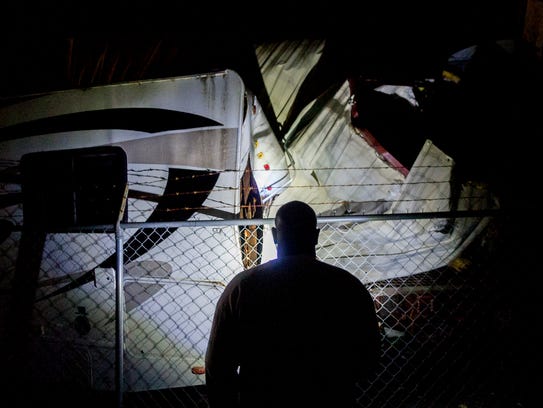
Michael Robinson, of Knoxville, discovers that his camper trailer was crushed by a train car at the scene of a 50-car train derailment in Knoxville, Tenn., on Sunday, October 22, 2017. (Calvin Mattheis/Knoxville News Sentinel via AP) (Photo: Calvin Mattheis, Associate Press)
Michael Armstrong, who owns Glassworxx Car Audio next door to Fiber Tech, said that he had left the area only an hour before the train derailed. Armstrong said he had just stepped out of the shower when he got a text saying that a train had gone off the tracks and hit a building.
Armstrong was on the scene Saturday night with his son, Chase Pressley, and his friend Michael Robinson when he saw that his RV, which was parked on the south side of the Fiber Tech building, had been crushed by the rogue containers.
The same containers ripped open the side of Fiber Tech, creating a massive hole to the interior. Armstrong, Pressley and Robinson were made to leave the scene early Sunday morning after he discovered what he believed was gasoline leaking from his RV.
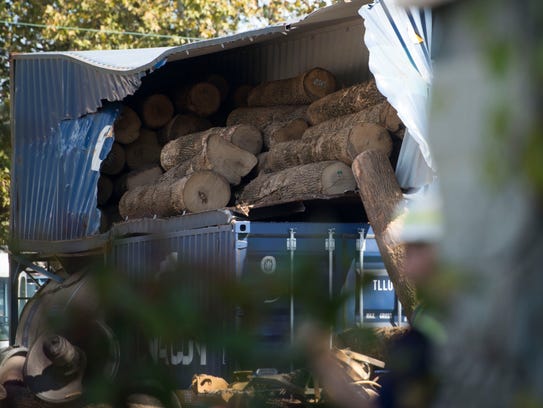
Logs spill out of a shipping container carried by a train that derailed at the intersection of East Inskip Drive and Fennel Road. (Photo: SAUL YOUNG/NEWS SENTINEL)
The Industrial Fumigates Co. and Kerley Heating & Air Conditioning were among the other businesses whose buildings were damaged in the derailment. Vic Kerley said he expected Kerley Heating & Air to reopen Monday despite damage done to the building's roof by a fallen tree.
Now that crews have finished removing the containers and cars from the tracks, they will repair the tracks and take the derailed cars and containers from the scene, according to Terpay. East Inskip Drive is expected to remain closed into Monday.