Richard Garrity
Cubs Fan Climbed On Handrail With Cup Before Falling To Death
May 23, 2017 6:47 AM
CHICAGO
(CBS) — The Chicago Cubs fan who died after a fall at Wrigley Field
last week was climbing on a railing with a red cup in his hand when he
fell backward and hit his head on the concrete below, a police official
said Monday.
Richard Garrity, 42, of Wheaton suffered head
injuries Tuesday night and died the next day at Advocate Illinois
Masonic Medical Center.
Garrity, a marketing manager for
Heineken, was at the Cubs’ win over the Cincinnati Reds. He was on a
work outing with his wife. Cubs officials believe they were sitting in
Section 239, which is in the main grandstand, close to the right-field
foul pole.
Garrity, the father of a boy and a girl, was leaving
the game shortly before 11 p.m. after most fans had exited the stadium,
officials said. He fell over a handrail on a ramp leading from the upper
deck to the terrace level, officials said.
Garrity landed on
his head after falling more than five feet, officials said. He was taken
to the hospital in a private ambulance. Police were contacted about the
accident the next day after he died, officials told the Sun-Times.
Police
said two associates of Garrity saw him climb on the handrail with the
cup before he fell. A stadium employee heard the fall but didn’t see it.
The Cook County medical examiner’s office has ruled the death an
accident.
ADVERTISING
The handrail that Garrity fell over was 36 inches high. Some major league ballparks have 42-inch handrails.
“Given
the age of our ballpark, we have been grandfathered,” said Julian
Green, vice president of communications for the Cubs. The height of the
railing “in no way contributed to this incident.”
=========================
CHICAGO
(CBS) — Autopsy results were released Thursday for a 42-year-old man
who was at Tuesday’s Cubs-Reds game when he tumbled over a railing for
unknown reasons around 11 p.m., as he was exiting the stadium.
Richard
Garrity, Junior’s death was ruled an accident, caused by injuries to
the skull and brain after falling from a significant height.
As the Cubs cheered coach Joe Maddon’s 1,000th win Tuesday, Rick Garrity, Jr. was celebrating the last victory he would see.
Minutes
later, the longtime fan fell over a Wrigley Field railing. The fall
caused him to strike his head, causing severe trauma. Garrity Jr. was
taken to Advocate Illinois Masonic Medical Center, where he died
Wednesday afternoon.
“I’ll miss him dearly,” said Rick Garrity, Sr.
Garrity,
Sr. told CBS 2 over the phone that the circumstances around his
42-year-old son’s death are hazy; confusion, especially that night when
his daughter-in-law couldn’t find her husband.
“She was calling
him on his cellphone and there was no answer and finally somone picked
up and it was the hospital,” Garrity, Sr. said.
Garrity, Jr. was
at Wrigley Field for a work event with Heineken. Representatives for
the company call the marketing manager a passionate member of the
Heineken family and say they are committed to supporting his wife and
two children.
Meanwhile, Wrigleyville Alderman Tom Tunney said the baseball team is keeping contact during its internal investigation.
“The
Cubs have proven they do things right and they are certainly the most
at-risk at whether it is inside or exterior and I know that they have
all their safety experts and team not only on this case, but every day
along the ballpark,” Ald. Tunney said.
Garrity’s father was too
distraught to discuss any possible legal action. Instead, he broke down
describing the fun-loving dad of a 5- and 9-year-old.
“He was a great person,” Garrity, Sr. said.
The Cubs issued a statement saying the thoughts and prayers of the entire organization are with the Garrity family.
==================
CHICAGO (AP) - Chicago police are investigating the death of a 42-year-old man who fell over a railing at Wrigley Field.
Richard
E. Garrity of Wheaton was pronounced dead Wednesday at Advocate
Illinois Masonic Medical Center. An autopsy Thursday by the Cook County
medical examiner determined he died of head injuries from an accidental
fall.
Authorities say Garrity fell and suffered head trauma as
he was leaving the ballpark after Tuesday night's game between the
Chicago Cubs and Cincinnati Reds.
Cubs spokesman Julian Green
said Thursday the team doesn't know how far Garrity fell, but it wasn't
from the upper deck. Spokesmen for the Chicago police and fire
departments also said they didn't have information on where or how
Garrity fell.
Garrity's father, Richard Garrity Sr., told The
Chicago Tribune his son had been attending a work outing with his wife
and co-workers.
=================
ORIGINAL STORY: A man who struck his head after tumbling over a railing at Chicago's Wrigley Field has died.
The
Cook County medical examiner's office says 42-year-old Richard E.
Garrity of Wheaton was pronounced dead Wednesday at Advocate Illinois
Masonic Medical Center.
Authorities say Garrity fell over a
railing after Tuesday night's game between the Chicago Cubs and
Cincinnati Reds. Police say he suffered head trauma from the fall.
The medical examiner has scheduled an autopsy for Thursday to determine the cause of death.
==============
Cubs fan dies after falling over railing at Wrigley: 'He was a great guy, everyone loved him'
Richard E. Garrity is survived by his wife, 9-year-old daughter and 5-year-old son.
Rosemary Regina Sobol and Tony Briscoe Chicago Tribune
A
Wheaton man died a day after falling over a railing and hitting his
head while leaving Wrigley Field after Tuesday night's game, officials
said.
Richard E. Garrity, 42, was pronounced dead at 3:33 p.m.
Wednesday at Advocate Illinois Masonic Medical Center, according to the
Cook County medical examiner’s office. Garrity was taken by private
ambulance to the hospital, police said.
The Cubs said in a
statement that Garrity fell as he was leaving the ballpark around 11
p.m. The game had ended around 10:20 p.m.
"The thoughts and prayers of our entire organization are with his family during this difficult time," the Cubs statement said.
Garrity,
a marketing manager for Heineken, had attended the Cubs game against
the Cincinnati Reds as a work outing with colleagues and his wife,
according to his father, Richard Garrity Sr.
“He was a great guy,
everyone loved him,” Garrity said of his son, who loved golfing and
gardening. “When he walked in a room, there were no strangers.”
He said his son was a lifelong Cubs fan.
The
elder Garrity said he spoke with his son during the game because he was
babysitting the couple’s 9-year-old daughter and 5-year-old son.
Relatives
didn’t have many details about the circumstances of Garrity’s death.
His wife wasn’t with him and had tried to call him after the game, his
father said. She learned he had been taken to the hospital.
A
graduate of Arizona State University, Garrity Jr. had also worked for
Chicago Beverage Systems, according to his LinkedIn profile. He was born
in Aurora and lived in the 2300 block of Embden Lane, according to the
medical examiner's office. An autopsy was slated for Thursday

Rolesville (N.C.) junior
football player Isaiah Langston died in 2014 after suffering a head
injury during practice. Photo: Facebook
By: Tim Whelan Jr., USA TODAY High School Sports | May 23, 2017
The family of a North Carolina football player who died after sustaining a head injury in practice is suing the school system and members of the school’s athletic staff.
Rolesville (N.C) junior Isaiah Langston, 17, died Sept. 29, 2014, from a stroke that a state medical examiner’s report said was caused by a head injury suffered five days before in football practice. According to the lawsuit filed in Wake County Superior Court and obtained by The News & Observer, Langston’s family accuses the school of not following the state’s concussion protocol and of not acting after the teen complained of headaches prior to his collapse before a football game two days later.
“The aforesaid injuries, death and damages sustained by Isaiah Langston were directly and proximately caused by the careless, negligent, grossly negligent, reckless, and willful and/or wantonly actions of the Defendants,” the family says in the lawsuit filed in August and obtained by The News & Observer.
Under state law, per the News & Observer, student-athletes in North Carolina who display symptoms of a concussion must be cleared by a medical doctor or licensed athletic trainer before returning to practice.
In its response to the lawsuit, school officials acknowledge Langston wasn’t cleared to play by any doctor and didn’t participate in the concussion protocol. School attorneys deny, however, that school employees knew that Langston had suffered a concussion or that he had complained of headaches prior to his collapse.
“Isaiah Langston was negligent in one or more respects and failed to exercise the proper care which prudent persons under the same or similar circumstances would have exercised,” the district writes in its legal response, per The News & Observer.
Langston was hit in the back of the head during football practice Sept. 24, 2014, and had a headache for two days, per the report by medical examiner Dr. Andrew Rand. The 17-year-old was then “held out” of practice during those two days, according to Rand.
In the pregame warm-ups Sept. 26, 2014, Langston collapsed and was taken to the hospital. He died three days later.
Per The News & Observer, in addition to suing the school system, the lawsuit names as defendants Rolesville athletic director Tommy Moore; Jermaine Evans, the head football coach at the time; Anthony McKoy, an assistant football coach; and Brad Farrell, the school’s head athletic trainer at the time.
A jury trial requested by the family could begin as soon as Nov. 13.
================
Isaiah Langston, a football player at Rolesville (N.C.) High School, died of a hit to the back of the head, according to the autopsy as reported by WTVD-TV in Raleigh-Durham.
The medical examiner listed the official cause of death as “complications of vertebral artery dissection due to blunt force injury of the head and neck.”
The 17-year-old died days after collapsing in warmups before a Sept. 26 game. At the time, eyewitnesses told HighSchoolOT that the linebacker apparently gave no signs that he was feeling ill or under the weather in any way prior to his collapse. He was immediately taken to a nearby hospital where he died three days later.
The report said Langston had a “large posterior circulation stroke … which most likely occurred secondary to verbal dissection,” the report said.
After Langston died, his brother told WTVD-TV that the collapse was related to a blood lot in Isaiah’s brain.
Langston is among nine high school football players whose death occurred after a player collapsed at a football game or practice
The nine player deaths is the most player deaths that may be directly related to football in a single season since 11 in 1986, according to the National Center for Catastrophic Sport Research at the University of North Carolina at Chapel Hill, which annually analyzes football deaths. The number is a stark statistic that underlines the growing concern shown by parents about the safety of youth football at various levels.
Langston was remembered in the aftermath of his death at the team’s next game with a moment of silence and balloons being released into the sky as his family looked on.


How Rising Seas and Coastal Storms Drowned the U.S. Flood Insurance Program
Sea level rise and more severe storms are overwhelming U.S. coastal communities, causing billions of dollars in damage and essentially bankrupting the federal flood insurance program. Yet rebuilding continues, despite warnings that far more properties will soon be underwater.
By Gilbert M. Gaul • May 23, 2017
Long Beach Island is the largest and richest barrier island in New Jersey, an oasis of sprawling oceanfront retreats and second homes located midway down the state’s heavily developed coast, a two-hour drive from the metropolitan centers of New York City and Philadelphia. On a clear day, visitors in the southern end can see the shiny facades of the Atlantic City casinos rising like obelisks across Great Bay. In the north, historic Barnegat Lighthouse towers over an unruly inlet steadied by boulders stretching into the Atlantic Ocean. In many places, the long, slender island is barely a few feet above sea level. And like most of New Jersey’s coast, it has been eroding for decades, leaving it vulnerable to flooding and rising seas.
Recently, the U.S. Army Corps of Engineers pumped more than ten million cubic yards of sand from offshore dredges to widen Long Beach Island’s beaches and dunes – part of a Sisyphean-like effort to protect the island’s $15 billion of high-calorie real estate. But there is a problem. The sand keeps washing away. A series of storms over the last two years gouged the neatly groomed beaches, costing tens of millions in additional repairs. When all is said and done, the project will cost more than half a billion dollars, most of the money paid by U.S. taxpayers.
Like other barrier islands up and down the Atlantic and Gulf coasts, Long Beach Island is drowning in slow motion. Over the last century, researchers estimate that the ocean and bays that flank the island have risen by about a foot. That doesn’t sound like much, but the added water has made a huge difference in life on the island. Barnegat Bay now routinely washes over the bulkheads and floods the streets. Occasionally, school buses have to wait for the water to recede to pick up or drop off children. Even more worrisome, the rising water makes it easier for storm surge and waves to do more damage in violent storms such as Hurricane Sandy, which wrecked Long Beach Island and the back-bay communities in Ocean County in October of 2012.
The federal insurance program has subsidized thousands of risky properties along the coast by charging them below-market premiums.
Sea level rise played an important role in Sandy, with historic flooding from Delaware to the Battery in lower Manhattan. Upward of 100,000 people experienced flooding who otherwise would have been dry, researchers estimate. Most late season hurricanes veer out to sea by the time they reach the mid-Atlantic. Sandy took a hard left-hand turn, crashing ashore near Atlantic City and pushing a five-foot plume up the bays, into places water had never reached before.
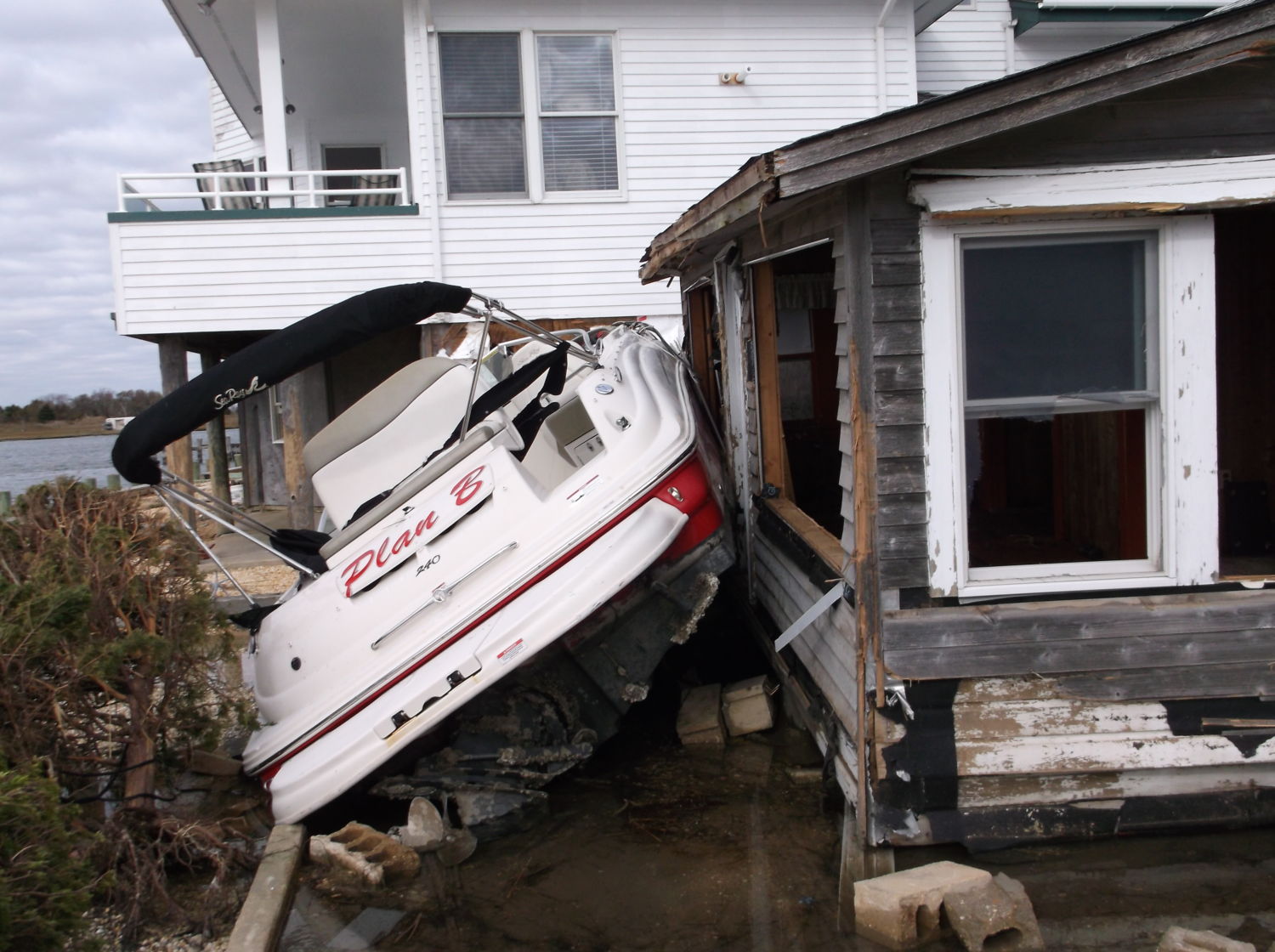
Dave Rinear’s small bungalow on Cedar Bonnet Island – a smudge mark of sand and sedge located just behind Long Beach Island – had the misfortune of facing a vast, open fetch of Barnegat Bay. Surges from Sandy lifted a 24-foot speedboat named Plan B from its winter mooring and launched it into Rinear’s cedar shake cottage, blowing out a wall and washing away most of the contents, including 50 years worth of prized fishing journals. “Talk about laser-guided misfortune,” the 72-year-old retired professor moaned. “That thing came up the bay like a laser-guided missile with my name on it.”
Rinear’s bungalow was totaled. But he filed a claim with the National Flood Insurance Program (NFIP) and received enough to help him rebuild a larger new house on the same footprint. In all, the federal flood program paid out $8 billion in Sandy-related claims. More than $2 billion went to property owners in Ocean County, including $200 million on Long Beach Island. That was nearly twentyfold what island property owners had collected in the prior 35 years of the program.

A bungalow belonging to David Rinear off Long Beach Island, New Jersey, was totaled during Hurricane Sandy by an unmoored boat that crashed ashore. DAVID RINEAR
Today, the NFIP is effectively bankrupt. It owes the U.S. Treasury nearly $25 billion – money it borrowed from federal taxpayers to cover its obligations in Sandy, Katrina (2005), and Hurricane Ike (2008). No one expects that money to be repaid. Some coastal state lawmakers are even calling for Congress to write off the massive debt, contending it is the only way the troubled insurance program, which is up for reauthorization this year, can regain its financial footing.
Wiping away the debt will help. But it is only a matter of time until the next big storm drains the coffers again. Even relatively weak hurricanes cause hundreds of millions in damage, while monster storms like Katrina and Sandy cause billions. Complicating matters, the NFIP has improbably subsidized thousands of risky properties along the coast – low-lying houses that flood over and over – by charging them below-market premiums to entice them to join the program.
Now the federal flood program faces no less than an existential threat. As seas rise, coastal floodplains are expected to expand, exposing more property to routine flooding, surge, and waves. By some estimates, hundreds of thousands of U.S. houses could be underwater by century’s end and a trillion dollars worth of property at risk. Much of Long Beach Island’s heavily insured housing could be covered by several feet of water twice a day at high tide, rendering it inaccessible except by boat. Meanwhile, the average losses for each flood policy could increase by half, according to a 2013 government study, leading to sharp increases in premiums that price out all but the wealthiest property owners.
Elevating homes above predicted flood levels and adopting other mitigation strategies will help in the short run, says Robert E. Kopp, an expert on climate change and sea level rise at Rutgers University. But not enough coastal communities are taking the long-term threat seriously. “So what we have is a lot of changes on the margins,” Kopp said.
Rising Seas and the Jersey Coast

The NFIP also lacks a reserve fund to help cover losses from catastrophic storms like Sandy. Instead of charging a little more and setting aside money, the way private insurers do in other lines of business, the federal flood program relies on the U.S. Treasury – taxpayers – as its financial backstop, or reinsurer. In 2013, the NFIP finally added a 15 percent assessment to its flood policies, and gradually built up about $1 billion in reserves. But an epochal 2016 flood in Louisiana used up that money.
Many Americans probably associate the NFIP with floods along the Mississippi River and other inland bodies of water. The program does cover those floods. And with climate change spawning monsoonal deluges in Texas, Louisiana, and other places, the risks are significant.
But most of the losses plaguing the program are now at the densely developed U.S. coasts. NFIP data show that hurricanes and nor’easters account for three-quarters of all the program’s losses – $38 billion of the $52 billion paid out since 1978. Just six huge storms, including Sandy and Katrina, are responsible for $35 billion of the coastal claims. All occurred in the last 15 years, highlighting the growing risks to coastal development.
Over time, the government flood program has become the insurer of last resort in vulnerable coastal floodplains for second homes, oceanfront mansions, investment properties, and more modest homes stacked along the nation’s back bays and sounds. With so much property in the line of fire, it is unsurprising that the price tag for disaster aid and flood losses keeps increasing. And with rising seas and bigger, more violent storms, it will likely get worse. In 2013, researchers estimated that a major hurricane slamming into Tampa could cause upward of $175 billion in damage.
Mounting Flood Insurance Losses
It wasn’t supposed to be like this. The government got into the flood insurance business reluctantly, and only after private insurers fled the market because it was too risky and unpredictable. When Congress finally passed the NFIP in 1968, it was intended in part to steer development away from vulnerable floodplains. However, many coastal communities ignored the restrictions and filled the nation’s barrier islands and back bays with property. The value of land and property on the New Jersey coast soared from less than $1 billion in 1960 to over $170 billion today. Most of that property is located in what NFIP officials call Special Flood Hazard Areas, low-lying places likely to flood and suffer extreme damage in catastrophic storms.
Today, at least $3 trillion worth of property lines the Atlantic and Gulf coasts. Much of it is insured by the NFIP, including approximately one million second homes and investment properties. Rising sea levels will make it easier for future storms and waves to damage those houses by elevating the angle of attack. “Think of it this way,” says Kopp, “if the flood level is five feet and you add a foot of sea level, then the new flood level is six feet. That elevates the platform (for surge and waves). It’s that simple.”
Of course, no one knows exactly how high the seas will rise by the end of the century. That will depend on the rate of greenhouse gas emissions, melting ice sheets in Greenland and Antarctica, warming ocean temperatures (water expands when temperatures rise), and local geological conditions. Some low-lying, porous areas like Miami and Norfolk appear to be more vulnerable than others.
A 2016 Rutgers study found that seas near New Jersey could rise between 1 and 1.8 feet by the middle of this century under a scenario of low carbon emissions. But under a high emissions scenario, seas could swell as high as 4.5 feet by 2100. Recently, a National Oceanic and Atmospheric Administration study estimated mean global sea levels could rise as high as 8 feet by the end of the century.
Several more feet of water would be devastating, swallowing vast swaths of real estate, according to several studies. A June 2014 report called Risky Business, prepared by a group co-chaired by former New York City Mayor Michael Bloomberg, estimated that between $66 billion and $160 billion worth of U.S. real estate could be below sea level by 2050 – and up to half-a-trillion by the end of this century.
Nearly two million U.S. homes worth almost $900 billion could be underwater by the end of the century, one study found.
Another study by researchers at the real estate firm Zillow found that nearly two million U.S.homes worth almost $900 billion could be underwater by 2100. The researchers weren’t referring to a situation where the market value of a home dips below the value of the mortgage; they literally meant underwater, swamped by rising sea levels.
Zillow researchers looked at coastal states where sea levels would rise by six feet by 2100. In Florida, the most vulnerable and heavily developed, they found nearly 1 million homes – one of every eight in the state – would be underwater. The next most vulnerable state was New Jersey, where 190,429 houses would be inundated.
The researchers agreed to analyze their data for me by county and town. Unsurprisingly, 80 percent of the houses expected to be underwater in New Jersey were located in the state’s four coastal counties – Atlantic, Cape May, Monmouth, and Ocean. That also happens to be where most of the second homes are located and where the NFIP is the insurer of last resort.
Nearly 60,000 of the homes expected to be underwater are in Ocean County along the barrier islands and back bays. Almost 5,000 are on Long Beach Island, which means one quarter of all the properties there would be inundated, according to Zillow.

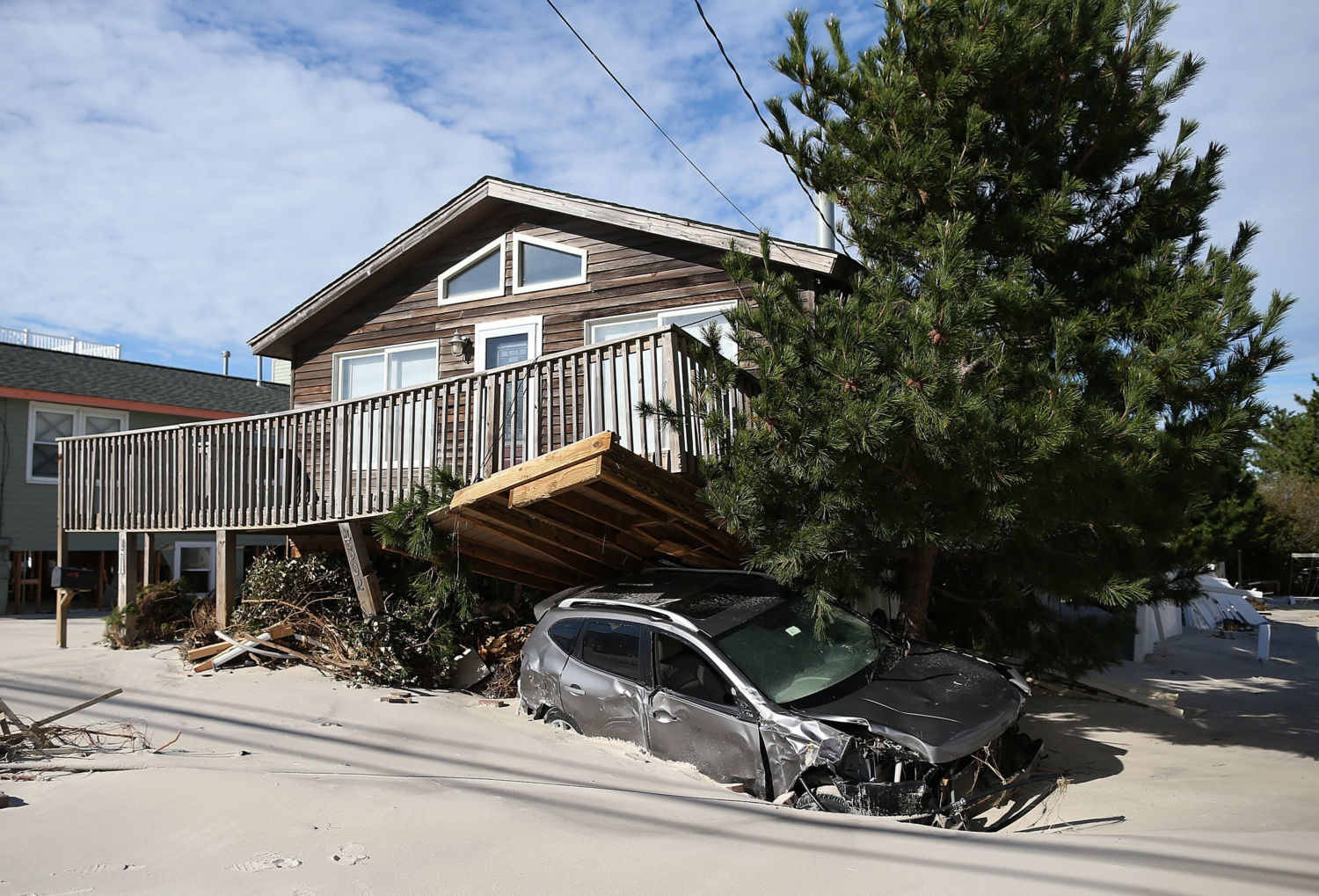
A house and car on Long Beach Island damaged in 2012 by Hurricane Sandy. MARK WILSON/GETTY IMAGES
One of the Long Beach Island properties likely to be swamped is Joeys’ Pizza & Pasta, a popular restaurant on Long Beach Boulevard in the middle of the island. Joeys’ is the bellwether for flooding on the island. “If someone sneezes, it floods there,” jokes Joe Mancini, a local mayor and prominent developer. There is almost no elevation and when it rains water runs downhill from the crown of the boulevard to the low-lying, one-story concrete restaurant. It doesn’t help that Joeys’ is only 100 yards or so from Barnegat Bay, which now floods routinely in nor’easters and thunderstorms.
Joe Rulli, the owner of Joeys’, told me he first noticed a change in the early 1990s. “The bay seemed higher and we started getting water. We had a couple of big storms that shut everything down in `91 [the Halloween nor’easter or so-called Perfect Storm] and `92 [a nasty December nor’easter]. Then afterward we just started to get more and more.”
Without federal flood insurance, Rulli said he would be out of business. “I’ve probably filed seven or maybe as many as ten claims over the years. In the old days, if I had a loss of say $13,000, I’d file a claim. Now I don’t even bother unless I get three feet (of water in the restaurant). I just go in there with a broom.”
Rulli has done everything he can to flood-proof his pizza shop, elevating the ovens and running all of the electrical wiring through the ceiling. After Sandy pushed six feet of brackish water and mud inside, he considered tearing it down and building a new shop high above the flood stage. But with real estate so expensive, he couldn’t afford to move to higher ground.
At least Rulli is able to maintain his sense of humor. A number of years back he added a message to the large sign outside his restaurant: Occasional Waterfront Dining. “It was my way of making a joke,” he said. “Everyone who knows this place got it right away.”


UPDATE:
The stepson of a 59-year-old worker who died this week while installing a cesspool at a Huntington home said Thursday it was an unforeseen accident.
“Nobody is at fault,” said John Jahoda, 29, standing outside his stepfather’s house, also in Huntington. “It’s a tragedy.”
Edward Sinnott and other workers were in the front yard of the house on Beech Place installing the cesspool when, according to Suffolk police, the rim of a freshly dug hole collapsed, Sinnott fell and was buried under a large mound of dirt.
Jahoda, who lives in Laurel, Maryland, had viewed a video of the collapse posted on social media that showed the moment a hole in ground where Sinnott was standing opened up.
“It looked like he was going down a water slide, straight down, feet first,” Jahoda said. “It was like a sink hole wherever he was standing. He just went down and everything came on top.”
SuffolkOfficials: Man dies after cesspool hole collapses 
Workers immediately tried to dig Sinnott out, first by hand, but quickly realized Sinnott had fallen deep into the ground and was out of their reach, Jahoda said.
“The earth just consumed him, just sucked him up,” he said.
An inspector with the federal Occupational Safety and Health Administration is investigating to determine whether the company hired to install the cesspool met safety regulations.
“As part of its inspection, OSHA is gathering information to determine which OSHA standards may apply in this situation and, ultimately, whether or not the employer complied with those standards,” said a spokesman for the agency, which has oversight of workplace safety issues.
A spokesman for the Suffolk County police said Thursday Sinnott worked for Don Antorino Sewer & Drain.
The owner of the Huntington home on Thursday said he was up the street when he heard yelling. The homeowner, who asked not to be named, said he walked back to his house and saw a hole in his yard and two workers frantically digging in an effort to get to Sinnott.
The homeowner, who called 911, also said the hole collapse was a “freak” accident.
“My condolences to Mr. Ed and his family. It’s a sad situation,” said the homeowner. “The poor man went to work and never came home.”
As his family members make arrangements to bury Sinnott, they are still grappling with his sudden death.
“There is no word — just shock,” said Jahoda.
He remembered his stepfather as “an amazing human being.
“When he came into the room he made you feel like you are family and loved, no matter who you are,” Jahoda said.
Jahoda said Sinnott also is survived by a wife, a second son, three brothers, a sister, and a grandson.
==========================
Body of construction worker found after falling into Long Island cesspool in front yard of home. Worker fell into a cesspool in Huntington, Long Island Wednesday, officials said. (NBC4)
BY Thomas Tracy
NEW YORK DAILY NEWS
Updated: Thursday, May 25, 2017, 12:48 AM
The body of a construction worker was fished out of a massive Long Island sinkhole Wednesday, hours after the man fell in and did not resurface, officials said.
Edward Sinnott was working on the cesspool at a home on Beech Place in Huntington — roughly 40 miles outside of Manhattan — about 1 p.m. when it collapsed.
The ensuing cave-in covered most of the homeowner’s front yard and parts of his driveway, NBC4 reported.
Sinnott, an employee for Antorino & Sons, was directing a crane when he was sucked into the ground and covered in as much as 15 feet of dirt in the blink of an eye, witnesses told police.
A second worker managed to save himself by grabbing a piece of equipment and pulling himself out of the hole.
First responders brought in a crane to sift through the dirt, and a device designed to suck mud and muck from the hole, but the construction worker remained missing for around six hours. A call to Antorino & Sons was not immediately returned. The federal Occupational Safety and Health Administration is investigating the incident.
================
Gigantic Sinkhole Swallows Man Alive After Cesspool Collapse in Long Island Yard
spawning a gigantic sinkhole that swallowed him alive, authorities said.
Crews were still filling in the massive sinkhole — wider than two cars — on Wednesday night after a frantic, hours-long rescue effort involving dozens of firefighters, police officers and workers failed to save the man.
Sinkhole Swallows Man in Huntington
Emergency services were frantically searching for a man who was swallowed by a sinkhole on Long Island Wednesday. (Published Wednesday, May 24, 2017)
"It's horrible, my heart goes out to the men," Regina Sineno said.
Police say a crew was installing the cesspool at a Beech Place home when it collapsed shortly before 1 p.m., leaving a gaping hole that consumed the entire front yard and ate the top half of the driveway.
The worker, later identified as 59-year-old Edward Sinnott, was sucked in, authorities say. Another worker nearly suffered the same fate but managed to grab of construction equipment as Sinnott was pulled down.
Chopper 4 showed an extensive emergency presence at the scene. A large vaccum crane was sifting through mud and other debris. Later, crews brought in a device to suck muck out of the hole.
First responders planted a large American flag at the site as they worked, and anxious family members, co-workers and neighbors watched as mounds of dirt were scooped from the hole.
Hours after the collapse, Sinnott still hadn't been found, and sources said a rescue effort for him had changed to a recovery effort for his body.
Sinnott was pulled from the dirt shortly before 7 p.m. and he was pronounced dead at the scene, police said. Sinnott, was an employee for Antorino & Sons.
There have been a number of incidents of people and animals falling into cesspools on Long Island in recent years.

Rabbi Daniel Greer of New Haven File photo
New Haven Rabbi Daniel Greer found liable for $15 million in civil trial alleging he sexually abused a student
By Anna Bisaro, New Haven Register
 Rabbi Daniel Greer, his wife, Sara, and lawyer William Ward leave the federal courthouse in Hartford Thursday. Anna Bisaro — New Haven Register
HARTFORD, CT
A federal jury Thursday awarded a New Jersey man $15 million in his civil lawsuit accusing Daniel Greer, a prominent New Haven rabbi, real estate developer and founder of an Orthodox Jewish school of sexually abusing him for years while he attended Greer’s yeshiva.
The verdict was read at 3:40 p.m., with jurors in agreement that there was enough evidence to find Greer and the Yeshiva of New Haven legally liable over the victim’s accusations that Greer raped and sexually molested him over several years.
The jury was tasked with determining liability on civil counts against Greer and the yeshiva. The counts included negligence by the school, intentional infliction of emotional distress by Greer and the school, recklessness by the school and Greer and assault and battery against Greer.
The jury found there was sufficient evidence on each count.
The $15 million award in compensatory damages was announced at the time of the verdict. The victim also is entitled to punitive damages. By state law, punitive damages are calculated as one-third of the verdict, or $5 million in this case. As of late Thursday, the amount of punitive damages had not been determined. The judge asked the lawyers to file a memo about how they felt punitive damages should be determined and the amount would be discussed later.
Greer, principal of Yeshiva in New Haven and the Gan School, who also was a leader in the revitalization of the city’s Edgewood neighborhood, was accused in May 2016 of repeatedly raping and molesting a former student, Eliyahu Mirlis, of New Jersey, over several years in the early- to mid-2000s. Mirlis attended the school from 2001 to 2005.
After the verdict was read and the jurors had left the courtroom, Mirlis’ lawyer, Antonio Ponvert III, pumped his fist in celebration as he gathered his belongings.
“This completely justifies all faith in the justice system,” Ponvert said. “Even incredibly difficult ... cases can be solved fairly.”
Neither Mirlis nor his wife, who had been present for some of the trial, were present for the reading of the verdict. Mirlis appeared in court to testify, but was absent for the rest of the proceedings.
“What the plaintiff suffered and has been suffered by children for generations needs to stop,” Ponvert said. “Child abuse in all its forms is a plague that we should all work together to solve.”
Greer’s attorney Bill Ward said they would appeal the verdict.
“We feel the verdict is outrageous, especially in light of the fact that the jury was deadlocked a mere two hours before they rendered it,” he said.
David Grudberg, who along with Ward was Greer’s trial counsel, said, “We are deeply disappointed with the verdict and will pursue all possible options to challenge it, including an appeal.”
Mirlis claimed in the federal lawsuit that Greer had sexually abused him in his sophomore, junior and senior years at the school, and that some of the abuse had occurred on school property. The federal complaint states that the abuse began when Mirlis was 15 and Greer was in his 60s. The alleged abuse included sexual acts and being forced to watch pornography while drinking alcohol. The suit also alleged these acts occurred in Greer’s home, motels in Branford, and other properties owned by the school.
The New Haven Register generally does not identify people who allege sexual abuse, but Mirlis wanted to come forward, his lawyer said. Mirlis, now 29, said the abuse has led him to suffer from post-traumatic stress disorder as well as distress, humiliation, depression, low self-esteem, and an inability to maintain emotional relationships, according to court documents.
According to court documents, Greer invoked his right against self-incrimination at a deposition last year. He repeatedly invoked his Fifth Amendment rights last week when he was compelled to testify at the civil trial.
Greer’s lawyers asked a judge to bar Mirlis from calling Greer to the witness stand, but the request was denied.
Ultimately, the jury was asked to decide whether the Yeshiva of New Haven was negligent in hiring and supervising Greer and whether Mirlis’ claims of suffering a result of that negligence and if Greer did cause the emotional distress Mirlis claimed to have suffered.
Greer declined to comment Thursday.
The jury heard closing arguments Wednesday morning and began deliberations just before lunch. A conclusion was not reached and the eight jurors — four men and four women — returned to deliberate Thursday.
Thursday morning began with a replaying of the deposition of Aviad Hack, another former student of Greer, who also claimed to have entered into a sexual relationship while he was a student at the Yeshiva in New Haven. Hack has not filed his own case, but said that later as an employee for the school, he knew of the abuse Greer allegedly was inflicting on other boys and did not report it.
The video played Thursday showed Hack being questioned by both sides about his alleged relationship with the rabbi. Hack said that he believed his relationship with Greer began sometime in 1991 or 1992 — he graduated in 1992 — and had continued to about 2003.
After watching the tape, the jurors continued their deliberations for another three hours. At about 12:30 p.m., they reentered the courtroom and told U.S. District Judge Michael Shea, who had presided over the case, that they could not come to an agreement on the first charge in the complaint — whether the school was negligent. Shea instructed the jury to return to deliberations and take the questions out of order if they had to, to continue moving on. Shea also said the jury should not feel rushed or pressured into making a decision.
In a civil trial, the burden of proof lies with the plaintiff. The threshold for civil liability is lower than in a criminal case, which requires guilt beyond a reasonable doubt. New Haven police have an open investigation involving the allegations of sexual assault by Greer.
Greer is one of the founders of the Gan School, which was founded as an experiment in blending religion and education in 1977.