
MEC&F Expert Engineers

Friday, April 28, 2017

Pilot Gilbert Thomas Gutierrez, 75, killed after he crashed his "flaming mistress" Nanchang CJ-6A plane in Kern County NW of Tehachapi, CA


One person dead in plane crash near Keene.  Flaming Mistress plane crashed onto the mountain side.


By: SUZANNE SULLIVAN
Updated: Apr 28, 2017 11:36 AM PDT


KEENE, Calif. - We now know the name of the man killed in a plane crash near Keene. The coroner identified him as Gilbert Thomas Gutierrez, 75, from Phoenix, Arizona.

Officials got a report from a passerby who said she saw a plane hit the side of a mountain around 2 p.m. Thursday afternoon near Keene, California.

A Kern County Fire helicopter spotted the wreckage at 2:40 p.m. after performing a hoist operation. The firefighter who was lowered to the ground confirmed one person was dead in the crash.

The plane was confirmed as a Yak-18A , FAA officials confirmed. The plane appears to be registered out of Phoenix, Arizona.

A command post was being set up at Broome Road and Highway 58, between Keene and Tehachapi, a KCFD official said.


=======================


BAKERSFIELD, Calif. - UPDATE (9:03 a.m.): The Kern County Coroner's Office has identified the man killed in Thursday's plane crash as 75-year-old Gilbert Gutierrez of Phoenix.

======

One person is dead after a plane crashed near Keene on Thursday afternoon, the Kern County Fire Department said.

"A single-engine Yak-18A crashed under unknown circumstances near Keene," Federal Aviation Administration Public Affairs Manager Ian Gregor said.

KCFD received the call about the possible crash at 2:08 p.m. and launched a helicopter to search for the plane; the aircraft was later found in a remote area. The Kern County Sheriff's Department is searching the area for any other potential casualties.

KCFD crews have a command post set up in the area of Highway 58 and Broome Road, and the FAA and NTSB are also investigating.

It wasn't immediately clear what may have led up to the crash.


==============


Date: 27-APR-2017
Time: 14:08
Type:
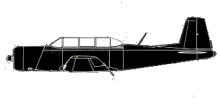
Nanchang CJ-6A
Owner/operator: G&C CJ6 LLC
Registration: 
C/n / msn: 3051217
Fatalities: Fatalities: 1 / Occupants: 1
Other fatalities: 0
Airplane damage: Written off (damaged beyond repair)
Location: Kern County NW of Tehachapi, CA - United States of America
Phase: Unknown
Nature: Unknown
Departure airport:

Destination airport:

Narrative:
The aircraft impacted desert terrain at Walong northwest of Tehachapi, California. The aerobatic airplane sustained substantial damage and the sole pilot on-board was fatally injured.

Sources:
http://www.kerngoldenempire.com/news/local-news/kern-county-fire-responding-to-report-of-downed-plane-near-keene/700702663
http://www.turnto23.com/news/breaking-news/plane-crash-reported-near-keene
http://www.asias.faa.gov/pls/apex/f?p=100:95:12346949782303::NO::P95_EVENT_LCL_DATE,P95_LOC_CITY_NAME,P95_REGIST_NBR:27-APR-17,KEENE,N192NG
http://registry.faa.gov/aircraftinquiry/MMS_results.aspx?Mmstxt=05618Z9&Statetxt=AZ&conVal=0&PageNo=1
http://www.airport-data.com/aircraft/photo/000939888.html

63 oil and gas extraction workers died from a fall during 2005-2014, resulting in an average of 6.3 fatalities per year.


Fall Fatalities among Oil and Gas Extraction Workers, 2005-2014

Posted on by Krystal L. Mason, ScM; Kyla D. Retzer, MPH; Ryan Hill, MPH; and Jennifer M. Lincoln, PhD
Figure 1
Previous research has shown that fatality rates for oil and gas extraction workers were decreasing for all causes of death except for those associated with falls. (1) 

A new study from National Institute for Occupational Safety and Health, published in the Morbidity and Mortality Weekly Report, examined risk factors for fatal fall events in this industry during 2005-2014 using data from case investigations conducted by the Occupational Safety and Health Administration (OSHA).  The study found that 63 oil and gas extraction workers died from a fall during 2005-2014, resulting in an average of 6.3 fatalities per year.   

This report found slightly decreasing rates (though not statistically significant) of fatal falls during 2005-2014. While the decreasing rates suggest that safety may be improving, falls are still a leading cause of death in the oil and gas industry and additional interventions could prevent deaths from falls.


Results indicate that the majority of oil and gas extraction workers who died from a fall worked for a drilling contractor and fell from a height of 30 feet or greater. Occupations most commonly involved in a fatal fall were derrickmen, who work up to 90 feet above the rig floor on the derrick board, handling pipe (Figure 1). 

Their work is physically demanding, repetitive, and requires a great deal of concentration. Without proper safeguards, one misstep can result in a fall fatality. Rigging up and down was also identified as a hazardous operation possibly due to the opportunity for miscommunication that is created with the simultaneous movements of large equipment, vehicles, and workers (2).

Fall protection was required by regulation in 54 of the 63 fall fatalities. Fifteen deaths occurred to workers who were wearing a harness, but fell because their harness was not attached to an anchor point. In several of these cases, a visual or verbal check between the driller and the derrickman before drilling operations began may have prevented the fall. This check would ensure the derrickman remembers to tie-off with both his self-retracting lifeline (SRL) and a restraint system* on the derrick board. There were two cases involving incorrect donning of the fall protection harness. Workers must be fitted for the proper size harness and trained on proper donning of their personal fall protection equipment (3). 

Lastly, there were seven cases due to equipment failure. Fall protection equipment should be checked every day.  

Worn, heavily soiled, or damaged equipment should be removed from service and destroyed to prevent future use. The NIOSH Rig Check Form for harnesses and lanyards can be used to ensure only undamaged fall protection equipment is available for use (4).

Greater efforts in fall prevention should target derrickmen and workers engaged in rigging up and down operations. Employers should first consider how to eliminate or control fall hazards by using engineering controls such as automated rig technologies that allow drill pipe to be handled from the rig floor. Where engineering controls are not feasible, administrative controls can be implemented to ensure derrickmen and other workers do not forget to anchor themselves while working at heights (5).  See the video Take Pride in Your Job: Fall Protection. Training on the proper use and fit of PPE can also be used to protect workers from falls (3).

A fall protection plan containing these processes should be available and understandable to workers. The use of existing training tools and ongoing job safety analysis should be completed and shared across companies to improve hazard identification and control during rigging up and rigging down operations (6). 

Additionally, training for self-rescue and rescue of fellow workers who have fallen and are suspended in the air by fall protection equipment should be written into the workplace hazard control program along with emergency response planning (7,8). Companies should ensure plans are being implemented on work sites. The oil and gas extraction industry has experienced a decline in the overall rate of fatalities. However, eliminating the need to work at height, training on how to identify and reduce the hazards of working at height, and proper use, fit, and inspections of PPE are essential in reducing fatal falls in this industry.

Additional research is needed to better understand fall fatalities that occurred outside of OSHA’s jurisdiction, such as self-employed workers. Your assistance with better understanding these worker fatalities would be helpful.  We are also interested in hearing from drilling contractors about the successes and challenges they have experienced with the use of engineering controls that remove the worker from the derrickboard. Please provide your input in the comment section below.

Krystal L. Mason, ScM, is an Epidemiologist in the Pennsylvania State Health Department (formerly with NIOSH).
Kyla D. Retzer, MPH, is an Epidemiologist in the NIOSH Western States Division. 
Ryan Hill, MPH, is an Epidemiologist in the NIOSH Office of the Director.
Jennifer M. Lincoln, PhD, is the Associate Director for Science in the NIOSH Western States Division.

References


    1. Mason KL, Retzer KD, Hill R, Lincoln JM. Occupational fatalities during the oil and gas boom – United States, 2003-2013. MMWR Morbidity and mortality weekly report 2015; 64(20): 551-4.
    2. Retzer KD, Ridl S, Hill R. Oil and Gas Extraction Worker Fatalities 2014 Mid-Year Report: January 2, 1014 – June 30, 2014; 2014. Available at http://www.cdc.gov/niosh/docs/2015-239/pdfs/2015-239.pdf.
    3. National Institute for Occupational Safety and Health. Strategic Precautions Against Fatal Falls on the Job are Recommended by NIOSH. In: Prevention HCfDCa, editor.; 2001.
    4. National Institute for Occupational Safety and Health. Rig Check Fall Protection Inspection Forms; 2012. Available at http://www.cdc.gov/niosh/docs/2011-204c/pdfs/2011-204c.pdf.
    5. National Institute for Occupational Safety and Health. Take Pride in Your Job: Fall Protection; 2009. Available at http://www.cdc.gov/niosh/docs/video/2009-108d/default.html.
    6. National Institute for Occupational Safety and Health. Move IT! Rig Move Safety for Truckers; 2012. Available at http://www.cdc.gov/niosh/docs/video/2012-168d/.
    7. McCurley L. Falls From Height A Guide to Rescue Planning. Hoboken, NJ: John Wiley & Sons, Inc; 2013.
    8. Hsiao H, Turner N, Whisler R, Zwiener J. Impact of harness fit on suspension tolerance. Human factors 2012; 54(3): 346-57.
    9. Mason KL, Retzer KD, Hill R, Lincoln JM. Occupational fatalities during the oil and gas boom – United States, 2003-2013. MMWR Morbidity and mortality weekly report 2015; 64(20): 551-4.
* Two common types of fall protection equipment include the fall arrest system and a fall restraint system. The fall arrest system consists of a vertical lifeline, connectors, lanyard, and harness with an anchorage point overhead, serving to arrest the fall of a worker. The fall restraint system consists of a harness, lifeline and/or lanyard, and a 5,000 pound capacity anchor which keeps the worker from reaching a fall point. There are also climbing assist devices that can be used while the worker is climbing the derrick ladder.

Cal/OSHA Urges Employers to Protect Outdoor Workers from Heat Illness


News Release No.: 2017-29                                                 Date: April 27, 2017

Cal/OSHA Urges Employers to Protect Outdoor Workers from Heat Illness
Fresno—With California’s heat season quickly approaching, Cal/OSHA today hosted a news conference to remind employers that prevention is the best defense for outdoor workers against heat-related illness and death.
A key component of Cal/OSHA’s prevention model includes annual trainings statewide in both English and Spanish. Nisei Farmers League and 11 other agricultural employers co-sponsored training sessions in each language today in Easton. The training highlights the need to protect outdoor workers from heat illness and the requirements under California’s heat illness standard.
“Cal/OSHA continues to enforce the nation’s most comprehensive heat illness prevention regulation, and we will continue our outreach, consultation and training for workers and employers to ensure that workers are protected from the heat,” said Cal/OSHA Chief Juliann Sum.
The risk of heat illness is generally highest for people who work outdoors. Therefore, Cal/OSHA’s prevention approach includes targeted enforcement inspections at outdoor worksites in industries such as agriculture, landscaping and construction during heat season. These inspections ensure compliance with the heat illness prevention standard and the injury and illness prevention standard, which require employers to take the following basic precautions:

1.    Train all employees and supervisors on heat illness prevention.
2.    Provide enough fresh water so that each employee can drink at least 1 quart per hour, or four 8-ounce glasses of water per hour, and encourage them to do so.
3.    Provide access to shade and encourage employees to take a cooldown rest in the shade for at least 5 minutes. They should not wait until they feel sick to cool down. Shade structures must be in place when temperatures exceed 80 degrees Fahrenheit, or upon request.
4.    Closely observe all employees during a heat wave and any employee newly assigned to a high heat area. Lighter work, frequent breaks or shorter hours will help employees who have not been working in high temperatures adapt to the new conditions.
5.    Develop and implement written procedures for complying with the Cal/OSHA heat illness prevention standard, including plans on how to handle medical emergencies and steps to take if someone shows signs or symptoms of heat illness.

The most frequent violation that Cal/OSHA cites during targeted heat inspections is for failure to have a proper written heat illness prevention plan specific to the worksite.  Serious violations are often related to inadequate access to water and shade, and to a lack of supervisor and employee training.

To remain in compliance with the standard, Cal/OSHA encourages employers and worker supervisors to learn more about the standard, which was amended in 2015. Please refer to the Cal/OSHA guidance on the new requirements and the Heat Illness Prevention Enforcement Q&A for more information on the updates.

Additional information about heat illness prevention, including details on upcoming training sessions throughout the state are posted on Cal/OSHA’s Heat Illness Prevention page. Cal/OSHA also has extensive multilingual materials for employers, workers and trainers on its Water. Rest. Shade. public awareness campaign website.
Questions related to heat illness prevention should be directed to Cal/OSHA’s Consultation Services Branch, which provides free and voluntary assistance to employers and employee organizations to improve their health and safety programs. Employers should call (800) 963-9424 for assistance from Cal/OSHA Consultation Services.
Employees with work-related questions or complaints may contact DIR’s Call Center in English or Spanish at 844-LABOR-DIR (844-522-6734). The California Workers’ Information line at 866-924-9757 provides recorded information in English and Spanish on a variety of work-related topics. Complaints can also be filed confidentially with Cal/OSHA district offices.

Storms moving through the Deep South Thursday left damage in southeastern Alabama and west central Georgia


Storms leave damage as they move across Deep South
 

Published 12:36 am Friday, April 28, 2017

The Associated Press


Storms moving through the Deep South Thursday left damage in southeastern Alabama and west central Georgia after flooding caused a death in North Carolina earlier in the week.


Trees are on top of houses and a mobile home is off its foundation along U.S. 29 between Troy and the Banks community, Jeanna Barnes of the Pike County Emergency Management Agency in Alabama said Thursday.


A man was trapped in his home by a fallen tree, Barnes said. To the north, in Montgomery County, fallen trees blocked roads and caused minor structural damage.


Central Georgia was under a tornado watch when a possible twister struck Talbot County, about 90 miles south of Atlanta, on Thursday afternoon. Three homes were damaged, including a mobile home that had a tree fall onto it, said Leigh Ann Erenheim, Talbot County emergency management director. She said a woman inside the mobile home sprained her ankle getting outside, but no one else was hurt.


The storm uprooted trees and snapped power lines, leaving many in Talbot County without power. Erenheim said the storm carved a path that appeared to be the mark of tornado.


“Where it gets into trees it looks like somebody went through with a lawnmower and cut them off,” she said.


No serious were injuries were reported, but the National Weather Service issued at least a half-dozen warnings.


The severe weather came on the anniversary of the day dozens of twisters plowed across the Southeast on April 27, 2011, killing more than 250 people in Alabama. In Montgomery, flags were lowered in memory of the victims as storms rumbled.


In North Carolina, flooding continued Thursday in more than a dozen counties in the eastern part of the state after storms dumped as much as 8 inches of rain in some places earlier this week.


Details emerged about a woman who died after the Highway Patrol said she drove around several barricades and was swept away by floodwaters.
Local news outlets said the car on N.C. 58 was carried away by high water from Contentnea Creek about 8 p.m. Wednesday in Greene County near Stantonsburg. The woman was alone in the car, which was later found by firefighters.


Highway Patrol Sgt. Michael Baker said the victim was 65-year-old Sandra Berry of Kissimmee, Florida.


Transportation department officials found a man’s body Tuesday while removing debris at a bridge over the Neuse River near Smithfield, but the police department said that a preliminary autopsy determined the man’s death wasn’t storm related. That man’s name has not been released.


The American Red Cross opened a shelter in Tarboro as the rain-swollen Tar River rises east of Raleigh.


Schools were closed Thursday for a second straight day in Edgecombe County. The county said on its Facebook page Wednesday that several roads were impassable and that residents on one road outside the town of Pinetops have been evacuated. The county reported nine state roads were closed in the county.

Three Milwaukee County Jail officers blamed each other for failing to document the shutoff of inmate's Terrill Thomas water seven days before he died of dehydration.


3 Milwaukee County Jail staffers point fingers at others in dehydration death


Jacob Carpenter and Dave Umhoefer , Milwaukee Journal Sentinel Published 1:50 p.m. CT April 27, 2017 | Updated 9 hours ago

Milwaukee County Sheriff's Department Lt. Kashka Meadors in court testifying in the inquest into the death of Terrill Thomas. Michael Sears / Milwaukee Journal Sentinel


(Photo: Michael Sears, Milwaukee Journal Sentinel)


Three Milwaukee County Jail staffers blamed each other Thursday for failing to document the shutoff of an inmate’s water seven days before he died of dehydration.

A corrections lieutenant and two officers all said they believed a co-worker had noted in jail logs that staff cut off the water in inmate Terrill Thomas’ solitary confinement cell. Without the notation, other corrections officers and supervisors had no way of knowing Thomas was deprived of water.

The testimony came on the fourth day of the inquest into the death of Thomas, 38, whose untreated bipolar disorder rendered him incapable of asking for help. An inquest is a rarely used legal procedure that allows prosecutors to question witnesses under oath in public before they decide whether to criminally charge anybody over a death. A jury hears the testimony and issues an advisory verdict on whether there’s probable cause to file charges.

The three jail staffers each offered differing accounts of the water shutoff.

Jail Lt. Kashka Meadors testified she ordered a corrections officer, James Ramsey-Guy, to cut off the water going to Thomas’ toilet in his new cell after he flooded a previous cell. Meadors, questioned by District Attorney John Chisholm, said she meant the shutoff order to stay in effect only until Thomas settled down.

She said officers told her the water situation was resolved before she left for the day.

“I was under the impression that it was taken care of, and as well, I briefed my supervisor,” Meadors said.

Ramsey-Guy testified he only shut off Thomas’ cold water and left on the hot water — even though investigators found the entire water system off. Ramsey-Guy said he expected another officer on the jail wing, John Weber, to document the shutoff.

“I was the one that turned the water off, so the officer at the desk was the one who was supposed to log it,” Ramsey-Guy said.

Weber, in turn, testified he didn’t know who issued the order or cut off the water.

The sequence of events was captured on surveillance video. But that part of the tape was overwritten because jail administrators didn’t download it quickly enough.

Testifying on Thursday, a Milwaukee police lieutenant leading the Thomas case, Eric Donaldson, said jail administrators knew early in the investigation about the video and had a corrections captain watch it. But Donaldson said administrators didn’t immediately download the tape or tell him about the captain’s viewing, which amounted to deception.

“It’s unconscionable,” Donaldson said. “It’s like you’re hiding something.”

The jail’s commander, Maj. Nancy Evans, testified Tuesday that she didn’t believe downloading the video was necessary because detectives initially said Thomas died of natural causes. She also said a corrections captain, George Gold, viewed the tape days after Thomas' death and reported to her that the video showed nothing suspicious.

Gold has testified that he saw Ramsey-Guy on the video enter a closet where water valves are located, presumably to turn off the water to Thomas’ cell. Nobody else entered the closet before Thomas’ death, Gold said.

Gold testified he reported this to Evans, but Evans never directed him to write a report or share the information. Evans denied the exchange.

Jail administrators finally downloaded the video around the time the Journal Sentinel questioned them about inmate accounts that Thomas might have died of dehydration. A final autopsy report concluding Thomas died of dehydration didn’t come until early September.

Sheriff David A. Clarke Jr. has not commented publicly about the details of the case or any administrative changes he’s made. Evans and the jail’s second-in-command, former deputy inspector Kevin Nyklewicz, have testified that jail staff committed numerous policy violations leading up to Thomas’ death.

Clarke has complained publicly that the news media fail to more prominently report on Thomas’ poor physical health and the charges that landed him in jail — neither of which had any bearing on his death.

The inquest is expected to finish early next week. Prosecutors have not said who is under consideration for criminal charges.


====================


April 25 (UPI) -- A Milwaukee County Jail inmate went seven days without water before dying of dehydration, prosecutors said at an inquest into the man's death.

Terrill Thomas was mentally unstable and unable to ask for help before he was found dead on April 24, 2016, Assistant District Attorney Kurt Benkley told jurors on Monday.

The cause of death was ruled "profound dehydration" and the medical examiner classified it a homicide.

The jury's advisory verdict could determine whether jail staff should be criminally charged.

Thomas had been placed in solitary confinement after using a mattress to flood his cell in the special needs unit, where he was kept for his bipolar disorder.

Milwaukee County Jail Lt. Jeffrey Andrykowski and corrections officer Decorie Smith both testified that they were never told the water in Thomas' new cell was turned off and that Thomas never asked for water.

Benkley said in his opening statement three corrections officers allegedly were captured on surveillance video cutting off Thomas's water supply. They never turned it back on and failed to document the action or alert supervisors.