MEC&F Expert Engineers

Tuesday, January 10, 2017

Redhawk Roofing fined $64K for four repeated safety violations after employees worked at heights up to 23 feet while roofing a residential home in Winnetka without adequate fall protection.

U.S. Department of Labor

January 9, 2017

OSHA finds workers exposed to multiple
fall hazards while roofing Winnetka home
Employer name:
Redhawk Roofing Inc.
Libertyville, Illinois 60048
Inspection site:
865 Gordon Terrace
Winnetka, Illinois 60093
Citations issued: Dec. 16, 2016

Investigation findings: The U.S. Department of Labor's Occupational Safety and Health Administration cited Redhawk Roofing for four repeated safety violations. OSHA initiated an investigation after observing employees working at heights up to 23 feet while roofing a residential home in Winnetka without adequate fall protection.

The agency's October 2016 inspection found the company exposed workers to:
  • Fall hazards due to lack of adequate fall protection, improper rigging of fall protection systems and allowing workers to carry loads up ladders.
  • Eye injury while operating pneumatic nail guns and electric saws without eye protection.
OSHA cited the company for these hazards previously in 2014 and 2015.

Quote: "Each year, hundreds of workers suffer severe injuries when they fall on the job," said Angeline Loftus, area director of OSHA's Chicago North Office in Des Plaines. "Redhawk Roofing needs to immediately review its safety procedures, and follow OSHA standards to protect workers on the job before disaster strikes."

Proposed Penalties: $63,494

View Citations here.

To ask questions, obtain compliance assistance, file a complaint, or report workplace hospitalizations, fatalities or situations posing imminent danger to workers, the public should call OSHA's toll-free hotline at 800-321-OSHA (6742) or the Chicago North Area Office at (847) 803-4800.
# # #

The Landtek Group Inc., a New York-based general contractor that specializes in sports facility design and construction, faces $197K in fines for safety violations


U.S. Department of Labor

Jan. 9, 2017

OSHA cites New York contractor for exposing workers
to excavation hazards at high school construction site
Contractor faces $197K in fines after complaint leads to inspection

VERONA, N.J. - Acting on a complaint in June 2016, the U.S. Department of Labor's Occupational Safety and Health Administration found employees of one of the area's largest general contractors working in an unprotected 10-foot deep excavation at a suburban New Jersey high school, in violation of federal safety and health laws. OSHA announced today it has issued citations for nine violations - one willful and eight serious - to The Landtek Group Inc., a New York-based general contractor that specializes in sports facility design and construction. The company faces $197,752 in fines as a result.

The citations - issued on Dec. 20, 2016 - follow an OSHA inspection at Verona High School in Verona on June 22, 2016, where the agency found that Landtek allowed its workers to enter and work in an unprotected, 10-foot deep excavation that had no protective systems in place, as required. Landtek is the general contractor for site improvements at Verona High School, including the construction of new tennis courts and synthetic turf fields.

"Without needed protections in place, an excavation can quickly become a grave as thousands of pounds of soil collapse upon workers below ground. The Landtek Group must re-examine its safety procedures and take all available precautions - including installing shoring or other means - to prevent unexpected movement or collapses of the soil that can lead to disaster," said Kris Hoffman, director of OSHA's Parsippany Area Office.

The contractor was cited with a willful violation for exposing workers to cave-in hazards because the excavation lacked proper cave-in protection or safeguards.

OSHA cited serious violations related to Landtek's failure to prevent employee exposures to fall, atmospheric and explosion hazards. The company also failed to:

Trenching Injuries & Deaths chart. Chart shows both Trench-Related Fatalities. Trench-Related Reported Injuries. 2012: 8 fatalities, 2 injuires 2013: 15 fatalities, 2 injuires 2014: 11 fatalities, 13 injuires 2015: 11 fatalities, 16 injuires 2016(YTD): 23 fatalities, 12 injuires Source: osha.gov. https://www.osha.gov/SLTC/trenchingexcavation/index.html
  • Have a competent person inspect the excavation.
  • Have a written permit space program.
  • Train employees on safely performing their job duties and the hazards associated with them.
  • Coordinate rescue and emergency services for workers entering a sewer manhole.
  • Provide mechanical retrieval equipment in case of an emergency.
The citations can be viewed at https://www.osha.gov/ooc/citations/TheLandTekGroupInc_1158268.pdf

The employer has 15 business days from receipt of its citations and proposed penalties to comply, request a conference with OSHA's area director or contest the findings before the independent Occupational Safety and Health Review Commission.

OSHA has a national emphasis program on trenching and excavations. The trenching standards require protective systems on trenches deeper than 5 feet, and soil and other materials kept at least 2 feet from the edge of trench.
To ask questions; obtain compliance assistance; file a complaint; or report amputations, eye loss, workplace hospitalizations, fatalities or situations posing imminent danger to workers, the public should call OSHA's toll-free hotline at 800-321-OSHA (6742) or the agency's Parsippany office at 973-263-1003.

Under the Occupational Safety and Health Act of 1970, employers are responsible for providing safe and healthful workplaces for their employees. OSHA's role is to ensure these conditions for America's working men and women by setting and enforcing standards, and providing training, education and assistance. For more information, visit http://www.osha.gov.
# # #

Monday, January 9, 2017

NEW JERSEY SPEEDY TRIAL ACT: Starting in January, if a person is held in jail, prosecutors will have 90 days to get an indictment, and then have 120 days to bring the person to trial

 Here you will find information related to the efforts of the Judiciary and its criminal justice reform partners in state, county and municipal government to implement bail and speedy trial reform and to form a pretrial services unit.

On Jan. 1, 2017, the state shifted from a system that relies principally on setting monetary bail as a condition of release to a risk-based system that is more objective, and thus fairer to defendants because it is unrelated to their ability to pay monetary bail. The statute also sets deadlines for the timely filing of an indictment and the disposition of criminal charges for incarcerated defendants. 


Q&A [+]
How will the speedy trial component work? [-]


The speedy trial component will set limits on the amount of time a defendant can remain detained before trial. There are three distinct speedy trial limits: 


1) from arrest to indictment,
2) from indictment to trial, and
3) an overall limit from detention to trial 


The law contains appropriate extensions of time for pretrial motions, competency hearings, plea negotiations, the consent of the parties, and other excludable time. 

How did we get here? [-]


The move to reform the state's criminal justice system grew from the work of the Joint Committee on Criminal Justice, a special committee of the Supreme Court established by Chief Justice Stuart Rabner to examine the issues of bail and speedy trial reform. The committee included the attorney general, public defender, judges and representatives of the executive and legislative branches, county prosecutors, defense counsel, court administration and the American Civil Liberties Union. 


It drafted a series of recommendations that were incorporated into landmark legislation. In addition, voters in November 2014 approved a constitutional change that becomes effective in January 2017 to permit judges to keep high-risk defendants detained without bail.

==========

Reforms bringing 'seismic shift' in bail, speedy trials, court officials say


A half day seminar was held at Essex County College attended by judges, prosecutors, attorneys and members of law enforcement which outlined reforms to the criminal justice starting in January designed o reduce the time defendants wait for bail hearings, and reduce the wait for a trial. Newark, NJ 9/15/16 (Robert Sciarrino | NJ Advance Media for NJ.com)
Robert Sciarrino | NJ Advance Media
By Tom Haydon | NJ Advance Media for NJ.com
 
on September 15, 2016 at 7:46 PM, updated September 17, 2016 at 6:42 PM


NEWARK -- In just over three months, New Jersey state courts will implement the most significant changes in decades in N.J. bail procedures, legal officials said at a seminar on Thursday.

Starting in January, if a person is held in jail, prosecutors will have 90 days to get an indictment, and then have 120 days to bring the person to trial, state judicial officials explained.

The reforms are aimed at cutting the number of people held on minor charges while keeping other defendants locked up without bail if they pose a threat to public safety and providing speedy trials for those held behind bars. Defendants now wait up to three years or more to come to trial, officials said Thursday.

State Supreme Court Chief Justice Stuart Rabner, speaking at the seminar, said people are often incarcerated for minor offenses because they are unable to post a low amount of bail.

Acting AG will prepare study on costs and hurdles related to "sweeping reforms" to criminal justice system.

"Even if they pose a minimal risk of flight, they can sit in jails for weeks, months," Rabner told the audience made up of judges, prosecutors, defense attorneys, public defenders and police and sheriff's officers. "They can lose jobs. They can lose contact with family."

Rabner cited statistics that one in 12 defendants remain in jails because they can't post bail of $2,500.

"We have the opportunity today to set our system on a better path," Rabner said.

Under the reforms, prosecutors will have to file a motion to keep a defendant locked up. Judges will make decisions at detention hearings that must be held within three days after a suspect is jailed.

"Bail reform is going to change everything in the judicial system. We will not lightly seek to detain an individual before trial," said Elie Honig, director of the Division of Criminal Justice in the state Attorney General's Office.

However, Honig said prosecutors want to detain anybody who threatens the safety and security of the public. He said witnesses to serious crimes often change their statements when they know a defendant is out of jail. The reforms will allow prosecutors to request that suspects be held without bail.

Previously, state law allowed a judge to deny bail only to defendants charged with offenses punishable by the death penalty. But the state abolished the death penalty in 2007.

Once the judicial reforms kick in courts will begin holding hearings on Saturdays, officials said.

State Public Defender Joseph Krakora said judges will review several factors in determining whether to keep a defendant in jail, including prior criminal offenses, prior failures to appear in court, and offenses committed while awaiting trial for another crime. The state has worked with a consultant to develop procedures for assessing defendants.

Judges will be able to decide to release persons with conditions, such as a curfew or a bracelet monitor. A new pre-trial services staff will supervise defendants who are released.

For defendants held on bail, defense lawyers will be able to come back within weeks and argue that the defendant is being detained solely because he can't afford the bail.

"This is a seismic shift. You have to get out of the culture of money bail," Krakora said.

Often as a trial lawyer, Krakora said, he saw defendants kept in jail because they could not post $1,000 or $500 bail. "There is no correlation that someone is more likely to come to court if they post bail," he said.

Two measures passed in recent years allowed for the development of the reforms. One was a bill Gov. Chris Christie signed into law establishing an alternative pre-trial release system so poor defendants are not stuck in jail because they can't afford bail. The other was a proposal approved by New Jersey voters to amend the state constitution allowing judges to deny pre-trial release to some defendants charged with serious crimes.

Similar seminars on the reforms will be conducted throughout the state in coming weeks.


=======


Editorial: Right to ‘speedy trial’ is in Constitution
NorthJersey 7:38 p.m. ET Dec. 29, 2016


In 2017, a large number of people charged with crimes in New Jersey will not go directly to jail. And that is a good thing. More important, it is a constitutional thing.

The Sixth Amendment states, “In all criminal prosecutions, the accused shall enjoy the right to a speedy and public trial.” That hasn’t always happened. Not at all. It is possible for defendants to sit in county jails for many months for a minor offense.

“We’ve got people waiting in jail for trial for minor offenses for over a year because they can’t raise $2,500 bail, and at the same time we have defendants accused serious crimes who have no trouble making even very high bail, and they are released," a judge told Record Staff Writer Jim Norman.


Reforms that will go into effect starting Sunday will not result in the random release of violent defendants, but rather ensure that individuals charged in non-violent cases will more often than not be released with limited restrictions. Someone charged, for example, with murder would have no option for bail or release at all.

Judges will use a three-part risk assessment to determine whether the defendant is a flight risk or a danger to the community, and whether he or she may try to threaten witnesses or victims. Giving judges the discretion to decide whether to set bail or not makes sense. Judges are in the best position to decide on a case-by-case basis.

As Norman reported, about 20 additional judges will need to be appointed statewide. Each new judge will require office space, support staff and a minimum of three county sheriff’s officers to ensure order in courtrooms. Courts will probably have to be operational on weekends as well, to ensure that criminal complaints are filed within 48 hours from when a defendant is detained in a county jail.

So this will not save money. That was not the point. Defendants, regardless of their financial circumstances, have a constitutional right to a “speedy trial.” County jails should not be filled with defendants who are never flight risks or dangerous.

Bail bondsmen are expected to take a big hit after these reforms are implemented. One owner of a bail bond business told The Record it would “take away 99 percent” of his industry’s business. That is not a reason for a judge to impose bail.

In 2014, New Jersey voters supported a constitutional amendment that prevents the most violent defendants from being released back into communities while they await trial. But there are distinctions to be made between an accused murderer and someone languishing for more than a year in a county jail on a minor offense.

Our only concern is that these reforms may not apply retroactively and defendants currently sitting in jails awaiting trial may not benefit. That should not happen.

The director of the New Jersey Association of Counties, which represents all 21 counties in the state, wants the Legislature to provide some economic relief to cover the costs of these reforms. But these are not new unfunded mandates coming from the state – this is a change in policy that reflects what is written in the Sixth Amendment.

The Constitution is not an unfunded mandate. These reforms come with a cost; so do our guaranteed civil liberties.

William Seckler, 54, plead guilty to workers’ compensation fraud Tuesday in the Franklin County Court of Common Pleas.


Ohio trucker stole comp money while working as delivery driver 


January 06, 2017

Franklin County, OH — A northeast Ohio truck driver on injured workers’ benefits since 1993 is on the hook for $17,000 after pleading guilty to workers’ compensation fraud Tuesday in the Franklin County Court of Common Pleas.

William Seckler, 54, of the village of Andover in Ashtabula County, must pay the Ohio Bureau of Workers’ Compensation (BWC) $14,520 in restitution and $2,530 in investigative costs for working while receiving permanent total disability benefits. A judge also ordered Seckler to serve 180 days in jail, suspended, and four years of community control for the first-degree misdemeanor.

Seckler was employed as a full-time truck driver at the time of his injury in 1993. Acting on a tip, BWC’s Special Investigations Department (SID) started looking at him in 2014 and found him working as a delivery driver for an Amish roofing company.


=======


Holidays bring convictions to 3 workers’ comp cheats
January 6, 2017


A northeast Ohio truck driver on injured workers’ benefits since 1993 is on the hook for $17,000 after pleading guilty to workers’ compensation fraud Tuesday in the Franklin County Court of Common Pleas.

William Seckler, 54, of the village of Andover in Ashtabula County, must pay the Ohio Bureau of Workers’ Compensation (BWC) $14,520 in restitution and $2,530 in investigative costs for working while receiving permanent total disability benefits. A judge also ordered Seckler to serve 180 days in jail, suspended, and four years of community control for the first-degree misdemeanor.

Seckler was employed as a full-time truck driver at the time of his injury in 1993. Acting on a tip, BWC’s Special Investigations Department (SID) started looking at him in 2014 and found him working as a delivery driver for an Amish roofing company.

In other news, a Columbus man was convicted for workers’ compensation fraud on Dec. 19 after falsifying his job search forms in order to receive non-working, wage-loss benefits from BWC.

Alfonso R. Hooper, 66, pleaded guilty to a first-degree misdemeanor count of workers’ compensation fraud after SID found he falsely claimed to have applied for work at more than 40 potential employers listed on his job search forms.

A Franklin County judge sentenced Hooper to 30 days in jail, suspended, and one year of community control. The judge also ordered Hooper to pay BWC $5,000 for its investigative costs.

In a court case Dec. 30, a central Ohio man was convicted for failure to comply after BWC found he was operating four gas stations in the Youngstown area with lapsed workers’ compensation policies.

A judge in Niles Municipal Court convicted Muhammad Rashid, 36, of Hilliard, Ohio, on a minor misdemeanor count of failure to comply and fined Rashid $100 and court costs.

Rashid worked with BWC to become compliant with three policies, but not on the fourth. Rashid later filed paperwork with BWC stating he closed that business and paid the outstanding balance due of $2,824.

To report suspected cases of workers’ compensation fraud, call 1-800-644-6292 or visit bwc.ohio.gov.

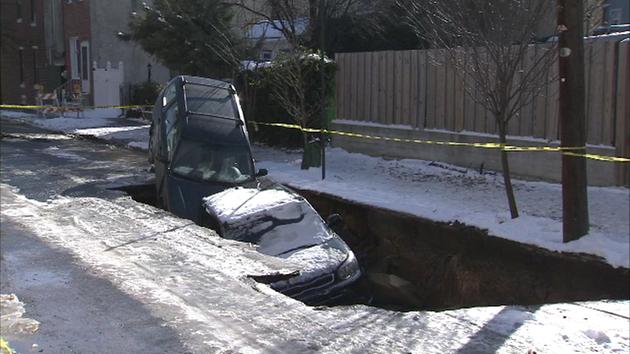
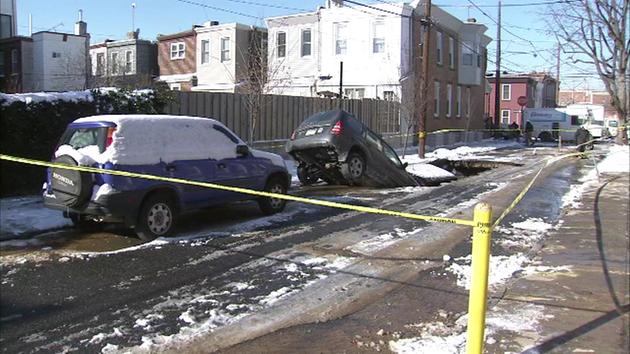
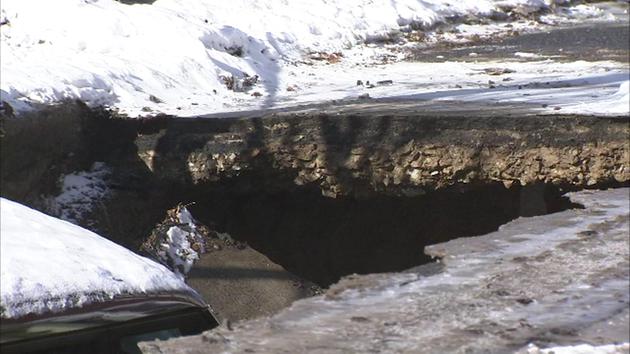
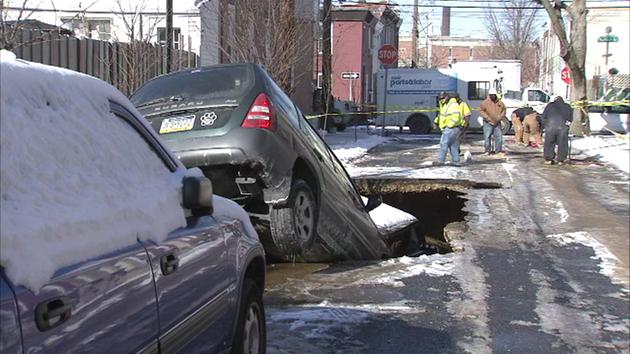
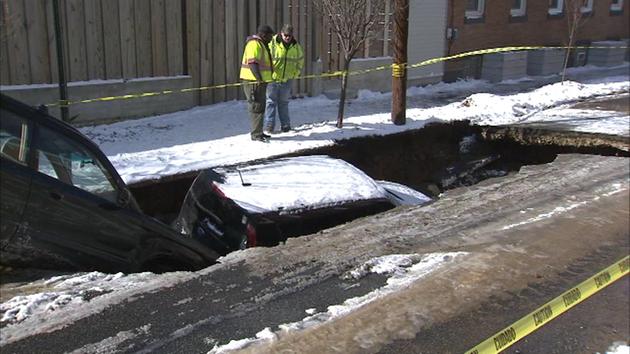
A six-inch water main ruptured, opening up a 40-feet-by-50-feet sinkhole in the 2300 of East Boston Street in Kensington, NJ


Repairs continue at Kensington sinkhole site


Philadelphia Water Department crews were back at work Monday in the 2300 of East Boston Street in Kensington. (WPVI)

By Annie McCormick
Updated 1 hr 59 mins ago
KENSINGTON (WPVI) -- Philadelphia Water Department crews were back at work Monday in the 2300 of East Boston Street in Kensington.

They are working to repair a six-inch water main that ruptured before 9 a.m. Sunday, opening up a 40-feet-by-50-feet sinkhole that caused much of the block to collapse.

"It was a frustrating, long day," said Alyssa Banks.


A water main break caused a large sinkhole to open up in the Kensington section of Philadelphia.

Banks' brand new car was one of two vehicles swallowed up in the hole.

"I'm a little overwhelmed," she said. "When I came out in the morning it took a little... it's not part of your visual vocabulary to come out and see your car in a big, giant hole."

The sinkhole is now a neighborhood curiosity. Kids took it Monday morning on their way to school.

"It's not surprising in this neighborhood," said resident John Sharkey. "It's happened a bunch of times."

Shortly before the ground opened the water department was already on scene responding to complaints of low water pressure and leaks inside residents' basements.


Crews handed out water to people who decided to stay in their homes. Officials tell Action News the water could be back on sometime later Monday or on Tuesday.

The city can't say yet if aging infrastructure or weather caused the break.

Repair crews were expected to be out at the scene all day on Monday.

According to the water department, the street will remain closed for about a week, but there has been no word how long it will take to fix the other the problems related to the sinkhole.