


New Jersey Transit to require conductors to ride with engineers
By MICHAEL BALSAMO
Thursday, October 06, 2016 05:01AM
HOBOKEN, New Jersey -- New Jersey Transit issued a directive to conductors requiring them to ride with engineers in the front of trains that pull into Hoboken Terminal.
The bulletin instructs conductors to move to the controlling car's cab after the eastbound train leaves the last stop before Hoboken or Atlantic City.
"Conductor and the engineer are to focus exclusively on the railroad, calling signal, checking the route and ensuring that the train is operated safely in compliance with all rules and restrictions."
The directive takes effect at 12:01 a.m. Saturday.
The directive, for the conductor to effectively serve as a second set of eyes and ears during the last segment of trips, comes after last Thursday's crash. The New Jersey Transit train engineer, Thomas Gallagher, claims he does not remember anything, a classic criminal defense move. This guy, Thomas Gallagher, obviously was distracted by something (a cell phone, a text, sexting, sex in the train cab, etc.) or perhaps had a medical condition. If he believes that we will not find out, he is wrong.
============
New Jersey train engineer, Thomas Gallagher, says he can't remember fatal crash so that he can avoid criminal negligence prosecution
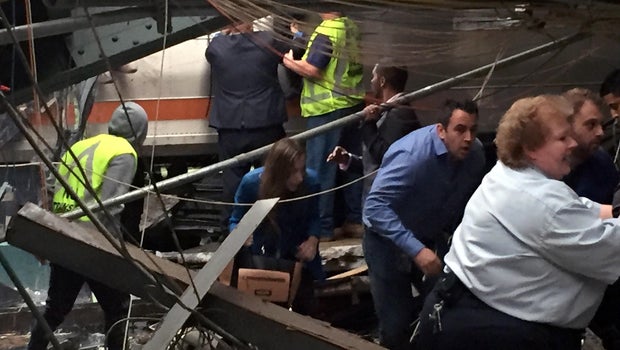
Passengers rush to safety after a NJ Transit train crashed in to the platform at the Hoboken Terminal September 29, 2016 in Hoboken, New Jersey. New Jersey emergency’s management system is reporting more than 100 people were injured in the crash.
Pancho Bernasconi, Getty Images
HOBOKEN, N.J. The engineer at the controls of the train that smashed into a commuter rail terminal, killing a woman and injuring more than 100 people, told federal investigators he was going only 10 mph as he approached the station but has no memory of the crash, federal investigators said.
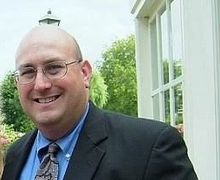
Thomas Gallagher. He claims that he does remember anything, a classic criminal defense move because he knows what he did wrong.
The statements from the engineer, Thomas Gallagher, came as investigators learned that an event data recorder that was supposed to record the New Jersey Transit train’s speed and braking information wasn’t functioning, according to the National Transportation Safety Board Vice Chair T. Bella Dinh-Zarr. Investigators haven’t been able to extract a second datarecorder, located in the cab control car in the front of the train, because it is under a collapsed section of the station’s roof.
“It’s likely that it’s a newer event data recorder in the lead passenger car, the controlling car, so we’re hopeful that will have information that will be functioning,” Dinh-Zarr said at a Sunday news conference. “We’ll just hope that the front event data recorder was working.”
Federal regulations require commuter trains to have a working recorder in the lead car, according to Jim Southworth, the NTSB’s lead investigator for the crash.
The regulations also require the recorders to be inspected every year. It was unclear when the recorders in the train were last inspected.
Federal officials said the recorder was an older device installed in 1995. An unknown number have had to be replaced over the years as they failed.
Gallagher told investigators that he was fully rested and that the train was operating properly Thursday morning before it crashed in Hoboken. Killed was Fabiola Bittar de Kroon, 34, who had paused her legal career, leaving the software company SAP in Brazil after her husband got a job with an international liquor company.
The 48-year-old train engineer told federal investigators that he remembered blowing the train’s horn and looking at the speedometer as he pulled into the station and said the train was going 10 mph, Dinh-Zarr said. But, Gallagher told the investigators that he had no memory of the crash and only remembered waking up on the floor of the engineer’s cab, she said.
Officials said they hoped to be able to gain access to the front of the train in the coming days.
The signals on the tracks leading to the train terminal appeared to working normally and officials have so far found no track problem that would have affected the train’s performance, the NTSB said. Investigators also obtained video from other trains in the station, but found nothing of value, Dinh-Zarr told reporters.
As commuters got back to the Monday grind, crews at the Hoboken terminal continued demolition, working to get closer to the second data recorder buried beneath debris.
“Yea it’s a little bit frustrating,” commuter Melissa Vignone told CBS New York. “I feel sorry for the people, for the innocent people who just want answers.”
“I’d rather they take their time and figure out what’s going on,” commuter Patrice Jones told CBS New York. “If you really want to figure it what happened, I don’t think anything is going anywhere. Get it right.”
Months before Thursday’s deadly train crash, federal rail officials found dozens of violations during an audit that focused on NJ Transit’s safety and operations, a U.S. official told The Associated Press.
The official, who was familiar with the Federal Railroad Administration audit, wasn’t authorized to speak publicly about an ongoing investigation and spoke to the AP on condition of anonymity.
The audit was launched after the federal regulatory agency noticed an uptick in rail incidents and found “dozens of safety violations” that needed to be fixed immediately, the official said. The commuter rail agency was fined as a result.
A spokesman for NJ Transit hasn’t responded to requests for comment.
On Monday, Democratic Assemblyman John McKeon called on federal and state railroad officials to give a public accounting of safety violations.
“It’s very disturbing to learn that a data recorder pulled from the crashed NJ Transit train in Hoboken wasn’t working. This is inexcusable,” he said.
Since 2011, NJ Transit trains have been involved in more than 150 accidents that caused more than $4.8 million in damage to tracks or equipment and has paid more than $500,000 to settle safety violations, according to federal data.
Information from the Federal Railroad Administration shows that NJ Transit has settled 183 safety violations - ranging from employee drug and alcohol use to violations of railroad operating rules or practices - since Jan. 1, 2011.
Below we write the story of the other train engineer, Brandon Bostian, with "foggy memory". These guys know the trick (just like Hilary Clinton during the FBI investigation): I remember nothing.
==========


Distracted Amtrak engineer in deadly Philadelphia train derailment made ‘standard human error,’ safety board says
BY Meg Wagner
NEW YORK DAILY NEWS
Updated: Tuesday, May 17, 2016, 11:28 AM
The engineer at the helm of the Amtrak train that derailed in Philadelphia last year, killing eight people, made a “standard human error” when he got distracted during the ride, investigators said.
Engineer Brandon Bostian turned his attention to radio chatter — dispatchers were discussing a nearby commuter train struck by a rock — just before his Amtrak flew off the rails, officials said Tuesday during a National Transportation Safety Board meeting to determine the cause of the fatal May 2015 wreck.
“The probable cause of the accident was the engineer’s acceleration to 106 mph as he entered a curve with a 50 mph speed restriction due to his loss of situational awareness because he attention was diverted to an emergency situation with another train,” the board said in a statement.
While investigators listed the absence of a key backup system — which would have slowed the speeding train — as a contributing factor, they insisted Bostian's distraction was mainly to blame.
Year after fatal Philly Amtrak crash, vics mad over no answers
“He went, in a matter of seconds, from distraction to disaster,” said Robert Sumwalt, the lead NTSB investigator on the derailment case.

Amtrak engineer Brandon Bostian was distracted by radio chatter just before his May 2015 train flew off the rails, investigators said. (Huy Richard Mach/AP)
“This is really not a complex error. It’s a very basic error,” Sumwalt said. “But in this case it was a very costly error.”
NTSB investigator Steve Jenner agreed.
“This is a standard human error,” he said. “(Train engineers) have no more of the right stuff than pilots — or anyone else.”
Philadelphia Amtrak derailment was caused by radio distraction
The engineer's full-throttle acceleration would have made sense for someone who thought he had already passed the curve, Jenner said. After the curve, the tracks open up into a straightaway with a speed limit of 110 mph.

Bostian, who has been suspended without pay since the crash for speeding, did not attend the hearing.
Christopher Hart, chairman of the National Transportation Safety Board, also said a key backup safety system, called positive train control, was not in place at the accident site and would have provided a "technological safety net for inevitable human error."
Positive train control is designed to automatically slow a train that's exceeding the speed limit.
Amtrak engineer had 'very foggy memory' following 2015 crash
If the system had been in place, "we would not be here today," said Ted Turpin, an NTSB investigator.

Eight people were killed in the May 2015 wreck. (Patrick Semansky/AP)

The Amtrak passenger train derailed in Philadelphia as it traveled to New York City. (Joe Marino/New York Daily News)
Hart also said that the train's emergency windows dislodged as the derailed train cars slid on their sides, allowing some passengers to be ejected.
Bostian — regarded by friends for his safety-mindedness and love of railroading — apparently commented in an online forum for train enthusiasts on a range of industry issues, including safety. Some of the posts lamented that railroads hadn't been fast enough to adopt technology that can prevent trains from going over the speed limit.
Eight people on board the New York City-bound train were killed. Dozens more were injured.


 Photo credit: Emirates News Agency
  Photo credit: Emirates News Agency
  Photo credit: Emirates News Agency
  Photo credit: Emirates News Agency

