This blog presents Metropolitan Engineering Consulting & Forensics (MEC&F) claim management and claim investigation analyses of some of the typical claims we handle
Emergency
officials in Catawba County say the pilot of a vintage aircraft has
died after the plane crashed into a building in Long View.
Emergency services responded to a call of a plane crash that happened near a BB&T Bank on Saturday afternoon.
Long
View Fire Department, Hickory Rescue Squad and N.C. State Troopers are
on the scene after a small red plane was found in the 3200 block of 1st Avenue SW.
Catawba
County Emergency Manager Karen Yaussy said 81-year-old George Baxter
Harris of the Hickory area was the only person onboard the Culver PQ-14A
when it crashed Saturday around 1:10 p.m. The Federal Aviation
Administration says the aircraft was headed to Hickory Regional Airport
when it crashed, adding that it had also left from the airport earlier.
The
National Museum of the U.S. Air Force says on its web page that the
Culver Aircraft Corp. built three basic models in quantity for the Army
in 1940. The PQ series was initially designed as radio-controlled target
aircraft for training anti-aircraft artillery gunners for the Army and
the Navy.
DEWEY BEACH, Del. The Delaware State Police are currently investigating a crash involving a Jolly Trolley south of Dewey Beach, CBS WBOC affiliate reports.
Police say the crash occurred around 4:41 p.m. when a 76-year-old Lewes man was operating a 2005 Ford Econo van, pulling the Jolly Trolley with approximately 22 passengers on board, who were wedding guests. For an undetermined reason, police say the trailer started to sway and then overturned in the southbound lanes on Route 1. The van immediately stopped and bystanders in the area began assisting, pulling passengers from the trolley. At least 12 people were transported by Sussex County EMS to nearby hospitals where they were treated for non-life threatening injuries. The operator of that van was uninjured.
No citations were issued; the cause of the crash remains under investigation. Route 1 northbound and southbound was closed, but has since been reopened due to that crash.
Further details will be reported upon the updates from the investigation.
If speed did not cause the crash, then the wedding guests were rocking the trailer too much.
1 worker killed, another hurt in trench collapse in American Fork, Utah By Ben Lockhart | Posted Sep 30th, 2016 @ 10:31pm
AMERICAN FORK— A construction worker died after a trench collapsed Friday in American Fork.
Another worker was also trapped in the collapse up to his thigh, according to American Fork Police Lt. Sam Liddiard. Emergency responders helped him out of the collapsed trench. He was able to walk around afterward but was taken to American Fork Hospital by ambulance "as a precaution," Liddiard said.
The incident occurred around 3:30 p.m. at the construction site, 860 E. 500 South, where an unstable trench, more than 6 feet deep, had started to collapse. The man who died had jumped in to try to fix the problem and clear debris, Liddiard said. The injured man had jumped into the trench to help the first man.
Construction crews were digging either a major waterline or sewer line at the time.
The name of 41-year-old man who died was not immediately released. Rescue teams from surrounding fire departments were still trying to recover his body late Friday afternoon, according to Liddiard.
A third worker was temporarily trapped after he jumped in to assist the first two men, but he was able to get out of the trench on his own power.
Workplace investigators were dispatched to the scene to determine what caused the incident. It appears that the trench was not properly shored, if any.
The trench filled quickly with dirt once it destabilized, Liddiard said.
"It wasn't a complete collapse. The dirt just started to roll over the top of them," he said.
The two other workers were taken to the hospital.
There was no update on the injured worker's condition.
The worker who died was an employee of Cap Construction, Liddiard said. A company representative told 2News nobody was immediately available to comment. Crews recovered the body after arriving on scene.
Governor's Office of Emergency Services issues earthquake advisory for surrounding areas
Thursday Posted Sep 29, 2016 at 8:41 AM Updated Sep 29, 2016 at 4:35 PM
By Jose Quintero Staff Writer
Small magnitude earthquakes near the Salton Sea earlier this week prompted state officials to issue an advisory on the possibility of similar or larger earthquakes in the near future.
“California is earthquake country. We must always be prepared and not let our guard down,” said Governor’s Office of Emergency Services Director Mark Ghilarducci in a statement. “The threat of an earthquake on the San Andreas Fault hasn’t gone away, so this is another important opportunity for us to revisit our emergency plans and learn what steps you need to take if a significant earthquake hits.”
Ghilarducci asked the California Earthquake Prediction Evaluation Council, which includes scientists from the California Geological Survey, University of California at San Diego, Southern California Earthquake Center at USC and the United States Geological Survey, to discuss and evaluate a sequence of small earthquakes that recently hit the Salton Sea area.
According to the Governor's Office of Emergency Services, the council “concluded that stresses associated with this recent earthquake swarm may slightly increase the probability between 0.03 percent and 1.0 percent of an additional earthquake as large, or larger, than the Sept. 26 magnitude 4.3” occurring until 9 a.m. on Oct. 4.
The Governor’s Office of Emergency Services has issued an earthquake advisory for the San Bernardino, Kern, Los Angeles, Riverside, Imperial, San Diego, Orange and Ventura counties based on the discussions.
“Local emergency management, government, schools and the public should review their earthquake preparedness plans, maintain awareness and be prepared to take action should the earthquake occur,” the Governor’s Office of Emergency Services said.
USGS Research Seismologist Robert Graves told the Daily Press that these types of advisories should serve as a reminder to residents to take precautionary measures.
“In general, advisories are not common. They have been issued in the past in situations like this where we see somewhat unusual behavior, particularly near our large active faults,” Graves said. “Living in Southern California we are in this together and have to acknowledge and recognize that earthquakes are a part of life.
"They are unpredictable in terms of when, where or how large. But past history has shown us you don’t go very long within a time span where you don't have a strong or major earthquake.”
The San Andreas Fault, which runs through the Cajon Pass, stretches 700 miles through California, and the southern end is estimated to be 50 to 100 years overdue for a large earthquake.
The San Andreas Fault suffered two major quakes in the 19th century — a 7.5 magnitude in 1812 and a 7.9 earthquake in 1857. The San Andreas Fault in Southern California has been quiet since and Southern California hasn’t had a true “Big One,” which is a quake greater than a 7.7 magnitude, since 1857.
Other nearby fault lines include the San Bernardino fault zone near Oak Hills, the Helendale Fault and a fault line that goes through Lenwood. Graves said most of the faults in the High Desert are active faults.
“The San Andreas Fault is a major player but it is not the only fault. But the rate in which (the other faults) have earthquakes is far lower than the San Andreas Fault,” Graves said. “In 1992, there was a large earthquake (magnitude 7.3) called the Landers Earthquake which ruptured north of Indio and east of Barstow. That quake ruptured on a series of faults that prior to that event, the previous earthquake was maybe 60 or 80 thousand years ago. So very infrequent, but obviously an active fault.
“Prediction in a precise sense is not and may never be possible, but with a fault like the San Andreas — (it's) had large earthquakes in the past and will have large earthquakes in the future.”
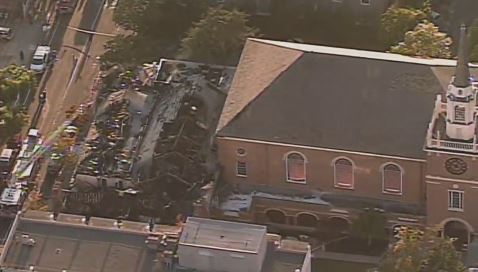
Berkeley fire chief said the flames were so intense, part of the roof collapsed at the church.
By
NBC Bay Area staff
Fire
crews raced on Friday afternoon to battle a four-alarm fire at an
iconic East Bay church just blocks away from the University of
California at Berkeley campus. Elyce Kirchner reports. (Published 3
hours ago)
Fire
crews raced on Friday afternoon to battle a four-alarm fire at an
iconic East Bay church just blocks away from the University of
California at Berkeley campus.
Asst.
Berkeley Fire Chief Donna McCraken said the fire broke out about 12:30
p.m. and the flames were so intense, part of the roof collapsed at the First Congregational Church at 2345 Channing Way.
Fire crew were able to get the blaze under control at 3:20 p.m.
Police are investigating the cause of the fire, including reports of someone lighting matches nearby.
The
fire forced 94 kids and 14 staff members to evacuate from a daycare
inside the church, officials said. A firefighter, who was trapped in the
attic during the initial firefight, had to jump out of a window,
officials said. The firefighter was not injured.
"Fire
crews went inside to try to make an aggressive interior attack and we
discovered that the fire is running through the attack," Berkeley Fire
Chief Gil Dong said.
Aerial
footage showed massive flames spewing from the top of the brick
building. The fast-moving flames triggered a roof collapse and forced
firefighters to back out of the church.
"We
had to go defensive, which means we are spraying water from the
exterior trying to put the fire out from the oustide," Dong said.
Fire officials said 60 firefighters responded to the blaze.
First
Congregational Church, which boasts a "progressive, welcoming
congregation" that serves the East Bay, is a three-minute walk from the
Cal campus.
In
addition to a congregation, the historic building houses a thrift
store, daycare and music venue that were also burned. The church has
also been used as a shelter for the homeless. Officials said that will
not be an option this winter.
"They have a very social presence, so it's a great loss to everybody," Berkeley-resident Laurie Gundling said.
First Congregation Church was built in 1925 and was designed by Horace G. Simpson, according to Berkeley Walks: Revealing Rambles Through America's Most Intriguing City by Robert E. Johnson and Janet L. Byron.
“Oh
man, that’s so sad,” Byron told NBC Bay Area on Friday. She and her
colleague routinely show off the church as one of the highlights on
their walking tours. She said the church’s sanctuary is especially
excellent for acoustics. She added that the particular neighborhood in
Berkeley is extremely dense with other churches nearby, including one
across the street. At one time, her book notes, Berkeley had among the
highest number of churches per capita in the Bay Area.
The
church is well known in liberal Berkeley for performing same-sex
marriages and hosting musical performances, such as the Midsummer Mozart
Festival. Evoloutionary biologists also come to speak there, and
rainbow flags and "Pray for Orlando" are the lead images on the church's Facebook page.
Next week, the church was poised to host a forum for young Christians called "Do No Harm! But take no S*@%."
====================
First Congregational Church of Berkeley, from New England to Progressive Berkeley By Rachel Witte
NBC Bay Area Fire crews raced on Friday afternoon to battle a four-alarm fire at an iconic East Bay church just blocks away from the University of California at Berkeley campus. (Sept. 30, 2016)
A fire so intense it collapsed a roof raged at an iconic Berkeley church on Friday afternoon.
The four-alarm fire broke out at 12:30 p.m. at the First Congregational Church of Berkeley, a church and building that has played a significant role in the history of the city.
The building currently located at 2345 Channing Way was erected in 1925 and was designed by Bay Area architect Horace G. Simpson, according to the book Berkeley Walks: Revealing Rambles through America's Most Intriguing City.
It is the third building of worship for the church and was built in the period revival style, meant to evoke the architecture of early New England churches, according to local historian Steve Finacom. The congregationalist church movement began in New England in the 17th century.
According to its website, the Berkeley congregationalist church was founded on December 1, 1874. It was formed after then University of California President Daniel Gilman issued a call during his inaugural address for moral and religious institutions to build halls near the university.
"What church, what association, what individual will be the first to establish such a hall?" he asked.
The First Congregational Church of Berkeley answered that call. The church's first chapel was located on the southeast corner of Telegraph Avenue and Dwight Way in Berkeley. A second church was built on the northeast corner of Dana Street and Durant Street in 1884. The current church sits on the northwest corner of Dana Street and Channing Way.
Finacom also pointed to the the church's historical significance during the internment of Japanese Americans in the 1940s. When Berkeley's Japanese-American residents were ordered to report to a local fire station to be processed for internment, Finacom said the First Congregational Church of Berkeley stepped in. The church welcomed the residents to come to its church instead, where congregants could provide hospitality as the Japanese-American residents were processed by the U.S. Army.
"It was a wonderfully beautiful thing that the church did," Finacom said. "It's been a progressive church ever since."
The hall where those residents were cared for, Pilgrim Hall, is in the part of the building destroyed by Friday's fire, Finacom added.
Finacom said a different fire in the 1970s destroyed part of the church's north wing, but that area of the building was eventually rebuilt.


 United States of America