MEC&F Expert Engineers

Saturday, October 1, 2016

The Army Corps of Engineers counts 3,262 dams in North Carolina, and 1,210 of those are considered "high hazard potential," meaning any breaches could affect many people

More than a thousand NC dams 'high hazard' if breached


The I-Team examines the condition of North Carolina's many dams.
By definition dams are barriers, but by design they're an integral part of making economies go. When they fail, there are devastating consequences.

Pummeling rains this week in Cumberland County have led to renewed concerns about dams in North Carolina, some of which date to the 18th century - older than our country.

Currently, Cumberland County Emergency Services is working with the City of Fayetteville, Public Works Commission and the North Carolina Division of Environmental Quality to monitor dams in the county affected by flooding and high water.

HOW RELIABLE ARE THESE CUMBERLAND COUNTY DAMS?

Among the dams on notice:
  1. Arran Lake Dam in the area of Bunce Road and Maykirk Drive, is being monitored for high water. No evacuations have been issued.

  2. Long Valley Farm Lake Dam at Carvers Creek State Park has breached and approximately 50 residents in the area of Collingwood Street have been notified by telephone alerts from Emergency Services and door-to-door alerts by Spring Lake firefighters.

  3. Rhodes Pond Dam in northern Cumberland County is experiencing floodwaters over the top of the dam along U.S. 301 Highway. Three residents affected have been notified by telephone alerts from Emergency Services and Godwin-Falcon volunteer firefighters.

  4. Lake Upchurch Dam in the Hope Mills/Parkton area is being monitored for high water. No evacuations have been issued.

  CUMBERLAND COUNTY RESIDENTS DEAL WITH FLOODED HOMES

The Army Corps of Engineers counts 3,262 dams in North Carolina, and 1,210 of those are considered "high hazard potential," meaning any breaches could affect many people. In Cumberland County alone the Department of Environmental Quality (DEQ) monitors 113 dams, including 52 considered "high risk." An ABC11 I-Team review showed the dams are an average of 71 years old.

Officials at the DEQ confirm the state visits high hazard dams for inspections at least once a year, and they encourage residents to play a role in the dam's maintenance. If residents have any questions or concerns about their dam, DEQ engineers are eager to answer those calls at (919) 707-9220.


Ultimately, the responsibility to maintain the dams belongs to the local towns and cities, which is only advised of recommendations from the DEQ. If the DEQ inspectors recommend repairs, thus, the local governments must budget accordingly. It's also up to the local governments to facilitate emergency action plans in case of dam breaches.

There are a number of resources available to learn more about dams, emergency plans and dam maintenance.

LEARN MORE ABOUT DAM SAFETY AT NCDEQ

READ MORE: COMPLETE NORTH CAROLINA DAM INVENTORY (.PDF)

ASSOCIATION OF DAM SAFETY OFFICIALS

Recent major U.S. commuter transportation crashes


Sept 29 (Reuters) - A commuter train derailed and crashed through the station in Hoboken, New Jersey, near New York, on Thursday, killing a woman on the platform and injuring more than 100 people. Here is a list of some recent noteworthy passenger train and commuter ferry crashes:

October 2003: A New York City-operated ferry carrying commuters from Manhattan to Staten Island struck a maintenance pier on Staten Island, killing 10 passengers and injuring 70. An 11th passenger died two months later of from injuries sustained.

January 2005: A Metrolink commuter train hit an unoccupied vehicle near a grade crossing in the Los Angeles suburb of Glendale, derailing and then colliding with a Union Pacific freight train, which was tied down on a siding. Eleven people were killed and more than 100 injured.

September 2008: A Metrolink commuter train collided head-on with a Union Pacific Railroad freight train in Chatsworth, a suburb of Los Angeles, resulting in 25 deaths, including the commuter train's engineer. The force of the collision caused the Metrolink's locomotive to telescope into the lead passenger coach by 52 feet (19 metres). More than 100 injured people were taken to area hospitals.

June 2009: A Washington, D.C., Metro subway train struck the rear of another Metro train stopped ahead of it in the nation's capital, killing the running train's operator and eight passengers, and sending 52 people to hospitals.

January 2013: A high-speed, privately operated passenger ferry traveling from New Jersey to New York struck a pier in Manhattan, seriously injuring four people and resulting in minor injuries for 75 passengers and one deckhand.

May 2013: An eastbound Metro-North commuter train derailed, then collided with a westbound Metro-North train in Bridgeport, Connecticut, injuring at least 65 people.

December 2013: A Metro-North train derailed in New York City's Bronx borough, killing four people and injuring at least 61.

February 2015: A Metro-North train collided with a sport utility vehicle at a railroad crossing in the New York suburb of Valhalla. The collision killed five train passengers and the SUV's driver as hundreds of feet of electrified rail skewered the train's first two carriages.

May 2015: An Amtrak passenger train derailed in Philadelphia after entering a curve at 106 miles per hour (171 km per hour), more than twice the recommended 50-mile-per-hour (80 km-per-hour) speed, killing eight passengers and sending 185 others to hospitals. The locomotive and seven passenger cars went off the rails.

April 3, 2016: An Amtrak train traveling from New York hit a backhoe performing maintenance on the tracks in Chester, Pennsylvania, a Philadelphia suburb, killing the two men working with the construction equipment and resulting in 41 people going to hospitals. A National Transportation Safety Board report determined the men had a right to drive the backhoe on the tracks at the time.


September 29, 2016:  The Hoboken crash.  The crash at Hoboken Terminal on Thursday, involving a morning rush-hour train from Spring Valley, New York, caused one fatality and 108 injuries. Trains were halted and the terminal evacuated as federal transportation investigators headed to the scene, where steel beams, wires and part of a roof rested atop a rail car.

The Hoboken commuter train crash: Positive train control still lacking at New Jersey Transit, the third-biggest railroad


Hoboken Crash Tests a Railroad Beset by N.J. Fiscal Crisis

Elise Young EliseOnDeadline
September 29, 2016 — 1:48 PM EDT Updated on September 29, 2016 — 2:51 PM EDT


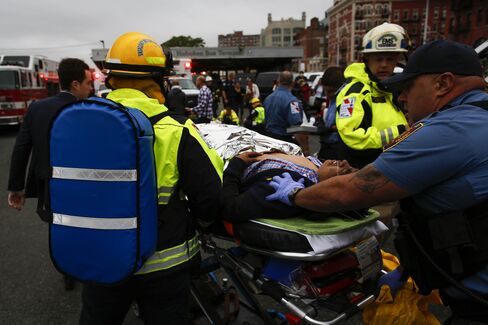
Injured commuters are treated outside the Hoboken Terminal.
Photographer: Eduardo Munoz Alvarez/Getty Images

Crash at Hoboken station while capital funding is on hold


Positive train control still lacking at third-biggest railroad

A fatal train crash that caused structural damage to a major Manhattan-area station exacerbates troubles at New Jersey Transit, which operates one of the nation’s biggest railroads and has been besieged by aging equipment and slipping reliability.

The agency is without a fiscal-year spending plan after the state in August exhausted its $8 billion account for road and rail work. Non-essential projects have been suspended since July as Republican Governor Chris Christie and Democratic legislative leaders squabble over a proposed gas-tax increase to replenish the fund.

The crash at Hoboken Terminal on Thursday, involving a morning rush-hour train from Spring Valley, New York, caused one fatality and 108 injuries, Christie said during a news briefing. Trains were halted and the terminal evacuated as federal transportation investigators headed to the scene, where steel beams, wires and part of a roof rested atop a rail car.

“Christie and the lawmakers don’t seem to to realize how insolvent their state is,” said Nicole Gelinas, a senior fellow who studies urban issues and finance at the Manhattan Institute for Policy Research, which promotes limited government. “He’s happy to raise the gas tax for transportation but he wants the legislature to cut another tax in return. New Jersey can’t afford any tax cuts. They don’t have money for infrastructure. They don’t have money for pensions.”

Federal Railroad Administration records show that none of the passenger fleet is fully equipped with positive train-control technology, designed to prevent the kind of derailment that killed eight Amtrak passengers in Philadelphia last year. New Jersey Transit and other railroads successfully asked Congress for a three-year extension on the October 2015 installation deadline.

Christie said that while it’s clear the train was traveling too fast, it’s too soon to speculate on a cause. The engineer, who was injured in the crash, was cooperating with investigators. The person who died was on the platform, not in the train, he said.

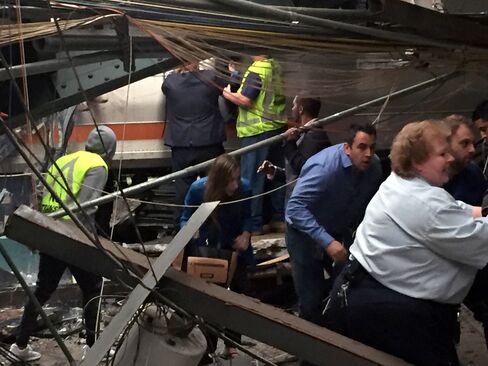
Passengers exit a NJ Transit train after it crashed at the Hoboken Terminal on Sept. 29.
Photographer: Pancho Bernasconi/Getty Images


Routine Delays

Reliability at the nation’s third-largest rail operator is crumbling, with trains breaking down more often as governors paid for daily expenses with money intended for capital improvements. Crowding and delays are routine.

While the Long Island Rail Road, Metro-North and other New York City-area commuter lines poured billions of dollars into new equipment, New Jersey Transit since 1990 has diverted at least $6.6 billion from its capital account to pay for salaries, health benefits and other costs. In recent years, as state and federal transit aid declined, the agency raised fares five times.

“The biggest challenge New Jersey Transit has is a predictable set of financial parameters,” Jishnu Mukerji, a member of the New Jersey Association of Railroad Passengers board of directors, said by telephone. “They’re stuck in a bad place. They don’t have any money. Trenton has never given them the operating budget they need.”

Hoboken Terminal, the state’s fourth-busiest train station, is key to high-paying jobs for New Jerseyans. The terminal, with more than 15,000 boardings on a typical workday, shuttles suburban riders to ferries, buses and Port Authority of New York and New Jersey trains for the final leg to Manhattan, a ride taking as little as 8 minutes.

The station had completed a $175 million restoration and expansion just 10 months before it was inundated by five feet of Hudson River water driven by Hurricane Sandy in October 2012. Full restoration took 17 months as crews worked on salt-damaged electrical lines, rusted track and a moldy Beaux Arts style waiting room.


Cars Destroyed

Sandy also destroyed dozens of rail cars stored in low-lying yards in Kearny and Hoboken, causing at least $120 million in damage. Last October, the agency cut some routes and raised fares an average 9 percent to help close a budget gap.

New Jersey Transit has been run by an interim executive director, Dennis Martin, a veteran of the agency’s commuter bus operation, since December. A permanent replacement, former Amtrak executive William Crosbie, backed out on taking the job this year when he decided not to move his family from Virginia.

Martin’s predecessor, Veronique Hakim, left after less than two years to become president of New York City Transit. She replaced Jim Weinstein, who was criticized for leaving trains vulnerable during Sandy and for unexplained delays and other commuter woes during an event billed as “the first mass-transit Super Bowl.”

It’s uncertain when New Jersey Transit service to and from Hoboken will resume. Dawn Zimmer, the city’s second-term Democratic mayor, said on Twitter that residents should make alternative arrangements for the evening commute and expect delays.

Kenmore Air de Havilland Canada DHC-2 Beaver aircraft crashed and sank after it impacted the waters of the Pacific Ocean at Cattle Pass south of Lopez Island, Washington


Kenmore Air floatplane crashes off Lopez Island


There were four people on board the plane at the time of the crash and all survived.
Travis Pittman , KING 7:48 PM. PDT September 30, 2016


SEATTLE, WA – A Kenmore Air floatplane crashed off Lopez Island and sank Friday. All four people on board were rescued.

The Coast Guard says the crash happened at 9:13 a.m. in Cattle Pass near the south end of the island.

Three men and a woman were on board. The crew of the Northern Rose saw people in the water and rescued them. All passengers were wearing portable floatation devices when they were rescued.

“Kathy (my wife) and I were able to pull them on board," said Daniel Schwartz, the boat's captain. "And Kathy immediately took all their wet clothing off and got them into just about every piece of clothes we had. And had our heater on in the cabin and wrapped them in blankets. And turned around and started back for Friday Harbor.”

"After we pulled everyone in off the boat, we just started saying the Lord's Prayer because we thought there must've been some kind of divine intervention," said Kathy.

"We were just in the right place at the right time," added her husband Dan.

Two were airlifted to Harborview Medical Center in Seattle in fair but stable condition. All four were treated by medics for hypothermia and minor injuries.

The Coast Guard says it was notified by Kenmore Air of an electronic emergency signal just before the plane went down.

The pilot says the plane sank. The Coast Guard says it's too early to know if the plane can be salvaged.

FAA spokesperson Allen Kenitzer said the aircraft is a DHC-2 de Havilland Beaver. All of Kenmore Air's planes of this type are float planes. Kenmore Air regularly uses float planes which are often seen taking off from and landing at Seattle’s Lake Union.

Kenmore’s chief pilot says the plane was a regularly scheduled trip. It left Lake Union to drop off a passenger at Lopez, and was then heading to Roche Harbor on San Juan Island to drop off another two passengers.

It was then expected to pick up passengers and then head back to Lake Union.

The FAA and NTSB will investigate.

FROM KENMORE AIR WEBPAGES:


DHC-2 de Havilland Beaver
The six-passenger piston de Havilland DHC-2 Beaver is the most successful floatplane ever built, and has been the mainstay of our fleet since the early 1960’s. The Beaver sports a thick wing for maximum lift, a sturdy structure and a powerful, reliable 450-horsepower Pratt Whitney R-985 radial engine. The last brand new Beaver came off the line in 1967, however our fleet of Beavers have all been meticulously overhauled by our world-renown aircraft maintenance facility.


Date:

30-SEP-2016
Time: ca 09:00
Type:
de Havilland Canada DHC-2 Beaver
Owner/operator: Kenmore Air
Registration:

C/n / msn:

Fatalities: Fatalities: 0 / Occupants: 4
Other fatalities: 0
Airplane damage: Written off (damaged beyond repair)
Location: between San Juan and Lopez Islands, WA - United States of America
Phase: Unknown
Nature: Non Scheduled Passenger
Departure airport:

Destination airport:

Narrative:
The aircraft impacted the waters of the Pacific Ocean at Cattle Pass south of Lopez Island, Washington. The floatplane sank. The four occupants onboard received minor injuries and were rescued by a passing ship.


Sources:
http://www.sanjuanjournal.com/news/395434561.html
http://www.king5.com/news/local/kenmore-air-plane-crashes-off-lopez-island/328030578
http://www.kiro7.com/news/local/floatplane-crashes-in-san-juan-islands/452166348

Friday, September 30, 2016

Salvage managed to dock chemical tanker YOWA MARU in Kudamatsu Port, vessel was righted, no leak of 450 tons of caustic soda cargo reported


Chemical tanker YOWA MARU with 450 tons of caustic soda sinking, Japan: UPDATE Oct 1

Sept. 30, 2016 at 06:31 by Mikhail Voytenko


Oct 01 UPDATE: Salvage managed to dock chemical tanker YOWA MARU in Kudamatsu Port, vessel was righted, no leak of cargo reported. According to media reports, citing officials, divers found no cracks in the hull, but there were 33 tons of sea water in ballast tank or tanks, which presumably, caused listing. Investigation under way.


Chemical tanker with 450 tons of caustic soda on board reported flooding and heavy list portside at 1045 Tokyo time Sep 30, in Kudamatsu Port, Shunan, Yamaguchi Prefecture, southeast Honshu Island, Inner Japan Sea. Vessel is in danger of sinking, 4 crew safe, salvage under way. It is not clear what happened, probably grounding or touching bottom caused water ingress and list. According to all available information, tanker in question is small chemical tanker YOWA MARU, IMO 8934116, dwt 432, built 1997, flag Japan, manager SEIWA KAIUN KK. No AIS history, AIS is off or not installed.