MEC&F Expert Engineers

Wednesday, September 21, 2016

The North Carolina Department of Labor has fined Sherrills Ford-Terrell Fire and Rescue in connection with the diving accident that took the life of a firefighter


NC FIRE DEPARTMENT FINED $5600 IN SCUBA LODD

September 20, 2016


The North Carolina Department of Labor has fined Sherrills Ford-Terrell Fire and Rescue in connection with the diving accident that took the life of a firefighter.


Bradley Long died while diving for a missing swimmer in Lake Norman.

Click to read the Department of Labor’s document on fine

The citation said Long’s air supply wasn’t adequately monitored. It also states there was an entanglement hazard with a rope.

At least one diver failed to perform an equipment safety check before the dive and there wasn’t a back-up air supply. The fine totaled $5,600.

The department has 15 days to contest the citation.

Channel 9 obtained an autopsy report that said Long drowned because of a buildup of gas in his arteries.

Long and another diver spent 14 minutes searching 82 feet below the surface.

They tried to resurface but Long experienced an emergency at 20 to 30 feet below the surface. Diving experts found the diving equipment had functioned properly.


======


Fire department fined after firefighter Bradley Long's death Tuesday, September 20th 2016, 4:43 pm EDTTuesday, September 20th 2016, 4:43 pm EDT
By WBTV Web Staff


Bradley Long (Photo provided to WBTV by Dion Burleson with the Denver Fire Department) SHERILL’S FORD, NC (WBTV) -

The N.C. Department of Labor has fined Sherrills Ford-Terrell Fire & Rescue in connection to the death of fallen firefighter Bradley Long, who drowned while searching for a missing swimmer in Lake Norman in June.

"The Labor Department cited Sherrills Ford-Terrell Fire & Rescue for two alleged serious violations of the Occupational Safety and Health Act of North Carolina with a total penalty of $5,600," Dept. of Labor officials said in a release Tuesday.

The citation states, in part "in Lake Norman, where, on June 6, 2016, the air supply for two public safety divers was not monitored at intervals adequate to prevent a low or no-air emergency while conducting underwater recovery operations to a depth of 80 feet."

The citation also states that "at least one member of the dive team conducted a recovery dive with the body recovery bag and search rope bag attached to his rig setup, creating an entanglement hazard," and "at least one diver failed to perform and document an equipment check prior to conducting underwater recovery operations to a depth of 80 feet."

It states that during the operation, one diver "was not equipped with a self-contained breathing (redundant) air supply capable of providing enough air for egress in the event of a primary air supply failure."

Long's exact cause of death was under investigation until, in late July, Major Andy Poteat of the Iredell County Sheriff's Office said test results showed Long "ran out of air under water."

Poteat said investigators found no problem's with Long's equipment and no signs of foul play. He said the death was a "tragic accident."


Long's family sent WBTV a statement about the citation and fines Tuesday.

"We stand 100% behind Sherills Ford fire department and know they have the documents necessary for the appeal process," the family wrote.

In late July, officials said that several agencies, including OSHA, were still investigating Long's death, and that his dive equipment was sent to experts.

Major Poteat said he believes it was standard gear and would show how much air was left, but that Long ran out before resurfacing. He would not speculate on why Long ran out of air.

Long and two other firefighters went into the water to search for a 29-year-old man who jumped off a boat and didn't make it out of the water.


Officials said early on that Long and the firefighters experienced an "emergency" in 35 to 75 feet of water, close to where the swimmer went missing. Two divers came out of the water, Long did not, officials said.

"A rescue effort was implemented and when they reached him he had already succumb to his injuries," Catawba County Emergency Management said in June. The two other firefighters went to Regional Medical Center with minor injuries.

Long worked at the Newton Fire Department and was a volunteer with Sherrills Ford-Terrell Fire and Rescue, where he had been a member for 12 years. He was working with Sherrills Ford during the search.

International Union of Marine Insurance (IUMI) Calls for More Action to Tackle Containership Fires


IUMI warning on containership fires -
20 September 2016


The marine insurers’ industry body said industry cooperation is needed to tackle the risk of containership fires, after several recent blazes.


Fires aboard container vessels are the subject of a note from the International Union of Marine Insurance (IUMI).

Two recent fires – aboard the NNCI Arauco in September and the Maersk Karachi in May – have drawn IUMI’s attention to the risk.

More industry cooperation is needed to tackle the challenges involved with managing these incidents at sea, the industry body said.

"At sea, below-deck fires cannot be fought with water and so CO₂ is used instead to displace the oxygen and extinguish the fire. However, if the fire is burning within a container, the box will protect it from the CO₂ and so this method of fire-fighting is rarely successful," said Uwe-Peter Schieder, vice chairman of IUMI’s loss prevention committee.

"Currently there are no other methods of fighting a containership fire below deck. Even on deck, the crew only have access to hoses and nozzles. They do not have sufficient monitors or foam and so cannot cool the vessel’s structure," Schieder added.

IUMI flagged concerns that seafarers are being asked to tackle onboard fires with inadequate equipment.

The association highlighted the unfortunate incident concerning MSC Flaminia when three sailors lost their lives.

The vessel burned for almost six weeks, with 70% of the cargo destroyed and the ship declared a constructive total loss.

Referencing the maritime industry’s Safety of Life at Sea (Solas) regulations, IUMI called for further dialogue involving the UN’s International Maritime Organisation (IMO) and shipping industry stakeholders to improve firefighting capabilities for containerships.

On September 1 2016 a fire broke out on NNCI Arauco while the container vessel was alongside in Hamburg during welding operations, leading to 300 firefighters were deployed to tackle the blaze.

The hold was sealed and flooded with CO₂, but this was unsuccessful, IUMI noted.

Water was then used for flooding the hatch and stopped before stability problems occur. Finally, foam was used to bring the fire under control, added IUMI.

On May 13 2016 a fire on the Maersk Karachi at Bremerhaven port – also caused by welding operations – needed more than 100 firefighters to control the blaze, said IUMI, with water monitors needed to flood the hold to extinguish the fire. "All stakeholders should work together to identify sustainable solutions to protect lives and property at sea," said IUMI.


=========
IUMI Calls for More Action to Tackle Containership Fires


Image Courtesy: Polizei Hamburg

Two recent onboard containership fires have fueled concerns from International Union of Marine Insurance (IUMI) over the challenges involved with managing these incidents at sea as seafarers are being asked to tackle onboard fires with inadequate equipment.

The two recent containership fires which raised concerns involve the 2015-built NNCI Arauco which ignited during welding operations on September 1 while the ship was in Hamburg. Some 300 firefighters were deployed, the vessel’s hold was sealed and flooded with CO₂, however, the attempt to extinguish the fire failed. Water was then used for flooding the hatch and stopped before stability problems occur. Finally, foam was used to bring the fire under control.

The other fire incident occurred on May 13, 2016, when Maersk Karachi caught fire due to welding operations. More than 100 firefighters were deployed to control the blaze and water monitors were needed to flood the hold to extinguish the fire.

“At sea, below-deck fires cannot be fought with water and so CO₂ is used instead to displace the oxygen and extinguish the fire. However, if the fire is burning within a container, the box will protect it from the CO₂ and so this method of fire-fighting is rarely successful,” Uwe-Peter Schieder, Vice Chairman of IUMI’s Loss Prevention Committee said.

He added that there are currently no other methods of fighting a containership fire below deck.

“Even on deck, the crew only have access to hoses and nozzles. They do not have sufficient monitors or foam and so cannot cool the vessel’s structure,” Schieder said.

Apart from the SOLAS regulations, IUMI is calling for further dialogue involving IMO, class, shipbuilders and shipping companies to further improve firefighting capabilities onboard containerships.


===========

IUMI calls for action on fires


Two recent fires onboard containership have increased concerns at IUMI over the challenges involved with managing these incidents at sea Uwe-Peter Schieder, Vice Chairman of the International Union of Marine Insurance's Loss Prevention Committee, explains: “At sea, below-deck fires cannot be fought with water and so CO₂ is used instead to displace the oxygen and extinguish the fire.

"However, if the fire is burning within a container, the box will protect it from the CO₂ and so this method of fire-fighting is rarely successful. Currently there are no other methods of fighting a containership fire below deck. Even on deck, the crew only have access to hoses and nozzles. They do not have sufficient monitors or foam and so cannot cool the vessel’s structure.”

IUMI is concerned that seafarers are being asked to tackle onboard fires with inadequate equipment. The Association highlights the unfortunate incident concerning MSC FLAMINIA where, sadly, three seafarers lost their lives. The vessel burned for almost six weeks, 70% of the cargo was destroyed and the ship was declared a Constructive Total Loss (CTL). 

IUMI is well aware of the SOLAS regulations, but is calling for further dialogue involving IMO, class, shipbuilders and shipping companies to further improve firefighting capabilities onboard containerships. All stakeholders should work together to identify sustainable solutions to protect lives and property at sea.
The two recent containership fires referenced by IUMI are:
  • NNCI ARAUCO - 1 September 2016: A fire broke out whilst alongside in Hamburg during welding operations and 300 firefighters were deployed. The hold was sealed and flooded with CO₂, but this was unsuccessful. Water was then used for flooding the hatch and stopped before stability problems occur. Finally, foam was used to bring the fire under control.
  • MAERSK KARACHI - 13 May 2016: A fire caused by welding operations needed more than 100 firefighters to control the blaze. Water monitors were needed to flood the hold to extinguish the fire.

Millennium Partners knew and the city knew and Transbay knew as early as 2009 that the building was sinking yet we failed to disclose that to the public


Millennium Partners blames sinking of tower on Transbay Terminal excavations
 
The developers of the luxury condo building in San Francisco, the Millennium Tower, spoke to reporters Tuesday for the first time since it was revealed the building is sinking and tilting at an unexpected rate. (KGO-TV)

By Vic Lee
Tuesday, September 20, 2016 07:54PM
SAN FRANCISCO (KGO) -- The developers of the luxury condo building in San Francisco, the Millennium Tower, spoke to reporters Tuesday for the first time since it was revealed the building is sinking and tilting at an unexpected rate.


Millennium Partners held their news conference on the same day San Francisco City Attorney Dennis Herrera formally subpoenaed them as part of his office's investigation into whether the developer complied with state law by disclosing known structural sinking issues to purchasers of more than 400 residential units in the Millennium Tower.

The exclusive residential Millennium Tower sits at the corner of Mission and Fremont streets in San Francisco.


The developers said they held their news conference to stop what they called rampant, reckless speculation and behavior by Transbay officials.

The developers of Millennium Tower revealed that it's groundwater level dropped by a staggering 20 feet when the Transbay Joint Powers Authority or TJPA built an underground buttress wall between the tower and its transit site.


Millennium Partner founder Chris Jeffries said that caused the skyscraper to tilt two inches and sink 16 inches, far more than they expected. "If you dig a 60-foot hole and dewater for six years and drop the water table by 20 feet on a major high rise structure, you're going to cause a problem," Jeffries said.


Whats more, Millennium Partners said it should have been no surprise to Transbay engineers. "TJPA knew well before they began work on the transit and their site that their construction and in particular their de-watering of their site could have a significant impact," Meier said.

"We were promised it would have zero impact on groundwater in our building," Jeffries said.

The developers said the environmental impact study for the transit site required TJPA to install devices to measure water levels at Millennium Tower.

The building's engineers began inquiring about the unexpected settlement last year. After that, the engineers say Transbay turned off the measuring devices.

San Francisco Supervisor Aaron Peskin said there's perhaps a more important question here. "We know that Millennium Partners knew and the city knew and Transbay knew as early as 2009 that the building was sinking yet we failed to disclose that to the public," Peskin said.

Transbay officials said they are working on a response, but they have said earlier that the settlement problem was caused because the tower's foundation is on piles of dense, deep sand and not on bedrock.

The developers counter by saying that most of the building's foundations in the area are the same as the tower.

Click here to read the subpoena.

Recipe for Food Safety. Protecting people from deadly Listeria food poisoning

Recipe for Food Safety

Protecting people from deadly Listeria food poisoning


	VitalSigns
A person's silhouette

	Man and woman1600

About 1,600 people in the US get sick from Listeria germs each year.

	Tombstone3rd

Listeria is the 3rd leading cause of death from food poisoning.

	Pie chart90%

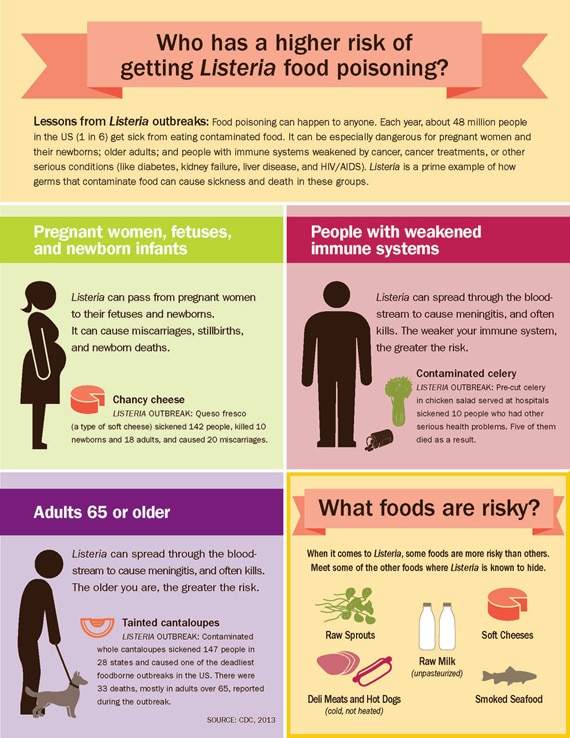
At least 90% of people who get Listeria infections are either pregnant women and their newborns, people 65 or older, or people with weakened immune systems.

Many germs can be spread through food. Some, like Listeria, can be deadly. Listeria strikes hard at pregnant women and their newborns, older adults, and people with weakened immune systems. Listeria can cause miscarriage and meningitis. Most people found to have Listeria infection require hospital care and about 1 in 5 people with the infection die. Outbreak investigations tell us what foods make people sick and what needs to change to make food safer and save lives. We have made some progress against Listeria, which is the third leading cause of death from food poisoning. However, we can do more to protect people at higher risk for food poisoning and make food safer for everyone.

If you, or someone you make food for, are pregnant, 65 or older, or have a weakened immune system, you must be especially careful when selecting, preparing, and storing foods.
  • Know your risk of food poisoning.
  • Select, prepare, and store food safely.
  • Follow the safe food guidelines – Clean, Separate, Cook, Chill – at www.FoodSafety.gov

Problem

Listeria is a deadly germ that is hard to control

Listeria is challenging because
  • When someone eats food contaminated with Listeria, sickness or miscarriage may not occur until weeks later when it is difficult to identify which food was the source.
  • Listeria can contaminate many foods that we don't usually cook, like deli meats, cheeses and sprouts.
  • Some foods we might not suspect can be contaminated with Listeria and cause sickness and outbreaks, such as cantaloupe and celery.
  • Listeria is a hardy germ that can even grow on foods that are refrigerated.
  • Listeria can hide unnoticed in the equipment or appliances where food is prepared, including in factories and grocery stores.
We can prevent Listeria infections by
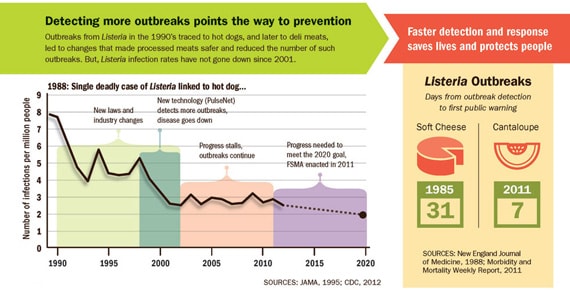
  • Identifying outbreaks fast by using special laboratory tests and disease detectives.
  • Rapidly finding and removing contaminated food before people eat it.
  • Using lessons from outbreaks, including environmental investigations, to make food safer.
  • Applying new safety measures for food production, like those included in the Food Safety Modernization Act (FSMA), so that food doesn't get contaminated in the first place.
  • Reducing Listeria contamination of ready-to-eat meat and poultry products by following USDA guidance[PDF - 2.34 MB].
  • Having a robust public health system that provides the tools and resources needed to promote food safety.
  • Learning more about which polices and practices work best.
 

Infographic

	Detecting more outbreaks points the way to prevention. Faster detection and response saves lives.


	Lessons from outbreaks can help us learn who is most at risk for Listeria food poisoning: Pregnant women and their newborns; older adults, and people with weakened immune systems.

What Can Be Done

Federal, state, and local governments are

  • Providing guidance to industry and developing regulations, like FSMA, to focus food safety efforts on safer production and handling of foods.
  • Tracking Listeria infections to identify opportunities to improve policies and practices, particularly to protect groups at higher risk.
  • Investigating and stopping outbreaks by recalling contaminated foods and warning the public.
  • Applying CDC's enhanced approach to investigating Listeria infections in all states so disease detectives can rapidly solve outbreaks by:
    • DNA fingerprinting the Listeria germ to identify outbreaks and contaminated foods, and interviewing people who are sick—quickly and uniformly—about what they ate. See Listeria Initiative[PDF - 617 KB]
  • Building public health capacity for advanced genome sequencing and analysis, which will make it possible to more quickly detect Listeria infections and outbreaks, and track them to their sources.

Food industry and places that sell or serve food can

  • Promptly communicate recalls of foods at risk for contamination.
  • Follow related guidance and regulations that address foods that are more likely to be contaminated.
  • Adopt proven actions like good sanitation and refrigeration in all food production and service facilities for Listeria control.
  • Identify and apply research to better prevent Listeria growth and cross-contamination in factories and stores, such as retail delis.

Health care providers can

  • Tell pregnant women, older adults, and people with weakened immune systems about Listeria and other dangerous germs spread through food.
  • Report Listeria infections quickly to the local health department to help spot and stop outbreaks.

People at higher risk and those who cook for them can

  • Know which foods are risky for pregnant women, older adults, and people with weakened immune systems, and avoid these foods. See http://www.cdc.gov/Listeria/prevention.html
  • Heat deli meats and hot dogs until steaming hot before eating.
  • Not drink raw (unpasteurized) milk or eat soft cheeses made from it.
  • Be aware that Mexican-style cheeses made from pasteurized milk, such as queso fresco, likely contaminated during cheese-making, have caused Listeria infections.
  • Refrigerate leftovers within 2 hours in shallow covered containers and use within 3-4 days.
  • Be careful to avoid cross-contamination in the refrigerator or other places in the kitchen.
  • Use a thermometer to make sure your refrigerator is 40°F or lower and your freezer is 0°F or lower.

Everyone can

  • Know the risks of food poisoning and follow the Clean, Separate, Cook, Chill guidelines.
  • Visit http://www.FoodSafety.gov for the latest information on preventing food poisoning.
 

Science Behind the Issue

Related Pages

On Other Web Sites

Kellogg Company Recalls Limited Number of Kellogg’s® Eggo® Nutri-Grain® Whole Wheat Waffles Due to potential Health Risk


Kellogg Recall of Eggo Waffle Batch Is the Latest of Listeria Concerns


GILLIAN MOHNEY
Tuesday, September 20, 2016 01:56PM


The latest in a line of food recalls that involve possible contamination with listeria bacteria is a variety of the popular Eggo brand waffles manufactured by the Kellogg Co.

The company announced a voluntary recall of 10,000 cases of its Nutri-Grain Whole Wheat waffles, prompting concern over the growing list of listeria scares.

Previous product recalls related to listeria included Blue Bell ice cream, frozen vegetables and raw milk.

The bacterium at the center of these outbreaks, Listeria monocytogenes, is a stubborn pathogen that has proved difficult to head off.

Here are a few things to know about the bacterium and about the U.S. food recall process:


Which Waffles Have Been Recalled? The Kellogg Co. has voluntarily recalled 10,000 cases of Kellogg Eggo Nutri-Grain Whole Wheat waffles, according to a company statement released yesterday. The recall affects products that were distributed in 25 states. The individual boxes of 10 waffles have the UPC Code 38000 40370 and a best-if-used-by date of Nov. 21, 2017, or Nov. 22, 2017.

A full list of affected states can be found here.


Why Were They Recalled? During routine testing, Kellogg found a problem with its cleaning process, which left an opening for Listeria monocytogenes bacteria to possibly contaminate this batch of Eggo waffles. There have been no reported illnesses related to the recalled Eggo waffles, according to the company statement.

"The recall is a result of tests, which identified the potential for contamination and a gap in our sanitation process. As soon as we learned of a potential concern, we moved quickly to identify any foods that might be impacted and resolve the issue, " a spokesman for the Kellogg Co. said in a statement sent to ABC News. "This includes initiating a recall, halting production on the line in question, conducting a deep sanitary clean of the area and reviewing our cleaning and sanitation protocols with the relevant plant employees."

Bill Marler, an attorney who specializes in foodborne illness, said the news was actually a good sign about the state of the food industry.

"Companies should be encouraged to test and should [receive] a pat on the back for testing and recalling the product," he said. "That's the system working properly."


What Is Listeria? The bacterium Listeria monocytogenes can cause dangerous infections, especially in pregnant women or people with compromised immune systems. The bacterium, which is often associated with foodborne disease outbreaks, can cause fever, muscle aches, diarrhea and other gastrointestinal symptoms. In severe cases, the infections can cause stiff neck, confusion, loss of balance and convulsions, according to the U.S. Centers for Disease Control and Prevention. Nearly everyone infected with the bacteria ends up with an invasive infection, meaning it moves outside the gastrointestinal tract.

The disease causes 1,600 illnesses and 260 deaths every year in the U.S. according to the latest CDC statistics, from 2011.

Pregnant women are at least 10 times as likely as the general population to develop a listeria infection - and the illness has been associated with miscarriage, stillbirth and premature delivery, according to the CDC.

Identifying the source of a listeria outbreak can be notoriously difficult, since the disease can incubate up to 70 days after exposure before a person develops symptoms.

Additionally, the bacteria can continue to grow even at refrigerated temperatures. Cooking contaminated foods to recommended temperatures can kill the bacteria.


How Is a Listeria Outbreak Detected? While the recalled Eggo waffles have not been linked to any cases of listeria infection, health officials have been increasing surveillance for listeria in recent years in an effort to combat outbreaks.

Today when a person is diagnosed with a listeria infection, epidemiologists and other health experts can sequence the bacteria's whole genome - essentially creating a unique DNA fingerprint - and enter that into a federal database. If a second person is found to have the same kind of listeria infection, officials can find a match. This means a listeria outbreak can be tracked after just two people have been infected by the same source.


=========


Kellogg Company Recalls Limited Number of Kellogg’s® Eggo® Nutri-Grain® Whole Wheat Waffles Due to potential Health Risk

Kellogg Company is voluntarily recalling approximately 10,000 cases of Kellogg’s® Eggo® Nutri-Grain® Whole Wheat Waffles because they have the potential to be contaminated with Listeria monocytogenes. No other Eggo products are impacted by this recall.

Listeria monocytogenes can cause serious and sometimes fatal infections in young children, frail or elderly people, and others with weakened immune systems. Although healthy individuals may suffer only short-term symptoms such as high fever, severe headache, stiffness, nausea, abdominal pain and diarrhea, Listeria infection can cause miscarriages and stillbirths among pregnant women.

The company has received no reports of illness to date but is taking this action as part of its commitment to the health and safety of the people who eat its foods.

Recalled product was distributed to customers and retailers in 25 states (CO, CT, DE, GA, IA, IL, IN, KS, MA, MD, ME, MI, MN, MO, ND, NE, NH, NJ, NY, OH, PA, VA, VT, WI, WY). The affected product is:
Eggo Recall labels

The date code can be found on the side of the package.
The recall is a result of routine tests that the company conducts which identified the potential for contamination. As soon as the company learned of a potential concern, it moved quickly to identify any foods that might be impacted and resolve the issue.

Kellogg is asking that people who purchased affected product discard it and contact the company for a full refund. Consumers can call 1-800-962-1413, Monday through Friday, 9 a.m. – 6 p.m. ET or by visiting https://www.kelloggs.com/en_US/contact-us.html

==========

Multistate Outbreak of Listeriosis Linked to Frozen Vegetables (Final Update)


Posted July 15, 2016 1:45 PM ET

This outbreak investigation is over. However, people could continue to get sick because recalled products may still be in freezers and people who don’t know about the recalls could eat them. Retailers should not sell and consumers should not eat recalled products. Read the Recall and Advice to Consumers and Retailers.

Highlights

  • This outbreak investigation is over. However, people could continue to get sick because recalled products may still be freezers and people who don’t know about the recalls could eat them. Retailers should not sell and consumers should not eat recalled products. Read the Recall and Advice to Consumers and Retailers.
  • CDC, several states, and the U.S. Food and Drug Administration (FDA) investigated a multistate outbreak of Listeria monocytogenes infections (listeriosis).
  • Listeria can cause a serious, life-threatening illness.
  • Nine people infected with the outbreak strains of Listeria have been reported from four states since September 13, 2013.
    • All nine people were hospitalized, and three of them died. Listeriosis was considered to be a cause of death for one person in Connecticut. For the two deaths in Maryland and Washington, listeriosis was not considered to be a cause of death.
  • Epidemiologic and laboratory evidence indicated that frozen vegetables produced by CRF Frozen Foods of Pasco, Washington and sold under various brand names were a likely source of illness in this outbreak.
    • On April 23, 2016, CRF Frozen Foods recalled 11 frozen vegetable products because of potential Listeria contamination.
    • On May 2, 2016, CRF Frozen Foods expanded the initial recall to include all organic and traditional frozen vegetable and fruit products processed in its Pasco, Washington facility since May 1, 2014. More than 350 consumer products sold under 42 separate brands were recalled, as well as at least 100 other products prepared by other companies that contained recalled ingredients from CRF Frozen Foods.
  • CDC recommends that consumers do not eat, and restaurants and retailers do not serve or sell, recalled organic and traditional frozen vegetables and fruit products and recalled products containing these items.
    • Recalled items were sold nationwide and in Canada.
    • A complete list of recalled products is on the FoodSafety.gov website.

Outbreak Summary

Introduction
CDC collaborated with public health officials in several states and the U.S. Food and Drug Administration (FDA) to investigate a multistate outbreak of Listeria monocytogenes infections (listeriosis). Listeria can cause a serious, life-threatening illness.

Public health investigators used the PulseNet system to identify illnesses that may have been part of this outbreak. PulseNet, coordinated by CDC, is the national subtyping network of public health and food regulatory agency laboratories. PulseNet performs DNA fingerprinting on Listeria bacteria isolated from ill people by using techniques called pulsed-field gel electrophoresis (PFGE) and whole genome sequencing (WGS). CDC PulseNet manages a national database of these DNA fingerprints to identify possible outbreaks.

A total of nine people infected with the outbreak strains of Listeria were reported from four states since September 13, 2013. A list of states and the number of cases in each can be found on the Case Count Map page.

Listeria positive specimens were collected from September 13, 2013, to May 3, 2016. Three illnesses were reported in 2016. The remaining six illnesses reported during 2013-2015 were identified through a retrospective review of the PulseNet database. Ill people ranged in age from 56 to 91 years, with a median age of 76. Seventy-eight percent of ill people were female. All nine (100%) ill people were hospitalized, including three people who died. 

Listeriosis was considered to be a cause of death for one person in Connecticut. For the two deaths in Maryland and Washington, listeriosis was not considered to be a cause of death.

The outbreak can be illustrated with a chart showing the number of people who were diagnosed each month. This chart is called an epidemic curve or epi curve.
Investigation Summary
Epidemiologic and laboratory evidence indicated that frozen vegetables produced by CRF Frozen Foods of Pasco, Washington and sold under various brand names were a likely source of illnesses in this outbreak.

This outbreak was identified in March 2016. State and local health departments attempted to interview the ill people, a family member, or a caregiver for the ill person about the foods the ill person may have eaten in the month before the illness began. Four of nine ill people, or their caregiver, were interviewed using a questionnaire that asked about a variety of foods. 

Three of these four people reported buying and eating frozen vegetables in the month before illness began and two reported Organic by Nature brand frozen vegetables. The third ill person reported eating O Organic brand frozen vegetables. Both Organic by Nature and O Organic frozen vegetables are produced by CRF Frozen Foods.

During the same time period, as part of a routine product-sampling program, the Ohio Department of Agriculture collected packages of frozen vegetable products from a retail location and isolated Listeria from True Goodness by Meijer brand frozen organic white sweet cut corn and from True Goodness by Meijer brand frozen organic petite green peas. Both products are produced by CRF Frozen Foods. 

Whole genome sequencing (WGS) showed that the Listeria isolate from the frozen corn was closely related genetically to eight bacterial isolates from ill people, and the Listeria isolate from the frozen peas was closely related genetically to one isolate from an ill person. This close genetic relationship provides additional evidence that some people in this outbreak became ill from eating frozen vegetables produced by CRF Frozen Foods.

Also, FDA collected environmental samples from Oregon Potato Company, located in Pasco, Washington and isolated Listeria from these samples. WGS showed that the Listeria found in these environmental samples was closely related genetically to eight isolates from ill people in this outbreak. Based on this information, Oregon Potato Company voluntarily recalled wholesale onion products made in their facility, which led to multiple recalls of products sold at retail under many brand names that contained recalled onions.

On April 23, 2016, CRF Frozen Foods recalled 11 frozen vegetable products because they may have been contaminated with Listeria. On May 2, 2016, CRF Frozen Foods expanded the initial recall to include all organic and traditional frozen vegetable and fruit products processed in its Pasco, Washington facility since May 1, 2014. More than 350 consumer products sold under 42 separate brands were recalled, as well as at least 100 other products from other companies that contained recalled ingredients from CRF Frozen Foods. State health departments collected recalled products from ill people in California and Idaho and isolated an outbreak strain of Listeria in these product samples. 

Recalled items were sold under various brand names, nationwide and in Canada. A full list of recalled products is available on the FoodSafety.gov website. CDC recommends that consumers do not eat, and restaurants and retailers do not serve or sell, recalled organic and traditional frozen vegetables and fruit products and recalled products that contain these items.

This outbreak investigation is over. However, people could continue to get sick because recalled products may still be in freezers and people who don’t know about the recalls could eat them. Retailers should not sell and consumers should not eat recalled products. Read the Recall and Advice to Consumers and Retailers.