MEC&F Expert Engineers

Wednesday, August 31, 2016

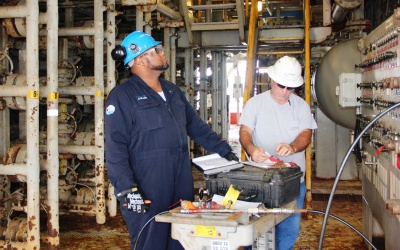
Offshore oil and gas operators in the Gulf of Mexico are evacuating platforms and rigs in preparation for Tropical Depression No. 9.


BSEE Tropical Depression No. 9 Activity Statistics: August 31, 2016


31 August 2016

NEW ORLEANS — Offshore oil and gas operators in the Gulf of Mexico are evacuating platforms and rigs in preparation for Tropical Depression No. 9. The Bureau of Safety and Environmental Enforcement (BSEE) Hurricane Response Team is activated and monitoring the operators’ activities. The team will continue to work with offshore operators and other state and federal agencies until operations return to normal and the storm is no longer a threat to Gulf of Mexico oil and gas activities.

Based on data from offshore operator reports submitted as of 11:30 a.m. CDT today, personnel have been evacuated from a total of 10 production platforms, 1.33 percent of the 750 manned platforms in the Gulf of Mexico. Production platforms are the structures located offshore from which oil and natural gas are produced. Unlike drilling rigs, which typically move from location to location, production facilities remain in the same location throughout a project’s duration.

Personnel have been evacuated from one rig (non-dynamically positioned (DP) rig), equivalent to 9.09 percent of the 11 rigs of this type currently operating in the Gulf. Rigs can include several types of offshore drilling facilities including jackup rigs, platform rigs, all submersibles and moored semisubmersibles.

A total of five DP rigs have moved off location out of the storm’s path as a precaution. This number represents 26.00 percent of the 19 DP rigs currently operating in the Gulf. DP rigs maintain their location while conducting well operations by using thrusters and propellers, the rigs are not moored to the seafloor; therefore, they can move off location in a relatively short time-frame. Personnel remain on-board and return to the location once the storm has passed.

As part of the evacuation process, personnel activate the applicable shut-in procedure, which can frequently be accomplished from a remote location. This involves closing the sub-surface safety valves located below the surface of the ocean floor to prevent the release of oil or gas. 
 
During previous hurricane seasons, the shut-in valves functioned 100 percent of the time, efficiently shutting in production from wells on the Outer Continental Shelf and protecting the marine and coastal environments. Shutting-in oil and gas production is a standard procedure conducted by industry for safety and environmental reasons.

From operator reports, it is estimated that approximately 19.52 percent of the current oil production in the Gulf of Mexico has been shut-in. It is also estimated that approximately 10.59 percent of the natural gas production in the Gulf of Mexico has been shut-in. 
 
The production percentages are calculated using information submitted by offshore operators in daily reports. Shut-in production information included in these reports is based on the amount of oil and gas the operator expected to produce that day. The shut-in production figures therefore are estimates, which BSEE compares to historical production reports to ensure the estimates follow a logical pattern.

After the storm has passed, facilities will be inspected. Once all standard checks have been completed, production from undamaged facilities will be brought back on line immediately. Facilities sustaining damage may take longer to bring back on line. BSEE will continue to update the evacuation and shut-in statistics at 1:00 p.m. CDT each day as appropriate.
  Total Percentage
of GOM
Platforms
Evacuated
10 1.33%
Rigs
Evacuated
1 9.09%
DP Rigs
Moved-off
5 26.00%
  Total shut-in Percentage of GOM Production
Oil, BOPD
Shut-in
312,280 19.52%
Gas,
MMCFD
Shut-in
360 10.59%
This survey information is reflective of seven companies’ reports as of 11:30 a.m. CDT today. 

U.S. Department of the Interior Issues Final Regulations to Address Current Offshore Production Safety Technologies


August 26th, 2016

WASHINGTON— Today, U.S. Department of the Interior Deputy Assistant Secretary for Land and Minerals Management Amanda Leiter and Bureau of Safety and Environmental Enforcement Director Brian Salerno announced final regulations to ensure that safety and maintenance requirements are current for offshore oil and gas production technologies. The Production Safety Systems Rule utilizes industry standards and best practices for the use of offshore safety equipment and systems, while also prescribing maintenance, testing and reporting requirements for specific production and subsurface safety devices.

“The Department has a responsibility to update its regulations to keep pace with advancing technology and ensure the safest possible offshore oil and gas operations,” said Deputy Assistant Secretary Leiter. “The regulations issued today reflect the industry’s shift to deeper waters and adoption of more sophisticated technology. The Administration is committed to safe and environmentally responsible operations utilizing the most effective technology available.”

These final regulations revise and update the Code of Federal Regulations section that addresses oil and gas production safety systems. The section was first published in 1988. The rule published today incorporates many Bureau of Safety and Environmental Enforcement (BSEE) policies that have been developed over the past 28 years. In 1988, many of the technologies currently in use did not exist. The final rule addresses a number of safety issues including production safety systems, subsurface safety devices, safety device testing, and production processing systems.

“By updating the requirements for these critical safety systems, we are meeting our commitment to promote the highest level of protection for both offshore workers and the environment,” explained BSEE Director Salerno. “The rulemaking process allowed us to develop the most effective and timely revisions by incorporating input from our partner federal agencies, industry, and research organizations.”

The revised requirements have been sent to the Federal Register and will go into effect 60 days following the publication of the final rule. BSEE has deferred the compliance dates for certain provisions of the final rule. These provisions and deferred compliance dates can be found in the Federal Register notice.

-- BSEE --

Click here for a copy of the final rule

Click here for a Production Safety System Rule fact sheet.

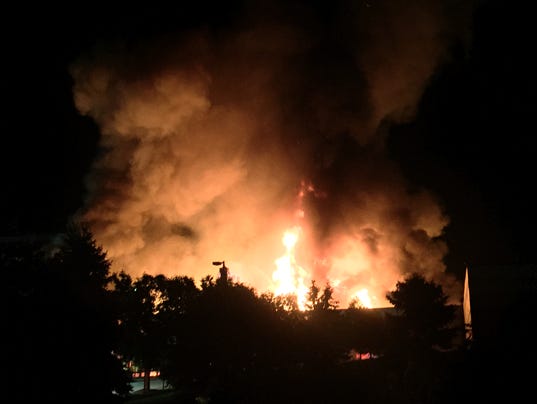
Millions of dollars in damages after a 6-alarm fire destroys the GAP Distribution Center in Fishkill, NY


(Photo: Patrick Oehler/Poughkeepsie Journal)


Gap, workers will need help after massive fire
Poughkeepsie Journal Editorial Board 9:56 p.m. EDT August 31, 2016


Considering the massive size of the blaze, the community should be extremely grateful no one was injured or killed at The Gap Distribution Center in Fishkill Monday night.

Firefighters did exceptional work to suppress the blaze, and employees were able to make it out safely. The Gap has people working during all sorts of shifts, so a fire breaking out at night could have had far more devastating consequences than for some businesses. Flames shot out of the building, and sections of the facade and roof caved as the blaze raged. Journal staffers reported that the heat from the flames could be felt from the access road leading to the facility.

The actual damage and cause are still being assessed, but there still is plenty of cause for concern. The fire caused millions of dollars in property and product damage, and The Gap is a major employer in the area, so the community will have to wait with great interest to see what the extent of the economic consequences might be. The center has multiple buildings, but the entire site has been shut down as result of the blaze.

Dutchess County officials rightly pointed out the priority will be to assist displaced employees and then get an assessment from company leaders regarding when part of the operation can get up and running.

State and federal officials also have a role here, and it's imperative they work in concert with the company to provide workers with assistance and get the facility back in business in the area. First, though, fire officials have to deem the area safe and complete their initial investigation. State police ask anyone who may have information regarding the fire to call 845-677-7300.

The facility opened in September 2000 and has expanded over time. Most recently, company officials were investing $96 million to upgrade the distribution center and add 1,200 jobs over the next few years.
These manufacturing jobs are an important component to the local economy. Economic-development officials provided the company with tax credits tied to how many jobs are created and retained over a period of time and may have to recalibrate these deals and also consider what might be best in the short term to provide help. That is just a sliver of the financial matters that will have to be sorted through as a consequence of this blaze.

For now, the community should give thanks to the firefighters who toiled on the scene and recognize the efforts being made to help the displaced workers and their families.

This fire will cause pain and hardship, but the worst part is over – and, through good work and fortune, it came with no loss of life.


=============


Inspector: No violations at Gap building during 2015 inspection
Abbott Brant, Nina Schutzman and John Ferro, Poughkeepsie Journal 9:43 p.m. EDT August 31, 2016


What we know about the Gap warehouse fire in Fishkill as of Wednesday afternoon. John Ferro/Patrick Oehler/Poughkeepsie Journal


(Photo: Patrick Oehler/Poughkeepsie Journal)


As police and federal officials continue to search for answers in the massive blaze that destroyed a building at the Gap Inc. distribution center in Fishkill, a local building inspector said Wednesday no violations were found during its last inspection.

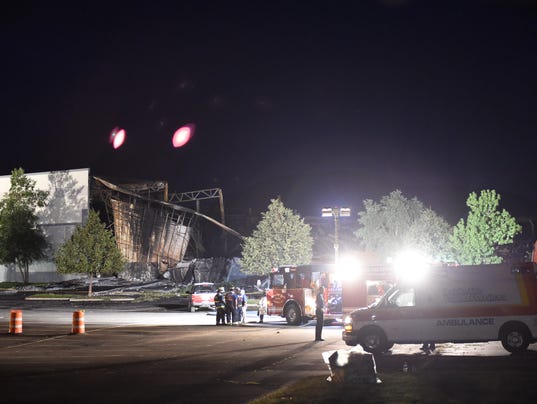
Demolition of an exterior wall of the building that was "at risk of collapse," according to state police, began Wednesday night.

Meanwhile, Dutchess County is working with economic leaders around the Hudson Valley to help Gap and its 1,300 employees, who were unable to go to work again on Wednesday.

More than 100 firefighters from more than 20 departments across three counties responded to the fire on the multi-building property late Monday night, using more than a million gallons of water to knock down the blaze. Building 100, the 990,000-square-foot building that was heavily damaged by fire, heat and smoke, remains inaccessible, Assistant Dutchess County Executive Ron Hicks said.

Village of Fishkill Building and Fire Inspector Thomas VanTine is in charge of making sure codes are enforced in Building 100. The Gap has two independent companies that annually inspect the building's fire suppression system and sprinkler system and submit reports to the village, VanTine said.

The village last inspected the structure on Aug. 20, 2015, and "no violations were found at that time," said VanTine who had "no concerns" about the safety of the building.


Another building on the property, Building 110, sustained smoke damage during the fire but was cleared by the ATF Wednesday, which will allow Gap officials to assess the damage to that building. Central Hudson was able to isolate the building and "reenergize" it, Hicks said, but gas remains offline to the campus.

The 1,300 employees impacted by the facility's closure, including the 600 that worked in the building that erupted in flames, were paid by Gap on Tuesday, Hicks said. Gap will also continue to pay all employees Wednesday, he said.

A Gap spokeswoman could not immediately confirm the company's plans for its local employees going forward.

Spokeswoman Debbie Felix also said she could not confirm whether the building's fire-suppression systems worked.

"A lot of the detail we just don’t have at this time," Felix said. "We don’t have access to the places inside where the fire was."

A portion of the Gap distribution center warehouse was torn down on Wednesday night. Patrick Oehler/Poughkeepsie Journal

VanTine said his inspections, which might last about 90 minutes, focus on "general life safety" — making sure the alarms sound properly and flash visibly, that fire extinguishers have up-to-date (yearly) inspection tags, that fire exits are clear and well-marked.

During a typical inspection, "you're escorted around (the structure) by someone from the company," VanTine added. "They activate the (fire) alarms upon my request." But the "actual testing of the systems ... that’s done by the independent companies," VanTine said.

State police, the lead agency investigating the fire, is working closely with the Bureau of Alcohol, Tobacco, Firearms and Explosives' National Response team to determine how the devastating blaze began, according to state police spokeswoman Melissa McMorris.

The Fishkill facility is located alongside I-84, off exit 13, where it intersects with Route 9.

According to Hicks, economic development officials in Orange, Putnam and Ulster counties have worked with Dutchess County to identify available warehouse spaces in the surrounding area in the event Gap "needs contingency operational space in the region."

The county executive's office continues to work with the state Department of Labor, the Dutchess County Workforce Investment Board, Empire State Development and representatives from Gov. Andrew Cuomo's office to further discuss how local and state resources can help employees, Hicks said.

Felix said the company has contingency plans in place and is "working across our North American network of distributions centers to continue to serve our customers."


An overview of what we know about the fire at the Fishkill Gap distribution center. Patrick Oehler, John Ferro, and Alex H. Wagner/Poughkeepsie Journal

A major employer in the region, Gap Inc. announced plans in 2014 to add 1,200 jobs over a five-year span, and invest $96 million into the Fishkill facility. At the time of the announcement, the facility had more than 425 employees.

Most jobs at a distribution center are warehouse-type work, moving boxes of merchandise around and keeping track of them with scanners and computers.There's truck unloading and loading, as well as some other support jobs like supervisory, security, maintenance and administrative roles.

The facility opened in September 2000, according to Journal archives, and expanded a year later.

A construction worker seriously injured after he fell about 30 feet down an elevator shaft at Dallas/Fort Worth International Airport.


Construction Worker Falls Down Elevator Shaft At DFW Airport 


August 31, 2016 2:15 PM


GRAPEVINE (CBSDFW.COM) – A construction worker fell about 30 feet down an elevator shaft this afternoon at Dallas/Fort Worth International Airport.

It happened at Terminal A near Gate A39 around 1 p.m. in an area walled off for construction.

The construction contract worker was flown by medical helicopter to a local hospital. No details about his injuries were available at the time of this report. Please click back for updates

Teen worker injured after getting stuck while cleaning a corn silo at H&H Feed and Grain in Vicksburg, Michigan


Emergency crews remove teenager from machine on W. Mich. farm

by Logan Crawford
Tuesday, August 30th 2016

Emergency crews remove teenager from machine on W. Mich. farm


VICKSBURG, Mich. (NEWSCHANNEL 3) - For the second time in just over a year, emergency crews are called out to a West Michigan company.

Right now, a teenager is in the hospital after getting stuck while cleaning a corn silo at H&H Feed and Grain.

We're told he is expected to recover.

The South Kalamazoo County Fire Authority arrived at H&H Feed and Grain Monday to pull a teen out of a corn silo.

He was cleaning the silo, when he got his leg stuck in a conveyer belt.

"Pretty quickly out of it. He stayed conscious throughout the whole thing, he talked to us through the whole issue. And we got him out without any further harm," said Chief Tracy McMillan, with the South Kalamazoo County Fire Authority.

This is not the first time tragedy has struck at this company. Just 1 year ago, there was another accident. That one ended more tragically, as a worker died.

In July 2015, Marcos Fonseca was killed on site at H&H. Authorities say the 31-year-old was looking at a new office being built, when he stepped down to a lower platform, and fell 15 feet.

"There's no criminal indication in this investigation. We have an accident that's very unfortunate," said Kalamazoo County Undersheriff Paul Matyas.

The Michigan Occupational Safety and Health Administration fined H&H for Fonesca's death. The citation was for employees not using fall protection. H&H paid $2,100 for the incident.

MIOSHA spokespeople say they are not currently aware or investigating Monday's incident.

According to MIOSHA:

"Employers are required to report injuries to MIOSHA only if the injury resulted in an amputation, an in-patient hospitalization or the loss of an eye."

"There was initial treatment on-scene for the injury, and then he was taken to Bronson hospital for further treatment," Chief McMillan said.

We asked the owners of H&H to talk about the incident, but they said they had no comment.

MIOSHA also cited H&H in 2014 for an "other-than-serious" citation for hazard communication, following a complaint.