


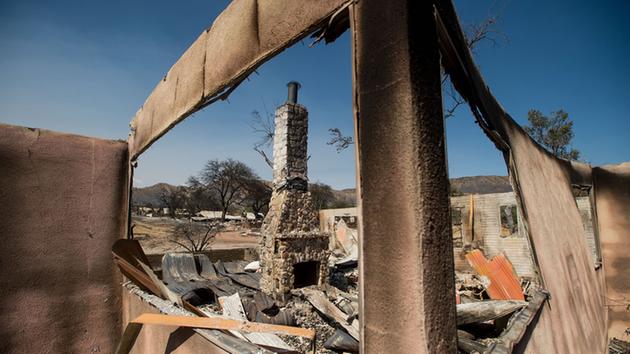
A chimney stands amid rubble at a house scorched by a wildfire in Phelan, Calif., Friday, Aug. 19, 2016. (AP Photo/Noah Berger)
By Brandi Hitt and ABC7.com staff
Updated 38 mins ago
CAJON PASS, Calif. -- Overnight progress has been made on the 37,020-acre Blue Cut Fire, which was at 68 percent containment Saturday morning, according to officials from the California Department of Forestry and Fire Protection.
Officials estimate 105 homes and 213 outbuildings have been destroyed since the wildfire began racing through San Bernardino National Forest Tuesday, forest officials said, and the massive blaze has continued to burn near the Cajon Pass.
A map shows the location of the Blue Cut Fire, which has burned thousands of acre around the Cajon Pass.
There was still concern over "explosive growth" in extremely dry areas such as the southeast part of Wrightwood, where old growth, brush and trees haven't burned in 70 years, fire behavior analyst Brendan Ripley said.
Late Friday, evacuation orders were lifted for residents of Phelan, west of Green Road to Snowline Road. However, about 34,500 homes remain under evacuation orders, including in the communities of Wrightwood, Lytle Creek and West Cajon Valley.
Many were not being allowed to return home until damaged power lines are back up and running.
"I'm hearing rumors that we can't go back until the power is turned back on, but many of us are prepared for that with solar panels and generators and stuff like that, so I don't really think that's an issue, but we're getting very frustrated because we've been out since Tuesday," said Lisa Holtsclaw, a Lytle Creek resident.
An Edison spokesperson said there are more than 300 damaged power poles to replace, miles of wire to restring and a number of transformers to repair.
"Imagine everything you own being taken from you, and you have absolutely no control. There's nothing you can do," said Lisa Gregory of Lytle Creek.
The American Red Cross said it has 301 people registered between its Fontana and Hesperia evacuation shelters. But they have room to grow should the fire threaten more communities.
Officials said Saturday morning 50 hand crews, 275 engines, 32 dozers and 14 helicopters were being used to work aggressively to gain more containment of the fire. Crews were also working to mop up all areas of the blaze in an effort to move toward re-population of evacuated areas.
I-15 is up and running in both directions, but traffic will still be impacted by intermittent lane closures as repairs get underway to the highway.
Gov. Jerry Brown issued a state of emergency for San Bernardino County, which provides more state resources to firefighting efforts and grants certain benefits to affected residents.
The cause of the fire remains unknown.
The Associated Press contributed to this report.


MARCH 30, 2015
Backing vehicles and equipment are a serious occupational hazard. The
Bureau of Labor Statistics states that, of the 443 struck-by fatalities
at road construction sites between 2003 and 2010, 143 cases involved a
vehicle or mobile equipment backing up.
To help prevent backover injuries and deaths, NIOSH recommends a number of standard operating procedures:
-
Create and enforce an operating procedure that addresses how to work
safely and lists best practices to follow when working near vehicles and
other equipment.
- Establish safety procedures for working at night with backing equipment. Ensure high-visibility apparel is worn.
- Take precautions. Use equipment that creates minimal blind spots or has proximity warning devices.
- Before work begins, design the worksites to minimize or eliminate the need for backing vehicles and equipment.
- Hire a competent person to supervise worksites involving backing vehicles and equipment.
- Be sure drivers know not to back up equipment unless they are under the direction of a spotter.
- Use barrels, barricades, cones or reflective devices to guide vehicles and equipment away from workers.
- Post signs informing workers where it is safe to walk.
NIOSH states that before work begins, vehicle and equipment operators
need to inspect their machinery for any issues. Ensure everything,
including mirrors and windows, is clear and in good working order. If
something is found to be defective, remove the vehicle or equipment from
service until repairs are made.
When operating equipment, know its blind spots. If you lose contact with your spotter for any reason, immediately stop work.
NIOSH also notes that clear communication is key. “At the start of each
shift, review communications signals (verbal, hand signals, flags)
between spotters, machine operators, truck drivers, and workers on
foot,” the agency states.
For workers on foot near backing vehicles or equipment, NIOSH recommends employees adhere to the following:
· Wear appropriate high-visibility personal protective equipment.
· Know the blind spots of vehicles and equipment you work near.
· Never approach a piece of equipment or vehicle without a clear signal of acknowledgment from the operator.
· Avoid areas where vehicles and equipment travel.
· Stay alert for the sound of reversing alarms.
· Avoid complacency. Always know your surroundings.
//----------------------------------//
VEHICLE & EQUIPMENT OPERATION : BACKING EQUIPMENT AND SNOWPLOWS
Vehicle backing accidents can happen at any time of the year, but when
winter comes and there is snow to be cleared, this type of incident
becomes even more likely.
It
seems like every year a backing accident involving a motorist and
county equipment occurs in Michigan, despite all the efforts of the
County Road Commissions to avoid these problems.
However,
you may also be interested to know that there are a number of backing
accidents that occur in Road Commission garages and even in Road
Commission yards. Often times, employees are injured or property is
damaged.
Backing accidents are due to a great many factors, including poor
visibility, blind spots, difficult terrain, and driver fatigue or
inattentiveness. But, let’s face it, the motoring public generally
doesn’t focus much attention on avoiding snowplows or other
vehicles/equipment with which they share the road. So it is your
responsibility as a Road Commission employee to take extra care while
out on the road.
That makes avoiding an accident your responsibility, a responsibility
that all county employees have to protect the public, but also a
responsibility mandated by law.
There
may be serious legal repercussions if you get into a vehicle backing
accident, so even though you as an operator may be doing everything else
correctly, you should still remember that you are the one driving the
160,000-pound truck. Let’s not dwell on the negative, however. The point
of our discussion today is to make sure that everyone on the road gets
home safely.
Here are some strategies that veteran drivers use to avoid vehicle backing accidents.
First
of all, try to make a mental note of all the vehicles around you as you
drive. If you see a motorist stop or turn off, then you can cross them
off your list; but if not, then that vehicle is likely hiding somewhere
in your blind spots or dead zone.
Use
curves in the road to help you. When entering an intersection, come to a
stop at an angle if it’s safe to do so. If it’s dark out, use reflected
light from snow banks or trees as additional queues that a vehicle is
behind you. Activate your lights and beacons so that you are more
visible. Ensure that back up alarms are functioning properly.
Keep
looking in your mirrors. Every few seconds you should be checking your
mirrors. Remember to look and lean to see as much in your mirrors as
possible. Stop and let the motorist pass before you begin clearing an
intersection, but be aware that some motorists may get confused in these
situations and may not react like you think they should.
Back
slowly at first, again, keeping an eye out for anything behind you.
Finally, if you are backing and you feel an unusual amount of
resistance, or the back end of the truck begins to rise, stop
immediately!
Check traffic so that you’re not going to be struck by a vehicle yourself, and get out and look.
The most important thing is to be ready! If you operate a snowplow or
any other heavy equipment on or near the public right of way, it’s not a
matter of if a motorist will come too close to you, it’s a matter of
when. So stay alert and be ready. Most of all, remember to drive safely.
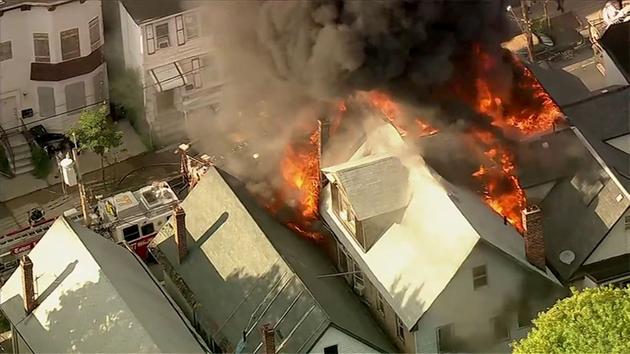
Lucy Yang has the story.
Eyewitness News
Friday, August 19, 2016 05:21PM
ST. GEORGE, Staten Island (WABC) -- Children playing with matches triggered a massive six-alarm fire on Staten Island Thursday that injured 21 people and destroyed seven homes, officials said.
A house on Benzinger Avenue in St. George caught fire just after 6 p.m. and quickly spread to neighboring homes on both sides. With flames devouring her home, a woman ran to safety just as the fire department arrived.
"We had three buildings on fire, extremely heavy fire conditions. Extreme radiant heat on the street, enough that it melted siding on the buildings across the street," said FDNY Chief of Department James Leonard. "The fire eventually spread to seven buildings."
A total of 42 individuals, 21 adults and 21 children, were left homeless and were being assisted by American Red Cross for temporary housing assistance.
On Friday, FDNY fire officials said the blaze was started by two boys -- ages 6 and 8 -- playing with matches. According to the FDNY, the boys set papers on fire and threw them onto the porch, thinking they'd be OK there. But the fire quickly spread and engulfed the porch and home.
The boys' mother was home but not directly supervising the boys at the time they set the fire, officials said. The mom is not going to be charged.
"It's a terrible, terrible accident," an FDNY official told Eyewitness News.
The boys will be enrolled in the FDNY Juvenile Fire-Setters Intervention Program.
THE AFTERMATH
Meanwhile, Melinda Wiegand is living out a nightmare after flames forced her and her four young children to flee for their lives from their Staten Island home.
She received bags of clothes from a local church, but anything of value, any sentimental family treasures, are now gone.
All of the injured were taken to Richmond University Medical Center.
An MTA bus was en route to the staging area, at Jersey Street and Benziger Avenue.
Seven buildings total were damaged. Two of them were totally destroyed and three others had moderate damage. Two others had minor damage.
Between 40 and 50 houses were without power because firefighters had to cut it to the area while battling the fire. National Grid was requested to shut gas to affected structures.
"It was really hot and scary," said Jonathan, a resident who took cell phone video after he helped an elderly woman in his building get down the stairs and out to safety.
The FDNY said that there was extreme radiant heat in the street, it was strong it melted the siding on buildings across the street.
For much of the night, the smoke even on the street was so thick, it was difficult to see the firemen working above.
About 250 firefighters and more than 60 apparatus responded to the fire.
"You can see they are big houses, on a hill. The firefighters did an unbelievable job," said Leonard. "On arrival, two minutes after three buildings on fire, they stopped that fire from spreading past that area. They did a really tremendous job with this fire."
USS Louisiana Collision at Sea
By Commander, Submarine Force, U.S. Pacific Fleet | August 19, 2016
BANGOR, Washington — The ballistic-missile submarine USS Louisiana (SSBN 743) and a U.S. Navy Offshore Support Vessel collided while conducting routine operations in the Strait of Juan de Fuca off the coast of Washington state on August 18, 2016.
The collision occurred at 6:00 p.m. There were no injuries to personnel. Assessments of the damage to both the submarine and the U.S. Navy Offshore Support Vessel are being conducted. The incident is currently under investigation.
Both ships returned safely to port under their own power. The U.S. Navy Offshore Support Vessel returned safely to port at Port Angeles, Washington, and the USS Louisiana returned safely to homeport at Naval Base Kitsap Bangor, Washington.
For questions related to this release, contact Lt. Tia Nichole McMillen at (808) 473-0625 or (808) 473-0911


DROWNING LISTED AS CAUSE OF DEATH OF NC FIREFIGHTER
August 19, 2016
A local firefighter who lost his life trying to recover the body of a missing swimmer on Lake Norman died from drowning, according to the North Carolina Office of the Chief Medical Examiner.
Authorities said Bradley Long, 28, drowned due to an arterial gas embolism while SCUBA diving.
Major findings at autopsy included heavy lungs, fluid in the sphenoid sinus, an enlarged heart, and air within the right pleural space and heart.
Long was a Newton firefighter and was working on a search and rescue mission through Sherrills Ford-Terrell Fire-Rescue to retrieve a body of a person who drowned in the lake.
RELATED: Community bids a final farewell to fallen hero Captain Bradley Long
According to witness statements and those on scene, Long and his dive buddy reached the rescue basket at the depth of around 80 feet. An air check with surface personnel with completed 14 minutes into the dive, and divers were told to begin a controlled ascent.
Per dive computer interrogation, Long’s ascent was performed with increasing speed from 68 feet and without performing required safety stops.
According to a witness statement, Long got to the 20 foot safety stop and motioned to another diver that he was out of air, removed his mask, removed the mask of his dive buddy and panicked.
The dive buddy surfaced from the water and called for help.
MORE: Authorities: 2 firefighters doing well after deadly accident on Lake Norman
Per Air Hogs Scuba interrogation of the dive computer, Long was breathing at a rapid rate throughout the dive, causing rapid gas consumption, descended to the maximal depth of 81 feet, and did not return to the surface when he was low on air.
The review of the dive equipment showed the gas cylinder was essentially empty. According to the report, the backup gas sources were unused.


