Typical Piper PA-11 planes
Authorities identify victim killed in small-plane crash
Typical Piper PA-11 planes
Authorities identify victim killed in small-plane crash
Published On: Aug 05 2016 11:49:07 AM CDT Updated On: Aug 06 2016 09:32:19 PM CDT

INDIANOLA, Iowa -
Two people were killed in the crash of a small plane Friday in Warren County, Sheriff Brian Vos said.
A Piper PA-11 crashed around 11:40 a.m. under what the Federal Aviation Administration called "unknown circumstances" in a field outside the airport, near 12341 Geneva St., just west of Highway 69, north of Indianola.
Officials said the plane was practicing landing maneuvers at a nearby landing strip when the crash happened.
Authorities said Alex Michael Winter, 22, of Indianola, was killed in the crash. The name of the second victim is still being withheld.
The FAA and the National Transportation Safety Board are investigating the crash, which remains ongoing.
===================
Date:
05-AUG-2016
Time: 11:40LT
Type: 
Piper PA-11
Owner/operator:
Registration:
C/n / msn:
Fatalities: Fatalities: 2 / Occupants: 2
Other fatalities: 0
Airplane damage: Written off (damaged beyond repair)
Location: near Laverty Field Airport, Indianola, Iowa -  United States of America
Phase: Unknown
Nature: Training
Departure airport:
Destination airport:
Narrative:
The aircraft incident occurred just west of Highway 69 in Warren County near Laverty Field Airport (IA41), Indianola, Iowa. Airplane damage not reported. The 2 occupants died.
Officials said the plane was practicing landing maneuvers at a nearby landing strip when the crash happened.
Sources:
http://m.kcci.com/news/small-plane-crash-just-reported-near-indianola/41068298
http://whotv.com/2016/08/05/plane-crash-reported-in-warren-county/
https://www.google.com/maps/@41.4138258,-93.5654185,16z/data=!3m1!1e3?hl=en-us
http://www.kcci.com/news/small-plane-crash-just-reported-near-indianola/41068298
http://whotv.com/2016/08/05/two-people-killed-in-warren-county-plane-crash/


The Forsyth wastewater treatment plant where an employee was killed Friday located on Towns Creek Road off Ga. 83 Laura Corley lcorley@macon.com
By Laura Corley
FORSYTH, Georgia
A man was killed in what his employer says was a freak accident Friday at a wastewater treatment plant in Monroe County.
James Kip Evans, 52, was in a 7-foot deep ditch trying to saw some pipes at the waste water treatment plant on Town Creek Road off Ga. 83 about 11 a.m. when he was gashed in his neck with the chop saw, Monroe County sheriff’s Sgt. Lawson Bittick said.
He was taken to a Macon hospital where he died 20 minutes after his arrival, Bittick said.
Evans, of Forsyth, worked for Utility Partners LLC, which handles the plant’s operations.
From his office in Alpharetta late Friday afternoon, Utility Partners President Bob Monette said he was still upset about the loss of a senior employee and a longtime friend.
“He was just cutting a piece of pipe today — something he’s done a thousand times, frankly,” said Monette, who arrived at the plant minutes after Evans was gashed. The blade was pinched between two pieces of pipe and “when he was pulling it out, it hit him on his neck. He immediately dropped to his feet, dropped the saw,” Monette said.
Co-workers came to Evans’ aid, putting pressure on his neck to stop him from bleeding.
“He just lost so much blood. It’s just a freak accident,” Monette said.
The Occupational Health & Safety Administration was called to investigate. Evans, a grandfather and stepfather, had been working for Utility Partners since 2006, when it contracted with the city.
“He’s the kind of person you like to have as part of your work force,” Monette said. “He really kept everybody’s spirits up. He was always pleasant to be around, always worked hard.
=====================
Chop Saw Safety
- For operation of the chop saw, a full face shield and safety
glasses are required. Operators should always wear safety glasses
under a full face sheild.
- Gloves, loose clothing, jewelry, or any dangling objects including
long hair should not be worn as they may catch in the rotating
parts of the saw.
- All guards must be in place and operating. If a guard seems
slow to return to its normal position or hangs up, adjust it or
repair it immediately. Unplug or lockout power when making repairs.
- Hands and fingers must be kept clear of the path in which the
blade travels.
- Clean the lower guard frequently to help visibility and movement.
Unplug before adjusting or cleaning.
- Use only the recommended RPM and sizes of blades.
- Regularly check and tighten the blade and the blade-attachment
mechanism.
- Prior to installing or changing a blade, be sure to lockout
or unplug equipment. Ensure that the blade and its related washers
and fasteners are correctly positioned and secured on the saw's
arbor.
- To avoid losing control or placing hands in the blade path,
hold or clamp all material securely against the fence when cutting.
Do not perform operations freehand.
- Never re-cut small pieces. Long material should be supported
at the same height as the saw table.
- Never place hands or fingers in the path of the blade or reach
in back of the fence.
- Use the brake if one is provided. To avoid contact with a coasting
blade, do not reach into the cutting area until the blade comes
to a full stop.
- After
completing a cut, release the trigger switch and allow the blade to
come to a complete stop, then raise the blade from the workpiece. If
the blade stays in the cutting area after the cutting is complete,
injury can result from accidental contact.
=====================

WMAZ 3:24 PM. EST August 06, 2016
UPDATE: City manager Janice Hall has identified the man who died in a power-saw accident at Forsyth's water-treatment plant.
She said he is Kip Evans of Forsyth.
Evans worked for Utility Partners, a company that manages the city's water and wastewater facilities.
Monroe County Coroner Joey Proctor says it happened around 11 a.m. at the plant on Town Creek Road.
Proctor says Evans was working on a water-line at a 12-foot ditch when the power saw jumped and cut him in the neck.
The man died around 12:20 p.m. at the Medical Center-Navicent Health in Macon.
Hall released this statement:
A tragic accident occurred this morning at the city of Forsyth northeast wastewater treatment facility which resulted in the death of Kip Evans, a Utility Partners employee. The City of Forsyth contracts with Utility Partners to manage the water and wastewater treatment facilities of the city. City Manager, Janice Hall stated that “City government is a family and Kip was a vital part of that family and he will be greatly missed”. Mayor Wilson stated “as a community we mourn the loss of Kip and our thoughts and prayers are with the family and with Utility Partners at this very difficult time”.
Hall said she had no further information on the cause of the accident.
-------------------------------
A man died after a power-saw accident at the City of Forsyth's wastewater treatment plant.
Monroe County Coroner Joey Proctor says it happened around 11 a.m. at the plant on Town Creek Road.
Proctor says a contractor was working on a water-line at a 12-foot ditch when the power saw jumped and cut him.
The man died around 12:20 p.m. at the Medical Center-Navicent Health in Macon.
The victim's name has not been released.
The accident is still under investigation.
Investigators for the federal Occupational Safety and Health Administration have been called to the scene.
Check back with 13wmaz.com for more on this developing story.
================
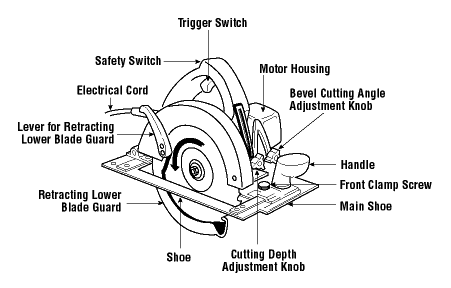
Powered Hand Tools - Saws - Circular
What should you do before start cutting with a circular saw?
- Wear safety glasses or goggles, or a face shield (with safety glasses or goggles).
- Wear an approved respirator or dust mask when exposed to harmful or nuisance dusts.
- Use appropriate hearing protection equipment in noisy areas.
- Check the retracting lower blade guard to make certain it works freely.
- Ensure that the blade that you have selected is sharp enough to do the job. Sharp blades work better and are safer.
- Check the saw for proper blade rotation.
- Set
the depth of the blade, while the saw is unplugged, and lock it at a
depth so that the lowest tooth does not extend more than about 0.3
cm (1/8") beneath the wood.
- Keep all cords clear of cutting area.
- Circular saws are designed for right-hand operation; left-handed operation will demand more care to operate safely.
What should you do to work safely with a circular saw?
- Check the retracting lower blade guard
frequently to make certain it works freely. It should enclose the
teeth as completely as possible, and cover the unused portion of the
blade when cutting.
- Check that the retracting lower blade guard has returned to its starting position before laying down the saw.
- Keep upper and retracting lower blade guard clean and free of sawdust.
- Disconnect power supply before adjusting or changing the blade.
- Allow the saw to reach full power before starting to cut.
- Use two hands to operate saws - one on a trigger switch and the other on a front knob handle.
- Keep motor free from accumulation of dust and chips.
- Select the correct blade for stock being cut and allow it to cut steadily. Do not force it.
- Secure stock being cut to avoid movement.
What should you avoid when cutting with a circular saw?
- Do not hold or force the retracting lower guard in the open position.
- Do not place hand under the shoe or guard of the saw.
- Do not over tighten the blade-locking nut.
- Do not twist the saw to change, cut or check alignment.
- Do not use a saw that vibrates or appears unsafe in any way.
- Do not force the saw during cutting.
- Do not cut materials without first checking for obstructions or other objects such as nails and screws.
- Do not carry the saw with a finger on the trigger switch.
- Do not overreach. Keep proper footing and balance.
- Do not rip stock without using a wedge or guide clamped or nailed to the stock.
========================
UTILITY PARTNERS
CITY OF FORSYTH
Forsyth, GA
The City of Forsyth was Utility Partners' first client in the State of Georgia and was the first client to be provided water treatment expertise and services. Initially awarded on an emergency basis, the agreement between the City and Utility Partners has now been extended to include a full term.
Our staff operates the Russellville (4.0 MGD) surface water treatment facility and the distribution system. Our certified operations staff is on-site at this facility twenty-four hours per day. There are 4 elevated water tanks and more than 30,000 feet of pipe in the distribution system that we maintain.
We operate the Northeast (2.0 MGD) and South (1.0 MGD) wastewater treatment facilities, perform laboratory testing, and process solids using a belt press. There are 12 sewage pumping stations that are maintained in the collection system.


Flat Roof Systems

Torch Down Roofing is a type of roofing that consists of levels of modified bitumen–similar to asphalt, that are adhered to layers of fiberglass with a flame torch. Torch Down Roofing is used only for flat or low-slope roofs.
Torch Down Roofing is popular with many contractors, mainly because of its ease of installation and its adaptability. Some roofers use this system because the modified bitumen can bond tightly to metal flashings and the bond rubbery additives in the asphalt allow the roofing to expand and contract, where other roofing systems may crack. Roofers like the fact that Torch Down Roofing is easy to apply – but it is also dangerous!
It is extremely easy to make a mistake with the torch that will result in disaster. Consider roofers that are torching down a roof and accidently overheat something in the attic. They end their work for the day and don’t notice the smoldering smoke coming out of the soffit vents. Before long, that smoldering material in the attic heats up and starts a fire that is quickly spread throughout the dry, hot attic area and often to the entire structure. We have seen too many disasters with Torch Down Roofing that resulted destruction of property.
Alternatives to Torch Down Roofing
There are many different types of flat roofing systems that will better meet your needs without posing a danger to your entire structure. Some types of flat roofing systems are applied with an adhesive, while other types are self-adhering or are hot mopped, as with cap sheet, in built-up roofing systems. Learn more about the best solutions for flat and low slope roofs.
Flat Roofs

There are many commercial buildings, beach homes and Spanish
architecture homes that have low slope or flat roofing systems. For
some buildings it is necessary to have flat roofs in order to provide a
location for mechanical equipment such as HVAC units. Other buildings
have flat and low slope roofs simply to keep the overall building costs
at a reasonable amount for the real estate market. These types of roofs
can present their own unique problems.
Items that you should consider when considering roofing a flat or low slope roofing system:
Ponding Water?
Most flat roofs are built with slope, some with more and some with
less. Both flat and low slope roofs were originally designed for the
water to drain in a certain direction, usually toward a drain, roof eave
or rain gutter. Many were designed with only 1/8″-1/4″ slope per foot.
This small amount of slope leaves very little leeway for mistakes,
building settlement or deflection in the roof framing and/or sheathing.
This leads to problems caused by poor drainage. When considering
re-roofing a flat or low slope roof, pay special attention to areas that
appear to have poor drainage. Possible improvements to the roof
drainage system may include additional drains, leveling ponding areas or
in some cases, re-sloping the entire roof.
Mechanical equipment?
Many buildings have mechanical equipment, HVAC, cell sites, solar,
skylights, etc. Each of those items need to be addressed individually to
make sure that they don’t become a leak problem after the roofing
system is installed. It is essential that each piece of equipment is
mounted properly with the least impact on the roofing system.
Remove or not to remove the existing roof ?
Building codes dictate how many roofs that you can apply over the
original roof. The latest revision is no more than one recover roof over
the original which totals 2-roofing systems. There are some other
considerations that must be considered like the type and condition of
the existing roof, soundness of the substrate under the roof or roofs
and the type of roofing system being proposed.
Which roofing system to use?
- Hot Asphalt Built-Up Fiberglass Roof with a Ceramic Cap Sheet Surface
- Hot Asphalt Built-Up Polyester Roof with Ceramic Granule Surfacing
- TPO Single Ply Membrane Roofing System
Which Roofing Contractor to use?
A new roof can be expensive and is a long term proposition, (if it is
installed properly). Careful consideration should be taken to make
sure the roofing contractor has been in business longer than any
warranties they offer.
Can we forget about the roof after it is installed?
No, “out of sight-out of mind” doesn’t work so well for roofs. We
recommend an annual cleaning, inspection and touch up as needed. This
very inexpensive preventative maintenance will help to insure the
longest life possible out of your new roof.
Fire Hazards Caused By Debris Left Behind After Roofing Job
According to the U.S.Fire Administration’s (USFA’s) National Fire Incident Reporting System (NFIRS), there are an estimated 10,000 residential attic fires each year, resulting in approximately 30 deaths, 125 injuries and $477 million worth of property damage. One of the many potential causes of residential attic fires is leftover debris from a roofing job. If you have a roofing job scheduled in the near future, or if you recently had one performed on your home, you should take note of what I’m about to tell you.
Water Heater Burner Open
During a roofing job, it’s not uncommon for workers to accidentally knock open the burner doors on an attic water heater. A worker could knock it with their body, or they could drop a tool down on it. When these doors are open, the exposed flame could easily catch fire to sawdust or other debris. After the roofing job is complete, take a minute to inspect the burner doors on your water heater, ensuring that it’s fully closed and secure.
Loose Breaker Wires
Of course, roofing contractors and workers may also knock loose some of the breaker wires in your attic. The power breaker serves as the ‘hub’ for your home’s electricity. All of the power travels to the power breaker where it’s distributed to partitions throughout your home. Allowing wires inside the breaker to remain loose is a serious fire hazard that needs to be addressed. With that said, you should never attempt to reconnect breaker wires unless you are certified electrician.
Shingles and Sawdust
You’re bound to find some leftover shingles and sawdust in your attic after a roofing job. If the contractor did a poor job of cleaning up after themselves, swallow your pride and remove the debris yourself. Both shingles and sawdust can fuel attic fires, turning a small flame into a devastating house fire. Contractors should clean this debris up before leaving the site, but as you probably know, they oftentimes leave a mess behind for the homeowner to handle.
Moisture
A lesser-known fire hazard that’s left behind after a roofing job is moisture. I know what you’re thinking — doesn’t moisture prevent fires? Yes and no. If the moisture gets on electrical wires running through your attic, then it could short and cause a fire.
When choosing a contractor to perform your roofing job, do some research on their history and experience. A short Google search will likely reveal feedback (good and bad) from previous clients.

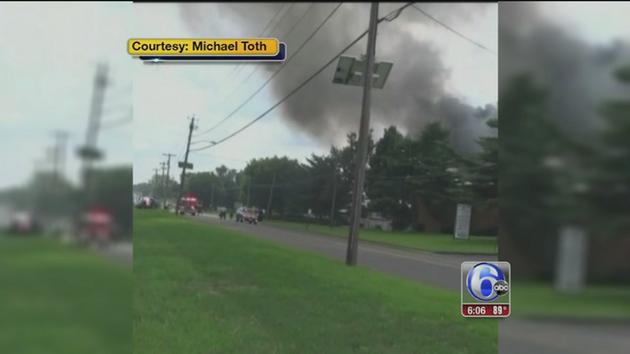
A firefighter was injured battling a blaze at a business in Pennsauken. (WPVI)
Saturday, August 06, 2016 08:07PM
PENNSAUKEN, N.J. (WPVI) -- A firefighter was injured battling a blaze at a business in Pennsauken, New Jersey.
The fire broke out before 1:15 p.m. Saturday at 825 Hylton Road.
Viewer video shows a thick plume of smoke billowing high into the air.
"The first units arriving reported fire visible from roof," said Chief Joseph Palumbo of the Pennsauken Fire Dept.
Firefighters had it under control within 30 minutes, containing the damage to the roof.
The bigger challenge for crews, the chief says, was the weather.
"The humidity proved to be a little more difficult than fire today. So we had to rotate some special companies for additional manpower," Chief Palumbo said.
Roofing contractors had been working on the building, which is being turned into a steel manufacturing plant called Innovaire.
It's unclear if the roofers who had just left accidentally sparked the blaze. Most likely the roofing material caught fire from a roofer's propane blow torch.
The building's owner said there was some smoke and water damage, but nothing that will significantly impact renovations.