Fire Hazards Caused By Debris Left Behind After Roofing Job
According to the U.S.Fire Administration’s (USFA’s) National Fire Incident Reporting System (NFIRS), there are an estimated 10,000 residential attic fires each year, resulting in approximately 30 deaths, 125 injuries and $477 million worth of property damage. One of the many potential causes of residential attic fires is leftover debris from a roofing job. If you have a roofing job scheduled in the near future, or if you recently had one performed on your home, you should take note of what I’m about to tell you.
Water Heater Burner Open
During a roofing job, it’s not uncommon for workers to accidentally knock open the burner doors on an attic water heater. A worker could knock it with their body, or they could drop a tool down on it. When these doors are open, the exposed flame could easily catch fire to sawdust or other debris. After the roofing job is complete, take a minute to inspect the burner doors on your water heater, ensuring that it’s fully closed and secure.
Loose Breaker Wires
Of course, roofing contractors and workers may also knock loose some of the breaker wires in your attic. The power breaker serves as the ‘hub’ for your home’s electricity. All of the power travels to the power breaker where it’s distributed to partitions throughout your home. Allowing wires inside the breaker to remain loose is a serious fire hazard that needs to be addressed. With that said, you should never attempt to reconnect breaker wires unless you are certified electrician.
Shingles and Sawdust
You’re bound to find some leftover shingles and sawdust in your attic after a roofing job. If the contractor did a poor job of cleaning up after themselves, swallow your pride and remove the debris yourself. Both shingles and sawdust can fuel attic fires, turning a small flame into a devastating house fire. Contractors should clean this debris up before leaving the site, but as you probably know, they oftentimes leave a mess behind for the homeowner to handle.
Moisture
A lesser-known fire hazard that’s left behind after a roofing job is moisture. I know what you’re thinking — doesn’t moisture prevent fires? Yes and no. If the moisture gets on electrical wires running through your attic, then it could short and cause a fire.
When choosing a contractor to perform your roofing job, do some research on their history and experience. A short Google search will likely reveal feedback (good and bad) from previous clients.

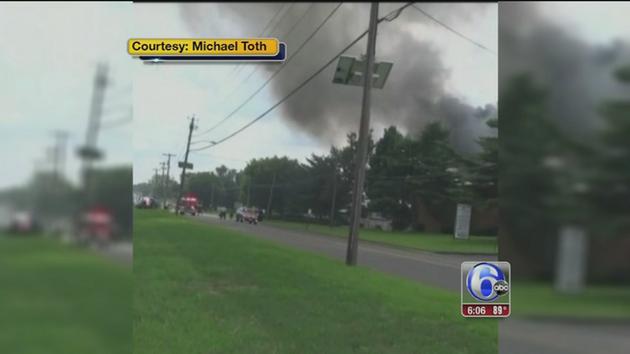
A firefighter was injured battling a blaze at a business in Pennsauken. (WPVI)
Saturday, August 06, 2016 08:07PM
PENNSAUKEN, N.J. (WPVI) -- A firefighter was injured battling a blaze at a business in Pennsauken, New Jersey.
The fire broke out before 1:15 p.m. Saturday at 825 Hylton Road.
Viewer video shows a thick plume of smoke billowing high into the air.
"The first units arriving reported fire visible from roof," said Chief Joseph Palumbo of the Pennsauken Fire Dept.
Firefighters had it under control within 30 minutes, containing the damage to the roof.
The bigger challenge for crews, the chief says, was the weather.
"The humidity proved to be a little more difficult than fire today. So we had to rotate some special companies for additional manpower," Chief Palumbo said.
Roofing contractors had been working on the building, which is being turned into a steel manufacturing plant called Innovaire.
It's unclear if the roofers who had just left accidentally sparked the blaze. Most likely the roofing material caught fire from a roofer's propane blow torch.
The building's owner said there was some smoke and water damage, but nothing that will significantly impact renovations.


Monsanto files motion to dismiss PCB lawsuit
Posted on August 5, 2016 by Sheryl Barr
Source: http://portlandtribune.com, August 5, 2016
By: Jim Redden
Lawyers for the companies that acquired Monsanto have asked the federal court in Portland to dismiss a lawsuit attempting to hold them liable for local pollution created by PCBs manufactured by the original firm.
The motion to dismiss filed with the US District Court in Oregon says the lawsuit is legally flawed and asserts that “Old Monsanto” never manufactured polychlorinated biphenyls in Portland or discharged them into the environmental. The filing includes a list of 33 other public nuisance cases that have been dismissed over the years for such products as PCBs, asbestos-containing materials, automobiles, flushable wipes, fossil fuels, guns, lead-based paint, pharmaceutical drugs, tobacco, and trans-fat foods, including pizza and popcorn.
The filing also says the suit will interfere with the U.S. Environmental Protection Agency-ordered cleanup of the Portland Harbor Superfund site, in which PCBs have been found.
“The City has needlessly resorted to litigation against a former product manufacturer that neither owned nor operated a PCB-manufacturing facility anywhere near the relevant water bodies and never deposited PCBs into the affected water bodies at any time — all in an effort to expand liability by circumventing traditional cleanup laws and regulatory tools, which rightfully focus on the actual dischargers. The City’s action will compel the product manufacturer that has discharged nothing into the water bodies to involve the actual PCB dischargers, including the City itself, in more litigation, which will upend the allocation process that has been ongoing for the past seven years. And because the City will contend its novel theories are not subject to any statute of limitations, the timing of this test case is particularly suspect. It could have been filed next year or thereafter under the City’s own rationale,” the filing says.
The suit filed in Portland is one of eight filed in West Coast cities with the assistance of the same two private law firms, Gomez Trial Lawyers and Baron & Budd. It was authorized by the City Council on March 16. All of the suits claim Monsanto, the exclusive domestic manufacturer of polychlorinated biphenyls from 1935 to 1979, knew the product was hazardous and hid the risks from the public.
PCBs were widely used in electrical and other industrial processes, and have been shown to be highly persistent in the environment and a likely cause of cancer in humans and animals. They have been found in Portland waterways, including the harbor Superfund site that the EPA believes was polluted by city sewers, among other sources.
“Although Monsanto knew for decades that PCBs were toxic and knew that they were widely contaminating all natural resources and living organisms, Monsanto concealed these facts and continued producing PCBs until Congress enacted the Toxic Substances Control Act (“TSCA”), which banned the manufacture and most uses of PCBs as of January 1, 1979,” says the suit, which seeks unspecified compensatory damages, punitive damages, litigation costs and attorney’s fees.
The Monsanto suit also involves pollution outside the Portland Harbor, says Sonia Schmanski, chief of staff to Commissioner Nick Fish, who oversee the Bureau of Environmental Services.
“I’m told the Monsanto case is broader than Superfund, including costs the city has and might in the future incur for investigating, monitoring, remediating, and mitigating PCBs not just in the Superfund site but also in the Columbia Slough, other parts of the Willamette, and tributaries like Johnson Creek,” says Schmanski.
You can read the motion to dismiss here.
You can read the lost of product liability suits that have been dismissed here.
You can read an earlier Portland Tribune story on the suit and find it at tinyurl.com/hu4r23w.


Is your West Deptford home on contaminated soil? EPA expanding testing to find out
Posted on August 5, 2016 by Sheryl Barr
Source: http://www.nj.com, August 4, 2016
By: Rebecca Forand
The Environmental Protection Agency has expanded the area to be tested for possible lead contamination in the Birchly Court neighborhood with 28 properties on Woodlane Drive being added to the list.
Homeowners in the development, which was built in the 1990s, have found pieces of crushed car batteries in the soil around their houses. The batteries are believed to have been deposited by Mattea & Sons, a scrap metal and recycling facility nearby which previously owned the property Birchly Court currently sits on.
The black plastic pieces, heavily contaminated with lead, have been found in large quantities throughout the neighborhood and the EPA is testing the soil to see how far the contamination has spread.
“We are expanding the investigation to the rest of the neighborhood,” David Rosoff, the project’s on site coordinator, said. “That should take the next 10 weeks or so to complete, and then the agency will evaluate the whole data set.”
Two properties are already slated for excavation and remediation, which is scheduled to begin in the next two weeks and be completed in October.
The cost of each cleanup varies, Rosoff said, but the first one — which includes the two initial properties — is estimated to cost about $500,000.
The EPA will be paying for the cleanup out of the federal budget and then attempt to identify the entities responsible in order to recoup those costs, he added.
=====================
Lead contamination could affect up to 34 homes in N.J. neighborhood, EPA says
By Rebecca Forand | For NJ.com
updated July 13, 2016 at 5:51 PM
WEST DEPTFORD TWP. — A family's recent plumbing project has exposed a potentially dangerous problem in the township's Birchly Court development, where lead-contaminated crushed car batteries have been found.
The Environmental Protection Agency is currently testing soil at a few properties in the neighborhood, and is looking to do so at the rest of them, representatives from the agency told concerned residents Wednesday afternoon.
An information session, the first of many, was held at the Verga Firehouse and provided those in attendance with a history of the find, the risks associated with it and what they can do.
Holding a large plastic bag filled with the black, plastic pieces, EPA on-site coordinator Dave Rosoff showed those residents what the contaminated material looks like.
"It is grossly contaminated with lead," he said. "Recyclers would take the lead core out and discard the plastic material."
The battery casings are believed to have come from another EPA Superfund site, the Matteo & Sons scrap metal and recycling facility. The property the development was built on was previously owned by Matteo, Rosoff added.
Seven sites in Gloucester County remain on the federal Environmental Protection Agency's list of Superfund program sites.
The investigation into the casing fragments began in May and the EPA is looking to collect soil samples from 34 properties on Birchly Court, Woodlane Drive and Oakmont Court.
If the soil is contaminated, the group will conduct an excavation of the contaminated ground material and replace it with clean fill, according to Rosoff. Two properties are already beginning the remediation process.
Lead contamination is a serious problem in a residential neighborhood, especially to children, EPA risk assessor Ula Filipowicz said.
"Children are a sensitive population. There's a lot of hand-to-mouth contact," she said.
Until a risk assessment is completed, they can't say how dangerous this particular contamination is, but since it contains lead — which is known to be toxic and cause neurological problems — she suggests anyone in the neighborhood take precautionary measures to limit exposure.
These include taking your shoes off when you enter your home, wet mopping walkways and washing children's hands.
At Wednesday afternoon's information session about a dozen residents were armed with questions and concerns about their own property and risk.
"Is any of this lead getting into our drinking water," Anthony Watson asked. "I'm hoping to find out I don't have a problem." As the EPA is just beginning their investigations, they ask any residents who are in the area to contact them with questions and respond to any inquiries and requests to investigate their property.

Source: http://ocnjdaily.com, August 5, 2016
Groundwater and soil contamination have been detected at an abandoned former gas station that has been an eyesore along Ocean City’s main gateway since it closed down five years ago.
Synergy Environmental Inc., a Cherry Hill consulting firm overseeing the (old Exxon) site at Ninth Street and Bay Avenue, said in a July 20 letter sent to surrounding property owners that the contamination consists of “petroleum-related constituents” that apparently stem from the station’s former operation.
But Synergy also noted, “The current soil and groundwater data indicates that the site poses no public health threats to the nearby communities.”
Synergy added that groundwater contamination has been detected in levels that exceed New Jersey Department of Environmental Protection standards. The contamination is being monitored by taking periodic samples, with the results sent to the DEP for its inspection, according to Synergy.
Synergy said that the groundwater contamination extends about 260 feet radially from the boundaries of the old gas station property, which occupies a prominent spot along the Ninth Street corridor, the main artery in and out of town.
“The environmental investigation is proceeding in accordance with NJDEP requirements,” the letter says. “Routine groundwater sampling is performed periodically. The proposed remedy for this property is to monitor the natural decrease in groundwater concentrations through periodic sampling.”
Contaminants found in the groundwater are “petroleum-related constituents which potentially result from gasoline station operations,” Synergy said.
Soil contamination has been found as well at the site, but an investigation is continuing to determine the extent and concentration, Synergy said.
David Robinson, a Synergy senior associate who is supervising the environmental work, could not be reached Thursday for more details about the site’s cleanup plan.
Doug Bergen, a spokesman for Mayor Jay Gillian, said Ocean City “fully supports the state Department of Environmental Protection’s efforts to hold the owners accountable and to make sure no contamination is left behind.”
Bergen noted that the investigation of the Exxon station’s contamination originally dates back to 1989. Since then, the state has been monitoring the site for 27 years and never found any health threat to the public or marine life, even when the gas station was still in business, he said.
The Ocean City real estate firm Keller Williams has plans to buy the former Exxon site and redevelop it into a new multimillion-dollar office for the company.
Eric Booth, a sales agent for Keller Williams, said Thursday he was not aware of Synergy’s July 20 letter about the contamination. However, he said Keller Williams still wants to buy and redevelop the site after the contamination is cleaned up by the current owner.
“Once they deliver a clean site, I don’t see a problem,” Booth said.
The property remains under contract to Keller Williams. Terms of the deal require that the site must be cleaned up before Keller Williams closes on the deal, Booth said.
Synergy’s letter was sent to property owners and tenants within 200 feet of the Exxon site. The letter notes that DEP regulations require the public to be notified periodically “about certain environmental work taking place.”
“We hope the work we are doing will progress smoothly and, in the end, restore the property as a valuable asset to the neighborhood,” the letter says. “In the meantime, we appreciate your concerns and your patience and pledge to conduct our work efficiently and as responsible members of the community.”
Synergy wrote the letter on behalf of 903 Bay Ave. Ocean City LLC, the owner of the former Exxon site. City officials have complained for years about the blighted condition of the property. They fear it creates a bad impression of Ocean City for tourists entering town along the Ninth Street corridor.
Exxon is one of three decrepit, former gas stations lining the Ninth Street entryway. Across the street from the Exxon site are abandoned BP and Getty stations.
The old BP was demolished recently after City Council approved a $475,000 bond ordinance to buy the site and transform it into landscaped open space and parking.
With the BP now gone, the old Exxon and Getty stations are the next targets for demolition.
The city has disclosed it has been in talks to acquire the Getty property and turn it into landscaped open space, too.


