What is an accident and why should it be investigated?
The term "accident" can be defined as an unplanned
event that interrupts the completion of an activity, and that may (or
may not) include injury or property damage.
An incident usually
refers to an unexpected event that did not cause injury or damage this
time but had the potential. "Near miss" or "dangerous occurrence" are
also terms for an event that could have caused harm but did not.
Please note: The
term incident is used in some situations and jurisdictions to cover
both an "accident" and "incident". It is argued that the word "accident"
implies that the event was related to fate or chance. When the root
cause is determined, it is usually found that many events were
predictable and could have been prevented if the right actions were
taken -- making the event not one of fate or chance (thus, the word
incident is used). For simplicity, we will use the term accident to mean
all of the above events.
The information that follows is intended
to be a general guide for supervisors or joint occupational health and
safety committee members. When accidents are investigated, the emphasis
should be concentrated on finding the root cause of the accident rather
than the investigation procedure itself so you can prevent it from
happening again. The purpose is to find facts that can lead to actions,
not to find fault. Always look for deeper causes. Do not simply record
the steps of the event.
Reasons to investigate a workplace accident include:
- most importantly, to find out the cause of accidents and to prevent similar accidents in the future
- to fulfill any legal requirements
- to determine the cost of an accident
- to determine compliance with applicable safety regulations
- to process workers' compensation claims
Incidents
that involve no injury or property damage should still be investigated
to determine the hazards that should be corrected. The same principles
apply to a quick inquiry of a minor incident and to the more formal
investigation of a serious event.
Who should do the accident investigating?
Ideally, an investigation would be conducted by someone
experienced in accident causation, experienced in investigative
techniques, fully knowledgeable of the work processes, procedures,
persons, and industrial relations environment of a particular situation.
Some jurisdictions provide guidance such as requiring that
it must be conducted jointly, with both management and labour
represented, or that the investigators must be knowledgeable about the
work processes involved.
In most cases, the supervisor should help investigate the event. Other members of the team can include:
- employees with knowledge of the work
- safety officer
- health and safety committee
- union representative, if applicable
- employees with experience in investigations
- "outside" expert
- representative from local government
Should the immediate supervisor be on the team?
The advantage is that this person is likely to
know most about the work and persons involved and the current
conditions. Furthermore, the supervisor can usually take immediate
remedial action. The counter argument is that there may be an attempt to
gloss over the supervisors shortcomings in the accident. This situation
should not arise if the accident is investigated by a team of people,
and if the worker representative(s) and the members review all accident
investigation reports thoroughly.
Why look for the root cause?
An investigator who believes that accidents are
caused by unsafe conditions will likely try to uncover conditions as
causes. On the other hand, one who believes they are caused by unsafe
acts will attempt to find the human errors that are causes. Therefore,
it is necessary to examine some underlying factors in a chain of events
that ends in an accident.
The important point is that even in the most seemingly straightforward accidents, seldom, if ever, is there only a single cause.
For example, an "investigation" which concludes that an accident was
due to worker carelessness, and goes no further, fails to seek answers
to several important questions such as:
- Was the worker distracted? If yes, why was the worker distracted?
- Was a safe work procedure being followed? If not, why not?
- Were safety devices in order? If not, why not?
- Was the worker trained? If not, why not?
An
inquiry that answers these and related questions will probably reveal
conditions that are more open to correction than attempts to prevent
"carelessness".
What are the steps involved in investigating an accident?
The accident investigation process involves the following steps:
- Report the accident occurrence to a designated person within the organization
- Provide first aid and medical care to injured person(s) and prevent further injuries or damage
- Investigate the accident
- Identify the causes
- Report the findings
- Develop a plan for corrective action
- Implement the plan
- Evaluate the effectiveness of the corrective action
- Make changes for continuous improvement
As
little time as possible should be lost between the moment of an
accident or near miss and the beginning of the investigation. In this
way, one is most likely to be able to observe the conditions as they
were at the time, prevent disturbance of evidence, and identify
witnesses. The tools that members of the investigating team may need
(pencil, paper, camera, film, camera flash, tape measure, etc.) should
be immediately available so that no time is wasted.
What should be looked at as the cause of an accident?
Accident Causation Models
Many models of
accident causation have been proposed, ranging from Heinrich's domino
theory to the sophisticated Management Oversight and Risk Tree (MORT).
The
simple model shown in Figure 1 attempts to illustrate that the causes
of any accident can be grouped into five categories - task, material,
environment, personnel, and management. When this model is used,
possible causes in each category should be investigated. Each category
is examined more closely below. Remember that these are sample questions
only: no attempt has been made to develop a comprehensive checklist.
Figure 1: Accident Causation 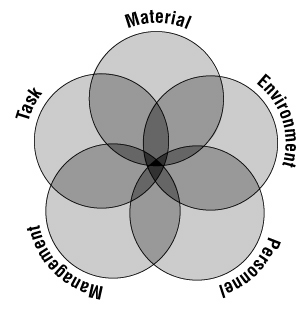
Task
Here
the actual work procedure being used at the time of the accident is
explored. Members of the accident investigation team will look for
answers to questions such as:
- Was a safe work procedure used?
- Had conditions changed to make the normal procedure unsafe?
- Were the appropriate tools and materials available?
- Were they used?
- Were safety devices working properly?
- Was lockout used when necessary?
For most of these questions, an important follow-up question is "If not, why not?"
Material
To seek out possible causes resulting from the equipment and materials used, investigators might ask:
- Was there an equipment failure?
- What caused it to fail?
- Was the machinery poorly designed?
- Were hazardous substances involved?
- Were they clearly identified?
- Was a less hazardous alternative substance possible and available?
- Was the raw material substandard in some way?
- Should personal protective equipment (PPE) have been used?
- Was the PPE used?
- Were users of PPE properly trained?
Again, each time the answer reveals an unsafe condition, the investigator must ask why this situation was allowed to exist.
Environment
The
physical environment, and especially sudden changes to that
environment, are factors that need to be identified. The situation at
the time of the accident is what is important, not what the "usual"
conditions were. For example, accident investigators may want to know:
- What were the weather conditions?
- Was poor housekeeping a problem?
- Was it too hot or too cold?
- Was noise a problem?
- Was there adequate light?
- Were toxic or hazardous gases, dusts, or fumes present?
Personnel
The
physical and mental condition of those individuals directly involved in
the event must be explored. The purpose for investigating the accident
is not to establish blame against someone but the
inquiry will not be complete unless personal characteristics are
considered. Some factors will remain essentially constant while others
may vary from day to day:
- Were workers experienced in the work being done?
- Had they been adequately trained?
- Can they physically do the work?
- What was the status of their health?
- Were they tired?
- Were they under stress (work or personal)?
Management
Management
holds the legal responsibility for the safety of the workplace and
therefore the role of supervisors and higher management and the role or
presence of management systems must always be considered in an accident
investigation. Failures of management systems are often found to be
direct or indirect factors in accidents. Ask questions such as:
- Were safety rules communicated to and understood by all employees?
- Were written procedures and orientation available?
- Were they being enforced?
- Was there adequate supervision?
- Were workers trained to do the work?
- Had hazards been previously identified?
- Had procedures been developed to overcome them?
- Were unsafe conditions corrected?
- Was regular maintenance of equipment carried out?
- Were regular safety inspections carried out?
This
model of accident investigations provides a guide for uncovering all
possible causes and reduces the likelihood of looking at facts in
isolation. Some investigators may prefer to place some of the sample
questions in different categories; however, the categories are not
important, as long as each pertinent question is asked. Obviously there
is considerable overlap between categories; this reflects the situation
in real life. Again it should be emphasized that the above sample
questions do not make up a complete checklist, but are examples only.
How are the facts collected?
The steps in accident investigation are simple:
the accident investigators gather information, analyze it, draw
conclusions, and make recommendations. Although the procedures are
straightforward, each step can have its pitfalls. As mentioned above, an
open mind is necessary in accident investigation: preconceived notions
may result in some wrong paths being followed while leaving some
significant facts uncovered. All possible causes should be considered.
Making notes of ideas as they occur is a good practice but conclusions
should not be drawn until all the information is gathered.
Injured workers(s)
The
most important immediate tasks--rescue operations, medical treatment of
the injured, and prevention of further injuries--have priority and
others must not interfere with these activities. When these matters are
under control, the investigators can start their work.
Physical Evidence
Before
attempting to gather information, examine the site for a quick
overview, take steps to preserve evidence, and identify all witnesses.
In some jurisdictions, an accident site must not be disturbed without
prior approval from appropriate government officials such as the
coroner, inspector, or police. Physical evidence is probably the most
non-controversial information available. It is also subject to rapid
change or obliteration; therefore, it should be the first to be
recorded. Based on your knowledge of the work process, you may want to
check items such as:
- positions of injured workers
- equipment being used
- materials or chemicals being used
- safety devices in use
- position of appropriate guards
- position of controls of machinery
- damage to equipment
- housekeeping of area
- weather conditions
- lighting levels
- noise levels
- time of day
You
may want to take photographs before anything is moved, both of the
general area and specific items. Later careful study of these may reveal
conditions or observations missed previously. Sketches of the accident
scene based on measurements taken may also help in subsequent analysis
and will clarify any written reports. Broken equipment, debris, and
samples of materials involved may be removed for further analysis by
appropriate experts. Even if photographs are taken, written notes about
the location of these items at the accident scene should be prepared.
Eyewitness Accounts
Although
there may be occasions when you are unable to do so, every effort
should be made to interview witnesses. In some situations witnesses may
be your primary source of information because you may be called upon to
investigate an accident without being able to examine the scene
immediately after the event. Because witnesses may be under severe
emotional stress or afraid to be completely open for fear of
recrimination, interviewing witnesses is probably the hardest task
facing an investigator.
Witnesses should be kept apart and
interviewed as soon as possible after the accident. If witnesses have an
opportunity to discuss the event among themselves, individual
perceptions may be lost in the normal process of accepting a consensus
view where doubt exists about the facts.
Witnesses should be
interviewed alone, rather than in a group. You may decide to interview a
witness at the scene of the accident where it is easier to establish
the positions of each person involved and to obtain a description of the
events. On the other hand, it may be preferable to carry out interviews
in a quiet office where there will be fewer distractions. The decision
may depend in part on the nature of the accident and the mental state of
the witnesses.
Interviewing
Interviewing is an
art that cannot be given justice in a brief document such as this, but a
few do's and don'ts can be mentioned. The purpose of the interview is
to establish an understanding with the witness and to obtain his or her
own words describing the event:
DO...
- put the witness, who is probably upset, at ease
- emphasize the real reason for the investigation, to determine what happened and why
- let the witness talk, listen
- confirm that you have the statement correct
- try to sense any underlying feelings of the witness
- make short notes or ask someone else on the team to take them during the interview
- ask if it is okay to record the interview, if you are doing so
- close on a positive note
DO NOT...
- intimidate the witness
- interrupt
- prompt
- ask leading questions
- show your own emotions
- jump to conclusions
Ask
open-ended questions that cannot be answered by simply "yes" or "no".
The actual questions you ask the witness will naturally vary with each
accident, but there are some general questions that should be asked each
time:
- Where were you at the time of the accident?
- What were you doing at the time?
- What did you see, hear?
- What were the environmental conditions (weather, light, noise, etc.) at the time?
- What was (were) the injured worker(s) doing at the time?
- In your opinion, what caused the accident?
- How might similar accidents be prevented in the future?
If
you were not at the scene at the time, asking questions is a
straightforward approach to establishing what happened. Obviously, care
must be taken to assess the credibility of any statements made in the
interviews. Answers to a first few questions will generally show how
well the witness could actually observe what happened.
Another
technique sometimes used to determine the sequence of events is to
re-enact or replay them as they happened. Obviously, great care must be
taken so that further injury or damage does not occur. A witness
(usually the injured worker) is asked to reenact in slow motion the
actions that preceded the accident.
Background Information
A
third, and often an overlooked source of information, can be found in
documents such as technical data sheets, health and safety committee
minutes, inspection reports, company policies, maintenance reports, past
accident reports, formalized safe-work procedures, and training
reports. Any pertinent information should be studied to see what might
have happened, and what changes might be recommended to prevent
recurrence of similar accidents.
What should I know when making the analysis and conclusions?
At this stage of the investigation most of the
facts about what happened and how it happened should be known. This has
taken considerable effort to accomplish but it represents only the first
half of the objective. Now comes the key question--why did it happen?
To prevent recurrences of similar accidents, the investigators must find
all possible answers to this question.
You have kept an
open mind to all possibilities and looked for all pertinent facts. There
may still be gaps in your understanding of the sequence of events that
resulted in the accident. You may need to reinterview some witnesses to
fill these gaps in your knowledge.
- When your
analysis is complete, write down a step-by-step account of what happened
(your conclusions) working back from the moment of the accident,
listing all possible causes at each step. This is not extra work: it is a
draft for part of the final report. Each conclusion should be checked
to see if:
- it is supported by evidence
- the evidence is direct (physical or documentary) or based on eyewitness accounts, or
- the evidence is based on assumption.
This list serves as a final check on discrepancies that should be explained or eliminated.
Why should recommendations be made?
The most important final step is to come up with a
set of well-considered recommendations designed to prevent recurrences
of similar accidents. Once you are knowledgeable about the work
processes involved and the overall situation in your organization, it
should not be too difficult to come up with realistic recommendations.
Recommendations should:
- be specific
- be constructive
- get at root causes
- identify contributing factors
Resist the temptation to make only general recommendations to save time and effort.
For
example, you have determined that a blind corner contributed to an
accident. Rather than just recommending "eliminate blind corners" it
would be better to suggest:
- install mirrors at the northwest corner of building X (specific to this accident)
- install mirrors at blind corners where required throughout the worksite (general)
Never
make recommendations about disciplining a person or persons who may
have been at fault. This would not only be counter to the real purpose
of the investigation, but it would jeopardize the chances for a free
flow of information in future accident investigations.
In
the unlikely event that you have not been able to determine the causes
of an accident with any certainty, you probably still have uncovered
safety weaknesses in the operation. It is appropriate that
recommendations be made to correct these deficiencies.
The Written Report
If
your organization has a standard form that must be used, you will have
little choice in the form that your written report is to be presented.
Nevertheless, you should be aware of, and try to overcome, shortcomings
such as:
- If a limited space is provided for
an answer, the tendency will be to answer in that space despite
recommendations to "use back of form if necessary."
- If a checklist of causes is included, possible causes not listed may be overlooked.
- Headings such as "unsafe condition" will usually elicit a single response even when more than one unsafe condition exists.
- Differentiating
between "primary cause" and "contributing factors" can be
misleading. All accident causes are important and warrant consideration
for possible corrective action.
Your
previously prepared draft of the sequence of events can now be used to
describe what happened. Remember that readers of your report do not have
the intimate knowledge of the accident that you have so include all
pertinent detail. Photographs and diagrams may save many words of
description. Identify clearly where evidence is based on certain facts,
eyewitness accounts, or your assumptions.
If doubt exists
about any particular part, say so. The reasons for your conclusions
should be stated and followed by your recommendations. Weed out extra
material that is not required for a full understanding of the accident
and its causes such as photographs that are not relevant and parts of
the investigation that led you nowhere. The measure of a good accident
report is quality, not quantity.
Always communicate your
findings with workers, supervisors and management. Present your
information 'in context' so everyone understands how the accident
occurred and the actions in place to prevent it from happening again.
What should be done if the investigation reveals human error
A difficulty that has bothered many investigators
is the idea that one does not want to lay blame. However, when a
thorough worksite accident investigation reveals that some person or
persons among management, supervisor, and the workers were apparently at
fault, then this fact should be pointed out. The intention here is to
remedy the situation, not to discipline an individual.
Failing
to point out human failings that contributed to an accident will not
only downgrade the quality of the investigation. Furthermore, it will
also allow future accidents to happen from similar causes because they
have not been addressed.
However never make recommendations
about disciplining anyone who may be at fault. Any disciplinary steps
should be done within the normal personnel procedures.
How should follow-up be handled?
Management is responsible for acting on the
recommendations in the accident investigation report. The health and
safety committee, if you have one, can monitor the progress of these
actions.
Follow-up actions include:
- Respond to the recommendations in the report by explaining what can and cannot be done (and why or why not).
- Develop a timetable for corrective actions.
- Monitor that the scheduled actions have been completed.
- Check the condition of injured worker(s).
- Inform and train other workers at risk.
- Re-orient worker(s) on their return to work.


 NEW ORLEANS — The Coast Guard has closed the Red River from mile marker 40 to mile marker 42, Sunday.
  An offshore worker has been injured on Eni Norge’s Goliat floating production storage and offloading (FPSO) unit in the Barents Sea.