Jun 14th, 2016
 NEW
YORK — The Coast Guard has suspended the search for a paddle boarder
who was last seen off Atlantic Beach, New York, on Sunday.
NEW
YORK — The Coast Guard has suspended the search for a paddle boarder
who was last seen off Atlantic Beach, New York, on Sunday.
Missing is Gary Turkel, 41.
Turkel was reported missing by the Nassau County Fire Department at approximately 6:15 p.m. on Sunday.
A
family member called local authorities and stated Turkel had gone out
on a paddle board and had not returned. A lifeguard in the vicinity of
Atlantic Beach last saw him at approximately 3:30 p.m. Sunday on the
paddle board without a life jacket.
Coast Guard crews began
searching Sunday at 7:30 p.m. During the 70-hour search effort, crews
completed 25 search patterns and covered 3,141 nautical miles.
The following search and rescue crews assisted with the search:
Coast Guard Station Jones Beach, New York, 47-foot Motor Lifeboat
Coast Guard Station Fire Island, New York, 47-foot Motor Lifeboat
Coast Guard Station Sandy Hook, New Jersey, 47-foot Motor Lifeboat
Coast Guard Cutter Bonito, an 87-foot Patrol Boat homeported in Montauk, New York
Coast Guard Cutter Sailfish, an 87-foot Patrol Boat homeported in Sandy Hook, New Jersey
Coast Guard Air Station Atlantic City, New Jersey, MH-65 Dolphin helicopter
Coast Guard Air Station Elizabeth City, North Carolina, HC-130 Super Hercules aircraft
New York Fire Department marine unit
New York Police Department aviation unit
Atlantic Beach Fire Department
Atlantic Beach Rescue
Nassau County Marine and Aviation Units
Lawrence-Cedarhurst Fire Department
Private Helicopter 353JS
“We
treat every search effort as if we were searching for one of our own
family members,” said Captain Edward Cubanski, III, commander Coast
Guard Sector Long Island Sound. “I would like to send my deepest
sympathy and heartfelt thoughts out to the family and friends of Mr.
Turkel during this tragic time.”
The Coast Guard wants to remind
all those who venture on the water to always wear a life jacket. The
number one cause of water fatalities is drowning. A proper life jacket
increases the chances of survival for anyone who may unexpectedly enter
the water.
The Coast Guard encourages boaters who enjoy
paddlesports to continue doing so, but to use the correct safety and
survival equipment. Paddlesport enthusiasts should also brush up on
paddling education by taking one or more of the paddler education
classes offered by the Coast Guard Auxiliary, state departments of
natural resources, community park districts, paddling clubs and local
commercial outfitters.
Paddlers should always check the weather
forecast before a trip and should dress for the water temperature,
rather than the air temperature. At times this might mean wearing wet or
dry suits while paddling.
A float plan should be completed and
left with someone who is not going out on the water. A float plan is a
lifesaving device on paper and provides emergency responders with
valuable information they would need in order to search for a distressed
or overdue boater. Information on a float plan and how to obtain a
blank float plan can be found at http://ift.tt/1lrgyd4.


Teresa, 31, worked at a pork processing plant in Nebraska for five years until injuries to her shoulder forced her to quit. She still has pain and can only work part-time. (Brian Seifferlein/Harvest Public Media)
Jun. 14, 2016
Peggy Lowe is Harvest Public Media's investigations editor, based at KCUR in Kansas City.
The nights were often worse for Gabriel, even after long days working on the production line at a pork slaughterhouse in Nebraska.
He had nightmares that the line – what the workers call “the chain” – was moving so fast, that instead of gutted hogs flying by, there were people.
“You’ve been working there for three hours, four hours, and you’re working so fast and you see the pigs going faster, faster,” he says.
“There are some supervisors, you stop the chain because there’s a problem, they come out yelling, ‘Let’s go! Let’s go!’ They swear at you, ‘C’mon, you son of a…’”
The chain is the heartbeat of any meat processing plant, the mechanized driver of eviscerated hogs, cattle and chickens, hung up on hooks and quickly moving down a line at these massive meat factories. Workers disassemble the animals into the cuts consumers prefer – tenderloins and chicken tenders, beef chuck and pork chops.
The workers, most often immigrants and resettled refugees, slaughter and process hundreds of animals an hour, forced to work at high speeds in cold conditions, doing thousands of the same repetitions over and over, with few breaks. That production literally feeds the average American, who eats about 200 pounds of meat a year.
That furious pace also fuels an array of assaults to workers’ muscles, tendons, ligaments and nerves called musculoskeletal disorders, or MSDs, causing sprains, strains, pains, or inflammation.
Often impossible to see and difficult to prove, MSDs have not been directly linked to the fast pace of the production line. Nor does the government track MSDs diagnosed in slaughterhouse workers. That’s despite lots of evidence, such as:
Occupational Safety and Health Administration (OSHA) 2014 data that showed repetitive motion cases caused by “microtasks” among beef and pork processing workers were nearly seven times that of other private industries.
Seventy-six percent of workers in a Maryland plant had abnormal nerve conditions in at least one hand, according to a 2015 report by three federal agencies.“Part of the business model in this industry is to sacrifice worker safety on the altar of profits,” says Debbie Berkowitz, a former OSHA official and now a senior fellow at the National Employment Law Project.
The North American Meat Institute (NAMI), an industry trade group, calls reports about fast line speeds and high rates of worker injuries a “myth.”
NAMI and meat companies cite a decline in worker injuries over the years, a trend noted in a recent government report that was also critical of persistently high injury rates and poor reporting. The meat industry also often points to voluntary ergonomics standards they embraced dating back to 1990 as well as an increase in the prevalence of safety gear on the line.
Dan McCausland, NAMI director of worker safety and human resources, says there’s no cost savings for companies to run the chains fast because people will get hurt or not be able to keep up, thus cutting into company profits.
“Interestingly enough, almost all the folks that I’ve ever talked to tell me, ‘The line is just too fast. It’s too fast.’ ‘I say, ‘OK, how fast is too fast?’ Well, nobody knows,” McCausland says.
Workers in meat processing plants tell another story. They describe punishing rates of production, leaving them with a lifetime of pain and physical problems. Workers who make on average $12.50 an hour, or about $26,000 a year, say they can get fired if their injuries prevent them from working harder; companies report constant employee turnover.
“It’s the same story,” says Gloria Sarmiento of Nebraska Appleseed, a worker advocacy group that surveyed 455 workers across that state in 2009. “The speed of the line is really fast. The supervisors are yelling all the time. They said ‘Would you please tell the employers to give a human resources training because they don’t know how to treat people.’”
“They are treating us like animals.”
Who’s in charge of line speeds?
Many of the workers at beef, pork and poultry plants don’t speak English but they know that when the boss talks about OSHA, it means the government is coming around and the plant better be running right. Meatpacking workers who talked to Harvest Public Media said guards at the front gates of the plants signal when OSHA inspectors are coming in, the chain often slows down and workers are added to the line.
Despite the companies’ fears, OSHA does not have any oversight of the pace of the production chain, a fact called a “regulatory perversion” by University of Iowa law professor Marc Linder in one of the first reports to call attention to line speeds and worker injuries in 1995.
OSHA is tasked with watching out for worker safety in the plants, but it continues to reject any suggestion that it has any authority over production speeds and denied a 2013 request by a dozen labor rights groups to set a lower line speed standard.
In a written response to the labor groups, David Michaels, OSHA’s assistant secretary of labor, noted that MSDs can’t solely be attributed to line speeds. Ergonomic risk factors and the cold temperatures in plants must also be considered, Michaels wrote.
Yet Michaels noted the high injury rates of meatpacking workers, while still maintaining that OSHA’s “limited resources do not allow for this comprehensive analysis and rulemaking effort.”
The U.S. Department of Agriculture oversees the factory line in meat processing plants, but the agency concentrates solely on food safety, leaving workers worried about injuries caused by line speeds without a safety net.
The government has argued that USDA regulations “act as a kind of de facto throttle on line speed that protects the workers,” says Ted Genoways, author of “The Chain,” an investigative book about Midwestern meatpacking.
“The USDA’s longtime argument is that they don't monitor worker safety but that worker safety is assured by the inspection process creating what they call a ‘friction point’ with the speed of the processing line,” Genoways, says.
Even that throttle is being removed, however, as the USDA champions a controversial program already in place in many chicken plants, which reduces the number of government inspectors and hands over many food safety duties to the companies. The USDA has recommended developing similar programs in pork factories.
The poultry modernization plan, designed to cut back on high salmonella rates, was implemented by the USDA’s Food Safety and Inspection Service (FSIS) in 2014. It initially called for allowing the chains to run at 175 birds a minute, but after an outcry by critics, settled on 140 birds a minute.
A similar plan aimed at the pork industry has been in the pilot stage for 20 years and is currently allowing the chain to run at 1,300 hogs per hour, according to what USDA inspectors told the Government Accountability Project, a consumer advocacy group.
“FSIS hierarchy is in bed with the regulated industry,” says Joe Ferguson, who spent 23 years with the USDA’s Food Safety and Inspection Service. “The companies are now calling the shots.”
During recent testimony before a congressional committee, FSIS’s Al Almanza touted the new poultry plan and says the pork pilot program will be modeled after that inspection model. Though there is no mention of the regulation of line speeds, the poultry modernization plan requires companies to submit an annual report on worker safety and allows FSIS employees to use OSHA’s confidential hotline to report workplace problems.
Asked to detail FSIS’ position on the role of line speed and worker safety, an FSIS spokesperson sent this statement:
“We listened carefully to the feedback we received from the public, experts and other federal partners about the 2012 proposal, and the result is an improved modernization effort that includes safeguards for worker safety and represents the most significant updates to the country’s food safety procedures for poultry products since the 1950s.”
Teresa: ‘pain the rest of your life’
Teresa, an immigrant from Mexico who has lived in Lincoln, Neb., for 15 years, was thrilled when she first got her job at a pork processing plant in 2011. She was in her twenties and started out making $11.50 an hour – a good wage. Teresa didn’t want to use her last name because she feared that her husband, who still works at a plant, might get in trouble.
She took on lots of hours, working 12-hour shifts sometimes seven days a week, helping to provide for her new family, and was awarded employee of the month four times.
Teresa worked on the line, stuffing 7- to 10-pound hams in bags, at times up to 50 hams a minute.
She started experiencing problems in her right shoulder. After reporting the pain to her supervisors, they told her that if she was injured, she should go home. But Teresa, who got a pay bump to $12.50 an hour, needed the money and losing the hours wasn’t an option.
“The supervisors were very nasty,” she says. “They wanted everything fast, they wanted to produce a lot of quantity. They didn’t care about the people.”
Teresa says she went to the company doctor, who told her the shoulder problem was a bone spur. Finally, her shoulder got so bad, she was diagnosed with injuries from repetitive motions and she had surgery. It didn’t work. She complained.
“I said, ‘OK, why are you sending me back to the line when I have pain? I need to see another doctor,’” Teresa says. “They said, ‘I’m sorry, the doctor said you’re going to have to live with pain for the rest of your life.”
She kept working. Pregnant with her second child, she says she wasn’t allowed bathroom breaks, as her supervisor didn’t want to slow down the line. A common complaint, many workers say people relieve themselves while standing and working on the chain and some wear adult diapers. A recent report by Oxfam America found dozens of people making those claims. A survey by worker advocacy organization Nebraska Appleseed also found workers denied bathroom breaks in 2009.
“Some people said they pee in the line and some people, they poo in the line,” Appleseed’s Sarmiento says. “Because they were asking permission to go to the restroom but they didn’t allow them to go.”
Companies who recently responded to a Harvest Public Media story on the Oxfam report questioned the validity of the study and said workers can call an anonymous tip line or contact a human resources representative if they experience workplace problems.
Finally, Teresa had had enough and after five years, she decided to quit, asking for a payout for her injuries. She was told that workers’ compensation insurance doesn’t pay for pain, although she says she was ultimately awarded $1,700 for her time away from work.
“When I quit, when I decided to stay home with my babies, I was so angry because my shoulder was bothering me a lot and when I wanted to hold my daughter with my right shoulder I was not able,” Teresa says. “I was not even able to tear the food, I was in pain all the time.”
Now 31, Teresa can work just part-time. She’s most often at home with her three children, a 7-year-old boy, a 3-year-old daughter and a 9-month old boy. She tells her friends who still work at the plant to get out.
“I told them you better find another job because you’re going to lose everything. Besides we lose all the dignity and we were humiliated,” she says. “Sooner or later, they’re going to get hurt. (The company is) not going to care. They’re just going to throw them away and hire more people.”
How much is an arm worth?
Complicating any chance at recourse for workers with MSDs is the ambiguous nature of injuries, both medically and legally.
Many companies have medical staff on-site at the plants, so when workers complain of problems, they are sent to a nurse or doctor. While some get treated, many are turned away with ice packs to relieve inflammation and pain relievers.
Many workers are told to go back to work and are barred from reporting injuries, as managers want to keep OSHA injury reports low, a recent Government Accountability Office report noted. Injured workers that spoke to Harvest Public Media say they have stayed on the line because of a lack of sick leave or for fear of losing their jobs.
Those who file and are denied a workers’ compensation claim for “cumulative trauma” sometimes seek an attorney like Britton Morrell of Greeley, Colorado.
The claims are hard to prove, Morrell says, because a worker must apply a checklist of risk factors. How many repetitive motions are required on the job? Is the use of force involved? Does the worker hold his extremities at an awkward posture? Is there a vibratory mechanism attached to the job? Does the worker experience extreme cold in the plant?
“It's a Byzantine checklist in the sense that now you've got to kind of break down the job into very specific predetermined risk factors that the state has created using the medical treatment guidelines which don't have the force of law,” Morrell says.
Experts must be hired, which is expensive, Morrell says. If a claim can be won, the payout is generated by a complicated calculation, he says, which is different in each state because of workers’ compensation laws. Age, body part, and pay rates all go into the arithmetic.
For instance, in a simplified version of the calculation, if a worker in Colorado loses the use of her arm at the shoulder, a worker would be paid roughly $60,000.
Morrell says he likes to try to get five things for his clients: improvements in pain, range of motion, strength, speed and endurance.
“If we can get those five things as close to the way before injury that’s how I personally describe improvement,” he says. “At some point for serious injuries there’s an acknowledgement, we’re never going to get these things back to the way they were before.”
’Why don’t they care about their people?’
Gabriel, who didn’t want to name the company he works for or uses his last name for fear of retaliation towards family members who still work there, says he was fired years ago from a slaughterhouse because he sought vacation rights. A Mexican immigrant, Gabriel has since worked at another plant in southeast Nebraska for 11 years.
To be fair, Gabriel says, some supervisors don’t treat workers poorly, but they can resort to cursing at people and refusing breaks because they are being pushed by the company for more and more production. He has had friends and family member who have also been fired, mostly for being injured, he says.
“Once you get hurt, they are just waiting for these people to do a mistake to fire them because they don’t want them over there,” Gabriel says. “Even if you’re on light duty and (that means) you are hurt, you sit down, you get tired, they fire you because they say you’re sleeping.”
In a time when concern for animal welfare has changed the way companies do business – making sure eggs are produced cage-free, that chickens roam free-range, that pregnant hogs are not confined in small gestation crates – there is still little outcry about conditions for workers who produce our meat.
Last year, Oxfam America released a report about the “grim” conditions workers face at poultry plants. In “Lives on the line: the human cost of cheap chicken,” the anti-poverty group placed the responsibility for changing the industry on consumers.
“One of the workers we were working with,” recalled Oliver Gottfried of Oxfam America, “said ‘If they can care this much about their animals, why can’t they care about their people?’”
OSHA schedules meeting about hazards in tree care industry
June 14, 2016
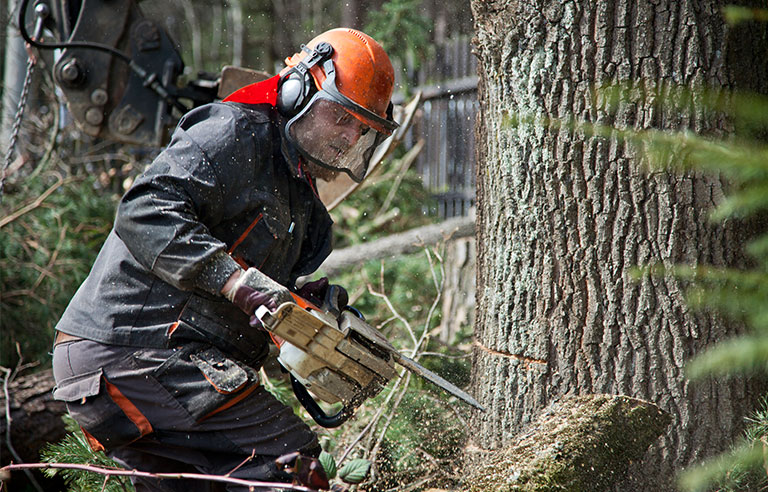
Photo: Josef Mohyla/iStockphoto
Related Articles
OSHA issues bulletin on protecting tree care workers
OSHA schedules meeting on recordkeeping rule
Deaths in high-hazard industries send extra OSHA inspectors to North Dakota
Washington – OSHA has scheduled an informal stakeholder meeting to discuss the hazards associated with tree care operations, as it considers creating a proposed rule to protect workers in the industry.
The meeting is slated for July 13 in the nation’s capital. Individuals interested in participating must register
by July 1. To encourage group interaction, formal presentations by
stakeholders will not be permitted. Instead, OSHA says it intends to
have conversations about the following:
Fatalities and injuries:
What are the primary causes, circumstances or factors for incidents in
specific organizations and the industry as a whole? What actions do
organizations take when a fatality or injury occurs?
New technology
in the tree care industry: What types of emerging technology have
organizations found effective for controlling hazards and protecting
workers?
National consensus and State Plan standards: What
provisions and requirements in formal standards have organizations found
most effective? Which provisions or requirements should OSHA consider
as it looks toward a proposed rule?
Vehicles and mobile equipment:
How often do organizations use vehicles and mobile equipment such as
bucket trucks, aerial lifts and cranes to perform tree care? What are
best practices for using vehicles and mobile equipment while working in
the industry?
Information and training: What topics do organizations
cover during worker training? How do they ensure temporary workers,
non-English speaking workers and workers with limited literacy
understand the information?
OSHA has deliberated
taking action to protect tree care workers for nearly a decade. In
2008, the agency issued an advance notice of proposed rulemaking to
collect information about hazards in the industry and possible solutions
but later removed it, citing insufficient resources.
June 13, 2016
Worker suffers serious injury after arm caught in machine at HBD/Thermoid, Bellefontaine, Ohio, rubber-hose manufacturing plant
HBD/Thermoid cited in May 2015 for similar hazards, faces $70K in OSHA fines
BELLEFONTAINE, Ohio - Less than a year after federal inspectors cited an Ohio rubber-hose manufacturer for 11 machine safety violations, the company now faces an additional $70,000 in fines after safety lapses led a 27-year-old male worker to suffer severe injuries at its Bellefontaine plant.
Inspectors from the U.S. Department of Labor Occupational Safety and Health Administration investigating the Feb. 16, 2016, injury at HBD/Thermoid Inc. found an improperly guarded drive belt caught the worker's left arm and caused lacerations and fractures. The agency issued one willful citation to the company on June 9.
"HBD/Thermoid is a repeat violator that continues to put workers at risk of amputations and serious injuries by ignoring safety rules for industrial machines used by workers who manufacturer rubber hoses at the company's six facilities across the country," said Kim Nelson, area director of OSHA's Toledo office. "The company needs to take immediate action and fix these safety issues at its facilities. Employees and their families pay the painful price when companies don't follow standards to reduce injuries."
In May 2015, OSHA cited the Bellefontaine facility, for one willful and 10 serious safety violations and levied penalties of $134,000. The agency initiated the 2015 inspection after receiving a referral from the North Carolina Occupational Safety and Health Division after an employee died after being caught in an industrial machine at the company's Salisbury facility.
View the current citations here.
HBD/Thermoid employs about 1,000 workers corporatewide and manufactures hoses used in a variety of industries, such as transportation, food processing and agriculture. The company also has facilities in Bell Gardens, California; Chanute, Kansas; Salisbury, North Carolina; Oneida, Tennessee; and Eglin, South Carolina.
The company has 15 business days from receipt of its citations and penalties to comply, request an informal conference with OSHA's area director, or contest the findings before the independent Occupational Safety and Health Review Commission.
To ask questions, obtain compliance assistance, file a complaint, or report workplace hospitalizations, fatalities or situations posing imminent danger to workers, the public should call OSHA's toll-free hotline at 800-321-OSHA (6742) or the Toledo Area Office at 419-259-7542.
Under the Occupational Safety and Health Act of 1970, employers are responsible for providing safe and healthful workplaces for their employees. OSHA's role is to ensure these conditions for America's working men and women by setting and enforcing standards, and providing training, education and assistance. For more information, visit http://www.osha.gov.
June 7, 2016
OSHA finds flammable chemicals caused fire hazards,
unguarded machine amputated worker's fingertip at PhytogenX
Cosmetics manufacturer fined $285,300 for hazards at Morgantown facility
Employer name: PhytogenX Inc.
Inspection site: 35 Thousand Oaks Blvd., Morgantown, Pennsylvania
Citations issued: On June 8, 2016, the U.S. Department of Labor's Occupational Safety and Health Administration issued citations to PhytogenX for four willful and six serious violations.
Inspection findings: On Dec. 10, 2015, OSHA initiated an inspection after the employer notified the agency that a worker had a finger amputated by a machine. The inspection was also in response to a separate complaint alleging hazards related to the storage and handling of flammable liquids at the cosmetic manufacturer.
The willful violations involved improper storage and handling of flammable liquids.
The agency found serious violations when PhytogenX:
- Improperly stored, transferred and processed flammable liquids.
- Exposed employees to fall and forklift hazards.
- Failed to properly guard a filling machine, which caused the amputation.
- Failed to provide fire extinguisher and hazards of flammable liquid training.
- Failed to develop and implement a written hazard communication program.
Quote: "PhytogenX did not uphold its legal responsibility to provide a safe workplace by exposing employees to serious fire hazards, and not training them to recognize warning signs or special precautions required when working with flammable liquids," said Kevin Kilp, area director of OSHA's Harrisburg office. "An employee needlessly suffered the loss of a fingertip, which is something that could have been prevented through basic machine safeguards. This company must immediately address the cited hazards to avoid further incidents from occurring."
Proposed penalties: $285,300
The citations can be viewed at:
https://www.dol.gov/sites/default/files/newsroom/newsreleases/OSHA20161188a.pdf
https://www.dol.gov/sites/default/files/newsroom/newsreleases/OSHA20161188b.pdf
The employer has 15 business days from receipt of its citations and proposed penalties to comply, request a conference with OSHA's area director or contest the findings before the independent Occupational Safety and Health Review Commission.
To ask questions; obtain compliance assistance; file a complaint; or report amputations, eye loss, workplace hospitalizations, fatalities or situations posing imminent danger to workers, the public should call OSHA's toll-free hotline at 800-321-OSHA (6742) or the agency's Harrisburg Area Office at 717-782-3902.
Under the Occupational Safety and Health Act of 1970, employers are responsible for providing safe and healthful workplaces for their employees. OSHA's role is to ensure these conditions for America's working men and women by setting and enforcing standards, and providing training, education and assistance. For more information, visit http://www.osha.gov.


