June 13, 2016
Dove Die & Stamping Company, Brook Park, Ohio faces more than $45K in
federal fines for exposing workers to noise hazards
Employer name: Dove Die & Stamping Company, Brook Park, Ohio
June 7, 2016
Investigation findings: The U.S. Department of Labor Occupational Safety and Health Administration's Cleveland Area Office cited Dove Die & Stamping Company for two willful and two serious safety and health violations.
The agency opened an investigation at the Brook Park metal stamping facility in March 2016 after receiving a complaint alleging unsafe working conditions.
Investigators found the company failed to:
Quote: "Employers have a responsibility to protect workers from exposure to noise hazards that can lead to debilitating health conditions," said Howard Eberts, OSHA's area director in Cleveland. "Training workers, providing and requiring the use of hearing protection and annual audiograms are required to protect worker's long-term health."
Proposed Penalties: $45,500
Citations: View here.
To ask questions, obtain compliance assistance, file a complaint, or report amputations, eye loss, workplace hospitalizations, fatalities or situations posing imminent danger to workers, the public should call OSHA's toll-free hotline at 800-321-OSHA (6742) or the agency's Cleveland Area Office at (216) 447-4194.
OOCL Belgium Out of Action Due to Main Engine Issues

Image Courtesy: Shipspotting
The 1998-built containership OOCL Belgium is currently undergoing unscheduled maintenance in the port of Montreal, Canada, due to a possible issue with the vessel’s main engine.
“The unscheduled maintenance work was recommended by the surveyor following a main engine inspection at the port of Montreal,” a representative from the Hong Kong-based container shipping company Orient Overseas Container Line (OOCL) told World Maritime News.
The 40,972 dwt boxship’s schedule is expected to be delayed by more than two weeks under the company’s Gateway Express 1 (GEX1) service.
OOCL said that, as a schedule recovery plan, it would phase in a replacement vessel, the 51,699 dwt MV Cap Harrisson, to the GEX1 service in Antwerp on June 16, which would conduct a single round voyage.
Featuring 39,174 gross tons, the 245-meter long OOCL Belgium previously encountered trouble when its propeller was damaged as the ship reportedly hit ice in the Strait of Belle Isle in February 2013.
At the time of the incident the 2,992 TEU vessel was on its way from Montreal to England.
In March 2013, OOCL Belgium arrived at Bremerhaven, Germany, where it underwent emergency dry dock.
World Maritime News Staff
FOR IMMEDIATE RELEASE
Tuesday, June 14, 2016
Chinese National Charged for Stealing Source Code from Former Employer with Intent to Benefit Chinese Government
Xu Jiaqiang, 30, was charged in a six-count superseding indictment with economic espionage and theft of trade secrets, in connection with Xu’s theft of proprietary source code from his former employer, with the intent to benefit the National Health and Family Planning Commission of the People’s Republic of China.
The superseding indictment was announced by Assistant Attorney General for National Security John P. Carlin and U.S. Attorney Preet Bharara of the Southern District of New York.
Xu was initially arrested by the FBI on Dec. 7, 2015, and was previously charged with one count of theft of trade secrets. Xu is scheduled to be arraigned on the superseding indictment at 12 p.m. EDT on June 16, 2016, before U.S. District Judge Kenneth M. Karas of the Southern District of New York.
“Xu allegedly stole proprietary information from his former employer for his own profit and the benefit of the Chinese government,” said Assistant Attorney General Carlin. “Those who steal America’s trade secrets for the benefit of foreign nations pose a threat to our economic and national security interests. The National Security Division will continue to work tirelessly to identify, pursue and prosecute any individual who attempts to harm American businesses by robbing them of their valuable intellectual property.”
“As alleged, Xu Jiaqiang is charged with stealing valuable, proprietary software from his former employer, an American company, that he intended to share with an agency within the Chinese government,” said U.S. Attorney Bharara. “Economic espionage not only harms victim companies that have years or even decades of work stolen, but it also crushes the spirit of innovation and fair play in the global economy. Economic espionage is a serious federal crime, for which my office, the Department of Justice’s National Security Division, and the FBI will show no tolerance.”
According to the allegations contained in the criminal complaint on which Xu was initially arrested, the original indictment and the superseding indictment:
From November 2010 to May 2014, Xu worked as a developer for a particular U.S. company (victim company). As a developer, Xu had access to certain proprietary software, as well as that software’s underlying source code. The proprietary software is a clustered file system developed and marketed by the victim company in the United States and other countries. A clustered file system facilitates faster computer performance by coordinating work among multiple servers. The victim company takes significant precautions to protect the proprietary source code as a trade secret because the value of the proprietary source code depends in part on its secrecy. Among other things, the proprietary source code is stored behind a company firewall and can be accessed by only a small subset of the victim company’s employees. Before receiving proprietary source code access, victim company employees must first request and receive approval from a particular victim company official. Victim company employees must also agree in writing at both the outset and the conclusion of their employment that they will maintain the confidentiality of any proprietary information.
In May 2014, Xu voluntarily resigned from the victim company. Xu subsequently communicated with one undercover law enforcement officer (UC-1), who posed as a financial investor aiming to start a large-data storage technology company, and another undercover law enforcement officer (UC-2), who posed as a project manager working for UC-1. In these communications, Xu discussed his past work with the victim company and indicated that he had experience with the proprietary software and the proprietary source code. On March 6, 2015, Xu sent UC-1 and UC-2 a code, which Xu stated was a sample of Xu’s prior work with the victim company. A victim company employee (employee-1) later confirmed that the code sent by Xu included proprietary victim company material that related to the proprietary source code.
Xu subsequently informed UC-2 that he was willing to consider providing UC-2’s company with the proprietary source code as a platform for UC-2’s company to facilitate the development of UC-2’s company’s own data storage system. Xu informed UC-2 that if UC-2 set up several computers as a small network, then Xu would remotely install the proprietary software so that UC-1 and UC-2 could test it and confirm its functionality.
In or around early August 2015, the FBI arranged for a computer network to be set up, consistent with Xu’s specifications (UC network). Files were then remotely uploaded to the FBI-arranged computer network. Thereafter, on or about Aug. 26, 2015, Xu and UC-2 confirmed that UC-2 had received the upload. In September 2015, the FBI made Xu’s upload available to a victim company employee who has expertise regarding the proprietary software and the proprietary source code (employee-2). Based on employee-2’s analysis of technical features of Xu’s upload, it appeared to employee-2 that the upload contained a functioning copy of the proprietary software. It further appeared to employee-2 that Xu’s upload had been built by someone with access to the proprietary source code that was not working within the victim company or otherwise at the victim company’s direction.
On Dec. 7, 2015, Xu met with UC-2 at a hotel in White Plains, New York. Xu stated, in sum and substance, that he had used the proprietary source code to make software to sell to customers, that he knew the proprietary source code was the product of decades of work on the part of the victim company and that he had used the proprietary source code to build a copy of the proprietary software, which he had uploaded and installed on the UC network. Xu also indicated that he knew that the copy of the proprietary software he had installed on the UC network contained information identifying the proprietary software as the victim company’s property, which could reveal the fact that the proprietary software had been built with the proprietary source code without the victim company’s authorization. Xu told UC-2 that he could take steps to prevent detection of the proprietary software’s origins, including writing computer scripts that would modify the proprietary source code to conceal its origins.
Later on Dec. 7, 2015, Xu met with UC-1 and UC-2 at the hotel. During that meeting, Xu showed UC-2 a copy of what he represented to be the proprietary source code on his laptop. Xu noted to UC-2 a portion of the code that indicated it originated with the victim company as well as the date on which it had been copyrighted. Xu also stated that he had previously modified the proprietary source code’s command interface to conceal the fact that the proprietary source code originated with the victim company and identified multiple specific customers to whom he had previously provided the proprietary software using his stolen copy of the proprietary source code.
In connection with the economic espionage counts charged in the superseding indictment, Xu stole, duplicated and possessed the proprietary source code with the intent to benefit the National Health and Planning Commission of the People’s Republic of China.
The superseding indictment charges Xu with three counts of economic espionage, which each carry a maximum sentence of 15 years in prison. He was also charged with three counts of theft of a trade secret, which each carry a maximum sentence of 10 years in prison. The maximum potential sentences in this case are prescribed by Congress and are provided here for informational purposes only, as any sentencing of the defendant will be determined by a judge.
A superseding indictment contains allegations that a defendant has committed a crime. Every defendant is presumed to be innocent until and unless proven guilty.
The case is being investigated by the FBI, and is being prosecuted by Assistant U.S. Attorneys Benjamin Allee and Ilan Graff of the Southern District of New York, with assistance from Trial Attorney David Aaron of the National Security Division’s Counterintelligence and Export Control Section.
Xu Superseding Indictment
06/14/2016
GALVESTON, Texas – Bureau of Safety and Environmental Enforcement (BSEE) preparedness analysts and engineers recently conducted an unannounced oil spill drill and deployment exercise off the coast of Texas in the Gulf of Mexico. The exercise, conducted on June 8, tested Genesis Crude Oil, L.P.’s ability to execute its oil spill response plan.
As part of the drill, Genesis Crude Oil, L.P. was required to respond to a simulated discharge originating from a rupture in one of its pipeline facilities by deploying the appropriate oil spill recovery equipment. A 95-foot vessel operated by Clean Gulf Associates deployed from Galveston Channel as the operator coordinated from offices in Houston and Houma, La.
BSEE staff with the Oil Spill Preparedness Division boarded the response vessel to evaluate the use of built-in brush skimmers and boom in approximately 59 feet of water. Scientists from the Bureau of Ocean Energy Management along with staff from the U.S. Coast Guard and Texas General Land Office also observed the exercise. Additional BSEE staff monitored the simulated response actions with Genesis Crude Oil, L.P.’s emergency management team in its command center in Houma, La.
Government Initiated Unannounced Exercises are designed to give BSEE the opportunity to evaluate, on a no-notice basis, an operator’s access to necessary resources and test the effectiveness, performance and viability of oil spill response plans, oil spill equipment and spill management recovery vessels. This was the third deployment exercise that BSEE has conducted within the current year.


10 train cars still off rails in Howard Street Tunnel in Baltimore
Colin Campbell The Baltimore Sun
Cleanup continues Tuesday after a CSX freight train derailed in downtown Baltimore.
Ten train cars remained derailed Tuesday in the Howard Street Tunnel in Baltimore after part of a CSX freight jumped the track the day before, a CSX spokesman said.
The number was revised from an earlier Baltimore Fire Department report that said nine cars remained.
Thirteen of the southbound freight train's 124 cars derailed just north of the tunnel about 5:45 a.m. Monday and came to a halt inside. The cars that remained on the rails in front of and behind those that derailed were uncoupled and removed, authorities said.
A crew of about 50 CSX workers and contractors working around the clock took cranes and other heavy equipment into each end of the tunnel to lift the derailed cars onto the tracks, CSX spokesman Rob Doolittle said.
"The crews are making good progress," Doolittle said. "It's a challenging environment because of the constraints of working in a tunnel."
The tunnel should be cleared in the next few days, Doolittle said, but he declined to provide a more exact estimate.
"We are committed to restoring the site as quickly as we can so that the citizens of Baltimore who have been inconvenienced by it can get back to their normal patterns," he said.
The workers removed two cars Monday night that were carrying the flammable chemical acetone — one of them derailed, another upright. The 10 remaining cars are empty except for residual amounts of liquefied petroleum gas, Doolittle said.
All roads were open around the tunnel by Tuesday afternoon, said Adrienne Barnes, a spokeswoman for the city Department of Transportation.
The Howard Street Tunnel is considered to be the most troublesome bottleneck for north-south freight traffic on the East Coast. Since a tunnel derailment and fire in 2001 halted freight traffic in the corridor for nearly a week, there has been a series of smaller-scale incidents along the approaches to the tunnel.
In April, the Hogan administration and CSX announced a $425 million plan to expand the tunnel so that double-stacked trains could pass through. The state and the railroad pledged to kick in $270 million for the project and applied for a $155 million federal grant through the U.S. Department of Transportation's Fastlane program.
---------------////////////////////-----------
Work begins to clear derailed Howard Tunnel train; expected to take more than 24 hours
Colin Campbell and Michael DresserContact ReportersThe Baltimore Sun
A train derailed inside the Howard Street tunnel in Baltimore early Monday.
CSX crews began uncoupling and removing train cars Monday evening from the Howard Street Tunnel in Baltimore, starting the process of clearing a derailment that shut down freight traffic through the city earlier in the day.
The Cumberland-bound train was carrying a volatile, flammable chemical when 13 cars went off the rails Monday morning, but authorities said there were no reports of leaks or injuries.
Work to clear the tunnel was expected to take more than 24 hours.
"This is going to be a long operation," said Bob Maloney, the city's emergency management director. "The Fire Department identified there was not an immediate threat to the public. We still consider that to be the case. We're prepared if that changes."
The 124-car train went off the rails near the tunnel's north entrance at the Mount Royal Station in Bolton Hill about 5:45 a.m. Monday, authorities said. But they waited until after the evening rush hour to begin clearing the tracks.
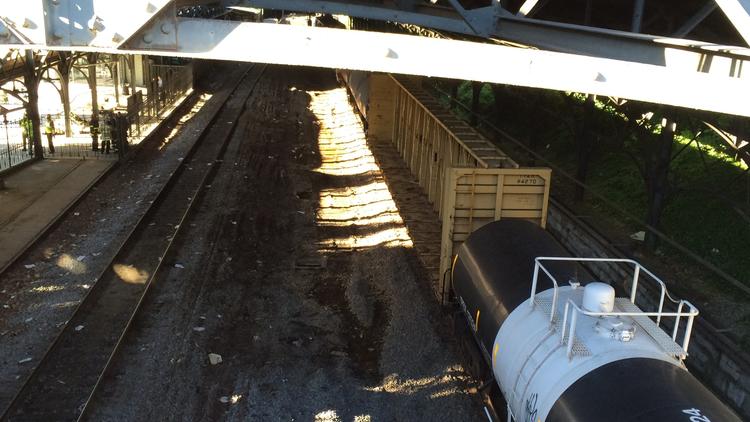
Twelve of the derailed train cars were empty "but possibly contained a residual substance in them," authorities said. The 13th carried acetone, a substance used in paint thinner and nail-polish remover.
Other cars in the train were carrying phenol, butane, liquefied petroleum gas, scrap iron and acid, authorities said.
In the event of a chemical spill during the clearing of the derailed cars, authorities said, the Fire Department would use a reverse 911 system to tell residents who live within a quarter-mile radius of the incident to shelter in place, officials said.
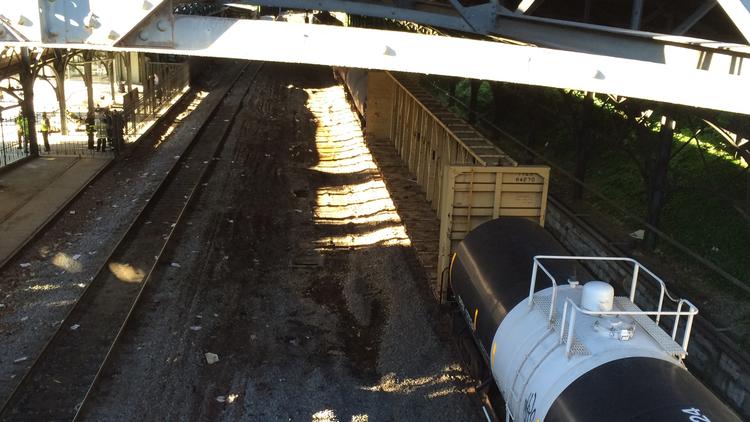
Crews are investigating a 13-car freight train derailment inside the Howard Street Tunnel Monday.
"Our meters show there's no immediate danger," Assistant Fire Chief Mark Wagner said.
Authorites are investigating the cause of the derailment. It started about one-third of the way through the train at car 47, one of the 18 that were carrying loads, authorities said.
The front of the train had entered the tunnel when the cars derailed just north of the tunnel, Maloney said. The derailed cars continued into the tunnel, where they stopped, he said.
The Philadelphia-to-Cumberland run "is a regular, routine route for this train," said Brian Hammock, resident vice president of CSX.
Hammock said he did not know when the tunnel was last inspected. He said CSX has full confidence in all of its tracks throughout the city.
A day after the deadliest mass shooting in U.S. history Sunday at a gay nightclub in Orlando, Fla., Wagner called the FBI to help investigate the derailment. "With everything going on, especially in Orlando, I asked the FBI to be here because we want to rule out foul play," Wagner said.
Investigators determined it was not caused intentionally.
Baltimore Police Commissioner Kevin Davis said his department, too, was assisting. "We want to be on the ground at the very, very beginning in case a twist or turn occurs," Davis said. "Twists and turns have not occurred, but we're nonetheless involved right now in this critical incident."
Several roads were closed near the tunnel Monday. They included a stretch of Howard Street between North Avenue and John Street.
The Maryland Transit Administration announced it was suspending light rail service between the Camden Yards and North Avenue stations after 10 p.m. Monday, and would use buses to ferry passengers between the two stops until midnight.
Freight rail traffic was stopped in the area Monday. The line running through the tunnel is used only by CSX freight trains; Amtrak and MARC service was not affected.
The Howard Street Tunnel is considered to be the most troublesome bottleneck for north-south freight train traffic on the East Coast.
For many years, transportation planners have discussed replacing the tunnel, but the estimated cost — $1 billion to $3 billion — has stymied progress.
In April, the Hogan administration and CSX announced a stripped-down, $425 million plan to expand the tunnel so that double-stacked trains could pass through.The state and the railroad pledged to kick in $270 million for the project and applied for a $155 million federal grant through the U.S. Department of Transportation's FASTLANE program.
Matthew A. Clark, a spokesman for Gov. Larry Hogan, said the state is waiting for a decision on its application. Federal officials are expected to announce awards this summer.
Since the spectacular tunnel derailment and fire of 2001 halted freight traffic in the corridor for almost a week, there have been a series of smaller-scale incidents along the approaches to the tunnels.
In 2005, a three-car derailment near the site of the 2001 incident prompted then-Mayor Martin O'Malley to call for a federal inspection.
Two years later, 12 cars derailed near M&T Bank Stadium. The next month, a CSX tanker left the rails in Locust Point.
Deadlier CSX derailments have occurred elsewhere in Maryland. In August 2012, two young women who were on railroad property in Ellicott City were killed when a train went off the tracks and spilled a load of coal on them. In 2000, a train left the tracks in the Western Maryland town of Bloomington, crashed into a home and killed a 15-year-old boy.
The last major CSX derailment in Maryland took place in May 2014, when three locomotives and 11 cars left the tracks while crossing a culvert blocked by debris in Prince George's County. There were no injuries, but the mishap caused more than $300,000 in damage, federal records show.
Environmental advocates and city residents have long voiced concern about freight trains carrying hazardous chemicals through and underneath Baltimore's neighborhoods. The City Council held a two-hour public hearing last summer on the safety of shipping crude oil through Baltimore.
Keisha Allen, president of the Westport Neighborhood Association, said her home is within a block of freight tracks — well within the "blast zone," should a derailment cause an explosion.
"That's the issue, the fact that it's highly flammable," she said.
Allen said she and her neighbors want the city to require CSX and Norfolk Southern to disclose what's being shipped on the freight trains and when.
"There needs to be a clear indication of what's coming through," she said. "If it's something that flammable, that volatile, there needs to be notification, at a minimum. ... We would sleep better knowing there's a process."
Lawrence Mann, a Washington attorney who specializes in railroad liability cases, said the industry has generally been lax about track inspections.
"The railroads have either fired or furloughed thousands of track inspectors around the country," he said. "They just don't have the manpower to do the job that's required."
The country's major railroads spent $28 billion on capital expenditures and maintenance in 2014, the Association of American Railroads reported Monday.
That investment increased to $30 billion last year and is expected to hover around $26 billion this year, said Edward Hamberger, president and CEO of the trade industry group.
That has increased from the roughly $20 billion in annual infrastructure investment between 1983 and 2011, as carriers work to keep up with customer demands for reliability and service, including new double-stack containers, he said.
The investments have also improved safety, Hamberger said. The association recently reported a 79 percent decline in train accidents since 1980.
"A well-maintained railroad is a safer railroad," he said. "The fact that we can spend this amount of money to put in new tracks, all-new technologies, and maintain it is really a point that needs to be driven home."
He said some carriers have been reluctant to participate in public-private partnerships because public money typically comes with constraints and major projects often get bogged down in lengthy public permitting procedures.
"It's never fast enough, but we're trying to do the best we can," he said.
Baltimore Sun reporter Natalie Sherman contributed to this article.


