
CeFaan Kim has more from Lower Manhattan.
CeFaan Kim
Sunday, June 12, 2016 12:06AM
BATTERY PARK CITY, Manhattan (WABC) -- A woman on a bicycle was struck and killed by a truck on the West Side Highway on Saturday night. The driver of the truck tried to take off, but a Good Samaritan - an off-duty MTA officer wouldn't let him get away.
The accident occurred on Chambers Street and West Street just before 8 p.m.
"She was trying to get up - they were trying to help her. Somebody chased after him and they called the cops," says eyewitness Donte Williams.
That 'someone' who chased after the suspect was Otis Noboa, an off-duty MTA officer. Noboa says he was driving northbound on the West Side Highway, saw the victim lying on the road, and pulled over. After witnesses told him what happened, he radioed for backup, then canvassed the area.
Moments later, Noboa spotted the vehicle that matched the description by witnesses just three blocks away. Noboa says the suspect had pulled over with his engine running, didn't say a word, and calmly surrendered.
Noboa works for the MTA's Rapid Transit Unit on Staten Island.
Police have not identified the suspect or the victim.
Saturday, June 11, 2016 11:58PM Do you find yourself powering through work one minute and watching cat videos the next? That sounds about right: A study last year by Microsoft discovered that the average attention span is eight seconds. (Curse smartphones!) Refocus with these five adjustments.
1. Take a break
Give yourself two short breathers over the course of an hour. While that may sound counterintuitive, research shows that periodic diversions make it easier to zero in on one thing for a longer amount of time. Why? The brain gradually gets habituated to whatever the stimulus is (say, doing your taxes), so you need to stop and "reactivate" your goal from time to time to maintain your concentration.
The 5 Steps to Quitting Anything Gracefully
2. Turn off your cell phone
It's not just making a phone call or sending a text message that distracts you from what you're doing: A study out of Florida State University revealed that people who merely received text or call notifications committed more mistakes on a computer task they were working on than those who did it free of phone interruptions. On deadline? Put the iPhone on silent and stash it away.
3. Reel in your multitasking
Eating dinner, watching TV, and also skimming a report? Stick to two activities (or one!): Your brain can't handle more than two big tasks simultaneously, suggests a 2010 study in Science. Why? A part of the brain called the medial prefrontal cortex helps divide the work so that half the region attends to one task while the other focuses on the second one, leaving no room to juggle a third.
How to Fall Asleep Fast, According to 6 Health Editors
4. Practice mindfulness
During breaks at home or on the job, take some steady, deep breaths and simply concentrate on your inhalations and exhalations. The Buddhist technique has been shown to improve mental performance by helping ground your mind in the present, instead of letting it wander throughout the day.
5. Take a nap
Some American workplaces are embracing the concept of an afternoon siesta, but plan carefully to wake well rested and feel more productive.
Ready for a midday snooze? Don’t feel guilty about it. Napping may just be the answer to a more productive workday.
More companies in the United States are starting to offer on-the-job sleep options for employees, ranging from special napping rooms to expensive sleep pods. Progressive, well-known companies like Google, Zappos, and Ben & Jerry’s are “nap friendly.” Yet can naps really help your concentration and focus?
The key is how much you sleep and when you sleep. A 10- to 30-minute nap taken before the afternoon slump can keep you more alert for several hours, said Robert Rosenberg, DO, medical director of the Sleep Disorders Centers of Prescott Valley and Flagstaff in Arizona. “It can be very effective for workplace productivity,” said Dr. Rosenberg.
For most people, the afternoon slump comes between 1 and 3 p.m. -- think about how you might reach for a snack or cup of coffee around 2 p.m. to keep yourself from falling asleep on your desk.
While a longer nap may sound appealing, if you take one, you may experience something called sleep inertia, where you feel groggy as opposed to refreshed, said Dr. Rosenberg. Stick to no longer than an hour.
Midday naps can be a key part of today’s workforce as many of us get less-than-optimal sleep at night, said Christopher L. Drake, PhD, chair of the National Sleep Foundation and associate professor of psychiatry and behavioral neurosciences at the Wayne State University School of Medicine. A large number of adults are trying to scrape by on six hours a night instead of the more ideal eight hours.
“You can survive on six hours an night, but you’ll get sleepy,” said Drake. That’s why he also supports the idea of midday naps instead of further skimping on sleep or trying to catch up with sleep on the weekends. “We live in a 24/7 society. One option to help people is to take a nap at work,” he said.
Midshift naps are also crucial for night workers, Drake added. In fact, a 2013 study in the journal Ergonomics found that an hour-long nighttime nap helped night shift workers improve their performance and reduce sleepiness without reducing their daytime sleep.
At South Burlington, Vt.-based Ben & Jerry’s, there's a nap room with a futon, blanket, pillows, and bedroom-style lamps, said Liz Stewart, a company spokesperson. When one of the ice cream maker's 110 employees use the room, they put their shoes outside the door and post a sign to indicate the room is occupied.
“The nap room serves different purposes,” said Stewart. Some employees use the room when they feel overwhelmed and need a break or if they’re feeling ill. Still others do indeed use it to catch up on sleep, said Stewart.
Still, that doesn’t mean that employees sit around every day eating ice cream and taking naps. “It’s something you don’t think of every day, but when the need arises, you can take advantage of it,” she said.
Maximizing Your Midday Napping
As Rosenberg suggested, a nap of less than an hour is ideal to boost your afternoon concentration and focus. Here are tips to maximize your midday napping and wake well rested:
Find an ideal place for your siesta. “Instead of your office chair, it’s better to find another space where you can lay down,” Drake said. “You want to be in an environment conducive to sleep.” Perhaps your workplace has a break room or other quiet area where you can sleep (without getting in trouble for it). If you must use your chair, consider wearing earplugs or an eye mask to help drown out your surroundings.
Consider coffee and a nap to keep your snooze short. If you’re concerned you’ll sleep too long, drink an eight-ounce cup of coffee before your nap. “The caffeine will take effect when you wake up,” said Drake. Of course, you’ll want to avoid this idea if the caffeine might keep you up later at night. Drake finds the coffee/nap combination works best for nighttime workers who need a quick sleep.
One word of caution: If you can fall asleep just about anywhere,even after a good night’s rest, talk to your physician. You might have an underlying condition that needs investigating.
A Meditation to Start Your Day
This article originally appeared on Health.com.
San Bernardino Fire Department mourns loss of one of its own
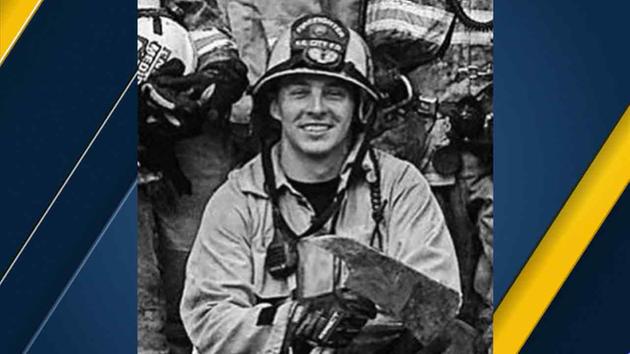
John Ruppert of the San Bernardino Fire Department, who was electrocuted to death on Friday, June 10, 2016, is seen in an undated photo.
Saturday, June 11, 2016 04:53PM
SAN BERNARDINO, Calif. (KABC) -- The San Bernardino Fire Department was mourning the loss of one of its own on Saturday.
Officials said engineer John Ruppert was electrocuted on Friday in Lake Powell, a reservoir in the Colorado River between Utah and Arizona.
He was trying to make a repair on the house boat where he and his family were vacationing.
Officials said his family was now going to Salt Lake City, Utah, where Ruppert's body was being delivered.
SBFD officials said he was with the San Bernardino Fire Department for over 10 years, and asked to keep his wife, Kristen, and his family in prayers and thoughts.
A GoFundMe page was set up for the Ruppert family. To donate, visit https://www.gofundme.com/supporttheRupperts.
Posted: Jun 07, 2016 8:49 PM EST Updated: Jun 07, 2016 8:49 PM EST
 A chemical spill at a plant in Wisconsin leaves five people injured. (Source: WTMJ/CNN)
GERMANTOWN, WI (WTMJ/CNN) - A chemical spill at a plant in Wisconsin left five people hospitalized Tuesday.
Hundreds of employees had to be evacuated due to the spill.
It happened at Gehl Gurney Farms in Germantown.
The factory makes cheese and sauces.
According to the Germantown Fire Department, a contractor accidentally poured acid into a tank of sodium chloride.
The combo caused the tank to burst, releasing lethal fumes into the air.
Fire crews were working to clear out the chemicals and get operations back to normal.
Copyright 2016 WTMJ via CNN. All rights reserved.
By Danielle Lopez in 40 Acres, Research on June 8, 2016 at 12:17 pm

Six years have passed since the largest accidental oil spill in history invaded the Gulf of Mexico. From the day the BP oil rig Deepwater Horizon exploded, pumping thousands of gallons of oil into the water, engineers and scientists have relentlessly tried to return the environment to its normal state. But all the while, nature was working on its own solution.
When the oil began making its way through the water in 2010, scientists noticed a few particular species of bacteria began to grow exponentially. Though they usually exist in small numbers among the millions of bacteria living in saltwater, these species thrived because of their ability to easily break down the complex structure of oil. This advantage in oil consumption, which has been a key part in the Deepwater Horizon cleanup, recently caught the interests of UT microbiologist Brett Baker and his team at the UT Marine Science Institute in Port Aransas.
“I just kind of noticed that a lot of research that’s been done on the bacteria has been on figuring out who is there,” Baker says. “We wanted to go beyond that. We wanted to figure out what [the bacteria] were actually doing.”
So he and five other researchers spent roughly a year closely studying these oil-eating bacteria. Before publishing their findings in the journal Nature Microbiology in May, they ventured into the community of organisms surrounding the oil spill and extracted their DNA. Employing techniques similar to those used to sequence the human genome, the researchers were able to decode what about their physiology gave particular bacteria an upper-hand.
“It’s really powerful,” Baker says. “It’s essentially changing our whole views of the environment.”
Including species named Alcanivorax and Neptuniibacter, the bacteria have specific characteristics that allow them to use compounds found in oil, like alkanes and aromatic hydrocarbons, as their carbon source. “It’s their food,” Baker says, despite oil’s complexity.
Considering the recent Shell oil spill in May, UT marine science professor Edward J. Buskey says Baker’s research can mean a number of possibilities for future oil spills. “You could stockpile some of these hydrocarbon-degrading bacteria, and the idea is if you had an oil spill you apply them to it,” says Buskey, who is also the director of the Gulf of Mexico Research Initiative Consortium.
Currently, scientists use recovery methods like the spreading of chemical dispersants throughout the water to break down the oil into small droplets. But applying these chemicals to the ocean, which coincidentally helps bacteria more readily consume oil, might be damaging to the environment. If scientists could harness the genetic potential of the oil-eating bacteria, harmful methods could be avoided. “One of the reasons we’re doing these studies is to help decision makers decide when to use dispersants,” Buskey says.
The problem they run into is the bacteria themselves. Unlike terrestrial bacteria, which are typically cooperative in a lab, ocean bacteria are more stubborn and must be worked on in their natural environment. The next step for Baker and his team is determining how to culture the species and turning them into a practical tool.
“What [Baker’s] lab is doing is very important,” Buskey says. “In the past, people have mainly just said what’s out there. So [this research is helping] to get an idea of which species are doing what and what are some really new insights to the world of bacteria.”
A ship floats among a sea of spilled oil in the Gulf of Mexico after the BP Deepwater Horizon oil spill disaster. Photo by Kris Krug via Flickr.