
MEC&F Expert Engineers

Friday, June 10, 2016

NYPD officer to be sentenced in Bedford-Stuyvesant head-stomping incident


Eyewitness News
Updated 59 mins ago
BEDFORD-STUYVESANT, Brooklyn (WABC) -- An NYPD officer will be sentenced Friday for stomping a suspect in the head two years ago.

Brooklyn District Attorney Kenneth Thompson has asked a judge to sentence officer Joel Edouard to two months in jail and two years probation in the incident. He could also receive no jail time.

Edouard was convicted of misdemeanor assault in the July 2014 stomping of Jahmi-El Cuffee on Malcolm X Boulevard in Bedford-Stuyvesant, an attack caught on camera.

Edouard could face up to a year in jail. He will be sentenced by Brooklyn Supreme Court Justice Alan Marrus.

"When a police officer engages in such an open and deplorable act of police brutality, his conduct has a direct and lasting impact upon the public perception of police officers in general," said Thompson.

In March, Thompson recommended NYPD Officer Peter Liang serve 500 hours of community service, five years probation and six months of house arrest for the reckless manslaughter death of Akai Gurley. A judge sentenced him to five years' probation and downgraded the jury's verdict to criminally negligent homicide.

In this case, Thompson asked the judge for jail time.
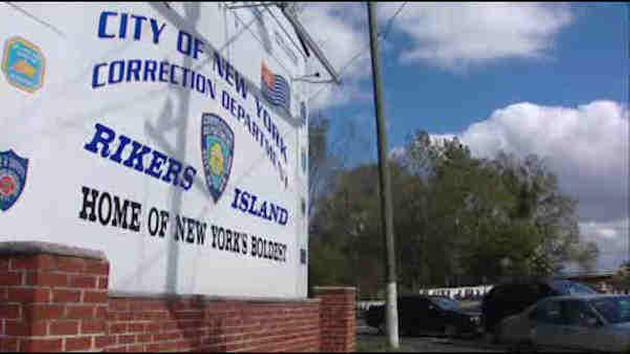
3 more Correction officers guilty in Rikers inmate beating, cover up


N.J. Burkett has details on the guilty verdict against 5 New York City correction officers.


Updated 15 mins ago
RIKERS ISLAND, New York (WABC) -- Three more New York City Department of Correction officers who had opted for a bench trial were found guilty Friday in connection with a 2012 gang assault of an inmate and subsequent cover-up at Rikers Island.

Captain Gerald Vaughn was convicted of the beating and cover up of inmate Jahmal Lightfoot, while officers Harmon Frierson and Dwayne Maynard were convicted of official misconduct.

Verdicts were returned by a jury against six other correction officers on Tuesday, on the jury's fourth day of deliberations. Five were convicted of all charges, including the most serious count of first-degree attempted gang assault. A sixth officer, Jeffrey Richard, who was not directly involved in the beating, was acquitted of all charges related to the cover-up.

Those officers -- former Chief Eliseo Perez and officers Alfred Rivera, Tobias Parker, Jose Parra and David Rodriguez -- were convicted of attempted gang assault, attempted assault, assault, falsifying business records, offering false instrument for filing and official misconduct. The top count carries a maximum of 15 years in prison.

According to DOC policy, they have all been fired because they were found guilty.

The incident began when the inmate, Jahmal Lightfoot, then 28, dropped a piece of metal, likely a handmade weapon. When the guards went to pick it up, a scuffle ensued involving the officers and Lightfoot.

Afterwards, he was taken to a holding pen and severely beaten.

Two Correction officials ordered staff members to assault the inmate, and officials then faked their reports, claiming the inmate had attacked first.

Lightfoot suffered fractures to both of his eye sockets, a broken nose and other facial injuries that caused his eyes to swell shut.

"We have zero tolerance for any illegal behavior on the part of staff, and the officers found guilty of felonies will be terminated," DOC Commissioner Joseph Ponte said in a statement. "The vast majority of our officers carry out their duties with care and integrity, and we are taking many steps to ensure that all staff adhere to the highest professionalism. We are confident that our reforms are yielding a quality staff in which all New Yorkers can take pride."

5 injured, hundreds evacuated after chemical spill at Gehl Foods in Germantown


  Jonah Kaplan

6:26 PM, Jun 7, 2016


5 injured, hundreds evacuated after chemical spill


GERMANTOWN -- Five people have been hospitalized after a chemical spill at Gehl Gurney Farms in Germantown, fire officials say.

Hundreds of employees were evacuated from the plant, which makes cheese and cheese sauces. Officials say there's no danger to residents, but the spill prompted a massive response from at least six different fire departments.
 
According to the Germantown Fire Department, a contractor accidentally poured acid into a tank of sodium chloride. That combination of chemicals caused the tank to burst, releasing fumes similar to mustard gas.

Fire crews flushed everything out of the building and are working to return to normal operations. Once the contaminated area was flushed and the pH had returned to neutral, air monitoring was completed and the plant was handed back over to Gehl's.

A total of 45 firefighters responded to the spill, according to the fire department.

Chemical spill in Riverside County injures 16, including firefighter


A member of the hazardous materials response team assists in cleaning up a chemical spill at Starkist Foods in Mira Loma that injured 16 people. (Gina Ferazzi / Los Angeles Times)

Angel Jennings


Sixteen people, including a firefighter, were injured Thursday in a chemical spill at an Eastvale food distribution center, authorities said.

Cal Fire/Riverside County firefighters received a call at 2:48 p.m. of hazardous material waste at Starkist Foods in the 12000 block of Philadelphia Avenue. When firefighters arrived, they discovered about 40 gallons of an unknown chemical overturned inside the warehouse.

All 16 people suffered inhalation injuries and were taken to hospitals.

The Riverside County Sheriff's Department has closed Philadelphia Avenue between South Milliken Avenue and Vintage Avenue.

Authorities are investigating the cause of the spill.

Possible rulemaking to limit diesel exhaust at all mines

Diesel Exhaust Redux: MSHA Requests Information on Diesel in Mines

On the same day that Mine Safety and Health Administration, MSHA, announced a major new workplace examination rule for metal/non-metal mines, Assistant Secretary of Labor Joe Main also announced that MSHA is exploring further possible rulemaking to limit diesel exhaust at all mines – both coal and metal/non-metal. This morning, MSHA published in the Federal Register a “request for information” on diesel exhaust in mines (“RFI”), kicking off a 90-day comment period. MSHA seeks “information and data on approaches to control and monitor miners’ exposures to diesel exhaust.” Read on for a full analysis…

Taking a fresh look at fairly recent standards

MSHA’s current diesel exhaust or “diesel particulate matter” (“DPM”) standard in metal/non-metal is only a few years old, last revised in 2008, contested in litigation until 2010, and coming at the end of a series of rulemakings that began in 2001 (full disclosure: my colleagues and I represented the National Mining Association in challenging some of those rules).
The latest version of that M/NM rule, at 30 CFR 57.5060(b)(3), requires that a “miner’s personal exposure to diesel particulate matter (DPM) in an underground mine must not exceed an average eight-hour equivalent full shift airborne concentration of 160 micrograms of total carbon per cubic meter of air (160TC µg/m3).” It requires mine operators to use engineering and/or workplace controls to reduce exposures before allowing use of respiratory protection to help reduce exposures to the permissible exposure limit (“PEL”).
In coal, MSHA’s 1996 diesel rule required monitoring diesel emissions, using clean-burning engines, training miners in health risks and maintenance, and revised standards for approving engines and components. MSHA’s 2001 final rule in coal restricted the diesel emissions of certain equipment, requiring use of engineering controls to limit exposures, and instituted additional miner training.
In its RFI, MSHA touts sampling data in its possession (which it said it would post in the public docket), showing significant decreases in DPM exposure in recent years. MSHA says that from 2006 to 2015, average exposures of metal/non-metal miners decreased by 57% percent from 253TC to 109TC µg/m3. According to the agency, approximately 63% of these mines had average exposures below 100TC µg/m3 in 2015, with 75% below below 122TC µg/m3. “Overall,” says the RFI, “50% of the mines sampled have average exposures between 48TC and 122TC µg/m3.” MSHA noted that “newer light-duty equipment makes up about 66 percent of the total existing diesel-powered fleet.”
But, in announcing the RFI today, Mr. Main said that it’s “time to determine whether existing rules are adequate to protect miners’ health.” He added that “there’s evidence of miners being at risk . . . We know we’re in better shape today than when these regulations were crafted. It’s time for us to take a look back.”

Revisiting diesel exhaust

MSHA says that several developments since it issued its current diesel rules have caused it to request “input from industry, labor, and other interested parties on approaches that may enhance control of DPM and diesel exhaust exposures to improve protections for miners in underground coal and MNM mines.” The input will help MSHA decide what, if any, further regulatory actions are necessary.
In particular, MSHA says that it is revisiting diesel exhaust controls because “of the carcinogenic health risk to miners from exposure to diesel exhaust and to prevent material impairment of miners’ health.” In support of its new concerns, MSHA cites, in particular:

  • The hotly-contested Diesel Exhaust in Miners Study (“DEMS”) performed by the National Institute for Occupational Safety and Health (“NIOSH”) and the National Cancer Institute (“NCI”). According to MSHA, that study, published from 2009 through 2012, “found that diesel exhaust exposure increases miners’ risk of death due to lung cancer.”
  • The International Agency for Research on Cancer’s (“IARC”) follow-on decision in 2012 to classify diesel exhaust as a human carcinogen based on the DEMS study.
  • A November 2015 evaluation by the Health Effects Institute, which also reviewed the DEMS study and a Trucking Industry Particle Study, finding those studies to be “well-designed and well-conducted” though noting that despite their strengths, “any effort at quantitative risk assessment will need to acknowledge some key uncertainties and limitations.”
  • MSHA’s own Health Hazard Alerts relating to diesel exhaust following the IARC announcement.
  • The fact that three states (West Virginia, Pennsylvania, and Ohio, in particular) have requirements for control diesel exhaust that exceed MSHA’s. According to MSHA, these states “require diesel powered equipment used in underground coal mines to include an exhaust emissions control and conditioning system” that meets certain DPM emissions limits. They also limit “ambient concentrations” of exhaust, and some limit ambient nitric oxide, as well. In addition, they require certain testing, examination, and maintenance records.
  • According to MSHA’s briefing, it also received requests by “stakeholders” to review current rules in light of the latest information on scientific evidence, cost-effectiveness, and risk.

Seeking specific information

The RFI contains a long list of questions about equipment and controls that are in use in the mining industry, their cost, effectiveness, advantages, and disadvantages. Major areas of interest by MSHA include:

  • In coal, lowering emissions limits for light-duty equipment. MSHA says it would like to determine “whether it is feasible to lower the emissions limits for non-permissible, light-duty, diesel-powered equipment to 2.5 g/hr of DPM or less.” Can the current generation of equipment meet or exceed a 2.5 g/hr standard? What challenges (administrative, engineering, and technological) would such a standard create? What costs? What would be the advantages and disadvantages of such a limit or of a requirement that meets current EPA standards? What percent of current equipment does not meet current EPA standards, and what modifications could occur to meet the EPA standard?
  • Adopting stricter state coal-mine diesel standards. Since, MSHA says, three states have adopted additional diesel regulations, what are the advantages and disadvantages of MSHA adopting those same requirements?
  • Testing and maintenance of light-duty, non-permissible equipment in underground coal mines. In coal, what would be the advantages, disadvantages, safety and health benefits, and costs of testing non-permissible, light-duty, underground diesel-powered equipment on a weekly basis for carbon monoxide as currently required for permissible equipment? What maintenance requirements are appropriate, and what testing and maintenance documentation should MSHA require?
  • Types and effectiveness of exhaust after-treatment technologies in underground mines. What are some best practices for selecting and using after-treatment devices? What technologies are in use? What do they cost ? How effective are they? How durable? What sensors are built in? Are integrated systems used, and at what cost? “What are the advantages, disadvantages, and relative costs of requiring that all light-duty diesel- 27 powered equipment be equipped with high-efficiency DPM filters?”
  • EPA Tier 4/4i-compliant equipment. MSHA seeks to understand whether, and to what extent, mine operators already are purchasing engines that comply with the latest EPA Tier 4 standards. Is such equipment used with after-treatment systems? How long has this equipment been in use and at what cost?
  • Surrogates for measuring DPM other than total carbon. MSHA requests “information on alternative surrogates, other than TC [total carbon], to estimate a miner’s DPM exposure. What is the surrogate’s limit of detection and what are potential interferences in a mine environment? What are the advantages, disadvantages, and relative costs for using the alternative surrogate to determine a MNM miner’s exposure to DPM?”
  • Sampling and analysis. Since reliably measuring DPM at such low levels has always been a problem, MSHA asks what “advances in sampling and analytical technology and other methods for measuring a MNM miner’s DPM exposure . . . may allow for a reduced exposure limit?”
  • Best practices. Overall, MSHA asks the mining community to provide information on best practices that have succeeded for operators in reducing exhaust.
In short, MSHA’s questions appear geared toward collecting a vast amount of industry data and experience in controlling DPM since various regulations took effect in the last decade and a half. While the RFI is a very preliminary stage of possible rulemaking, it seems to hint that MSHA may view many mine operators’ significant successes in reducing exposure as a reason to lower the limits further, rather than a cause for celebration. It also may suggest that MSHA is considering mandating certain equipment, procedures, or maintenance, rather than simply setting an exposure limit that leaves operators free to decide how to comply.
Needless to say, it is not clear that MSHA even will proceed with rulemaking after receiving answers to its questions (and doubtful that it has time to do so before the end of the current administration). But, the RFI is an important opportunity for mine operators to be helpful to MSHA on the record in understanding these issues.

A renewed debate over the DEMS study and surrogates?

One question in many minds will be whether MSHA’s information request will kick up a new storm of discussion on several closely intertwined issues: the reliability of the DEMS study, what it really says about the levels at which DPM may be harmful, and how best to measure diesel particulate matter.
The DEMS study was embroiled in challenges, litigation, and questions about its transparency, approach, and reliability nearly from its start in 1992 until as recently as 2012 (full disclosure: my colleagues and I represented a number of companies and groups in that long-running litigation, especially the mines that had been participants in the study).

Yet, despite those questions about DEMS, the study served as a basis for MSHA’s earlier rulemaking on DPM (even before the study was complete), for the IARC finding in 2012, for the Health Effects Institute paper in 2015, and apparently for MSHA’s RFI today.
The history and potential future of this issue is a long tale. How MSHA’s latest action may re-kindle this discussion is worthy of a future blog post all its own. Suffice it to say, however, that MSHA’s specific reliance on that study (and its offspring), as well as MSHA’s specific questions about how to measure DPM, make a renewed focus on the study highly likely.