This blog presents Metropolitan Engineering Consulting & Forensics (MEC&F) claim management and claim investigation analyses of some of the typical claims we handle
Coca-Cola distribution warehouse in Monmouth Junction, New Jersey, cited for repeat and serious safety and health workplace violations. OSHA fines Coca-Cola Refreshments USA Inc. more than $61K
Employer name: Coca-Cola Refreshments USA Inc.'s distribution warehouse is located at 60 Deans Rhode Hall Road in Monmouth Junction, New Jersey.
Citations issued: On Dec. 11, 2015, the Occupational Safety and Health Administration issued citations for four repeat and two serious safety and health violations.
Investigation findings: OSHA inspectors cited repeat violations for hazards associated with obstructed exit routes, lack of illuminated emergency exit signs, unmarked exits, and improper storage of compressed gas cylinders.
The serious violations were related to unguarded floor holes and lack of refresher training related to forklifts.
Proposed penalties: $61,600
Quote: "Blocked exit routes and unmarked exits pose a serious danger to Coca-Cola's warehouse employees, as they prevent quick escape in case of an emergency," said Patricia Jones, director of OSHA's Avenel Office. "Employers have a legal obligation to ensure workers have a safe and healthy workplace, and will be held accountable when they fail to do so."
Coca-Cola Refreshments USA Inc. manufactures and distributes Coca-Cola brand products such as, but not limited to, Coca-Cola, Fanta, Coke, Sprite, and Nestea at facilities throughout the United States.
To ask questions; obtain compliance assistance; file a complaint; or report amputations, eye loss, workplace hospitalizations, fatalities or situations posing imminent danger to workers, the public should call OSHA's toll-free hotline at 800-321-OSHA (6742) or the agency's Avenel Area Office at 732-750-3270.
Illinois metal plating company exposes workers to noise, toxic metal, other hazards at Cicero plant. OSHA proposes fines of more than $157K for 18 violations found at Electronic Plating Co.
CICERO, Ill. - While electroplating machine parts, workers were exposed to metal, machinery and live electrical hazards at a Cicero manufacturing facility because their employer failed to follow federal safety and health requirements. Exposure to metals - such as cadmium used in the plant - can harm the heart, nervous and digestive systems.
Following an inspection, the U.S. Department of Labor's Occupational Safety and Health Administration cited Electronic Plating Co. on Dec. 10 for one willful, eight repeated, eight serious and one other-than-serious safety and health violation. Proposed penalties total $157,080.
"OSHA inspectors found multiple preventable safety and health hazards in this facility, eight of which Electronic Plating violated in 2011," said Kathy Webb, OSHA's area director in Calumet City. "Employers cited for repeated violations are failing their employees and their obligation to provide a safe and healthy working environment."
OSHA opened an investigation at the facility after receiving a complaint alleging unsafe working conditions. The agency found numerous violations, including the following: Failure to implement a continuing, effective hearing conservation program. Lack of personal protective equipment for metal and other hazardous chemical exposure. Electrical safety hazards. Inadequate worker training on hazardous chemicals used in the facility. Lack of medical examinations to monitor employee exposure to chromic acid and cadmium. Workers exposed to operating mechanical and electrical parts because equipment lacked guards. Unsanitary conditions. Powered industrial trucks were not inspected, and operators lacked required training.
Electronic Plating employs approximately 30 workers. The company has 15 business days from receipt of its citations and penalties to comply, request an informal conference with OSHA's area director, or contest the findings before the independent Occupational Safety and Health Review Commission.
To ask questions, obtain compliance assistance, file a complaint, or report amputations, eye loss, workplace hospitalizations, fatalities or situations posing imminent danger to workers, the public should call OSHA's toll-free hotline at 800-321-OSHA (6742) or the agency's Calumet City Area Office at 708-891-3800.
Under the Occupational Safety and Health Act of 1970, employers are responsible for providing safe and healthful workplaces for their employees. OSHA's role is to ensure these conditions for America's working men and women by setting and enforcing standards, and providing training, education and assistance. For more information, visit http://www.osha.gov.
On Dec 15, 2015, the "Explorer of the Seas" was docked in Sydney with more than 180 passengers suffering from gastro.
Paramedics were on standby as the passengers disembarked the ship at Sydney’s Circular Quay.
The gastro outbreak started on 5 December and peaked on Dec 11 and 12. More than 180 guests and crew have been struck with the gastrointestinal illness norovirus.
The "Explorer of the Seas" arrived from New Zealand about 6 a.m. with 3,566 passengers and 1,139 crew on a 14-night trip.
Royal Caribbean confirmed 182 cases of an increased level of gastrointestinal illness. Those affected by the short-lived illness have responded well to over-the-counter medication administered on-board the ship.
The South Eastern Sydney local health district said the outbreak was under control. No patient had to be removed from the ship prematurely, or taken to hospital. With new passengers due to board before it left port on Dec 16 evening, the ship and terminal were sanitized to prevent any spread of the illness.
All new guests received a letter at boarding asking them to advise if they had experienced any gastrointestinal symptoms within the past three days.
The U.S. Coast Guard continues work in response to the Monday collision of towing vessels Margaret Ann and William Strait in the Lower Mississippi River. The two vessels apparently misjudged distances after making passing arrangements, and the Strait sank in 20 feet of water after the collision.
The USCG and local media have reported no injuries from the accident.
Images and video from local news helicopter flyovers show the tug's wheelhouse out of the water and an apparent oil slick downstream.
The USCG has left the Mississippi open to one way traffic in the affected area as response crews work on the cleanup and salvage of the sunken wreck.
Crews have deployed 1,100 feet of containment boom and 600 feet of sorbent boom around the vessel to prevent any further spreading of pollution.
Aircraft surveys by the Coast Guard and local police authorities are under way to determine the extent of environmental damage, and a salvage plan is being developed to safely remove the sunken tug. Her tow of multiple aggregate barges has already been salvaged.
The National Transportation Safety Board and the USCG are investigating the incident.
The National Oceanographic and Atmospheric Administration's response center reported that petroleum products of concern in the incident included 90,000 gallons of diesel and 2,000 gallons of lube oil. The NOAA report suggests that the Strait collided with an asphalt barge in the Ann's tow.
The William Strait was operated by Western Rivers Boat Management. The company has been in the towing, barge shifting, and ship repair businesses on inland waterways since 1996.
File photo: Lou VestWith no explicit reference to shipping in the historic climate deal
unanimously adopted by almost 200 nations in Paris this weekend, it is
now up to the International Maritime Organization (IMO) to cut
greenhouse gas emissions from a sector which ranks among the world’s
biggest contributors of carbon dioxide emissions. The a final deal, known as the Paris Agreement, was agreed to on Saturday after two weeks of around-the-clock negotiations involving delegates from 195 countries at the United Nations Climate Change Conference (COP21)
held in Paris. The aim of the agreement is to keep a global temperature
rise this century well below 2 degrees Celsius and to drive efforts to
limit the temperature increase to just 1.5 degrees Celsius above
pre-industrial levels. The final text
of the Paris Agreement includes no explicit reference to international
shipping, which according to the IMO accounts for 2.2% of earth’s
man-made CO2 emissions. The shipping industry has largely welcomed the Agreement, but stakeholders have also acknowledged that work must continue
at the IMO to further reduce international shipping’s overall CO2
emissions as part of the global effort to mitigate the impact of climate
change. The International Chamber of Shipping (ICS), representing the global
shipping industry throughout the United Nations Climate Change
Conference, says it “greatly welcomes” the Paris Agreement and
reiterates that the shipping industry remains committed to ambitious CO2
emission reduction across the entire world merchant fleet, reducing CO2
per tonne-km by at least 50% before 2050 compared to 2007. ICS asserts
that dramatic CO2 reductions from ships will only be guaranteed if
further regulation continues to be led by IMO. “I am sure IMO Member States will now proceed with new momentum to
help the industry deliver ever greater CO2 reductions, as the world
moves towards total decarbonization by the end of the Century” commented
ICS Secretary General, Peter Hinchliffe. ICS says it plans to engage in meaningfully in discussions at the IMO
during the next meeting of the Marine Environment Protection Committee
in April 2016, where ICS plans to discuss possibility of agreeing a CO2
reduction target for shipping. Prior to the Paris negotiations, the ICS had hoped that any deal
would include acknowledgment of the importance of IMO in continuing to
develop further CO2 reduction measures. “CO2 is a global problem and shipping is a global industry,” added
Hinchliffe in a press release issued Monday. “IMO is the only forum
which can take account of the UN principle of ‘differentiation’ while
requiring all ships to apply the same CO2 reduction measures, regardless
of their flag State. Unilateral or regional regulation would be
disastrous for shipping and disastrous for global CO2 reduction, whereas
IMO is already helping shipping to deliver substantial CO2 reductions
on a global basis.” A similar sentiment is held by European shipowners, represented by
the European Community Shipowners’ Association, which also welcomed the
Agreement and is now calling on solid action at the IMO, referencing the
specialized United Nations’ agency as “the appropriate international
body to address greenhouse gas emissions from ships engaged in
international trade”. Specifically, the ECSA (and ICS for that matter) would like to a see a
global data collection system of CO2 emissions from ships. “Following the adoption in 2011 of measures to increase the energy
efficiency of the industry, the agreed next step is a global data
collection system of CO2 emissions”, said Patrick Verhoeven, Secretary
General of ECSA, in a statement released Monday in the wake of the Paris
Agreement. “The governments in IMO will resume discussions on such a
system in April next year, with the aim of ascertaining the real
contribution of international shipping to global CO2 emissions. We
strongly encourage all parties to ensure that these discussions lead to
the establishment, as soon as possible, of a mandatory data collection
system.” Critics, on the other hand, have said that the absence of shipping
(and aviation) from the Paris Agreement casts doubts over who is
responsible for reining in emissions from the two transport sectors,
which together account for an estimated 8% of global CO2 emissions, and
undermine the prospects of keeping global warming below the 1.5°C target. “The Agreement now leaves it unclear which actors have responsibility
to reduce emissions from these sectors. If [International Civil
Aviation Organization and IMO] wish to retain a role, they must urgently
scale up their ambition. Otherwise states and regional actors will have
a right to adopt measures to ensure these sectors contribute to the
1.5°C target,” commented Andrew Murphy, Aviation and Shipping Officer
for Transport & Environment, a green NGO and one of the more vocal
proponents of including the two sectors in the any climate deal. So now it’s up to the IMO the decide on regulations concerning greenhouse gas emissions from ships, a role in which it has recognized wholeheartedly. “The absence of any specific mention of shipping in the final text
will in no way diminish the strong commitment of IMO as the regulator of
the shipping industry to continue work to address GHG emissions from
ships engaged in international trade,” commented IMO Secretary-General
Koji Sekimizu in a press briefing released Monday titled “Full speed
ahead with climate-change measures at IMO following Paris Agreement”. In the briefing, the IMO recapitulated that it remains the only
organization to have adopted energy-efficiency measures that are legally
binding across an entire global industry and applicable to all
countries. “Mandatory energy efficiency standards for new ships, and mandatory
operational measures to reduce emissions from existing ships, entered
into force under an existing international convention (MARPOL Annex VI)
in 2013. By 2025, all new ships will be 30% more energy efficient than
those built last year. This is more than a target, it is a legal
requirement, and demonstrates that IMO is the correct and only forum to
identify solutions and an appropriate pathway for international shipping
to de-carbonize with the rest of the globe,” the IMO said in the
briefing. The IMO’s briefing added:
Continuing efforts will include development of a global
data collection system for ship’s fuel consumption to be discussed in
detail at the next meeting of IMO’s Marine Environment Protection
Committee in 2016, further consideration of a total-sector reduction
target for GHG emissions from international shipping as proposed by the
Marshall Islands in 2015, and continued investigation of additional
mechanisms for ships to support the implementation of the Paris
Agreement. During COP21, IMO provided an update of its work to address GHG
emissions from bunker fuels used for international shipping.
Specifically, IMO reported on its work on further developing guidelines
to support the uniform implementation of the regulations on
energy-efficiency for ships; and on its efforts with regard to technical
co-operation and capacity-building to ensure effective implementation
and enforcement of the aforementioned new regulations worldwide and,
importantly, activities to support promotion of technical co-operation
and transfer of technology relating to the improvement of energy
efficiency of ships. At IMO, the Governments of the world come together to develop the
regulatory framework for international shipping which forms the basis
for investment decisions. There is a clear imperative now for IMO’s
Member States to rise to the challenge set by the Paris Agreement.
Secretary-General Sekimizu said, “I now encourage Governments to bring
the spirit of the Paris Agreement to IMO and come forward with new,
creative proposals and to approach them in a constructive and
cooperative manner.”

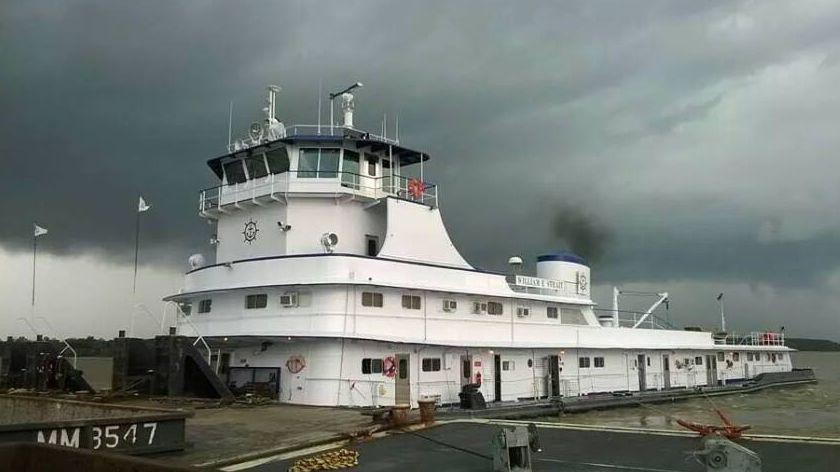 The tug William Strait (file photo courtesy Western Rivers Boat Management)