MEC&F Expert Engineers

Tuesday, September 1, 2015

Contractor McCarthy Building Companies announced that work resumed Monday in areas of the second Presbyterian Rust Medical Center tower not affected by the deadly scaffolding collapse last week


AUGUST 29, 2015

ALBUQUERQUE, N.M. — 


Contractor McCarthy Building Companies announced that work resumed Monday in areas of the second Presbyterian Rust Medical Center tower not affected by the scaffolding collapse last week.

One person died and seven others were injured when a six-story scaffolding collapsed in an interior courtyard of the under-construction tower on Aug. 18. The identities of the victims haven’t been released, and an investigation into the cause is ongoing.

According to an emailed statement, in cooperation with the Occupational Safety and Health Administration’s New Mexico office and local authorities, the work was to begin again as McCarthy subcontractors got safety orientations. They were to work outside the perimeter of the collapse site.

McCarthy project supervisors, occupational safety specialists and subcontractor managers will provide information about restricted areas, new entrance and emergency exit routes and an analysis of potential hazards for the workers in each trade and how to eliminate those hazards, according to the release.

That “soft start” is expected to happen over several days.

“This will allow us time to carefully and clearly re-establish extensive safety measures, protect areas that remain under investigation and most importantly, ensure each person coming onto the site is entering the safest work environment possible,” the statement said. “It’s impossible to be returning to the site without thinking of those who were affected by the tragic event last week. Our thoughts and prayers continue to be with each worker who was involved, their families and friends.”

With the community and people in the contracting field expressing a desire to help the workers injured and their families, McCarthy is working with Associated General Contractors of New Mexico to set up a fund for donations. According to the statement, McCarthy will share details with the public when they’re available.

“We also want to thank Presbyterian Rust Medical Center and its employees for their responsiveness, support and collaboration,” the statement said. “We remain deeply concerned by the tragic event last week and continue to provide our complete support to OSHA and local authorities in their ongoing investigation.”

Sec’y of Labor v. Int’l Shipbreaking Ltd., LLC, OSHRCJ, Nos. 14-0031 & 14-0032, 7/27/15: OSHA should be equitably estopped from pursuing litigation because it had breached the settlement agreement by conducting inspections during the mutually agreed-upon abatement period


Judge Reproaches OSHA for ‘Affirmative Misconduct’ over Enforcement Action


posted on: Sunday, August 30, 2015

Vacating citations against a Texas company, an administrative judge has lambasted the Occupational Safety and Health Administration for having “fallen short of any standard of decency, honor, or reliability” by citing the company for alleged violations occurring during a period in which OSHA had agreed in a written settlement the company could establish a program to prevent such violations.

Administrative Law Judge Patrick B. Augustine of the Occupational Safety and Health Review Commission granted International Shipbreaking Limited, LLC (ISL) summary judgment, saying OSHA was equitably barred from seeking to enforce the new citations. The decision also erased a $22,300 penalty. ALJ Augustine’s June 23 ruling (Sec’y of Labor v. Int’l Shipbreaking Ltd., LLC, OSHRCJ, Nos. 14-0031 & 14-0032, 7/27/15), was issued by the Commission, without review, as a final order on July 27. The government retains the option of appealing to the U.S. Court of Appeals for the Fifth Circuit, in New Orleans.

Applied only sparingly against the government, “equitable estoppel” may be appropriate when one party is denied a benefit after it has reasonably relied upon the misrepresentations of another party. Referencing court precedent, Augustine explained that equitable estoppel here, among other things, requires proving the government engaged in affirmative misconduct. That, in turn, requires a showing of intentional wrongdoing or reckless conduct. ISL contended that because it had breached the settlement agreement by conducting inspections during the mutually agreed-upon abatement period, OSHA should be equitably estopped from pursuing litigation.

In July 2013, OSHA inspected two ships the company was breaking up for scrap, eventually issuing citations for alleged electrical violations. The enforcement action came two weeks after the agency and the company had come to terms on an agreement giving ISL 60 days to institute an electrical safety check program, designate a competent person to inspect electrical components, hire a certified electrician, and institute an equipment-grounding-conductor program. Electrical equipment inspections were to be conducted and documented at least quarterly. In return, OSHA agreed to drop a host of citations for alleged violations involving electrical infractions, personal protective equipment, fall protection, fire prevention, and others issued in November 2011.

OSHA asserted the 2013 inspections were conducted as part of its National Emphasis Program (NEP) on shipbreaking, the citations were not covered by the 60-day abatement period in the settlement agreement, and, if it were estopped from pursuing its litigation, ISL would have a “free ride” to continue violating the law. The agency also claimed it was merely a coincidence that its inspectors visited the ships so soon after reaching the settlement.

ALJ Augustine disagreed. He determined OSHA’s NEP argument was hollow because, despite the NEP, OSHA had discretion not to inspect some ships being broken down. In addition, inspections of the two ships could have taken place either before or after the abatement period, since the dismantling process was expected to take 11 months. Besides, the judge observed, of the 21 points on which the NEP is supposed to focus, none include electrical violations, even though these were the only violations OSHA reported. Finally, Augustine was “troubled” that OSHA had engaged three times as many compliance officers for the July 2013 inspections as it had committed in 2011. “Contrary to [OSHA’s] argument, … the Court finds that there are simply too many coincidences to be coincidental,” Augustine said.

As for OSHA’s contention that the settlement agreement did not address or apply to the specific electrical violations the agency found, Augustine called that argument “patently unreasonable,” “inconsistent,” “disingenuous,” and “an intentional misrepresentation” of the agreement’s abatement provisions.

He also swept away OSHA’s “free ride” contention. The agreement, he said, was a far-reaching attempt to address electrical hazards and included a clause allowing OSHA to enter ISL’s workplaces after the abatement period ended to verify that conditions contained in the citations had been corrected. The language also committed ISL to continue good-faith efforts to comply with the law, Augustine said. ISL estimated its abatement costs came to $1.25 million.

Why would such a provision be included if not to reaffirm ISL’s responsibility to correct hazards and comply with the law during the abatement period, Augustine asked. He added, “Given the expense involved and the comprehensive nature of the abatement, the 60-day period could hardly be classified as a free ride. ... [OSHA] acted recklessly, if not intentionally, in depriving [ISL] of a mutually bargained-for right to reasonable abatement.” -


See more at: http://www.natlawreview.com/article/judge-reproaches-osha-affirmative-misconduct-over-enforcement-action#sthash.88RO20yf.QEokB9IX.dpuf


1 person medevaced after several pedestrians struck, including child in Lakewood, New Jersey

(thelakewoodscoop.com)
A vehicle struck several pedestrians, including a child, in Lakewood, New Jersey Monday night.

It happened at River Avenue (Rt 9) and Edgewood Court around 10 p.m.

At least one child in a stroller and two other people were hit.

The extent of their injuries is not yet known, but at least one person was taken by medevac to Jersey Shore Medical Center.

The vehicle remained at the scene and the investigation is ongoing by Lakewood Township Police.

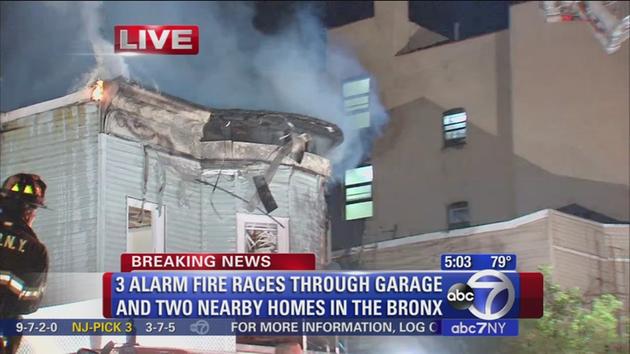
3-alarm fire burning through homes in Crotona Park East in Bronx, NYC


Dray Clark reporting live in Bronx
A three-alarm fire quickly burned through a garage and spread through two homes in the Bronx

The fire broke out in the garage on the 1500 block of Bryant Avenue in the Crotona Park East section of the Bronx just after 4 a.m.

Flames quickly spread to two adjacent homes. Several cars were also on fire.

No injuries are immediately reported.

Firefighters initially had low water pressure.

IEA Report: significant drop in the price of solar and wind generation costs, especially for solar photovoltaic (PV) installations


Report Details Plunge in Cost of Renewable Energy
 
By MarEx 2015-09-01 01:22:42

The cost of producing electricity from renewable sources like wind and solar has been falling for several years. Now, a new report provides, in detail, the contrasting costs for different power generation technologies around the world and shows that renewable sources can produce electricity at close to or even below the cost of new fossil fuel-based power stations.

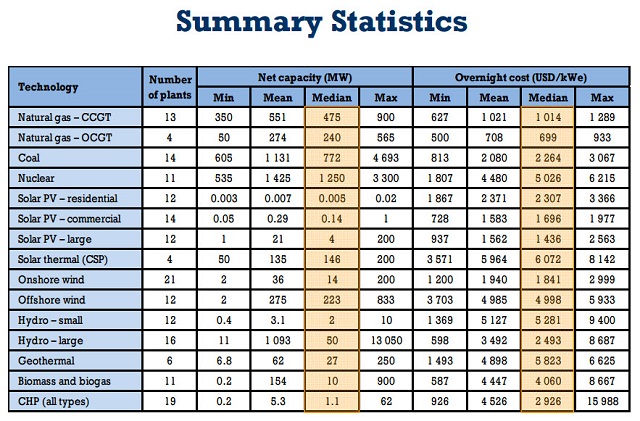
The report, Projected Costs of Generating Electricity: 2015 Edition, a joint project by the International Energy Agency and the Nuclear Energy Agency, calculates the cost of producing electricity from different types of new power plants including offshore wind.

Compared with the previous edition published five years ago, the report details a significant drop in the price of solar and wind generation costs, especially for solar photovoltaic (PV) installations, as a result of sustained technological progress. That drop, as well as a plateauing in the price of new nuclear energy plants, helped arrest cost inflation in electricity generation over the past five years.

No single technology proves the cheapest form of electricity generation under all circumstances: many factors determine the final cost of any investment, principally local influences such as market structure, policy environment and resource endowments.

Projected Costs of Generating Electricity: 2015 Edition looks at generation costs at more than 180 plants – from large nuclear and fossil-fuel facilities to wind farms to residential-sized solar PV installations – in 22 countries, including Brazil, China and South Africa. The data were used to project, country by country and for the different technologies, what it would cost to generate electricity over the lifetime of a plant built to enter service in 2020. The report’s standardized form of analysis, levelized cost of electricity (LCOE), displays the cost range of generation in each country for each technology, based on three discount rates.

While the costs of renewable technologies in some higher priced markets can be well above that of coal- or gas-fired plants, the report details how utility-scale solar PV and especially onshore wind power are comparable and often lower in countries featuring plentiful resources and appropriate market and regulatory frameworks.

Further, while more significant regional variations remain than for baseload technologies, variable renewable technology costs continue to converge towards international benchmarks at the lower end of their cost range.

Projected Costs of Generating Electricity: 2015 Edition looks into the future by examining the potential cost of emerging technologies like ocean energy and fuel cells. The report also discusses the value and cost of generation from the perspective of the power system as a whole, examining other relevant cost metrics that may be more appropriate for a world where the concept of baseload power is of declining relevance.

More immediately, the report analyses pressing issues in projecting costs of electricity generation:

• how to price in the impact of renewable variability – changes in generation when the sun does not shine or the wind does not blow,
• the effects of liberalization of prices on LCOE and investment return, and
• various technologies’ sensitivities to a carbon price.

The vast majority of the technologies included in this study are low- or zero-carbon sources, suggesting a clear shift in the interest of participating countries away from fossil-based technologies, at least as compared to the 2010 study.


The report is available for purchase here.