This blog presents Metropolitan Engineering Consulting & Forensics (MEC&F) claim management and claim investigation analyses of some of the typical claims we handle
By Sarah Onufer, Producer Published: August 5, 2015
MANCHESTER, Conn. (WTNH) — A fire at a Manchester scrap yard is under investigation. It happened Tuesday at Ostrinksy’s Scrap Metal Yard on Parker Street.
Crews were called to the scene just before 11 a.m. after workers reported seeing flames at the base of a scrap pile. When the fire department arrived a 40 foot wide, 20 foot high pile of used appliances was on fire. The fire was out by 1 p.m.
The Department of Energy and Environmental Protection was called to the scene to figure out if there would be an environmental impact but determined there was minimal danger from hazardous materials.
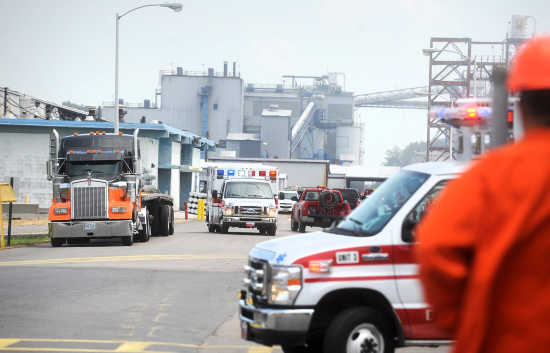
This is what the scene looks like at Noranda Aluminum. (Photo by Laura Simon)
AUGUST 5, 2015
WDIO.com
MARSTON, Mo. (AP) -
A federal agency says molten aluminum hitting water
is the apparent cause of explosions that injured more than 30 employees
at a southeast Missouri aluminum plant.
The U.S. Department of Labor's Occupational Safety and Health
Administration says it's investigating two explosions that occurred
Tuesday at the Noranda Aluminum plant in New Madrid County, about 170
miles south of St. Louis.
OSHA says the preliminary cause of the explosions appears to be the
result of molten aluminum contacting water. The agency says it also
investigated the facility in June after a worker was burned, and that an
investigation is ongoing.
OSHA said in a release late Tuesday that preliminary information shows
33 employees were injured in the explosions Tuesday, with most suffering
ringing ears and eye and throat irritation.
//-------------------///
AUGUST 4, 2015
MARSTON, Mo. -
Emergency crews are on the scene of a massive explosion at a southeast Missouri aluminum plant.
The explosion and fire around 12:30 p.m. Tuesday sent a large plume of
smoke above the Noranda Aluminum (NYSE:NOR, Forum) plant near the town
of Marston in New Madrid County, about 140 miles south of St. Louis.
John Parker, Noranda's vice-president of communications, says the
company is still working to account for all employees. He says there are
no known fatalities or critical injuries, though some people suffered
what appeared to be non-critical burns.
Parker called the blast a molten metal explosion in the cast house of
the plant, which employs about 900 workers. He isn't sure how many
employees were working at the time.
The cause of the explosion is under investigation.
//////////////------------------------///
Explosion erupts at Noranda Aluminum plant
Tuesday, August 4, 2015 ~ Updated 3:54 PM By Erin Ragan ~ Southeast Missourian
This is what the scene looks like at Noranda Aluminum. (Photo by Laura Simon)
An explosion occurred in the metal service building at Noranda Aluminum
around 12:30 p.m. today, injuring five employees and taking out the side
of a building.
A large plume of smoke could be seen above the plant near the city of
Marston in New Madrid County, according to the Associated Press.
Missouri Highway Patrol spokesman Clark Parrot could not confirm whether
anyone was transported from the smelter plant for further treatment.
Noranda spokesman Mark Christian said workers were being assessed for
their injuries, but everyone appeared to be OK. None of the injuries was
reported to be fatal.
John Parker, Noranda's vice president of communications, called the
blast a molten metal explosion in the cast house of the plant, which
employs about 900 workers. He wasn't sure how many employees were
working at the time, according to AP.
The cause of the explosion is under investigation.
More information will be available soon at semissourian.com. Also check for updates on Twitter, @semissourian.
The Associated Press contributed to this story.
Disclosure: Reporter Erin Ragan's husband works at Noranda. She covered
this story because she was in the vicinity on an unrelated piece when
the explosion occurred.
A
massive explosion rocked a southeast Missouri aluminum plant Tuesday,
injuring some workers and creating a plume of smoke that could be seen
for miles.
The explosion and fire occurred around 12:30 p.m. at
the Noranda Aluminum plant near the town of Marston in New Madrid
County, about 170 miles south of St. Louis.
Noranda spokesman
John Parker said all workers had been accounted for and there were no
life-threatening injuries. He said some people suffered what appeared to
be non-critical burns and smoke inhalation.
Parker said one of the injured workers was taken to a hospital for treatment. Others were treated at the scene.
Parker
said a molten metal explosion occurred in the cast house of the plant,
where aluminum is converted into finished products. Production in the
cast house has been suspended, Parker said, but work continued at the
rest of the facility.
Noranda employs about 900 workers in New
Madrid County. Parker said about 20 people were working in the area
where the explosion happened.
The cause was under investigation.
A woman answering phones for the New Madrid County Sheriff's Department
said investigators were on the scene and unavailable for comment.
Noranda,
based in Franklin, Tennessee, is an aluminum producer with six plants
in the U.S. and one on Jamaica. The Missouri plant is the company's
primary aluminum smelter. The company's website says the plant produces
about 263,000 metric tons of primary aluminum annually, roughly 15
percent of all U.S. aluminum production as of 2009.
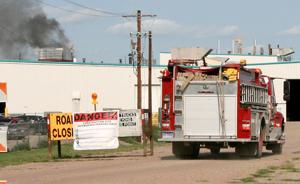
A firetruck heads toward the Sapa facility Monday afternoon in response to a fire in one of the company’s painting lines. Rob Nielsen/P&D
Posted: Tuesday, August 4, 2015 10:43 pm
By Rob Nielsen rob.nielsen@yankton.net
Sapa Extrusions officials are saying a fire that forced a 3 ½-hour evacuation of their Yankton operation Monday afternoon will not have a major impact on operations.
Plant manager Kevin Perakslis told the Press & Dakotan said he doesn’t have a cost estimate on damage, but that the fire was contained to a small area.
"We have two paint lines," Perakslis said. "The fire only involved one paint line, and in that paint line, there’s two paint booths and all the fire was contained to one of the paint booths, which we’re very happy about. … From our first assessment, some of the individuals who have helped have worked through paint line fires before and they’re amazed at how limited the destruction was."
Yankton deputy fire chief Larry Nickles told the Press & Dakotan a paint gun is the suspected cause of Monday’s fire.
"Right now, we’re looking at the possibility of static electricity while a paint gun was being flushed out with solvent," Nickles said.
Perakslis said, after employees were let back in Monday evening, elements of the Sapa plant were incrementally brought back online throughout the night. Everything except for the damaged paint line was up and running normally by Tuesday morning.
Perakslis said the fire will not have any significant impacts on output.
"We have a self-paint line which is our newer, high-performance paint line," he said. "One hundred percent of our customers are painted on that paint line — that’s the one that’s undamaged. The north paint line, we were only running it a few days a week when we had enough customer demand and we had the manpower. It’s not one we plan on running every day. It shouldn’t be a major impact on our customers at all."
He added that repairs aren’t expected to take very long.
"We are still checking the structural damage on the roof and it looks like we might need to do some repairs," he said. "But it’s all minimal. We can possibly have the paint line repaired and up by the end of this week."
During the fire, large quantities of firefighting equipment ended up coming into contact with some of the paint used by Sapa.
Nickles said while some pieces are able to be cleaned and salvaged, others will need to be discarded.
"The thing we were fearing was our airpacks that are about $6,500 a piece," he said. "Turns out we were able to salvage everything on those. We did lose about 10 sets of turnout gear (protective clothing) and gloves and about 400 feet of hose."
He added that the paint is a safety issue on these pieces of equipment.
"Typically, a little bit of paint doesn’t hurt anything, but in this case this paint does not dry until it’s been baked at 350 degrees for an unspecified amount of time," he said. "If we would try to clean it with a solvent, the problem is it reduces the flashover resistance of that gear. Our gear is about 1,350 degrees where it accepts a flashover for up to 60 seconds. Anytime you’ve got grease and oils and paints into the material, it reduces that temperature rating."
Estimated equipment losses are around $20,000.
Perakslis said he was grateful that the situation didn’t end up being any worse than it was.
"No one was hurt," he said. "Our employees were evacuated quickly. The fire department was here very quickly, so I want to thank the Yankton and Gayville fire departments. They came in and got it resolved as quickly as they could which allowed us to get back in the plant quickly and clean up. I was very happy with how the plant reacted. Everything was done safely. No one from the fire department was hurt, no one from Sapa Yankton was hurt so we’re very happy about that."
A journalist sits April 9
near the North Korean cargo ship Mu Du Bong, anchored in the port of
Tuxpan, Mexico, after it accidentally ran aground in July 2014. Despite
North Korea's protests, a panel of experts that monitors U.N. sanctions
against Pyongyang for its nuclear arms and missile programs asked the
Mexican government not to release the boat. North Korean diplomats have
said the ship was carrying nothing prohibited by sanctions. | AP
Plaintiffs pursue Mexico-held North Korea ship in kidnap-killing U.S. suit award
AP
UNITED NATIONS – Winning
a lawsuit against North Korea is rare. Collecting millions of dollars
in damages from the isolated country? Pretty much impossible. But an
Israel-based civil rights group thinks it has found a way, starting with
a North Korean ship that’s been held, against Pyongyang’s wishes, in a
Mexican port for the past year.
The effort illustrates the challenges of holding North Korea to account in more ways than one.
The Shurat HaDin law center began its pursuit after winning a
$330 million U.S. District Court judgment in April over the abduction
of a South Korean-born pastor in China and his presumed torture and
killing in North Korea 15 years ago. Now the center is aiming for
whatever North Korean assets it can find. It has focused on the Mu Du Bong, a cargo ship that
accidentally ran aground off Mexico last July. Despite North Korea’s
protests, a panel of experts that monitors U.N. sanctions against
Pyongyang for its nuclear arms and missile programs asked the Mexican
government not to release it. The ship’s North Korean parent company, Ocean Maritime
Management Co., has been under sanctions ever since another ship it
operated was found to be carrying two Cuban fighter jets, missile and
live munitions hidden under a cargo of sugar. Seizing the Mu Du Bong requires that a Mexican court
recognize the U.S. court’s judgment. Civil courts in Mexico City and in
the state of Veracruz have declined to hear Shurat HaDin’s request, but
it is now appealing. The plan is to sell the ship to the highest bidder, with the money going to the South Korean pastor’s family. “There are so few North Korean assets around the world that
an opportunity like this, to seize the boat, should not be allowed to
simply slip away out of fear of North Korea or other political
consideration,” Nitsana Darshan-Leitner, Shurat HaDin’s director, told
The Associated Press on Tuesday. Shurat HaDin is known for suing states such as Iran and
Syria on behalf of victims of torture or terrorism, aiming for bad
publicity for those governments even if it can’t get them to pay. North Korea has never admitted the abduction and torture of
the pastor, U.S. resident Kim Dong Shik. Pyongyang has been known to
respond harshly to people who try to promote religion, even among the
thousands of North Koreans who have fled to neighboring China. Normally, foreign states can’t be sued in the United States,
but an exception in the Foreign Sovereign Immunities Act allows it
against countries that are listed as state sponsors of terrorism. Shurat
HaDin filed suit over Kim’s disappearance just one day before the
George W. Bush administration removed North Korea from that list. The removal has complicated efforts to collect damages from
Pyongyang, including by accessing the millions of dollars of its money
still thought to be frozen in several U.S. banks. As of 2008, the last
year the U.S. Treasury reported it, $34 million of North Korean money
remained in U.S. banks. A Treasury spokeswoman didn’t comment. Even if a suit is won, collecting money from Pyongyang is extremely difficult. In 2010, Shurat HaDin won $378 million in a U.S. court
against North Korea over the killing of Americans at an Israeli airport
in 1972, but it was unable to collect. In 2008, attorney Richard Streeter received a $65 million
judgment on behalf of U.S. Navy crewmen held captive for nearly a year
by North Korea in 1968. The former crewmen have never collected any
money. “Let me know if they get anything,” Streeter said of the latest case. Pursuing assets is often hampered by the U.S. government
because of real or perceived conflicts with its political goals, said
Jeffrey Addicott, director of the Center for Terrorism Law at St. Mary’s
University. “If a nation does something adverse to another nation, the
fear is that the harmed nation may retaliate in a way that produces a
great deal of mischief,” he said in an email. “Particularly true when
dealing with totalitarian states.” There was no comment Tuesday on the attempt to seize the
cargo ship from North Korea’s mission to the U.N., which has said Mexico
“forcibly detained” it under U.S. pressure. North Korean diplomats have
said the ship was carrying nothing prohibited by sanctions. The head of the U.N. panel of experts, Hugh Griffiths, did
not comment. But a former panel member, former U.S. official William
Newcomb, said U.N. permission isn’t needed for Mexico to allow Shurat
HaDin to seize the ship. “I think the Security Council will be happy if the ship does
not go back to North Korean hands,” Mexican lawyer Alberto Mansur, who
has helped with the court filing, told the AP.
A
Coast Guard Cutter Stratton boarding team investigates a self-propelled
semi-submersible interdicted in international waters off the coast of
Central America, July 19, 2015.(Coast Guard byPetty Officer 2nd Class
LaNola Stone)
August 5th, 2015
ALAMEDA, Calif. –
The U.S. Coast Guard seized a self-propelled
semi-submersible vessel carrying more than 16,000 pounds of cocaine in
the Eastern Pacific Ocean July 18.
The crew of the Coast Guard Cutter Stratton from Alameda apprehended
four suspected smugglers and seized 275 bales of cocaine worth more than
$181 million wholesale from the self-propelled semi-submersible. A
U.S. Navy maritime patrol aircraft detected the 40-foot
semi-submersible vessel more than 200-miles south of Mexico.
“Our success intercepting this drug-laden, self-propelled
semi-submersible is a testament to the collaboration of our partner
agencies, and demonstrates the importance of our increased presence in
the Western Hemisphere,” said Vice Adm. Charles W. Ray, commander,
Pacific Area. “Every interception of these semi-submersibles disrupts
transnational organized crime networks and helps increase security and
stability in the Western Hemisphere.”
After removing 12,000 pounds of the narcotics aboard, the crew of
Stratton attempted to tow the vessel to shore as evidence; however, the
semi-submersible began taking on water and sank. Approximately 4,000
pounds of cocaine left in the SPSS vessel to stabilize it during the
towing evolution sank in over X,XXX-feet of water and is unrecoverable.
The crew of the Cutter Stratton interdicted or disrupted 15 different
drug smuggling attempts since April including another self-propelled
semi-submersible vessel carrying 5,460 pounds of cocaine June 16. Coast
Guardsmen aboard Stratton have seized more than 33,000 pounds of cocaine
worth more than $540 million wholesale since May 2015.
The July 18 semi-submersible seizure is the largest recorded
semi-submersible interdiction in Coast Guard history. Stratton’s
semi-submersible busts are also the first and second by a Legend Class
Cutter, the Coast Guard’s newest and most capable vessels.
This is the first interdiction of two semi-submersibles in a single
patrol at sea where Coast Guardsmen recovered both the narcotics and the
vessels. Coast Guardsmen from the Coast Guard Cutter Mohawk from Key
West, Florida, interdicted two semisubmersibles in the Caribbean in
2011; however, both vessels sank during the course of the interdiction.
There have been 25 known semi-submersible interdictions in the
Eastern Pacific Ocean since November 2006 when the first documented
interdiction occurred. A semi-submersible is a vessel constructed for
illicit trafficking that is mostly submerged with just a cockpit and
exhaust pipe visible above water. These vessels are extremely difficult
to detect and interdict because of their low-profile and ability to
scuttle.
U.S. Customs and Border Protection Office of Air and Marine also
assisted by monitoring the semi-submersible using a maritime patrol
aircraft during the course of the interdiction July 18.
Transnational Organized Networks in the Western Hemisphere draw
immense profits from drug trafficking, terrorism, human smuggling,
weapons trafficking, piracy, environmental crime, intellectual property
theft, and cyber-crime. As these well funded illicit networks broaden
their activities, they could become mechanisms to be employed by
terrorist organizations located in Central and South America.
The Coast Guard’s leadership role in Western Hemisphere security and
prosperity is critical in the fight against TOCs active in the Western
Hemisphere as continually strained national security resources are
stretched across the globe.