Saturday, June 6, 2015
NIOSH-Funded State FACE Investigation Leads to Safer Handicapped-Accessible Accelerator Pedals
June 2015
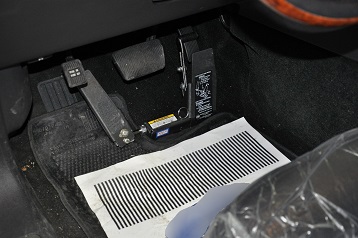
Photo of handicapped-accessible brake and accelerator pedals. Photo courtesy of Kentucky OSHA.
Auto technicians play an important role in ensuring the safety of our cars.
However, technicians encounter a number of dangers in their workplace when dealing with passenger vehicles that range in weight from about 2,200 to 3,300 lbs., depending upon the make and model.2
Nationally, there were 71 fatal injuries reported in the automotive repair and maintenance industry in 2012.3
The Kentucky (KY) Fatality Assessment and Control Evaluation (KY FACE) program—funded by the National Institute for Occupational Safety and Health (NIOSH)—investigated a death of a 50-year-old certified master technician who was struck by a car while sitting at a desk in a dealership’s service bay.
An auto technician working in the service bay was preparing a vehicle for an oil change when he mistook a handicapped-accessible accelerator pedal for the brake pedal.
The handicapped-accessible pedal, which can be removed, had a left foot accelerator made for individuals who have lost the ability to use their right foot.
Mistaking the accelerator pedal for the brake pedal caused the vehicle to strike the victim from behind and pin him against his desk and a wall causing blunt force injuries. After calling 911, an employee with emergency medical technician experience, rushed to the scene, assessed the situation, and covered him to prevent shock until emergency responders arrived. On the way to the hospital, the victim suffered cardiac arrest and died from his injuries.
The KY FACE
program investigator evaluated the incident and produced the report
"Auto Technician Mistakes Handicapped Accessible Accelerator Pedal for
Brake Pedal and Fatally Pins Co-Worker".4
The report identified two key recommendations to prevent future
incidents from occurring: (1) removal of handicapped-accessible
equipment prior to operation; and (2) moving office spaces away from car
servicing areas.
References
- U.S. Census Bureau [2012]. Automotive repair and maintenance (NAICS 8111). Industry snapshot. [http://thedataweb.rm.census.gov/TheDataWeb_HotReport2/econsnapshot/2012/snapshot.hrml?NAICS=8111
 ].
]. - MacKenzie D, Zoepf S, Heywood J [2014]. Determinants of US passenger car weight. International Journal of Vehicle Design, 65(1): 73–93.
- BLS[2012]. Fatal occupational injuries by industry and event or exposure, all U.S., 2012. Bureau of Labor Statistics [http://www.bls.gov/iif/oshwc/cfoi/cftb0268.pdf
 ].
]. - NIOSH
[2014]. Auto technician mistakes handicapped-accessible accelerator
pedal for brake pedal and fatally pins co-worker. Kentucky Fatality
Assessment and Control Evaluation Program, Kentucky Injury Prevention
Research Center, National Occupational Institute for Occupational Safety
and Health, Centers for Disease Control and Prevention, U.S. Department
of Health and Human Services. Kentucky Report 14KY001. [http://www.cdc.gov/niosh/face/pdfs/14KY001.pdf ]. Date accessed: March 2015.
- Veigel [2015]. Veigel electronic left foot accelerator brochure.
Working out in the Heat? Hydration and Taking Frequent Breaks are Keys
Trainer Lori Patterson holds all her boot camp classes outdoors. In the summer, the days are hot, the workouts intense and her advice simple.
Drink plenty of water.
“Hydration is No. 1,” Patterson says, when it comes to maintaining an outdoor workout routine through June, July and August, when high temperatures average in the upper 80s and can easily reach 100.
The early days of summer can be the most stressful, because we aren’t used to the sticky wallop of soaring thermometers and elevated humidity. It can take several days to adjust to the swelter.
Preparation is key.
“It’s water prior to exercise, during exercise and after exercise,” says Patterson, who founded her St. Peters-based Boot Camp Challenge in 1984.
That can mean up to 6 ounces of water every 15 minutes, says Chris Merli, executive director of the Safety Council of Greater St. Louis.
“You can lose 2 or 3 gallons of sweat per day working in the heat,” Merli says. “Don’t wait until you feel thirsty to start drinking.” That’s especially important for anyone over 40, the age when sensitivity to thirst starts to decline.
Hydrating should start as soon as you wake up, especially if you know you will be toiling outside — whether it’s with yard work, running, biking or even walking around the zoo. Then constantly replenish, says Merli.
Water is the best bet, though sports drinks are also OK. Avoid caffeine, which constricts blood vessels and can lead to dizziness, and alcohol, which is dehydrating.
Then dress for the weather. Workout gear should be lightweight and light in color, Merli says. “Performance” fabrics such as polyester and spandex wick sweat away from the body and dry quickly.
“We like to say ‘cotton is rotten,’” says Patterson. Or "Cotton Kills". “When you sweat, it will stick to your body and can lead to rashes and other skin issues. Performance materials really are worth it.
“And wear the least amount of clothing you feel comfortable in.”
Tank tops and shorty-shorts leave you more vulnerable to sunburns, though, so any exposed skin should be covered in sunscreen, Merli says.
“Put on plenty, allow it time to absorb into the skin, and use waterproof versions,” she recommends. An SPF of 30 is plenty as long as it is applied correctly. Higher SPFs don’t offer a significant amount of extra protection.
Finally, consider where and when you will be exercising.
Boot Camp Challenge classes are held in parks throughout the area, and Patterson tries to keep her trainees in the shade. She schedules her classes early, when temperatures are usually still hovering below sweltering.
The most brutal time is late morning through the afternoon, but “even evening can be a struggle on the hottest summer days,” she says.
Patterson advises you don’t go full throttle the moment you step out of the air conditioning. Warm up with a short jog until you break a light sweat. Then ease into the workout.
“If you need to, decrease the intensity and take more breaks,” Patterson says. “We manipulate our programs so they’re less intense” during the dog days.
Afterward, give your body some time to recover. Walk and stretch. Sip some water. A cool, wet cloth on the back of your neck or your wrists can help bring down your temperature.
Some folks face particular challenges in the heat, Merli says. Seniors and people with diabetes can be extra sensitive to warm temperatures.
Certain over-the-counter and prescription medications can hinder the body’s ability to cool itself or increase sensitivity to the sun. Antihistamines can impede one’s ability to sweat. Diuretics reduce the amount of water in the body, which can lead to dehydration.
And if you weren’t working out before Memorial Day, taking off for a long jog on a 90-plus-degree afternoon isn’t the smartest decision. But with the right preparation, there is no reason to curtail most outdoor workouts, Patterson says.
She recommends exercising with a friend or in a group — for safety as well as motivation and camaraderie. If you’re out on your own for a walk or a jog, take a phone and let someone know your route, she says.
Most importantly, says Patterson, be smart. Sometimes it’s best to just move your workout indoors.
“No one likes the treadmill,” she says. “But if it’s 100 degrees outside, what’s more important — working out or your overall health?”
TIPS FOR WORKING OUT IN THE HEAT
Hydrate before, during and after your workout.
Wear lightweight, light-colored clothing.
Apply sunscreen at least 20 minutes before you go outside.
Avoid the heat of the day, usually between 10 a.m. and 4 p.m.
Stay in the shade and take plenty of breaks.
Do not try to show off to other that you are strong and in great shape. Resist the temptation.
HEAT EXHAUSTION SIGNS
Dehydration and an elevated body temperature can quickly put a person in distress. Signs of heat exhaustion include dizziness, fatigue, headache, nausea and shortness of breath. Anyone experiencing those symptoms should be helped to a cool or shady place to rest and drink water.
Heat stroke is a more serious form of heat exhaustion. It has similar, but more severe symptoms and can also include vomiting, confusion and agitation. A person may stop sweating as the body loses its ability to cool itself. Heat exhaustion is a medical emergency; 911 should be called immediately.
Source: Occupational Safety and Health Administration
CONTRACTOR ELECTROCUTED BY POWER LINE WHILE WORKING ON NORTH CHARLESTON ST. MATTHEWS BAPTIST CHURCH ON A CHERRY PICKER


JUNE 5, 2015
NORTH CHARLESTON, SOUTH CAROLINA
A man working on a North Charleston church was shocked
unconscious when he came into contact with a power line on Friday. The man was in the bucket of the cherry
picker to repair items at the church.
The contractor was shocked while working on St. Matthews
Baptist Church at Grayson and North Atlantic streets on Friday morning, North
Charleston Fire Department spokeswoman Bianca Bourbeau said.
As he swung the bucket around, the cherry picker hit a
7,200-volt line owned by South Carolina Electric & Gas.
Crews arrived to see a man in a lift unconscious. South
Carolina Electric & Gas cut off the power to the line and firefighters
lowered the man to the ground in a platform ladder truck.
EMS treated the man and transported him to the Medical
University of South Carolina with life-threatening injuries. More information
on his condition was not available.
These are preventable accidents. People always take shortcuts to safety for
all kinds of reasons (cost cutting, shorten the job duration, ignorant of the power
line risks, etc.) and they end up injuring themselves.
Uncertain Outlook for Natural Gas as Demand in Asia Weakens. Cheap Energy Costs will Promote Economic Activity in Many Other Industries

Published in Oil Industry News on Friday, 5 June 2015
Lower prices will feed a pick-up in global natural gas demand over the next five years following a marked slowdown in 2013 and 2014, the International Energy Agency (IEA) said Thursday in its 2015 Medium-Term Gas Market Report, which provides an analysis of global demand, supply and trade developments through 2020.
Nevertheless, the growth in demand will fall short of previous forecasts.
The annual report sees global demand rising by 2% per year by the end of the forecast period, compared with 2.3% projected in last years outlook. A significant reason for the downward revision is weaker gas demand in Asia, where persistently high gas prices until very recently caused consumers to switch to other options.
“One of the key – and largely unexpected – developments of 2014 was weak Asian demand,” said IEA Executive Director Maria van der Hoeven. “Indeed, the belief that Asia will take whatever quantity of gas at whatever price is no longer a given. The experience of the past two years has opened the gas industry’s eyes to a harsh reality: in a world of very cheap coal and falling costs for renewables, it was difficult for gas to compete.”
Asian gas prices are indexed, or linked, to those for oil. For several years, as oil prices hovered over USD 100/barrel, that meant Asian consumers were paying a hefty premium for their gas compared with buyers in other parts of the world.
The rout in oil prices that began in mid-2014 has spilled over to natural gas markets in Asia and allowed the Asian premium to narrow substantially. But demand for gas in Asia may not recover as quickly as the drop in prices.
In the short term, gas demand will benefit from plunging prices, but the report adds that the long-term outlook for gas has become more uncertain – especially in Asia. A few Asian countries have decided to move ahead with plans to expand coal-fired power generation instead of gas-fired generation. “For the fuel to make sustained inroads in the energy mix, confidence in its long-term competitiveness must increase,” the report says.
Slow production growth
On the supply side, the report notes that lower oil prices will have a major impact on gas upstream and infrastructure investment. Companies are cutting capital expenditures and refocusing on core assets with fast returns, which will unavoidably lead to slower production growth over the medium term.
Due to their capital-intensive nature and long lead times, liquefied natural gas (LNG) projects are soft targets for investment reductions and several of them are likely to be delayed or even cancelled. If current low prices persist, LNG markets could start tightening substantially by 2020, with demand gradually absorbing the large supply upswing expected over the next three years.
In the short term, gas markets will need to cope with a flood of new LNG supplies. The report projects global LNG export capacity to increase by more than 40% by 2020, with 90% of the additions coming from Australia and the United States. Lower oil prices pose little risk to the timing of projects already under construction. The Australian projects are at an advanced stage of development, while project’s operators in the United States have limited price exposure once deals have been signed. New projects, however, will struggle to get off the ground at current prices.
As LNG supplies surge over the next five years, Europe is set to offer an important outlet. The report projects that the region’s LNG imports will roughly double between 2014 and 2020. Despite the foreseen increase in LNG intakes, the report does not anticipate a meaningful reduction in European imports from Russia, which will remain locked in a 150-160 bcm range.
In OECD-Europe, domestic gas production is projected to continue to fall and to stand 25% below its 2010 level by 2020. Compounding the declining trend in production is a moderate recovery in demand. As a result, European gas import requirements are set to increase by almost one-third between 2014 and 2020.
Overall, cheap energy costs will promote economic activity in many other industries. Following a 1-year "recession" due to capital investment reduction in the O&G industries, the economy will rebound very strongly due to the cheal energy costs.
Source: www.offshoreenergytoday.com
Subscribe to:
Posts (Atom)