MEC&F Expert Engineers

Thursday, June 4, 2015

Investigators: Was Amtrak engineer using cellphone when train crashed?


June 3, 2015

Washington, DC
 

Federal investigators looking into the Amtrak derailment that killed eight people and injured scores of others in Philadelphia last month are trying to determine whether the engineer was using his cellphone when his train approached a curve at more than twice the speed limit.

Christopher A. Hart, chairman of the National Transportation Safety Board, told a congressional committee Tuesday that investigators want to know whether train engineer Brandon Bostian, 32, was texting or speaking on the phone as his locomotive accelerated to 106 mph into the bend.

“We know that there is text and voice activity on that day,” Hart said. “We’re trying to narrow down [the time frame]. We were surprised by the complexity ourselves, and we’re experts on this.”

Bostian, through his attorney, said after the May 12 crash that his cellphone was inside his backpack in compliance with federal rules.

Federal safety regulators and Amtrak officials faced questions at a congressional hearing June 2, 2015, on why technology to slow trains that are going too fast was not in place before the deadly derailment in Philadelphia. (AP)
 
Hart said Tuesday that a seemingly simple matter — getting a time stamp on phone calls and text messages — was complicated by the fact that Bostian’s cellphone carrier was three time zones away in California.

“And we found [time] discrepancies within the carrier’s own system,” Hart said.
He also said that the clock in the train’s data recorder might show an incrementally different time from that shown on Bostian’s phone.

Although it will be months before the NTSB issues a formal report on the cause of the crash, the focus of the investigation appears to have narrowed to Bostian’s actions. Hart told the committee that there was no indication of problems with the locomotive, track, braking or signal system.

“We need technology that can step in when humans fail,” Hart said.
Sarah Feinberg, acting head of the Federal Railroad Administration, told the committee that within weeks her agency would roll out plans to control for human error.

“Speed, simply put, is what we refer to as a human factor,” said Feinberg, who was nominated by the Obama administration to become permanent head of the FRA.


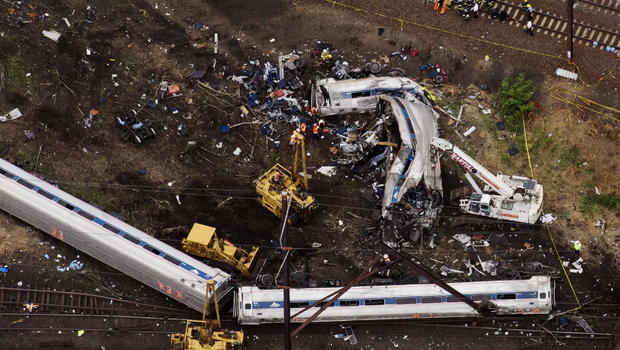
Bostian was at the controls of the northbound train that began its trip at Washington’s Union Station and had just stopped at 30th Street Station in Philadelphia. After leaving that station it gained speed to 80 mph as it moved east across the city. Rather than slow as it approached a sharp left curve with a 50-mph speed limit, the train sped to 106 mph before Bostian hit the emergency brake.

Entering the turn at 102 mph, the train derailed. Bostian survived with minor injuries, but the passenger car just behind the engine crumpled like a tin can. In addition to those killed, about 200 people were injured.

The question of whether Bostian was using his cellphone at the time of the crash might have been answered if Amtrak trains were equipped with inward-facing video cameras. Amtrak’s president and chief executive, Joseph H. Boardman, said last week that inward-looking cameras would be installed.

Bostian told investigators that he had no memory of what happened immediately before the crash.

“Inward-facing cameras would help fill in those gaps,” Hart told the committee.
Dennis R. Pierce, president of the Brotherhood of Locomotive Engineers and Trainmen, first said the use of inward-looking cameras would be “un-American” and then clarified the union’s position after coming under fire from committee members.

“There are privacy concerns about the storage of [camera] data,” he said. “Nobody wants to see their last moment on Earth floating around on YouTube.”
Hart, Feinberg and Boardman spent much of the three-hour hearing answering questions about a safety advance they all agreed would have prevented the accident.

Called positive train control, the system would have automatically slowed the train to a safe speed as it approached the curve. Amtrak has installed the system on all portions of Northeast Corridor track that it owns, but its use has been delayed by problems with bandwidth interference.

Boardman promised that the system would be running by the end of the year, meeting a congressional deadline for its full implementation. Few of the freight rail lines are expected to meet that deadline, and delays will affect Amtrak trains that run on freight lines. Although the passenger rail agency owns portions of track in the Northeast, most of its trains run on freight lines elsewhere.

“Positive train control is the game changer,” said Feinberg, who ordered Amtrak to take four immediate corrective steps after the accident.

Boardman said Amtrak has complied with three of them and would submit a plan for the fourth by the June 10 deadline set by Feinberg.

“A lot of people around the country have died as a result of the lack of positive train control,” said Rep. Peter A. DeFazio (D-Ore.). “This was probably human error. Positive train control could have prevented that.”

Source: http://www.washingtonpost.com

Human Error Probed in Amtrak Accident That Cost $9.2 Million


Investigators and first responders work near the wreckage of an Amtrak passenger train carrying more than 200 passengers from Washington, DC to New York that derailed late last night May 13, 2015 in north Philadelphia, Pennsylvania.
Photographer: Win McNamee/Getty Images

Investigators probing a fatal Amtrak crash in Philadelphia last month pointed to human error after finding no defects in the brakes or signals as a cause for the wreck estimated to have cost the railroad more than $9 million.

The accident that killed eight passengers remains under investigation by the National Transportation Safety Board. Northbound Train 188 was traveling at 106 miles per hour, more than twice the speed limit on a bend in the track when it derailed on May 12, investigators have said.

“We are not aware of any defects or issues identified to date with respect to the track, locomotive, or other infrastructure,” Representative Bill Shuster, a Pennsylvania Republican who heads the House Transportation and Infrastructure Committee, said in a statement before a Tuesday hearing on the crash.

Investigators are still analyzing the mobile phone records of engineer Brian Bostian and matching them with data from the train. That will determine whether Bostian, who has said he doesn’t remember what happened, was using his phone in violation of policy, NTSB Chairman Christopher Hart said in testimony at a House hearing on Tuesday.

Amtrak estimates the crash cost more than $9.2 million, the safety board said in a preliminary report released Tuesday.

A system that can automatically slow a train going too fast into a curve wasn’t installed on the northbound tracks in Philadelphia. Amtrak hadn’t anticipated that an engineer might speed up going into the curve, Amtrak Chief Executive Officer Joseph Boardman told Shuster’s committee.

Positive Control

“The notion that an engineer might actually accelerate into the northbound curve was not a circumstance we anticipated, and thus we didn’t mitigate for it,” Boardman said.

The technology was installed on the southbound tracks at that curve. U.S. regulators want all passenger rail systems including Amtrak to install a more advanced technology called positive train control, Sarah Feinberg, the acting administrator of the Federal Railroad Administration, said in prepared testimony.
“This committee expects answers,” Representative Jeff Denham, a California Republican, said at the hearing. “We’re also looking for solutions. I’m looking forward to seeing PTC implemented in a very, very quick manner.”

Amtrak Deadline

PTC can automatically slow trains and prevent collisions or travel on incorrect tracks. Feinberg called it the most important advance in railroad safety in a century. U.S. law requires PTC to be installed and in use by the end of 2015 for all tracks carrying rail passengers. Amtrak “should” meet the deadline on the Northeast Corridor between Washington and Boston, Boardman said.

After the crash, Amtrak installed automatic braking technology on the northbound tracks where the train derailed. The railroad says it will install cameras in its locomotives to help determine the causes of future crashes.
The head of the labor union that represents Bostian cautioned that such cameras won’t prevent a crash.

“Installation of cameras will provide the public nothing more than a false sense of security,” Dennis Pierce, Brotherhood of Locomotive Engineers and Trainmen national president, said in his testimony.

Republicans on the committee want to know why Amtrak didn’t spend profits earned from its Northeast Corridor route on safety upgrades, including locomotive cameras and positive train control.

Source:bloomberg.com

Two Dirty and Cheapskate Industries Decide to Take Action; Do Not Hold Your Breath: Railroad And Oil Refineries Sign Mutual Aid Agreement To Respond To Accidents


  June 2, 2015 


War and Buffet's BNSF Railway and oil refineries in Washington are teaming up to better respond to accidents.  The railroad and BP Cherry Point, Phillips 66, Shell Oil Products US, Tesoro Companies and U.S. Oil Refining Company have all signed the agreement.

But, environmentalists say it doesn't address safety problems with oil trains.

Courtney Wallace, spokeswoman for BNSF Railway, says the mutual aid agreement formalizes what the railroads and refineries have already been doing informally.

“If there was an accident or an incident on the railroad and we needed assistance we could call the refineries because they have extensive equipment, they have extensive experience,” Wallace said.

That experience includes expertise in handling hazardous materials. And, Wallace says, if there’s an explosion or accident at a refinery,  B-N-S-F would send help.

Rebecca Ponzio, with the Washington Environmental Council, says agreement between the refineries and railroad doesn't do anything about the underlying problems with oil trains.

“You know, better coordination and having this mutual aid agreement does not truly address the risk,” Ponzio said.

She says those risks come from mile long trains hauling highly flammable crude oil. Environmental organizations are pushing for stronger regulations that they say would prevent accidents in the first place.

Source:www.kplu.org

YOU ARE NOT IN MEXICO, JOSE, PAY ATTENTION TO THE ROAD: 2 DEAD, 30 INJURED IN TEXAS WHEN A TRANSPORTES DEL NORTE BUS REAR-ENDED A TRACTOR TRAILER


JUNE 3, 2015

WEIMAR, TEXAS (AP)

Two people were killed and dozens more hurt when a passenger bus crashed on I-10 near Weimar Wednesday afternoon.

The bus slammed into the back of a big rig causing it to hit a car and pushing the car into an SUV.

The bus driver wasn't paying attention when traffic slowed down in a construction area, according to DPS.

He apparently tried to stop but it was too late.

The bus driver and a passenger who was ejected from the front of the bus were killed.

The injured victims were taken to hospitals in Columbus and La Grange. Some were treated by EMS crews at a nearby high school.

A Houston woman was in the car sandwiched between the big rig and SUV.
"It started spinning me around and I just put my head down under my arms and um, rode it out," Susan James said.

Her car was crushed but, remarkably, James wasn't hurt.

 A statement from the agency says the driver and another person on the bus were killed. The injured were taken to hospitals.

The crash happened in a construction area as traffic stopped in front of the bus, which the agency said was traveling from the border city of Laredo, Texas, to North Carolina. Video from the scene showed it was a Transportes del Norte bus.

The Mexican company didn't immediately return a message seeking comment.
Source: http://www.mysanantonio.com and http://www.khou.com

2 DEAD AFTER SPEEDING CAR STRIKES ANOTHER IN CHESTER, PENNSYLVANIA


JUNE 4, 2015

CHESTER, PENNSYLVANIA (WPVI)

Two people are dead following a massive collision in Chester, Delaware County early Thursday morning.
The crash happened around 1:00 a.m. at the intersection of West 2nd Street (Rt.291) and Pusey Street.

According to police, a white car traveling at a high rate of speed slammed into a red car.

The striking car kept going about a block before coming to a stop.

Witnesses who heard the impact say it was heart-stopping.

Authorities say the two people who died were in the red car.

Source: http://6abc.com