MAY 21, 2015
Story highlights
- Six pelicans and one young sea lion need cleaning
- Ruptured pipe was carrying 1,300 barrels an hour, below its 2,000 barrel maximum
- Oil pipeline firm has among highest number of infractions since 2006, feds say
What caused the oil spill, however, remained under investigation.
The
underground oil pipeline was carrying 1,300 barrels an hour, below its
maximum capacity of 2,000 barrels an hour, said Rick McMichael of Plains All American Pipeline.
"Line 901 was not operating at capacity before or during the release," McMichael told reporters.
Meanwhile,
Plains All American Pipeline is among the worst violators listed by the
U.S. Pipeline and Hazardous Materials Administration and surpassed all
but four of more than 1,700 operators in reporting safety and
maintenance infractions, the federal agency said.
The company has 175 federal safety and maintenance violations since 2006, responsible for more than 16,000 barrels in spills that have caused more than $23 million worth of property damage.
When
asked about the firm's regulatory record, McMichael said the company
reports every incident -- even those it's not required to document-- and
two-thirds of them involved five or fewer gallons.
Pat
Hutchins, the company's senior director of safety, said Plains has been
committing money to safety improvements for the past seven years.
Crews continued to clean
beaches and coastal waters, and officials reported that the leak killed
an undisclosed number of lobsters, kelp bass and marine invertebrates.
Six oil-soaked pelicans and one young sea lion were being rehabilitated,
officials said.
As of Thursday night, vessels had skimmed 9,500 gallons of oily water from the ocean, McMichael said.
Seventeen vessels scoured the ocean surface, he said.
The
cleanup could last months, officials said. For now, currents, tides and
winds make the oil plume "a moving target" as it drifts offshore, said
U.S. Coast Guard Capt. Jennifer Williams.
"It's
a continual effort," added U.S. Coast Guard Chief Petty Officer David
Mosley. "It's not something that we can say, 'Yeah, we are hitting it
out of the park,' but it's something our guys are dedicated to."
No stranger to oil spills
This isn't the first oil spill suffered by scenic Santa Barbara.
A
spill in January 1969 became what was, at the time, the nation's worst
offshore oil disaster. Though this week's spill is smaller, it still
prompted California's governor to declare a state of emergency in Santa
Barbara County.
The 1969 disaster was
so catastrophic and the media coverage so extensive that it gave birth
to an environmental movement, a host of regulations against the oil and
gas industry, and a new commission to protect California's coast,
experts said.
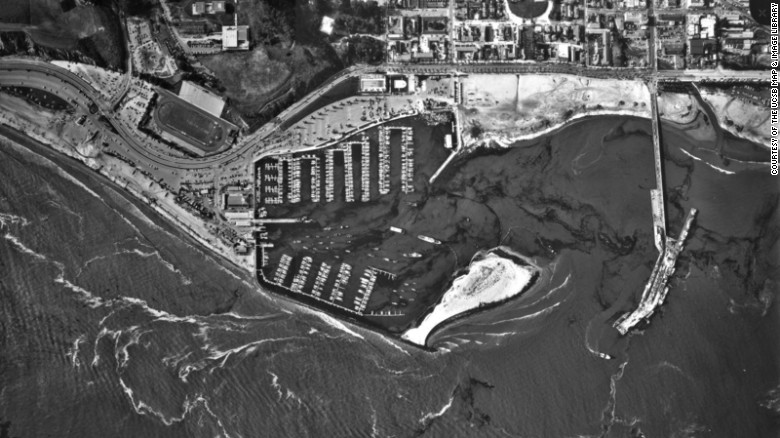
Santa Barbara Harbor after what was then the worst oil spill in U.S. history, in February 1969.
In
all, about 3 million gallons of oil spewed from a Union Oil drilling
rig 5 miles off the coast of nearby Summerland, California. The pipe
blowout cracked the seafloor, and the oil plume killed thousands of
seabirds and "innumerable fish," according to an analysis by the University of California, Santa Barbara.
About
35 miles of coastline was coated with oil up to 6 inches thick, and
about 800 square miles of ocean was affected, according to a paper by
university geographers. Oil platforms are a common sight off the Santa
Barbara coast and elsewhere in California, and activists have
unsuccessfully sought to phase out oil development in the state.
A backlash and consequences
Subsequent
U.S. oil spills were much larger, including the Exxon Valdez accident,
which dumped 11 million gallons off Alaska's shores in 1989, and the
Deepwater Horizon spill of 210 million gallons in the Gulf of Mexico in
2010.
But the 1969 Santa Barbara spill
energized a grass-roots movement that led to new federal and state
environmental laws and helped establish the first Earth Day the next
year.
"While the popular backlash
against the oil companies involved grew, the public discussion that was
to have long-term consequences for the nation started in earnest," wrote
geography department chairman Keith C. Clarke and graduate student
Jeffrey J. Hemphill.
This week's oil
spill began with a broken pipe on land but has spilled into the ocean
and onto beaches, dumping more than 100,000 gallons of crude in Southern
California.
A county emergency
It was enough to prompt Gov. Jerry Brown to declare a state of emergency for Santa Barbara County.
"This emergency proclamation cuts red tape and helps the state quickly mobilize all available resources," Brown said Wednesday evening. "We will do everything necessary to protect California's coastline."
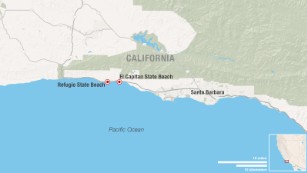
An oil spill contaminates Refugio and El Capitan State Beaches.
EXPAND IMAGE
Houston-based Plains All American Pipeline estimated up to 105,000 gallons may have spilled, based on the typical flow rate of oil and the elevation of the pipeline.
The pipeline is underground, so it will take a few days to determine how much crude oil was actually spilled, said McMichael.
McMichael said an estimated 21,000 gallons of crude had gone into the Pacific Ocean. The rest was spilled on land.
Fined for prior oil spills
Plains All American Pipeline violated federal environmental violations
10 times between 2004 and 2007, when about 273,420 gallons of crude oil
were discharged into waters or shorelines in Texas, Louisiana, Oklahoma
and Kansas, the EPA said.
Most of the spills were caused by corrosion on pipe, the EPA said.
The
oil company agreed to pay a $3.25 million civil penalty and spend $41
million to upgrade 10,420 miles of crude oil pipeline operated in the
United States, the EPA said in 2010.
The apology
Plains All American Pipeline Chairman Greg Armstrong said he was deeply sorry for the spill.
"We
apologize for the damage that has been done to the wildlife and to the
environment, and we're very sorry for the disruption and inconvenience
that it has caused the citizens and visitors of this area," he said.
Armstrong said Plains was given permission to work through the night on the cleanup.
The
spill took place on its Las Flores-to-Gaviota pipeline, which was built
in 1987. The company said the leaked oil reached a culvert, and it
spilled into the Pacific Ocean from there. The culvert was later blocked
to stop the flow.
Armstrong said the pipeline had been recently inspected.
The cleanup
California mobilized crews from multiple state agencies to tackle the mess.
"I
can tell you we have more than 100 people responding in the EOC
(Emergency Operations Center) right now," said Brad Alexander, a
spokesman for the California Office of Emergency Services. "They have
several ships, scooping up oil and assessing the boundaries on the
water," he said.
The California
Department of Fish and Wildlife also was on the scene with nine vessels
collecting oil and containing the spill, according to its Twitter feed.
More than 70 of its people were in the field collecting oil and
protecting shorebirds.
It is painstaking work.
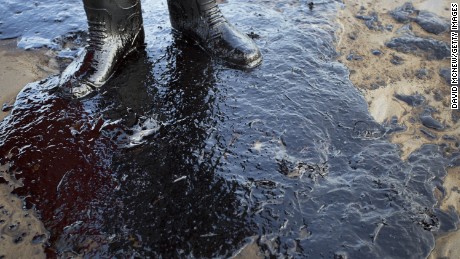
Workers dressed in white protective suits raked up balls of tar from the shore, sand and rocks and put them into plastic bags.
The
Coast Guard has seven ships in the area, laying down protective booms,
skimming the water and collecting the oil to prevent it from spreading.
The threat
The cleanup was little consolation to environmental groups.
"We
continue to see it's not a question of if there is going to be an oil
spill but when?" said Maggie Hall from the scene of the spill. She is
an attorney with the Environmental Defense Center.
"It's a constant threat. And as you can see, the cleanup is not easy."
The
Environmental Defense Center's executive director, Owen Bailey, said
there were still a number of unanswered questions, such as why there was
no automatic shutoff on the pipeline and why the early response was not
more successful in halting the spill.
"The
fact is that oil development is innately risky," Bradley said. "We need
to realize that allowing these dangerous industrial operations in our
most sensitive environments will inevitably lead to oil spills -- the
most predictable of accidents."
A big concern is the environment around Refugio State Beach.
There are shorebirds that live in the area -- the snowy plover
and least tern nest on sandy beaches, and the cormorant can dive deep
to find food. Officials want to make sure that none of the birds or
other wildlife suffers damage from the spill.
"An
aggressive and effective cleanup response to the spill is underway,"
said Mark Crossland with the California Department of Fish and Wildlife.
"It will go on as long as necessary.
"Every effort will be made to minimize the damage to the environment, including taking care of oiled wildlife," said Crossland.
Fishing and shellfish harvesting have been closed in Santa Barbara County until further notice.
There's also concern about the next park down the road, El Capitan State Beach, with sandy shores and rocky tide pools.
Thousands
of people are expected to flock to El Capitan over the Memorial Day
weekend. It's on another unspoiled stretch of coast. Visitors go there
to kayak, hike and picnic