May 17, 2015
 FORT
MYERS, FLORIDA
A Coast Guard crew rescued six adults and three children
from a 25-foot recreational boat taking on water in the vicinity of the
Cape Coral Bridge, Sunday.
A member of Seatow Fort Myers contacted Coast Guard Station Fort
Myers Beach at 4:15 p.m., reporting the incident and stated the owner of
the boat was requesting Coast Guard assistance.
A 29-foot Response Boat — Small II crew from the station arrived on
scene, removed the people from the vessel, assisted the owner in
dewatering the vessel and towed it to Everest Park Marina.
There were no injuries reported.
“Boating season is upon us, and when you’re on the water, anything
can happen,” said Chief Warrant Officer Bob Swanson, a search and rescue
coordinator at the sector. “We strongly recommend contacting your local
Coast Guard Auxiliary for a free vessel safety check, file a float plan
and wear your life jackets in case you find yourself in a deteriorating
situation.
In addition, the Coast Guard unveiled a new smartphone app, CG
Mobile, which provides mariners with boating safety information,
including float plans, safety equipment, weather and safety checks. For
more informations of CG Mobile please click here.
FORT
MYERS, FLORIDA
A Coast Guard crew rescued six adults and three children
from a 25-foot recreational boat taking on water in the vicinity of the
Cape Coral Bridge, Sunday.
A member of Seatow Fort Myers contacted Coast Guard Station Fort
Myers Beach at 4:15 p.m., reporting the incident and stated the owner of
the boat was requesting Coast Guard assistance.
A 29-foot Response Boat — Small II crew from the station arrived on
scene, removed the people from the vessel, assisted the owner in
dewatering the vessel and towed it to Everest Park Marina.
There were no injuries reported.
“Boating season is upon us, and when you’re on the water, anything
can happen,” said Chief Warrant Officer Bob Swanson, a search and rescue
coordinator at the sector. “We strongly recommend contacting your local
Coast Guard Auxiliary for a free vessel safety check, file a float plan
and wear your life jackets in case you find yourself in a deteriorating
situation.
In addition, the Coast Guard unveiled a new smartphone app, CG
Mobile, which provides mariners with boating safety information,
including float plans, safety equipment, weather and safety checks. For
more informations of CG Mobile please click here.
 PORTLAND,
OREGON
The Coast Guard detained the 600-foot motor vessel Ikan Sudip,
after significant environmental and safety violations were found during
an inspection in Astoria, Saturday.
Vessel inspectors from the Coast Guard Marine Safety Unit in Portland
discovered the discrepancies during an inspection of the
Panamanian-flagged motor vessel, which was built in 2004.
“The Ikan Sudip’s safety and environmental conditions posed an
unacceptable threat to our waterways,” said Capt. Dan Travers, Coast
Guard Sector Columbia River Commanding Officer and Captain of the Port
for Oregon and Southern Washington. “We are focused on ensuring that all
issues are corrected by fixing the discrepancies and removing the risks
found on board the vessel.”
While inbound to U.S. waters, Monday, the vessel experienced two
separate fuel related propulsion losses within 24 hours, which
completely disabled the vessel at sea. After regaining minimal
propulsion with temporary repairs, the captain of the port expelled the
vessel from U.S. waters and prohibited its re-entry until the main
engine’s fuel system was properly repaired.
Vessel crewmembers and propulsion machinery technicians corrected the
fuel system issues on Saturday, and the vessel was allowed to enter the
Columbia River while under escort by the towing vessel Somer S. Vessel
inspectors from the MSU boarded the vessel while anchored in Astoria and
conducted a safety and security inspection where they identified
multiple equipment discrepancies and environmental violations.
The violations found included a failure to use engineering procedures
required by U.S. and international law, which guide the vessel’s crew
through fuel management and vessel propulsion requirements. Other
discrepancies were a lack of crew familiarity with emergency rescue
drills, deficient structural fire boundary doors designed to prevent the
spread of a fire and inoperable lifesaving equipment. Additionally,
severe corrosion was found throughout the vessel’s machinery piping
systems posing a significant threat to the vessel and crew.
Coast Guard vessel inspectors are working with the Ikan Sudip’s flag
state and Nippon Kaiji Kyokai, the vessel’s classification society
responsible for certification of the vessel’s construction and
engineering, Grace Hawk Shipping S.A. the vessel’s owner, EikoKisen Co.
Ltd. the vessel’s managing company and the vessel’s crew to make the
essential repairs.
“Eliminating substandard vessels from U.S. waters is critical to
ensuring our waterways are protected,” said Travers. “Only after the
vessel crew corrects its deficient safety management system and critical
vessel equipment will we allow it to return to commercial service.”
Ikan Sudip is a bulk carrier, which is scheduled to load potash in
Portland and will depart for Brazil after the safety violations have
been corrected.
PORTLAND,
OREGON
The Coast Guard detained the 600-foot motor vessel Ikan Sudip,
after significant environmental and safety violations were found during
an inspection in Astoria, Saturday.
Vessel inspectors from the Coast Guard Marine Safety Unit in Portland
discovered the discrepancies during an inspection of the
Panamanian-flagged motor vessel, which was built in 2004.
“The Ikan Sudip’s safety and environmental conditions posed an
unacceptable threat to our waterways,” said Capt. Dan Travers, Coast
Guard Sector Columbia River Commanding Officer and Captain of the Port
for Oregon and Southern Washington. “We are focused on ensuring that all
issues are corrected by fixing the discrepancies and removing the risks
found on board the vessel.”
While inbound to U.S. waters, Monday, the vessel experienced two
separate fuel related propulsion losses within 24 hours, which
completely disabled the vessel at sea. After regaining minimal
propulsion with temporary repairs, the captain of the port expelled the
vessel from U.S. waters and prohibited its re-entry until the main
engine’s fuel system was properly repaired.
Vessel crewmembers and propulsion machinery technicians corrected the
fuel system issues on Saturday, and the vessel was allowed to enter the
Columbia River while under escort by the towing vessel Somer S. Vessel
inspectors from the MSU boarded the vessel while anchored in Astoria and
conducted a safety and security inspection where they identified
multiple equipment discrepancies and environmental violations.
The violations found included a failure to use engineering procedures
required by U.S. and international law, which guide the vessel’s crew
through fuel management and vessel propulsion requirements. Other
discrepancies were a lack of crew familiarity with emergency rescue
drills, deficient structural fire boundary doors designed to prevent the
spread of a fire and inoperable lifesaving equipment. Additionally,
severe corrosion was found throughout the vessel’s machinery piping
systems posing a significant threat to the vessel and crew.
Coast Guard vessel inspectors are working with the Ikan Sudip’s flag
state and Nippon Kaiji Kyokai, the vessel’s classification society
responsible for certification of the vessel’s construction and
engineering, Grace Hawk Shipping S.A. the vessel’s owner, EikoKisen Co.
Ltd. the vessel’s managing company and the vessel’s crew to make the
essential repairs.
“Eliminating substandard vessels from U.S. waters is critical to
ensuring our waterways are protected,” said Travers. “Only after the
vessel crew corrects its deficient safety management system and critical
vessel equipment will we allow it to return to commercial service.”
Ikan Sudip is a bulk carrier, which is scheduled to load potash in
Portland and will depart for Brazil after the safety violations have
been corrected.
Published in Oil Industry News on Sunday, 17 May 2015
 An
oil leak that occurred when an offshore platform toppled during
Hurricane Ivan in 2004 has continued to spill oil into the Gulf of
Mexico – and could keep leaking for another 100 years, according to
documents obtained by The Associated Press.
The documents show that a century-long leak could occur if nothing is done to address the problem.
The
platform owners, Taylor Energy Company, tried to work with Department
of the Interior "to resolve financial obligations for the leak" worth
hundreds of millions of dollars, which were set aside to pay for
leak-related work.
However, the company has tried to cover up the
extent of the damage to the ecology of the Gulf, and the government has
been unwilling to renegotiate the costs to the Taylor. Instead, it
ordered them to do more work on the matter.
"There is still more
that can be done by Taylor to control and contain the oil that is
discharged," said an Interior Department fact sheet obtained by AP.
It
is suspected, by officials, that the leak is coming from at least one
of 25 wells that were buried under mounds of sediment from an underwater
mudslide that was triggered by waves during Hurricane Ivan. The company
ordered new wells drilled in order to plug nine of the wells that were
suspected could leak oil, but company officials cited experts to argue
that the best course of action is do no further drilling because of
risks.
In reviewing more than 2,300 Coast Guard pollution reports
from 2008 onwards, the AP found that since September 1, 2014, the leaks
have been getting greater. When they approached the Coast Guard about
the uptick, reporters were provided with new estimates showing leaks 20
times greater than what the company claimed.
Taylor claimed the
site was leaking 4 gallons per day, but revised Coast Guard estimates
show "shines as large as 1.5 miles wide and 14 miles long." They also
show daily oily discharges ranging from 42 gallons to as high as 2,300
gallons, with a daily average of 84 gallons.
AP said the company
is now down to one full-time employee after its founder died, and it
sold all its offshore leases and oil and gas interests in 2008.
A spokesman for the company declined to comment to AP on Friday.
Source: rt.com
An
oil leak that occurred when an offshore platform toppled during
Hurricane Ivan in 2004 has continued to spill oil into the Gulf of
Mexico – and could keep leaking for another 100 years, according to
documents obtained by The Associated Press.
The documents show that a century-long leak could occur if nothing is done to address the problem.
The
platform owners, Taylor Energy Company, tried to work with Department
of the Interior "to resolve financial obligations for the leak" worth
hundreds of millions of dollars, which were set aside to pay for
leak-related work.
However, the company has tried to cover up the
extent of the damage to the ecology of the Gulf, and the government has
been unwilling to renegotiate the costs to the Taylor. Instead, it
ordered them to do more work on the matter.
"There is still more
that can be done by Taylor to control and contain the oil that is
discharged," said an Interior Department fact sheet obtained by AP.
It
is suspected, by officials, that the leak is coming from at least one
of 25 wells that were buried under mounds of sediment from an underwater
mudslide that was triggered by waves during Hurricane Ivan. The company
ordered new wells drilled in order to plug nine of the wells that were
suspected could leak oil, but company officials cited experts to argue
that the best course of action is do no further drilling because of
risks.
In reviewing more than 2,300 Coast Guard pollution reports
from 2008 onwards, the AP found that since September 1, 2014, the leaks
have been getting greater. When they approached the Coast Guard about
the uptick, reporters were provided with new estimates showing leaks 20
times greater than what the company claimed.
Taylor claimed the
site was leaking 4 gallons per day, but revised Coast Guard estimates
show "shines as large as 1.5 miles wide and 14 miles long." They also
show daily oily discharges ranging from 42 gallons to as high as 2,300
gallons, with a daily average of 84 gallons.
AP said the company
is now down to one full-time employee after its founder died, and it
sold all its offshore leases and oil and gas interests in 2008.
A spokesman for the company declined to comment to AP on Friday.
Source: rt.com

Published in Oil Industry News on Sunday, 17 May 2015
Hundreds of people in kayaks and small boats have staged a protest in
the north-western US port city of Seattle against oil drilling in the
Arctic by the Shell energy giant.
Paddle in Seattle was held by activists who said the firm's drilling would damage the environment.
It comes after the first of Shell's two massive oil rigs arrived at the port.
The firm wants to move them in the coming months to explore for oil off Alaska's northern coast.
Earlier this week, Shell won conditional approval from the US Department of Interior for oil exploration in the Arctic. These are the same government "officials" who "oversaw" the BP drilling at the Deepwater Horizon. We know how well that turned out to be. So, breath a sigh or relief, with these clowns in charge, we and the environment are in good hands.
The Anglo-Dutch company still must obtain permits from the federal government and the state of Alaska to begin drilling.
It says Arctic resources could be vital for supplying future energy needs.
 'The only safe place'
The flotilla of kayaks, canoes, sailboats and paddle boats gathered near the 400ft (122m) tall Polar Pioneer drilling rig.
A solar-powered barge - The People's Platform - joined the protesters, who chanted slogans and also sang songs.
"This weekend is another opportunity for the people to demand that
their voices be heard," Alli Harvey, Alaska representative for the
Sierra Club's Our Wild America campaign, was quoted as saying by the
Associated Press news agency.
"Science is as clear as day when it comes to drilling in the Arctic -
the only safe place for these dirty fuels is in the ground.''
The protesters later gathered in formation and unveiled a big sign which read "Climate justice now".
They mostly stayed outside the official 100-yard (91m) buffer zone
around the Polar Pioneer, the Seattle Times newspaper reports.
Police and coastguard monitored the flotilla, saying it was peaceful.
The demonstrators are now planning to hold a day of peaceful civil
disobedience on Monday in an attempt to shut down Shell operations in
the port, the newspaper adds.
The port's Terminal 5 has been at the centre of a stand-off between
environmentalists and the city authorities after a decision earlier this
year to allow Shell use the terminal as a home base for the company's
vessels and oil rigs.
Shell stopped Arctic exploration more than two years ago after problems including an oil rig fire and safety failures.
The company has spent about $6bn (£3.85bn) on exploration in the Arctic
- a region estimated to have about 20% of the world's undiscovered oil
and gas.
Source: www.bbc.co.uk
'The only safe place'
The flotilla of kayaks, canoes, sailboats and paddle boats gathered near the 400ft (122m) tall Polar Pioneer drilling rig.
A solar-powered barge - The People's Platform - joined the protesters, who chanted slogans and also sang songs.
"This weekend is another opportunity for the people to demand that
their voices be heard," Alli Harvey, Alaska representative for the
Sierra Club's Our Wild America campaign, was quoted as saying by the
Associated Press news agency.
"Science is as clear as day when it comes to drilling in the Arctic -
the only safe place for these dirty fuels is in the ground.''
The protesters later gathered in formation and unveiled a big sign which read "Climate justice now".
They mostly stayed outside the official 100-yard (91m) buffer zone
around the Polar Pioneer, the Seattle Times newspaper reports.
Police and coastguard monitored the flotilla, saying it was peaceful.
The demonstrators are now planning to hold a day of peaceful civil
disobedience on Monday in an attempt to shut down Shell operations in
the port, the newspaper adds.
The port's Terminal 5 has been at the centre of a stand-off between
environmentalists and the city authorities after a decision earlier this
year to allow Shell use the terminal as a home base for the company's
vessels and oil rigs.
Shell stopped Arctic exploration more than two years ago after problems including an oil rig fire and safety failures.
The company has spent about $6bn (£3.85bn) on exploration in the Arctic
- a region estimated to have about 20% of the world's undiscovered oil
and gas.
Source: www.bbc.co.uk
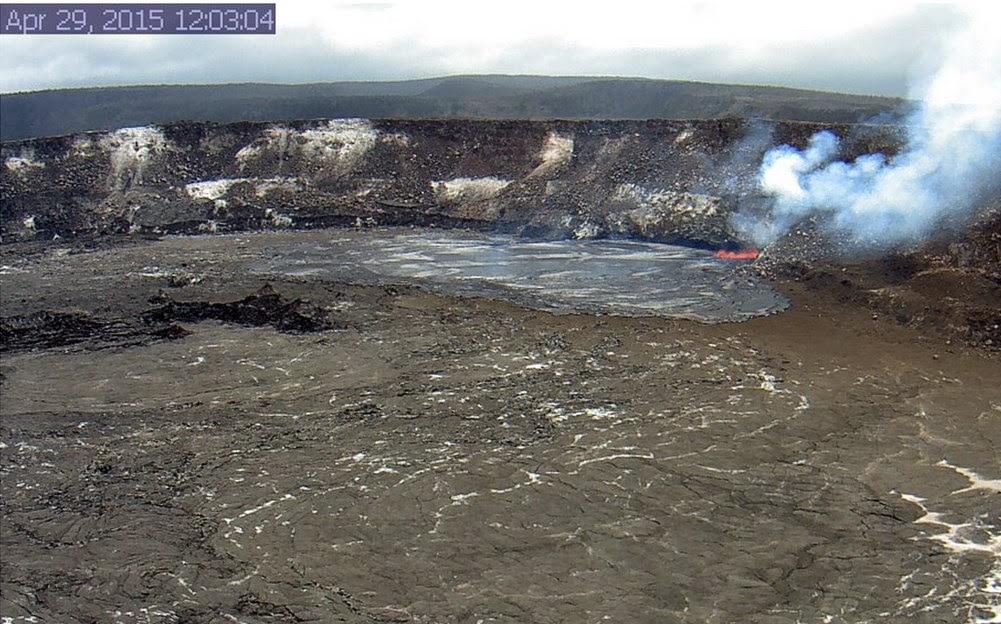
 A rockfall at the Halemaumau Crater triggered an explosion on Tuesday morning (Image source: USGS)
 April 29 (Image source: USGS)
 April 26, Kilauea (Image source: USGS)
KILAUEA VOLCANO, BIG ISLAND (HawaiiNewsNow)
The lava lake is rising in Halema'uma'u Crater and
it's putting on quite the show for visitors who have been able to see
spattering above the crater rim and the loud popping of rocks as the
crater walls expand with heat.
USGS geologists with the Hawaiian
Volcano Observatory say the Kilauea summit lava lake level has been at
or near the rim of the Overlook Crater -- the smaller crater within the
Halema'uma'u Crater -- since Tuesday. At 9:40 p.m. Tuesday, the lava
briefly overflowed onto the floor of the Halema'uma'u Crater. It then
overflowed again at 2 a.m. and then at 8 a.m. Wednesday.
Since then,
the flows have been brief and slowing down as the lava lake level fell
and lava subsided back into the Overlook Crater. No change in lava
spattering or surface circulation patterns have been seen.
The
recent overflows have built up the rim of the Overlook Crater roughly 4
yards above the floor of the Halema'uma'u Crater, geologists said. On
Friday morning, the lava level was slightly higher and very close to the
rim of the Overlook Crater.
The USGS said based on similar lava
lake activity at Halema'uma'u in the 1800s and early 1900s, the current
overflows are likely to continue intermittently.
A rockfall from
the wall of the Halema'uma'u Crater Tuesday morning also triggered an
explosion of spatter and smaller particles. HVO geologists said the
explosion deposited a large amount of spatter around the closed visitor
overlook.
"There was a lot of spattering that visitors are able
to see from the Jaggar Museum observation deck and also a lot of
rumbling sounds as the crater walls heat up and the rocks fall into that
roiling lava lake below. After the sun sets and the darkness starts to
come in, that dramatic glow from the lava lake casting it's reflection
on the clouds and on the plume of gas and ash coming out of there -- it
is just super dramatic and beautiful. Everybody is just super happy to
see this. The action isn't always like this so the people who are lucky
enough to be here right now are really in for a treat this evening,"
said Jessica Ferracane, Hawaii Volcanoes National Park spokesperson.
Dozens,
many of them local residents gathered at the Jaggar Museum overlook for
the past couple of evenings to catch the breathtaking show. National
Park Services said Monday visitors waited up to 30 minutes or longer
just to park. In response, park rangers will be directing vehicles to
park at the Kilauea Military Camp ball field. From there, visitors can
hike to the Jaggar Museum observation deck, the closest and best vantage
point to see the lava lake.
“Visitors should come prepared to
ensure a safe and enjoyable park experience,” said Superintendent Cindy
Orlando. “We encourage people to avoid peak hours, and arrive after 10
p.m. and before 4 a.m. if possible, or they will likely wait in line for
parking. The park remains open 24 hours a day,” she said.
Tips for an optimal viewing experience:
- Be
prepared to hike one mile each way between Kilauea Military Camp ball
field and the Jaggar Museum observation deck on Crater Rim Trail.
- Wear sturdy closed-toe shoes, bring rain gear, water, binoculars, a flashlight, and extra batteries.
- Carpool if possible to reduce the number of vehicles in the parking areas. As a courtesy to other visitors, no “tailgating” in the Jaggar Museum or Kilauea Overlook parking lots.
- Choose another picnic location so others have a chance to view the eruption.
- To
observe viewing and weather conditions, monitor the USGS Hawaiian
Volcano Observatory webcams. The KI camera provides a panoramic view of
Halema‘uma‘u Crater from HVO.
- High levels of dangerous sulfur
dioxide (SO2) gas and volcanic ash can be blown over Jaggar Museum by
southerly winds. These gases are a danger to everyone, particularly to
people with heart or respiratory problems, young children and pregnant
women.
HVO scientists say it's unclear whether the lake will continue to rise. They say it cycles through filling and falling.
In
the meantime, Kilauea Volcano's East Rift Zone lava flow continues to
feed widespread breakouts northeast of Pu'u 'O'o. The front of the
breakout that is farthest downslope is about five miles from the vent
and doesn't pose any immediate threat to any area communities.