MEC&F Expert Engineers

Wednesday, April 29, 2015

Maersk: Regrettably we’ve experienced a number of fatalities in our operations in the past year. There is no excuse for serious or fatal workplace injuries, and we are urgently working towards an incident-free operation.

Cost Cuts Should Not Affect Safety, Maersk CEO says

Published in Oil Industry News on Tuesday, 28 April 2015

Graphic for Cost Cuts Should Not Affect Safety, Maersk CEO says in Oil and Gas News
Maersk launches its Global Safety Day, engaging employees throughout the Group in discussions of how to support the Group’s safety awareness.
The Global Safety Day coincides with the World Day for Safety and Health at Work, an annual international campaign organized by the United Nation’s International Labour Organization.

According to Maersk, employees at sea and onshore have the opportunity to participate in a range of activities, including town halls, safety workshops and online campaigns. The event line-up marks the first-ever Maersk Group Global Safety Day where all Maersk business units take collective action.

“While we operate in challenging and sometimes harsh work environments, it is our responsibility to ensure that our employees return safely to their homes and families after work. That focus is central to the value Constant Care and defines the way we do business,” says Group CEO Nils S. Andersen.

“Regrettably we’ve experienced a number of fatalities in our operations in the past year. There is no excuse for serious or fatal workplace injuries, and we are urgently working towards an incident-free operation. We fundamentally believe that every accident can be prevented.”  Yes, folks.  After these people had all these accidents and fatalities decided to perform this lip service so that they reduce their insurance premiums.

Cost-cutting not contradictory to safety

Given the volatility of the oil price, the oil-related businesses in particular have instigated a cost-reduction mindset, Maersk said. However, according to its CEO, this does not mean compromising on safety.  Of course this is just lip service.

“Contrary to popular belief, cost leadership and safety go hand-in-hand. We can only streamline and improve performance if we take a structured, well-planned approach, and that means prioritizing safety. Our license to operate and continue executing on strategy simply depends on it,” Nils S. Andersen says.

Safety leadership

One key to safety is leadership, whatever this means. It is not enough to set up guidelines and procedures. It is up to the management teams on the ground to ensure employees understand they risk their lives if the procedures are not followed.  This is not leadership, it is called training the employees, taking time to do the tasks properly and establish well-thought and previously-tested/practiced emergency procedures.

“Every business has invested in safety initiatives to address individual challenges and progress toward the goal of zero incidents. APM Terminals, for example, faces unique challenges related to the high number of outside contractors, truckers and suppliers coming in and out of its terminals. 

The business is focused on managing the safety practices of outside contractors. It has also, like Maersk Drilling and Svitzer, adopted a principle of empowering all employees, regardless of rank, to stop unsafe operations,” says Bent Nielsen, Head of Marine Standards in Svitzer who has been coordinating campaign efforts on behalf of the Sustainability Council.  Of course this is BS, as a company need to show that it can deliver on safety and not merely pass the buck to the poor trained workers.

The Group CEO also encouraged employees to bring their good working habits home with them.

“While working at Maersk, you enter the tradition of taking care of one another. With this year’s umbrella theme for Global Safety Day, ‘Safe at Work – Safe at Home,’ I urge all our employees across the Group to focus on safety as a priority and to create environments where safety is deeply-rooted in behaviour, performance and company culture – whether at home or at work.”
Source: www.offshoreenergytoday.com


Maersk Victory
Rig:

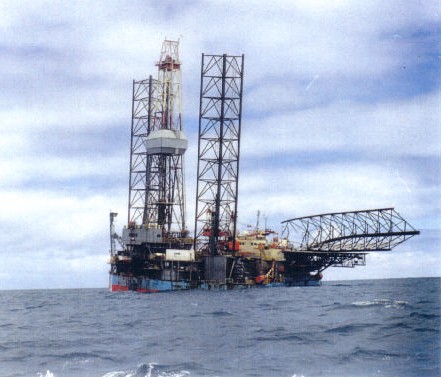
Maersk Victory Jack-Up

Date:

16 Nov 1996

Location:

Gulf Saint Vincent, South Australia

Operator:

Apache Energy Ltd for Canyon (Australia) P/L

Introduction

The Ocean Victory jack-up was a type 300C-35, constructed by Mitsui Ocean Development & Engineering Co. Ltd, Japan, and delivered in August 1981. From 1981, the rig worked in the Persian Gulf in a number of locations offshore UAE and Qatar. In October 1986, the rig suffered explosion and fire damage to the aft port corner and to legs #2 and #3 after an air attack during the Iran/Iraq war. It was transferred to Australia in April 1986 and worked in the North West Shelf from April to Oct 1986 before a dry tow on the Super Servant 3 relocated the rig to South Australia in November 1996.

1996 Punch-Through

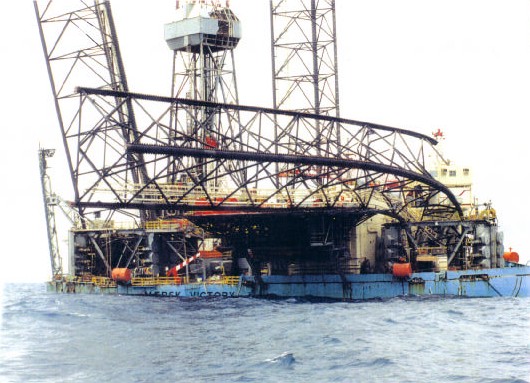
Once offloaded from the Super Servant 3, the Maersk Victory was towed onto location by the Massive Tide, with the Canning Tide sailing alongside in support. En-route, the position surveyor noticed the absence of a site survey on the rig and attempts were made to have one made available. Once on location in the early hours of 16 Nov 1996, the legs of the Maersk Victory were jacked down and the rig 'walked' onto location, with the help of the Massive Tide. The first attempt at jacking-up at 0630 hours aimed to achieve the 2m preload airgap, which resulted in the settling of leg #2 by 2m. The rig was then jacked down until level and then successfully jacked back up to a 2m airgap.
After waiting for the arrival of a helicopter at 0825 hours, preloading continued from 1000 hours. One third of the way through the pre-loading, at 1032 hours, the rig suddenly listed down to starboard, causing the sea to wash over the deck. After two or three punches, the rig stabilised and unsuccessful attempts were made to jack the rig down. Inspections revealed that legs #1 and #2 were severely damaged along their lengths. At 1035, the rig was evacuated using the fast rescue craft of the Canning Tide. In the afternoon, the rig was made watertight and the preload water was dumped.
Extensive damage to all three of the jack-up's legs resulted in divers cutting the hull free of the legs to allow the hull to be towed back to a safe anchorage near Port Adelaide. The legs of the rig were subsequently salvaged by Dockwise using the Dock Express 10 over December 1996 and January 1997 and delivered, along with the hull, to the Far East Levingston Ship Building company in Singapore for repairs.

Findings

The South Australia Department of Mines and Energy Resources (MESA) undertook an investigation in May 1997 and determined that the immediate cause of damage was the failure of the sub-sea sediments beneath the rig. There was no evidence of structural failure of the Ocean Victory contributing to the incident. The report concluded that there was a failure to fully evaluate the risks of a new drilling location, a failure to fully evaluate the geotechnical data of the sub-sea sediments with particular reference to the load bearing capacity of the sub-sea sediments, and a failure in management systems and procedures for locating the rig.

Toying with Disaster: BP’s Oil Hunt Off the Australia Coast is Causing Fear of Another 'Deepwater Horizon'


Published in Oil Industry News on Tuesday, 28 April 2015

Graphic for BP’s Oil Hunt Off the Australia Coast is Causing Fear of Another 'Deepwater Horizon' in Oil and Gas News
Five years after the Gulf of Mexico oil spill poured millions of barrels of crude into the sea, BP Plc is being challenged over its hunt for oil in the pristine waters off southern Australia.

Just over a year before the U.K.-based company has said it expects to start drilling, environmentalists say the company hasn’t yet disclosed its full emergency-response plans for a potential spill in the Great Australian Bight, home to about 18 threatened species from whales to turtles.

BP’s initial models show a less than 10 percent chance that a worst-case incident would lead to oil threatening areas where whales are likely to feed. It’s clear the project will face significant scrutiny before drilling begins.

“The Gulf of Mexico scenario was an absolute disaster, but the stakes are much higher out here,” said Peter Owen, the Wilderness Society’s South Australia director. “This is an undeveloped, non-industrialized part of the world, and the risks are high. It’s very deep, very rough and very remote.”

BP said that it has “the technological capability and expertise to safely explore the Great Australian Bight,” according to an e-mailed statement. The company had initially planned to begin drilling in early 2016 and pushed that out because of potential delays with the rig.

Unique Species

More than 85 percent of species in the Bight aren’t found anywhere else, according to Australia’s national science agency, the Commonwealth Scientific & Industrial Research Organization. Species in the Bight include the southern right, sperm and blue whales as well as sea lions and sharks.

BP estimated last year it would spend more than $1 billion ($785 million) to drill 400 kilometers (250 miles) west of Port Lincoln, in a region it describes as “pretty much the last big unexplored basin in the whole world.”

About 250 kilometers to the north, endangered southern right whales gather to give birth, drawing visitors to cliff-top lookouts on the nearby coast.

BP is working with Statoil ASA and plans to drill in waters as deep as 2,500 meters (8,200 feet). The Bight is a “hostile” place to work, according to BP’s website. Waves that reach 10 meters in height are comparable to conditions in the North Sea, and will happen more often.

They aren’t the only companies planning to drill in the Bight. Chevron Corp. won acreage in the region in 2013 and proposed spending almost A$500 million. Murphy Oil Corp. and Santos Ltd. also have permits to explore.

Elephant Territory

The prize could be huge.

The Bight has the potential for a string of discoveries of about 100 million barrels of oil, said Barry Goldstein, executive director of energy resources for South Australia’s state government.

“It’s got to be elephant-hunting country,” he said, using the term often used for discoveries with at least half a billion barrels of oil.

BP’s offshore efforts in Australia call up memories of the April 2010 blowout of the Macondo well off the coast of Louisiana. The worst spill in U.S. history killed 11 people aboard the Deepwater Horizon drilling rig.

The company expects to submit its environmental-protection plans to Australian regulators and release them publicly later this year. New deepwater drilling operations must have access to capping equipment and have plans for relief wells. They must also demonstrate that oil-spill contingency plans take account of the risks, BP said.

Spill Preparedness

“BP’s own requirements for oil spill preparedness, response planning and crisis management incorporate what we have learned over many years of operation, and specifically from the Deepwater Horizon accident,” the company said.

In a worst case scenario, without any response, a spill would result in as much as 805 metric tons of oil hitting about 100 kilometers of shoreline, according to a BP presentation. It predicted a less than 10 percent chance of oil reaching waters where whales feed and a less than 7 percent probability it would hit the coast.

Falling Costs

Drilling next year may be well timed. Global exploration costs are forecast to drop by a third in 2016 as oil-services companies reduce fees to win contracts, according to the consulting firm Wood Mackenzie Ltd. BP declined to comment on expected costs in Australia.

BP is curbing investment in other regions after oil prices slumped. Chief Executive Officer Bob Dudley said in February it could be a long time before oil returns to $100 a barrel.

In the Bight, the company is fulfilling a commitment to drill when it won the permits, said Graeme Bethune, CEO of the consulting firm EnergyQuest in Adelaide, Australia.

“Companies have to plan a long way ahead,” he said. “If you are first into a completely new basin, and you are successful, that’s terrific.”

The country is strengthening drilling regulations. It formed the National Offshore Petroleum Safety and Environmental Management Authority in 2012, after the Gulf of Mexico disaster and the 2009 Montara spill in the Timor Sea that’s considered one of Australia’s worst oil spills.

“No question, environmental protection comes first,” said South Australia’s Goldstein. “The drilling programs are eminently manageable, but you’ve got to watch it like a hawk.”

Get these clowns off our waters.   Our quality of the environment is much more important than the oil.

Source: www.bloomberg.com

Body of one of the 5 missing Dauphin Island Regatta boaters in Mobile Bay located


Hoist Ops 

MOBILE, ALABAMA

A body was recovered in the vicinity of an offshore gas platform in Mobile Bay, earlier today.

A Good Samaritan discovered the body while fishing in the area, and alerted first responders who recovered the individual.

The body was brought to Coast Guard Station Dauphin Island.

The Coast Guard and the Alabama Law Enforcement Agency have confirmed this person is one of the individuals missing from the regatta.

Model Employer: Hotel soap and shampoo manufacturer faces fines of nearly $104K for exposing employees to dangerous chemical and fire hazards. OSHA finds Marietta Corp. and its staffing agency violated safety standards

April 28, 2015


SYRACUSE, N.Y. – A leading maker of soap and shampoo for hotels and retail sale exposed workers to chemical and fire hazards and blocked emergency exit routes, the U.S. Department of Labor's Occupational Safety and Health Administration found in a November 2014 inspection. A company that provided it the manufacturer with temporary employees was cited for chemical-related hazards.

The fact that we found new and repeated hazards shows Marietta Corp. must take worker health and well-being more seriously.
Acting on employee complaints, inspectors visited Marietta Corp. in Cortland and found flammable liquids were not stored or used properly; employees with respirators were not trained or checked medically; and containers with hazardous chemicals were not labeled correctly. Similar hazards were found at the Cortland plant in 2011 and at the company's Chicago facility in 2010.

In addition, inspectors found workers without needed eye and face protection and emergency eyewash stations; employees not trained in the use of dangerous chemicals; and forklift operators who did not receive refresher training. In total, Marietta was cited for three repeat and six serious violations with $103,800 in fines. 

"The fact that we found new and repeated hazards shows Marietta Corp. must take worker health and well-being more seriously," said Christopher Adams, OSHA's area director in Syracuse. "Its employees are at risk of illness, injury or worse from dangerous chemicals, fire and an inability to escape in an emergency."

Select Staffing, the temporary agency that recruits workers for Marietta, received two serious violations with $10,000 in fines proposed. The staffing agency did not provide workers exposed to dangerous chemicals with proper eye and face protection; lacked accessible data sheets for hazardous chemicals; and did not prove that a hazard assessment had been done to determine what protective equipment employees would need.

The citations can be viewed here* and here*. 

In April 2013, OSHA announced an initiative to improve workplace safety and health for temporary workers, who are at increased risk of work-related injury and illness. The initiative includes outreach, training and enforcement to ensure that temporary workers are protected in their workplaces. OSHA and the National Institute for Occupational Safety and Health have issued a "Recommended Practices*" publication that focuses on ensuring that temporary workers receive the same training and protection that existing workers receive.

The companies have 15 business days from receipt of their citations and proposed penalties to comply, meet with OSHA's area director, or contest the findings before the independent Occupational Safety and Health Review Commission.

To ask questions, obtain compliance assistance, file a complaint or report workplace hospitalizations, fatalities or situations posing imminent danger to workers, the public should call OSHA's toll-free hotline at 800-321-OSHA (6742) or the agency's Syracuse Area Office at 315-451-0808.

Under the Occupational Safety and Health Act of 1970, employers are responsible for providing safe and healthful workplaces for their employees. OSHA's role is to ensure these conditions for America's working men and women by setting and enforcing standards, and providing training, education and assistance. For more information, visit http://www.osha.gov.

EXPLOSIONS AND 3-ALARM FIRE RIPS THROUGH QUALITY INN IN FORT BELVOIR, VIRGINIA; HUNDREDS EVACUATED, HOTEL A TOTAL LOSS


APRIL 26, 2015

FORT BELVOIR, VIRGINIA

About 200 people were evacuated overnight after what has been described as “a big explosion” at the Quality Inn Hotel in Fort Belvoir.

“We heard a kaboom and it woke us up. It rocked the town home,” said Nancy Robertson, who lives a half-mile away from the Quality Inn on U.S. 1 in Fairfax County.

Fire crews from all across the county arrived at the hotel n Fort Belvoir at about 2 a.m. Sunday morning, and found the hotel well engulfed in flames.

Fairfax County Assistant Fire Chief John Caussin told WTOP on the scene that the fire looks to have started in a utility room, perhaps an exploded transformer or boiler.  It took hours for firefighters to put out the blaze, which did significant damage to the hotel.

One person was injured and a firefighter suffered minor burns. NBC 4 reported Sunday morning that several people were taken to the hospital for smoke inhalation.

Inspectors say the hotel is a complete loss and crews expect to be on the scene for several more hours as the roof and other parts of the building have collapsed. 200 Displaced guests are at nearby hotels, and Red Cross is on the scene to assist.

Fairfax County Fire Chief Randy Bittinger said several floors in the hotel collapsed; the entire building has been condemned and declared a total loss. Due to the threat of recurring hot spots, Fairfax County will keep a fire truck at the site Sunday night.   

Bittinger said the fire is an electrical fire, it started in the electrical rook in the first floor.  The electrical nature of the fire made it tough to battle. Virginia Power also responded to the scene.