MEC&F Expert Engineers

Friday, April 17, 2015

The Anniversary of Sewol Ferry Disaster that Killed More than 300, most of them Children: The ferry was structurally unsound and overloaded, and many of the children followed instructions to stay in their cabins as the crew scrambled to safety in what was widely criticized as a botched rescue operation.


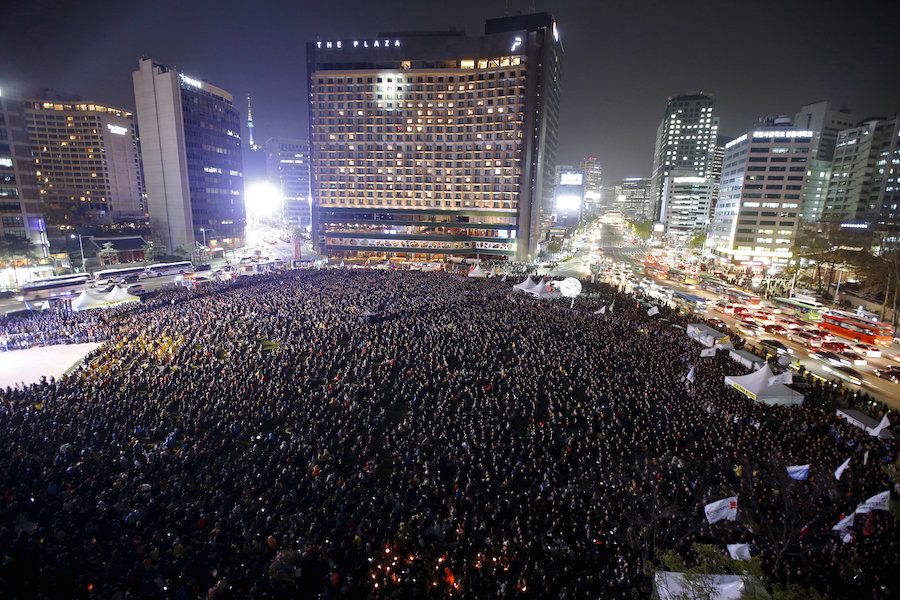
Thousands of mourners attend a rally to commemorate the first anniversary of the Sewol ferry disaster that killed more than 300 passengers, in central Seoul April 16, 2015. REUTERS/Kim Hong-Ji

Thousands of mourners attend a rally to commemorate the first anniversary of the Sewol ferry disaster that killed more than 300 passengers (most of them children), in central Seoul April 16, 2015. REUTERS/Kim Hong-Ji

Reuters
By Ju-min Park and Sohee Kim

ANSAN, South Korea, April 16 (Reuters) – A day of mourning for the 304 victims of the Sewol ferry sinking was overtaken by acrimony on Thursday, as organizers called off a ceremony planned to mark its one-year anniversary to protest against the South Korean government’s response to the disaster.

The main group representing bereaved families said the government had let them down again by failing to announce by the anniversary a decision to raise the ship in hopes of finding the bodies of nine victims still missing.

The group’s leader also cited President Park Geun-hye’s decision not to attend the memorial service as a reason for calling it off. Instead, Park visited the southwestern port of Jindo, which had served as a makeshift morgue when the ferry sank on April 16 a year ago.

“We want to say how disappointed we are that the government and the president have made it impossible for the families to hold this memorial service,” the group’s leader, Yoo Gyoung-geun, announced outside the hangar-like structure that houses a memorial altar for the Sewol victims.
“They are going to have to take responsibility.”

The year since the ferry sank during a routine voyage from Incheon to Jeju island has been one of both grief and anger towards the government for the families of victims.

Park’s prime minister was booed off by an angry crowd when he tried to visit the memorial altar in Ansan, home of Danwon High School, which lost 250 of its students on a class trip.

Park was heckled in Jindo, where she paid her respects at the dock lined with yellow flags carrying messages for the victims against the backdrop of a windy sea.

She said the government would begin preparing to raise the 6,800-tonne submerged ship, her clearest indication of a plan to recover it. The families and political opponents have accused the government of dragging its feet.

“I earnestly ask that we step beyond the pain of the Sewol, overcome the adversity and trial and go on the road of creating a new country,” Park said.
In Ansan, a long line of mourners waited in the rain as an outdoor stage for the memorial and rows of chairs stood empty.

Some family members of the victims and groups supporting their cause held a gathering in central Seoul late in the day, overseen by a heavy police presence which blocked them when they attempted to disrupt traffic and start marching on streets.

The Sewol set off on April 15 last year from Incheon, west of Seoul, for a routine overnight voyage to Jeju with 476 people on board. It capsized while making a sharp turn off Jindo.

It was later found to have been structurally unsound and overloaded, and many of the children followed instructions to stay in their cabins as the crew scrambled to safety in what was widely criticized as a botched rescue operation. 
(Writing by Jack Kim; Editing by Tony Munroe and Paul Tait)
© 2015 Thomson Reuters. All rights reserved.


//-----------------------------------//


A lesson to learn from the ferry disaster in South Korea

Posted in: Criminal Law. 5 Comments
By Chung Pui Ying


Background
On April 26, 2014, Sewol capsized and sank on a routine voyage from Incheon to Jeju Island. 304 out of 476 passengers on board were confirmed dead or missing, and among 250 of them were high school students who went on a school trip.

Causes of the heavy casualties
Firstly, the ferry was overloaded. The loosely-tied cargo exceeded twice the carrying limit, which accelerated the sinking. Investigation also discovered that it was not the first time that Sewol carried excess cargo to earn extra profit.

Secondly, the interior design of Sewol was questionable. Since the vessel was renovated in 2013 to accommodate additional passengers in the top floor, the increased carrying capacity may bring about the possibility of imbalance and top-heavy during voyage.

Besides, the crew’s craven and selfish actions of abandoning the vessel but telling passengers to stay were widely criticized. It is believed that more passengers could have been rescued if the captain could instruct the evacuation properly.

In addition, only an inexperienced third mate was at helm when the accident happened, while the captain was in his bedroom. In fact, a third mate could only navigate solely in a safety sea area. Yet, the accidental sea area was one of the most dangerous waters in South Korea, which meant the captain must accompany and direct the sailor to guide the ship.

Relevant articles and the verdict
Prosecutors sought for death penalty according to Article 250, Criminal Act (Republic of Korea, 2005). It stated that a person who kills another should receive death penalty or life imprisonment or more than five years.

However in November, the captain was only found guilty of negligence and dereliction of duty, but was acquitted of homicide. According to the judge, it could not be proved that he realized his actions were causing more than 300 deaths. He was sentenced to 36 years imprisonment.

Only the chief engineer was culpable of homicide and was sent to jail for 30 years. He was accused of abandoning his two colleagues and not helping them to ask rescuers for help, even though he knew his help would save their lives. The remaining crew was convicted of various charges, sentenced up to 20 years in prison.

The CEO of Chonghaejin Marine, Sewol’s company, was found guilty of allowing the overloading of ferry and approving illegal refurbishment. He was sentenced to 10 years imprisonment.

Nevertheless, the trial was not satisfying for the victims’ parents and relatives. For them, the punishment was not harsh and deterrent enough.

Suggestions
Currently there is no regulation in South Korea to monitor the modification in vessels. Ship companies may make use of this loophole to refit ferry in order to increase carrying capacity. It is suggested that the government could impose clear guidelines and requirements on the modification regarding the safety issue to protect passengers.

The crew’s reaction clearly showed the lack of evacuation training and monitoring of navigation. It is suggested that all crew members should be well-trained with evacuation skills, and educated with morals and ethics. They should be selfless and put passengers’ lives in front of theirs. Besides, the law should be strictly followed. Sanctions should also be imposed on ship companies who disobey the laws (Lawson; Weisbrod, 2005).

Conclusion
In short, this massive ferry disaster is what all we don’t want to see. To avoid the reoccurrence, South Korea government should review its navigation laws and regulations and impose measures to improve the monitoring system. The misbehavior of the crew members should be condemned but imprinted in people’s mind to prevent it from happening again.


References

Borowiec, S. (2014). Nearly 300 missing after South Korea ferry sinks. Los Angeles Times. Retrieved from http://www.latimes.com/world/worldnow/la-fg-wn-south-korea-ferry-hundreds-missing-20140416-story.html

Jindo, M. M. (2014). South Korea ferry disaster: third mate at wheel was navigating route for first time. The Telegraph. Retrieved from http://www.telegraph.co.uk/news/worldnews/asia/southkorea/10776250/South-Korea-ferry-disaster-third-mate-at-wheel-was-navigating-route-for-first-time.html

Lawson, C. T., & Weisbrod, R. E. (2005). Ferry transport: the realm of responsibility for ferry disasters in developing nations. Journal of Public Transportation8(4), 17.

McCurry, J. (2014). South Korea ferry verdict: Sewol captain sentenced to 36 years in prison. The Guardian. Retrieved from http://www.theguardian.com/world/2014/nov/11/south-korea-ferry-verdict-sewol-captain-sentenced-to-36-years-in-prison

Park, M. (2014). What went wrong on Sewol? CNN. Retrieved from http://edition.cnn.com/2014/05/15/world/asia/sewol-problems/index.html?iid=article_sidebar

Park, J. M. (2014). South Korea court jails captain of doomed ferry for 36 years. Reuters. Retrieved from http://www.reuters.com/article/2014/11/11/us-southkorea-ferry-idUSKCN0IV0CK20141111

Paula, H., Catherine E. S., Michael, P. (2014). South Korean shipwreck survivors: Passengers told ‘don’t move’ as ship sank. CNN. Retrieved from http://edition.cnn.com/2014/04/16/world/asia/south-korea-sinking-ship-students/

Reuters. (2014). South Korea court sentences ferry operator chief to 10 years in jail. Retrieved from http://www.reuters.com/article/2014/11/20/us-southkorea-ferry-idUSKCN0J40JP20141120

Republic of Korea. (2005). Criminal Act. Retrieved from http://www.acrc.go.kr/file/file.do?command=downFile&encodedKey=MTIxXzE=
5 comments on “A lesson to learn from the ferry disaster in South Korea”

Thank you for your sharing. The incident was with no doubt a tragedy, but also a reminder to all of us that an illegal practice can lead to fatal, irreversible mistakes…
In fact, this incident has revealed an obvious loophole in the regulations on vessels’ safety and the lack of training in evacuation and navigation. Regarding these major problems, the government and the lawmakers are duty-bounded to strengthen and further clarify the existing laws and the respective implementation. Ambiguities have to be eliminated in order to send a clear message to relevant parties about the importance of maritime safety management.
Moreover, training sessions and assessment should be held more regularly so as to keep sailors and cabin crew with updated skills and the readiness to due with any unexpected situations. Unqualified members have to attend make-up courses in order to return to his/her positions. I believe that strict supervision on the overall working attitude will be effective to sieve out irresponsible people such as those who sentenced to imprisonment.
In shorts, without the co-operation between the executive and legislative branches, similar scenarios will not be stopped from happening. Therefore, it’s time for the country to move forward and reshape a secure sea together.

Thank you for your post. This incident showed different problems of South Korea. Citizens, especially parents of victims, were extremely angry about the government and the crew member.
Some of the crew, including the captain, were caught on videotape abandoning ship while the children were told numerous times to stay put in their cabins where they awaited further orders.
In addition to reaction against the actions of the captain and much of the crew of the Sewol, there has been a much wider political reaction to the disaster. Criticism has ranged from anger at the lax regulatory environment which may have contributed to the safety violations that could have sunk the Sewol, to anger about the rescue operations, to anger at Park Geun-hye, the President of South Korea, whose approval ratings have fallen from a high of 71 percent before the disaster to “the 40 percent range” weeks afterwards.
Many parents of the victims of the tragedy have been expressing deep anger at the government, ranging from reportedly berating Prime Minister Jung Hong-won[283] to shouting at President Park Geun-hye, to parents staging protests at the presidential palace itself, partly inflamed by a reported remark by a senior news editor at the government-influenced Korean Broadcasting System that the number of dead in the ferry tragedy was “not many, compared with the number of people killed in traffic accidents each year”.
I think what the government can do is to prevent this incident happen again. Training provided, legislation and regulation can be done better.

Thank you very much for the post which helps to understand outline of Sewol Ferry Sank.
I spent most of my life in South Korea, and had once lived in Ansan, where the victims’ high school is located. After this tragic accident happened, the whole country was utterly devastated, mourned together after the loss of more than 300 lives, mostly high school students. Families of victims exploded with rage and heartbreaking grief. Some people blamed government while others brought charges against sailors and captain. The fact that this accident was entirely preventable made the citizens weighted with sorrow. If Sewol was NOT overloaded, If cargo on the ferry was properly secured, If ferry crews were educated properly on safety protocol, If the captain did not abandon the shop, and if passengers were told to move out of board. Then maybe this catastrophe would have never happened. Sewol ferry sank was not a natural disaster, it was obviously a man-made disaster. For this reason, people who found to have committed faults in the process of trial must have charged with heavy sentence.
I am aware that heavy imprisonment sentence cannot console victims’ families in grief for loss of their beloved children, families. However citizens need to feel that there must be justice in the country after all. We all must remember the time when we lost our friends and families and this must not be veiled by an argument whether the punishment is enough or not. This argument should have dealt separately with our mourning for the victims. I may seem emotional but as a citizen of Korea, I hope this accident will not be forgotten after tens of years. Tragic history must not be repeated and this can only be done by introspection and government effort to correct related laws and regulations.
Reference

Thank you for your post! I realized that the tragedy has raised awareness and concern in the globe.
I agree that the penalty and punishment are not harsh enough especially for the captain, who was acquitted of homicide. I think this judgment somehow having a mean of disrespect to the 300 deaths. Moreover, it is irrational and unfair that the accusation of the captain and chief engineer is indifferent as they were both criminal of the accident. However, instead of exerting the sin to the crew member, the corresponding ship company had the bear most of the responsibilities.
Instead of blaming the criminal, the most important thing to do is to prevent similar tragedy from happening.
Firstly, it is without doubt that captain should be well-trained and highly qualified. Professional evacuating skills should also be taught to all crew members. For the ship company, it is really shameful that having overloaded for earning more profit. Therefore, all ship companies should learn a lesson from this accident and ensure no more overload will be allowed in the future and regular inspection and maintenance are required. For they passengers, they should be taught the means for evacuations when they get on the ship such as watching relevant videos. Lastly, for the government, advertisement can be made to educate general public the evacuating skills and promote the ethical and moral standards.
References:

Thank you Chung Pui Ying for the post which reminds us once more of the tragedy in South Korea that is worth all of us to think about and the lesson we must learn from it. The structure of your post is very well written with clear and concise causes of the incident which made me understand the incident better. All of the causes of the tragedy can definitely be prevented, with tighter regulations on the amount of weight that can be carried on board and the the design of a boat. However the selfish acts of the crew members cannot be prevented and I do agree the sentence they received definitely do not do justice to the families of the thousands of deaths that occurred. It is true that safety procedures have to be done properly, However I think the more serious issue in this accident is the deeply engraved hierarchy system in the Korean culture, from the Confucianism. In the workplace, the workers who are lower in the hierarchy obey the ones who are higher in the rank or with authority and they do not dare to do anything that is against them. Similarly in this tragedy, many passengers obey what the crew members told them, the ones they consider to hold authority, to stay in the boat. However, I am positive about this as I do believe that they will learn from their mistakes after such tragedy that has shaken the nation.

 Source: http://hklawblog.com/2014/11/26/a-lesson-to-learn-from-the-ferry-disaster-in-south-korea/

3 Dockworkers Suffocated While Unloading Coal at Port of Antwerp in Belgium

MV Saga Frontier. Photo: Saga Welco

Three dockworkers were killed last Saturday at the Port of Antwerp after unloading coal from an open hatch cargo ship.

The three workers were reported to have suffocated when they entered the open cargo hold of the Hong Kong-flagged MV Saga Frontier to clean it. The three killed were all said to be experienced dockworkers.

Local media reported Thursday that investigators are looking into the possibility of negligence on behalf of the Captain and crew for not alerting the dockworkers to the presence of toxic gases in the hold.

A statement by International Transport Workers’ Federation President and chair, Paddy Crumlin, said “We can never relax on port safety and accident prevention. Antwerp is a port where health and safety is taken very seriously, and, like the three men’s trade unions, we are confident that a full investigation will take place into what happened and how any resulting lessons can be implemented.”

The 46,550 DWT MV Saga Frontier was built in 2007 and has a total of ten cargo holds with two traveling gantry cranes. The ship is owned by Saga Welco with head offices in Norway.

The ship was still docked at Antwerp as of Thursday night.

LOCAL EMERGENCY RESPONDERS ARE STILL WORKING TO GET THEIR MONEY BACK AFTER THE HAZARDOUS DIMETHYLAMINE CHEMICAL LEAK THAT SHUT DOWN I-90 AT STATE LINE IN FALL OF 2014. THEY ARE ASKING FOR ABOUT $80,000 IN REIMBURSEMENT COSTS.


APRIL 17, 2015

SPOKANE, WASHINGTON

Local emergency responders are still working to get their money back after the hazardous chemical leak that shut down I-90 at State Line in Fall of 2014. They are asking for about $80,000 in reimbursement costs.

People throughout the area reported smelling the toxic fumes. Since then, KREM 2 News has learned the trucking company responsible for hauling that chemical contends the leak never even happened.

"From their perspective only, since we let them drive down the highway the next day, then it wasn't, in fact, a leak," said Andy Hail, the Deputy Fire Chief in Spokane Valley.

Hail has been the point man since last September for documenting the local emergency response to the haz-mat scare that shut down I-90 at State Line.

It detoured traffic for more than 19 hours, while hazardous materials crews worked furiously to fix a leaking valve on tanker truck. It was hauling dimethylamine anhydrous - a highly toxic, flammable chemical that can cause respiratory damage if inhaled. It has a trademark odor of rotting fish.

"That was one of the indicators that we've got product in the atmosphere, because those guys were coming back reeking. And you couldn't get away from it," said Hail.

Hail has now submitted first-hand testimony to McKenzie Tank Lines out of Florida to prove the leak and the emergency response it prompted was real and absolutely necessary.

"I think by the challenge of the evidence that has been provided, they are, in fact saying, this really was a non-event," said Hail.

Hail said he is confident in the evidence he has gathered -- time logs, chemical tests, and witness reports to prove the reimbursement request is valid.

Six separate agencies, including Valley Fire, Spokane Fire, Fairchild Air Force Base, and the Washington DOT are asking for a combined total of about $80,000. Because this was not your typical emergency response, state law clearly says that they are entitled to that reimbursement.

"Most fire situations, most medical situations, even minor hazardous material situations, that is considered the normal expectation of a public safety agency to respond to those, and not seek reimbursement," said Hail. "But this one was different. This one was different."

Local authorities tell me they have submitted all of their evidence to McKenzie Tank Lines. Now, it is up to their attorney to respond, which will dictate the next move.
Source: http://www.krem.com

1 DEAD, 1 INJURED IN WASTE-TO-FUEL CONVERSION PLANT EXPLOSION AT MAGNEGAS IN TAMPA BAY, FLORIDA


APRIL 17, 2015 

TARPON SPRINGS, FLORIDA

Authorities on Friday identified the worker killed during an explosion at a Tarpon Springs waste-to-fuel conversion plant. 

Michael D. Sheppard, 29, of Safety Harbor, was found dead after the blast Thursday afternoon at MagneGas Corp., 150 Rainville Road, according to Tarpon Springs police.

Another MagneGas employee, 41-year-old Eric R. Newell, of Largo, was taken by medical helicopter to Tampa General Hospital for treatment of injuries sustained in the explosion. He was in stable condition, police said.
There was still no details on how the blast occurred.  This facility creates explosive material (mostly methane gas), so obviously something went wrong and the workers ignited gases or there was aleak somewhere that released the explosive gases, mostly methane.

//------------------------//
Authorities say one person is dead following an explosion at a Tampa Bay area gas plant.
Tarpon Springs police say the accidental explosion occurred Thursday afternoon at MagneGas Corp., an alternative energy company.
Officials say one man was found dead, and another was flown to a St. Petersburg hospital with serious injuries. Police weren’t immediately naming the victims. About two dozen other workers were evacuated from the area.
Tarpon Springs Fire Rescue reports the scene is secure. The State Fire Marshal’s Office is investigating the cause of the explosion.
According to the MagneGas website, the company converts liquid waste into a hydrogen-based fuel, which can be used for metal cutting, cooking, heating and powering natural gas bi-fuel automobiles.
“Our deep sympathy goes out to the immediate family, and our thoughts and prayers are with the family and all friends,” MagneGas spokesman Shepard Doniger says, in a prepared statement. “We are grateful for the efforts and immediate actions of the emergency responders. We are working closely with responders and local officials to determine the cause and circumstances surrounding the accident.”
The explosion happened just after 2 p.m. at the warehouse that a subsidiary of MagneGas purchased in 2007 for $700,000, according to property records. The facility was built in 1986, and MagneGas had long outgrown the space. 

Company officials previously announced plans to move to Pinellas Park later this year.
“Our top priority is to the health and safety of these people who, as we said, are considered family,” Doniger says. “We have strived to create a culture of safe, compliant operations. We take this matter very seriously, and are dedicating all the necessary corporate resources to assist in the investigation.”
MagneGas, trades on the Nasdaq using the symbol MNGA.  It reported a loss of $7.2 million, or 23 cents per share, in 2014 on revenue of $1 million, compared to a $6.3 million, or 29 cents per share, loss the year before on revenue of $989,000.

TRAINS TO GET SMARTER, SAFER IN AFTERMATH OF DEADLY CRASHES. CONGRESS MANDATED THE NEW SAFETY SYSTEM, CALLED POSITIVE TRAIN CONTROL, OR PTC, AFTER A DEADLY TRAIN COLLISION IN CHATSWORTH IN 2008 KILLED 25 PEOPLE AND INJURED MORE THAN 100. INVESTIGATORS DISCOVERED THE ENGINEER WAS TEXTING WHILE ON DUTY.


APRIL 16, 2015 

A single Metrolink train bears down on Fullerton after nightfall. Its passengers: dozens of 155-pound sandbags.
The train is among several testing a new wireless technology that promises safer travel in Southern California and across the country. On this night, the sandbags, each stationed where a commuter’s foot would rest, are meant to simulate a load of passengers.

The technology, in the simplest terms, takes control and stops trains when engineers make mistakes, such as ignoring warning signals. Congress mandated the new safety system, called positive train control, or PTC, after a deadly train collision in Chatsworth in 2008 killed 25 people and injured more than 100. Investigators discovered the engineer was texting while on duty.

“It would have definitely prevented an incident like Chatsworth,” Metrolink spokesman Jeff Lustgarten said. One of Metrolink’s trains was involved in the deadly collision.

In 2002, two people were killed and 270 injured in Placentia when a Burlington Northern Santa Fe freight train ran a red signal light and crashed into a stopped Metrolink train. More recently, a train engineer in Spain appears to have been talking on the phone while speeding in a train crash that killed 79 passengers and crew.

Metrolink has spent more than four years and $216 million installing PTC in the 169 trains it operates. Testing on the Orange County line, which started this week, is expected to last three to four weeks.

STARTING IN SUMMER

Orange County lines will likely begin running with PTC by this summer. Other Metrolink lines, like those in Ventura County and the Antelope Valley, are expected to begin operating the new system later this month.

In all, freight and commuter rail companies are spending upward of $10 billion on PTC. Congress is requiring all U.S. train operators to install PTC by the end of the year, although pending legislation could extend that deadline.

But when it comes to rail safety, experts agree that technology can only do so much.

Sitting in a Metrolink train simulator in Union Station in downtown Los Angeles, Jay Ellis pulls back on a throttle. A computer screen to his left shows the train’s speed: 45 mph. That’s too fast, according to a series of real-time calculations made by an array of communications units in the train and along the tracks. They take into account the train’s speed, weight and length and the track’s conditions.

This is PTC at work. Metrolink train engineers are using the simulator to learn the new system.

Ellis points to a flashing yellow warning.

“So if I don’t stop, it’s telling me it will take over in 27 seconds,” says the field operations manager for Metrolink.

In this track maintenance simulation, the computer has calculated to the second when the train must stop to avoid the damaged tracks. PTC, Ellis explains, is meant to prevent engineer errors. Between 2003 and 2012, human error accounted for 38 percent of train accidents, according to Federal Railroad Administration data.

If an engineer operating a PTC-equipped train fails to heed a warning, the system takes over and can shut down the train in time to avert a collision. The engineer’s supervisor is notified, and an investigation ensues.

But these safeguards, experts warn, won’t end all train-related deaths.

The Federal Railroad Administration estimates that 95 percent of train-related deaths are caused by individuals or vehicles on tracks – put there by accident or on purpose. PTC can’t adjust for that.

Just a few months ago, video footage captured a fitness instructor running between Burbank train tracks moments before he was hit and killed by a Metrolink train. Investigators were told the man, Greg Plitt, was filming a sports-drink advertisement without authorization. The train conductor and engineer sounded the horn multiple times to warn Plitt, authorities said, but couldn’t stop in time.

SAFETY IMPROVING

Overall, rail travel safety has steadily improved since the 1980s. The nationwide rail accident rate dropped 50 percent between 2004 and 2012, according to FRA officials and their data. In California, the state Public Utilities Commission reported that the number of train accidents fell from 625 in 2008 to 486 in 2012.

“We tend to focus on very rare, but very horrific incidents like the Chatsworth crash,” said Albert Churella, an associate professor at Southern Polytechnic State University and author of several books on the railroad industry. “In reality, the majority of fatalities would not be prevented by PTC.”

In the freight industry, the latest statistics show that human errors account for just 4 percent of freight train accidents, an official said. One of the most horrific freight accidents in recent memory, a fiery oil-tanker train explosion that killed 47 people in a remote Canadian town in 2013, was due in part to human error and brake failure, a Canadian transit report concluded.

Churella is concerned that the technology’s steep price tag will translate into higher fares, forcing some commuters back into their cars.

Lustgarten, the Metrolink spokesman, said passengers won’t foot the bill. Instead, the money is coming largely from state bond funds earmarked for transportation projects.

Commuters, however, could see more time between trains, Lustgarten explained, because the details for each leg of travel must loaded into the system before the train can depart. He said Metrolink has already begun building in more time between trips.

Emerging sensor technologies may eventually cut down on vehicle and pedestrian train accidents.

“We’re not there yet,” Lustgarten said. Even with the latest advances, trains remain in the hands of humans.
Source: http://www.ocregister.com