MEC&F Expert Engineers

Thursday, April 9, 2015

NTSB Opens Accident Docket on 2014 Houston Ship Channel Collision and Oil Spill


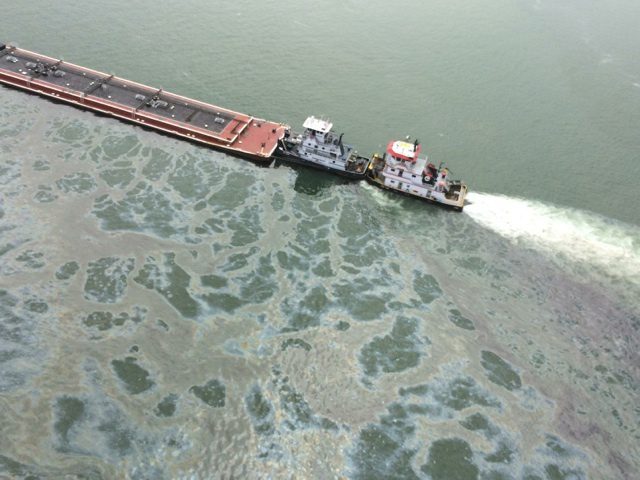
A tank barge leaks fuel oil following a collision with a bulk carrier, March 22, 2014 in the Houston Ship Channel. U.S. Coast Guard Photo


The U.S. National Transporation Safety Board has opened its accident docket in its ongoing investigation into a 2014 collision in the Houston Ship Channel involving a cargo ship and a tank barge being maneuvered by a Kirby tugboat. 

On March 22, 2014, the inbound cargo ship MV Summer Wind collided with two-barge tow being led by the Kirby 27706 tank barge and pushed by the Kirby inland towboat Miss Susan at approximately 12:35 p.m. CDT in the connecting waterways of the Bolivar Roads Precautionary Area where the Galveston Channel, the Texas City Channel, and the Gulf Intracoastal Waterway intersect with the Houston Ship Channel. 

Earlier in the day, the NTSB says, deep draft vessel movement was suspended due to fog in the area; however, at the time of the accident, the port was open.
The collision resulted in the release of approximately 4,000 barrels (168,000 gallons) of fuel oil into the waterway from a breach in the double hull of the Kirby 27706. Two crewmembers on the Miss Susan suffered injuries from exposure to hydrocarbon vapor. 

The docket contains more than 4,000 pages and includes a summary of the accident, transcripts from interviews with crewmembers from both vessels and witnesses aboard nearby vessels, and investigative group chairman factual reports.

The NTSB says it expects to release its final report into the incident this summer. 

The docket can be accessed at: http://dms.ntsb.gov/pubdms/search/projList.cfm?ntsbnum=DCA14FM008


Court orders dentist to pay $85K to employee fired for safety complaint. Assistant raised dangers of used needles as Dr. N. Terry Fayad allegedly sought cost savings

April 8, 2015

BOSTON, MASSACHUSETTS

It began when Massachusetts dentist Dr. N. Terry Fayad changed his practice's procedure for disposing of contaminated needles. He told those in his Beverly-based office to first remove the protective caps before dropping them into sharps disposal containers, allegedly to fill the containers with more used needles and reduce the frequency and cost of their disposal.

Concerned that she and her co-workers could be exposed to needle stick injuries and the risk of infection from bloodborne pathogens such as hepatitis and HIV, a dental assistant raised the issue with Fayad. When he dismissed her concern, she filed a complaint with the U.S. Department of Labor's Occupational Safety and Health Administration. After an OSHA inspector visited on Nov. 23, 2010, Dr. Fayad fired her later that day. 

A whistleblower investigation followed and, in September 2011, the Department of Labor sued Fayad in the U.S. District Court for the District of Massachusetts. In its complaint, the department charged that the dentist violated the anti-retaliation provisions of the Occupational Safety and Health Act. The suit eventually went to trial before U.S. District Judge George A. O'Toole.

Judge O'Toole has ruled in favor of the department and ordered Fayad's practice, N. Terry Fayad, D.M.D., P.C., to pay the worker $51,644.80 in back wages and ordered both Fayad and the practice to pay her $33,450.26 in compensatory damages. The judge found that the employee's firing by Fayad shortly after OSHA began its inspection was retaliatory and a violation of section 11(c) of the OSH Act.

"This worker suffered needless financial and emotional distress because Dr. Fayad chose to disregard a clear and important principle: Employees have the right to contact OSHA and raise workplace health and safety concerns with their employer without fear of termination or retaliation," said Greg Baxter, OSHA's acting regional administrator for New England. "Employers must pay attention to this verdict. It makes it clear that there will be legal and financial consequences if you retaliate against your employees in this manner."

"The OSH Act gives employees both a right to a safe and healthy workplace, and a right to voice concerns about workplace conditions, without fear of adverse consequences," said Michael Felsen, the department's New England regional solicitor of labor. "This case demonstrates the Labor Department will pursue legal remedies aggressively when employers fire workers or try to intimidate them into silence when they assert those rights." 

The court also entered an injunction against Fayad, his P.C., and their agents and employees, preventing them from violating the anti-retaliation provisions of the OSH Act, and directing the defendants to post a notice to their employees stating that they will not in any way discriminate against employees for activities protected by the Act.

The case was tried on the Secretary's behalf by Senior Trial Attorney Kelly Lawson and Trial Attorney Nathan Goldstein of the department's regional Office of the Solicitor in Boston.

OSHA's health inspection resulted in the Fayad practice being cited for violations of OSHA's bloodborne pathogen and hazard communication standards. The violations were corrected and he paid a fine of $11,000 in 2012.

OSHA enforces the whistleblower provisions of the OSH Act* and 21 other statutes protecting employees who report violations of various airline, commercial motor carrier, consumer product, environmental, financial reform, food safety, health care reform, nuclear, pipeline, worker safety, public transportation agency, maritime and securities laws.

Employers are prohibited from retaliating against employees who raise various protected concerns or provide protected information to the employer or to the government. Employees who believe that they suffered retaliation for engaging in protected conduct may file a complaint with the secretary of labor to request an investigation by OSHA's Whistleblower Protection Program. Detailed information on employee whistleblower rights, including fact sheets, is available at http://www.whistleblowers.gov/.

Under the Occupational Safety and Health Act of 1970, employers are responsible for providing safe and healthful workplaces for their employees. OSHA's role is to ensure these conditions for America's working men and women by setting and enforcing standards, and providing training, education and assistance. For more information, visit http://www.osha.gov.

Foundry workers exposed to numerous safety and health hazards OSHA cites American Spincast Inc. in Belton, Texas, with 50 violations, proposes $165,200 in fines

April 7, 2015

Employer name: American Spincast Inc. 

Inspection site: Belton, Texas 

Date inspection initiated and what prompted the inspection: This inspection, which includes both safety and health, began October 2014 as part of the Occupational Safety and Health Administration's Site Specific Targeting program, which directs enforcement resources to high-hazard workplaces where the highest rates of injuries and illnesses occur. The health inspection was initiated under the National Emphasis Program on Primary Metals* to identify and reduce exposures to harmful chemical and physical health hazards. 

Investigation findings: American Spincast Inc., a foundry, employs about 70 workers in Belton. OSHA issued 32 serious safety violations and 18 serious health violations. Some of the violations cited include failing to:
  • provide guardrails or personal fall arrest systems for work on elevated locations;
  • ensure forklift man basket had safe design and was properly attached;
  • provide machine guarding for lathes, saws, sander, conveyors and other machinery;
  • guard transmission belts and pulleys on multiple machines;
  • ensure arc welding cables were undamaged;
  • implement administrative or engineering controls when noise levels exceed 100 decibels;
  • ensure flammable liquids were stored in tanks or closed containers; and
  • provide Hazard Communication training on methylene chloride and hexavalent chromium.
A serious violation occurs when there is substantial probability that death or serious physical harm could result from a hazard about which the employer knew or should have known. 

Proposed penalties: $165,200

View the citation: http://www.osha.gov/ooc/citations/AmericanSpincast_999520_0407_15.pdf* http://www.osha.gov/ooc/citations/AmericanSpincast_999111_0407_15.pdf

Quote: "These workers were needlessly exposed to hearing loss, falls and other dangers," said Casey Perkins, area director of OSHA's Austin Area Office. "American Spincast failed to provide the minimal protective standards required by law. Employers need to implement programs for finding and fixing these hazards before workers become seriously injured or receive irreversible health effects."

Information: The company has 15 business days from receipt of its citations to comply, request an informal conference with OSHA's area director, or contest the citations and penalties before the independent Occupational Safety and Health Review Commission.

To ask questions, obtain compliance assistance, file a complaint, or report workplace hospitalizations, fatalities or situations posing imminent danger to workers, the public should call OSHA's toll-free hotline at 800-321-OSHA (6742) or the agency's Austin Area Office at 512-374-0271.

WORKER CRUSHED TO DEATH BY FALLING STEEL COIL


A 40-year-old male laborer was moving a 5-feet by 9-inch coil of slitted steel, weighing 6600 pounds, when it fell on him. 

The laborer was in the process of wrapping a chain through the middle of the coil and through a homemade device on the forks of a forklift when the coil tipped over. 

As the laborer tried to move away from the falling coil, it landed on his left side, breaking his left leg and causing internal injuries. Other workers in the area did not see, but heard the commotion of the falling coil. 

The plant manager and other workers rushed to aid the laborer who was conscious. They tried to lift the coil of steel off the laborer’s leg, but could not. 

While one of the workers called emergency services, another used a forklift to remove the coil from the laborer’s legs.  

Cognizant and using a cell phone, the laborer spoke to his wife while he was waiting for emergency management service personnel to arrive. Emergency personnel arrived and he told them that he was hurting and to get him to a hospital.  

The laborer was taken by ambulance to the closest hospital in a neighboring state where he died that same day from internal injuries.

To prevent future occurrences of similar incidents, the following recommendations have been made:

Recommendation No. 1:  Employers should provide workers with a safe work environment.
Recommendation No. 2:  Equipment should only be modified with the manufacturer’s approval.
Recommendation No. 3:  Coils should be kept from rolling or falling by use of chocking materials.
Recommendation No. 4:  An alternative system to transport coils could be implemented.

OSHA cites Global Construction & Engineering Inc. for exposing workers to safety hazards at Center Point, Alabama work site

April 07, 2015

Employer name: Global Construction & Engineering Inc. 

Inspection site: At the time of the inspection, workers were installing sewer lines at 3025 Wood Drive Center Point, Alabama 35215. 

Date inspection initiated: The Occupational Safety and Health Administration initiated the Oct. 8, 2014 inspection as part of the agency's National Emphasis Program on Trenching and Excavation

Inspection findings: OSHA issued the employer one willful citation for allowing employees to work in an excavation without cave-in protection. OSHA requires that all trenches and excavation sites 5-feet or deeper be protected against sidewall collapses. Protection may be provided through shoring of trench walls, sloping of the soil at a shallow angle or by using a protective trench box. One repeated citation was issued for not providing workers safe entrance and exit from the trench. Additionally, five serious citations were issued for allowing workers to perform trenching operations without head protection; not providing reflective vests for employees working near vehicular traffic; and not removing workers from a trench when cave-in hazards were discovered. 

Quote: "Trenching and excavation operations are widely known for being very dangerous, yet Global Construction made no attempts to protect its workers," said Ramona Morris, OSHA's area director in Birmingham. "When an employer willfully ignores OSHA standards it puts workers at risk of being injured or killed and OSHA will not tolerate this." 

Proposed penalties: $48,840

The citations can be viewed at: http://www.dol.gov/opa/media/press/osha/OSHA20150565fs.pdf*

Global Construction has 15 business days from receipt of its citations and proposed penalties to comply, request a conference with OSHA's area director or contest the findings before the independent Occupational Safety and Health Review Commission.

To ask questions, obtain compliance assistance, file a complaint or report workplace hospitalizations, fatalities or situations posing imminent danger to workers, the public should call OSHA's toll-free hotline at 800-321-OSHA (6742) or the agency's Birmingham Area Office at 205-731-1534.