MEC&F Expert Engineers

Thursday, March 26, 2015

SULFUR DIOXIDE LEAK AT THE SOUTH CROSS BAYOU WASTEWATER TREATMENT PLANT


MARCH 25, 2015

SAINT PETERSBURG, FLORIDA

A sulfur dioxide leak at the South Cross Bayou Wastewater Treatment was patched up Wednesday afternoon.

Sulfur dioxide is commonly used at treatment plants during the dechlorination of wastewater. When sulfur dioxide contacts water, it produces sulfuric acid.  It is very toxic if inhaled and can cause death.  It is corrosive if it comes in contact with skin or eyes.  It will irritate or burn the skin/eyes.

The hazmat team was investigating the incident.

Hazmat units responded to the leak in the one ton cylinder just before noon and crews were able to patch it around 2 p.m.

The leak was confined to the building and systems in place were working, according to a statement from the Lealman Fire Dept. There was no leak outside of the building.

Employees at the building on 54th Ave. in Lealman were evacuated as a precaution. Traffic was shut down at 54th Ave. between Belcher Rd. and Park St. but the roads have since been reopened.

There was no word on what caused the leak. No injuries were reported.
The South Cross Bayou Wastewater Treatment Facility is located at 5900 74th Street North in Saint Petersburg, FL and has had serious violation(s) over the past three years.

7 quarter(s) of Clean Water Act violations - resulting in 2 enforcement action and $293,460 in fines.

There is a population of 3,481 people (11% minorities) within a 3 mile radius of the facility.

US EPA will require registration under the federal pesticides law of products containing nanoscale silver that are designed to control microbes

MARCH 25, 2015
 
The Environmental Protection Agency on March 25 unveiled two precedent-setting regulatory moves on nanomaterials.

First, the agency will require registration under the federal pesticides law of products containing nanoscale silver that are designed to control microbes. EPA will not, however, classify all nanosilver products as pesticides, the agency says in a response to a 2008 petition from activist groups that are seeking stronger regulation of nanomaterials. The agency indicated it would not immediately act against unregistered antimicrobial nanosilver products, such as socks, now sold in the U.S.

Second, EPA separately proposed a one-time requirement for makers of nanoscale commercial chemicals currently on the market to notify the agency about all available health and safety data for their products. Under this Toxic Substances Control Act proposal, these manufacturers would also have to submit production volume and processing, use, exposure, and release information to EPA.

EPA Proposes Reporting and Record Keeping Requirements on Nanoscale Materials in the Marketplace


FOR IMMEDIATE RELEASE
March 25, 2015


For the first time the agency will use TSCA authority to collect health and safety information on nanoscale chemicals already in use

WASHINGTON D.C., – The U.S. Environmental Protection Agency (EPA) is proposing one-time reporting and recordkeeping requirements on nanoscale chemical substances in the marketplace.

“Nanotechnology holds great promise for improving products, from TVs and vehicles to batteries and solar panels,” said Jim Jones, EPA’s Assistant Administrator for Chemical Safety and Pollution Prevention. “We want to continue to facilitate the trend toward this important technology. Today’s action will ensure that EPA also has information on nano-sized versions of chemicals that are already in the marketplace.”

EPA currently reviews new chemical substances manufactured or processed as nanomaterials prior to introduction into the marketplace to ensure that they are safe. For the first time, the agency is proposing to use TSCA to collect existing exposure and health and safety information on chemicals currently in the marketplace when manufactured or processed as nanoscale materials.  The proposal will require one-time reporting from companies that manufacture or process chemical substances as nanoscale materials.

The companies will notify EPA of:

•certain information, including specific chemical identity;
•production volume;
•methods of manufacture; processing, use, exposure, and release information; and,
•available health and safety data.

Nanoscale materials have special properties related to their small size such as greater strength and lighter weight, however, they may take on different properties than their conventionally-sized counterpart. The proposal is not intended to conclude that nanoscale materials will cause harm to human health or the environment; Rather, EPA would use the information gathered to determine if any further action under the Toxic Substances Control Act (TSCA), including additional information collection, is needed.

The proposed reporting requirements are being issued under the authority of section 8(a) under TSCA. The agency is requesting public comment on the proposed reporting and recordkeeping requirements 90 days from publication in the Federal Register. EPA also anticipates holding a public meeting during the comment period. The time and place of the meeting will be announced on EPA’s web page at: http://www.epa.gov/oppt/nano/


Additional information and a fact sheet on the specifics of the proposed rule and what constitutes a nanoscale chemical material can be found at: http://www.epa.gov/oppt/nano/

1 CHILD DEAD WHEN TRAIN HITS CAR, INJURES 3 MORE IN ELLISTON, VIRGINIA


MARCH 25, 2015

ELLISTON, VIRGINIA (WSLS 10)


A child who was hurt in an accident involving a train Wednesday night has died, according to the Montgomery County Sheriff's Office.

The child was in a car driven by his father that was hit by a train around 6 p.m. in the Elliston area.

Three other people were hurt.

//----------------------------//

A collision involving a train and a car injured a father and three children Wednesday evening. 

The Montgomery County Sheriff's Office said it happened just before 6:00 p.m. on Reese Mountain Road near Lancer Truck Stop. 

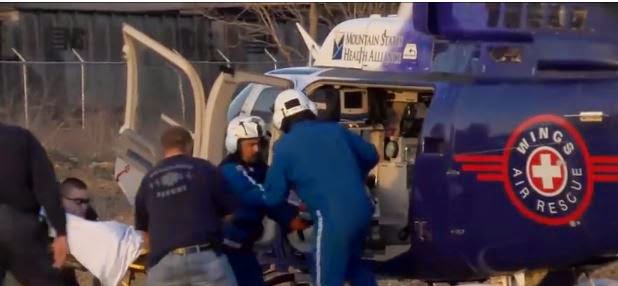
The car was occupied by one adult and three children between the ages of four and eight. All three of the children were flown by helicopter to Roanoke Memorial Hospital with serious injuries, along with the driver who was transported by ambulance.

The Sheriff's Office said Reese Mountain Rd. is a non-state maintained road and the crossing was marked with signs, but not with lights or a gate. 

Norfolk Southern had an investigation team on the scene, along with deputies from the Montgomery County Sheriff's Office.  

//-----------------------------------//

Four people were injured in an accident involving a train and a car Wednesday evening in Montgomery County.

According to deputies, just before 6 p.m., a car was crossing the railroad tracks on Reese Mountain Road in the Elliston area of Montgomery County, near Lancer truck stop, when it was hit by a Norfolk Southern train at a railroad crossing.

Investigators say four people were in the car. Three children between the ages of four and eight were transported by three different helicopters to Roanoke Memorial Hospital with serious injuries. An adult was transported by an ambulance.

Norfolk Southern officials say the train was traveling from Bluefield to Roanoke with 109 freight cars. Investigators say the front end of the train may have stopped up to three quarters of a mile away.

Investigators say it seems like the car tried to cross the train tracks as the train was coming. Deputies say Reese Mountain Road is a non-state maintained road. They say the crossing is marked with signs, but there are no lights or gate.

WDBJ7 spoke to Allen Waltz, who said he was near the accident when it happened. He said he was standing in front of a truck stop near the train tracks when a truck driver came running across the road pointing to where the incident had taken place. He said the truck driver yelled for him to call 911.

Waltz said he called 911 and then walked closer to the scene. He said once he saw the scene he called 911 again and told dispatchers they needed to hurry up because there were kids involved.

Waltz said he saw the father holding one of the children and screaming. The other two kids were unconscious, according to Waltz.

Howard Boylan is a truck driver. He said he saw the car and train collide.
 “All of a sudden the train came by and the car was coming across and as soon as the car came across they hit,” he said.

Boylan said he only heard the train blow its horn a couple of times
"You're supposed to blow the horn way back here way up here and let someone know you're approaching, but I never heard him my windows were down and everything," Boylan said. "I could have heard that horn, but I didn't hear that horn until, I mean, he had ten seconds."

Boylan said that the driver didn't have enough time to react.
“I honestly think that he didn’t hear it because, you know, he didn’t have but 10 seconds,” he explained.

Boylan said he got out of his truck and called 911 and ran as hard as he could to help.

“The young man was holding his baby and I just began to pray. That’s all I could do was pray because I knew the baby was in bad shape. And then I found out there were two more in the car.”

Boylan said it took about 10 minutes for emergency crews to arrive at the scene.

“It seemed like it took forever,” said Boylan. “All I could do was pray. I just prayed out loud. “I said, ‘Lord please help these young’uns,’” he said.
Source: http://www.wdbj7.com

GERMAN CO-PILOT, ANDREAS LUBITZ, APPEARS TO HAVE CRASHED GERMANWINGS PLANE DELIBERATELY: FRENCH PROSECUTOR


MARCH 26, 2015

(Reuters) - The co-pilot of the Germanwings airliner that crashed in the French Alps killing all 150 people aboard appears to have brought the A320 Airbus down deliberately, the Marseille prosecutor said on Thursday.

German Andreas Lubitz, 28, left in sole control of the Airbus A320 after the captain left the cockpit, refused to re-open the door and operated a control that sent the plane into its final, fatal descent, the prosecutor told a news conference. 

The French prosecutor said Lubitz was not known as a terrorist and there were no grounds to consider the crash as a terrorist incident. Recordings suggested passengers' screams began just before the final impact, he said.

Earlier, a German state prosecutor had said that just one of the two pilots of the Germanwings airliner was in the cockpit at the time it went down.

The statements came after the New York Times reported that "black box" recordings showed one of the pilots had left the cockpit and could not get back in before the plane crashed.

"One was in the cockpit and the other wasn't," Christoph Kumpa at the prosecutors' office in Duesseldorf told Reuters by telephone, adding that the information came from investigators in France. 

Investigators were still studying voice recordings from one of the "black boxes" on Thursday while the search continued for a second in the ravine where the plane crashed, 100 km (65 miles) from Nice.

The recordings did not make clear why the pilot left the cockpit or why he could not regain entry as the plane steadily descended toward a mountain range in a remote area of the French Alps on Tuesday.

"The guy outside is knocking lightly on the door and there is no answer," an investigator described only as a senior French military official told the New York Times, citing the recordings. "And then he hits the door stronger and no answer. There is never an answer."

"You can hear he is trying to smash the door down," the investigator added.
"VERY SMOOTH, VERY COOL"
The cockpit audio had showed "very smooth, very cool" conversation between the pilots in the early part of the flight.
"We don’t know yet the reason why one of the guys went out," the official said. "But what is sure is that at the very end of the flight, the other pilot is alone and does not open the door."
A spokesman for Germanwings' owner Lufthansa said: "We have no information from the authorities that confirms this report and we are seeking more information. We will not take part in speculation on the causes of the crash."
It confirmed that the main pilot had over 6,000 hours of flying time, while the more junior co-pilot had just 630 hours and had been with Germanwings since September 2013.

In France, the interior and defense ministries said they had no information on the newspaper report. Lufthansa announced it would hold a briefing for later in the day.

France's BEA air investigation bureau was not available for comment. On Wednesday, it said it was too early to draw meaningful conclusions on why the plane went down.

"We have not yet been able to study and to establish an exact timing for all the sounds and words heard on this file," BEA director Remi Jouty told a news conference.

Jouty expected the first basic analysis in days but warned that the read-out could be subject to errors and that more work would be needed for a full interpretation.

POST-9/11 RULES
The BEA said the plane started descending a minute after reaching cruising height and lost altitude for over nine minutes. The pilot's last words to the ground confirmed the next navigational waypoint, ending with a call-sign and "thank you".

Pilots may temporarily leave the cockpit at certain times and in certain circumstances, such whilst the aircraft is cruising, according to German aviation law. 

Lufthansa said that its cockpit doors can be opened from the outside with a code, in line with regulations introduced after the Sept. 11 attacks. However, the code system can be blocked from inside the cockpit, according to an Airbus promotional video posted online and confirmed by the planemaker.

The BEA on Wednesday already ruled out a mid-air explosion and said the scenario did not look like a depressurization.

It also noted the airliner had flown in a straight line directly into the mountain, but had no word on whether that seemed to be at the hand of a pilot or auto-pilot.

Germanwings said 72 Germans were killed in the first major air passenger disaster on French soil since the 2000 Concorde accident just outside Paris. Madrid revised down on Thursday the number of Spanish victims to 50 from 51 previously.

As well as Germans and Spaniards, victims included three Americans, a Moroccan and citizens of Britain, Argentina, Australia, Belgium, Colombia, Denmark, Israel, Japan, Mexico, Iran and the Netherlands, officials said. However, DNA checks to identify them could take weeks, the French government said.

The families of victims were being flown to Marseille on Thursday before being taken up to the zone close to the crash site. Chapels had been prepared for them with a view of the mountain where their loved ones died.
Source: http://www.reuters.com