

FEBRUARY 23, 2015
PALM SPRINGS,CALIFORNIA
A butane honey oil explosion in one of the rooms at the
Knights Inn in Palm Springs was the cause of the fire Sunday, Palm Springs
authorities said Monday.
At 1:41 p.m. on Sunday, Palm Springs police and fire
departments responded to a structure fire at 1450 S. Palm Canyon Dr. and, upon
arriving, saw smoke coming from one of the rooms. Police found the four people
who had been in the room at the time of the explosion in the nearby parking
lot.
Police learned that one of the subjects was attempting to
manufacture Butane Honey Oil (BHO) inside of the room when the explosion
occurred, Sgt. Harvey Reed said in a news release.
BHO is an extremely potent form of tetrahydrocannabinol, or
THC, the chemical responsible for most of marijuana's psychological effects,
Reed said in the release.
The process of extracting THC from marijuana to manufacture
BHO is a dangerous process.
During this process, marijuana is tightly packed into an
extraction device. During the different purification methods, butane -- a
flammable gas that is odorless, colorless, and heavier than air -- can
evaporate out of the substance and collect on the floor, accumulating to
explosive levels without proper ventilation. It is thought that during this
process, an explosion occurred within the room.
The occupants of the room were a man, woman and two teenage
males. All four, who resided in Cathedral City, were taken to nearby hospitals.
The two adults and one of the teenagers remain hospitalized in critical
condition, officials said Monday.
Due to the nature of the incident, specialized investigative
personnel from the Coachella Valley Narcotics Task Force, Riverside County
Sheriff's Department Special Investigations Bureau, CAL Fire Hazardous
Materials Unit and the Riverside County Department of Health responded to the
location to assist Palm Springs police and fire.
The criminal investigation is ongoing and no other details
will be released at this time, Reed said in the news release.
The names of the adult subjects have not been released. The
names of the juveniles are not being released in accordance with the law.


//------------------------------------------------------//
PALM SPRINGS MOTEL
FIRE INJURES 4 AT KNIGHTS INN IN CALIFORNIA; HASH OIL PRODUCTION USING BUTANE
CAUSED THE EXPLOSION
FEBRUARY 23, 2015
PALM SPRINGS, CALIFORNIA
A fire broke out at a Palm Springs motel Sunday afternoon,
injuring four, officials said. Three of them suffered severe third-degree burns
and "burns to a very large percentage of the body."
The fire happened at Knights Inn, 1450 S. Palm Canyon Drive,
and created plumes of smoke visible from nearby hiking trails.
Palm Springs Fire Department Battalion Chief David Rees said
at the scene that the fire started in a first-floor single room — whose window
was shattered — and extended up into the second floor above it.
Multiple calls reported the fire around 1:40 p.m.
Fire personnel responded quickly and brought the blaze under
control within 10 minutes with assistance from Riverside County Fire and
Cathedral City Fire Departments. Firefighters climbed out on ladders and stood
on the Knights Inn roof working to extinguish the second-floor flames.
All of the people hurt by the flames, most critical, were
transported by ambulance to Desert Regional Medical Center.
Rees did not know if they were motel guests or guests of
people staying there.
The cause remains under investigation by Palm Springs Fire
and the Palm Springs Police Department, authorities said.
The blaze brought handfuls of bystanders from nearby shops
and bars outside to figure out what was happening and closed off part of Sonora
Drive by the motel. Six fire trucks, multiple police cars and ambulance and
paramedic teams flashed their lights and sirens roared as they worked to secure
the area.
Rob Beitz, a neighbor right next door to the Knights Inn,
said he was in his living room when he heard 15 to 20 explosions.
He came outside right away to try to figure out what caused
the strange explosions and watch while crews worked on the fire.
"It's never happened before," he said, staring at
the inn.
//-----------------------------------------------------------------------------------------//
HASH OIL CAUSED EXPLOSION IN WHEAT
RIDGE, COLORADO HOME. GAS EXPLOSIONS
CAUSED DURING THE EXTRACTION OF OIL FROM MARIHUANA PLANTS ARE ON THE RISE
ACROSS THE UNITED STATES
February
6, 2015
WHEAT
RIDGE, COLORADO: Authorities say an explosion that rocked a Wheat Ridge
home was caused by the manufacturing of hash oil.
Firefighters
who responded to the blast at about 4:30 p.m. Wednesday say they found evidence
of a butane explosion that was sparked during the manufacturing process. Police
later found more than 400 marijuana plants in two buildings on the property.
A
person who was at the home was arrested for cultivation of marijuana. The
suspect’s name and age have not been released.
Hash
oil is typically made by packing the castoff leaves and stems of pot plants
into a pipe and pouring highly flammable butane through it. The concoction is
heated to make the potent oil for far cheaper than it can be bought in stores.
Building
inspectors say the home involved in Wednesday’s blast is uninhabitable.

//__________________________________________//
FIRE IN ARVADA
LEADS TO DOUBLE DISCOVERY — HASH OIL AND POT PLANTS
Published:
Feb 5, 2015
First,
investigators linked a fire in an Arvada home Wednesday to explosion caused by
attempted hash oil extraction. Then police discovered something more — more
than 400 marijuana plants in two separate buildings on the property.
Wheat
Ridge police said an unidentified suspect has been arrested on charges of
cultivation of marijuana in the case, which began at about 4:28 p.m., when
police officers were called to a home in the 4100 block of Youngfield Street by
firefighters with the Arvada Fire Protection District.
The
firefighters were in the area, police said, when they observed a fire at the
home. Firefighters were able to extinguish the flames and observed evidence of
a butane explosion due to attempted hash oil extraction. Police found the
marijuana plants soon after.
Wheat
Ridge building inspectors deemed the buildings uninhabitable due to numerous
unsafe modifications. Wheat Ridge police said it will release more information
on the case as it becomes available.
//_________________________________________//
GAS EXPLOSIONS CAUSED DURING THE
EXTRACTION OF OIL FROM MARIHUANA PLANTS ARE ON THE RISE ACROSS THE UNITED
STATES
The Rise of Hash Oil Extraction Explosions
The national media is increasingly reporting on cases of
explosions due to the production of honey oil, also known as hash oil or dabs,
across the country. The production process uses butane, and explosions from
honey oil production have blown walls out, moved houses off foundations, and
caused people severe burns. While most
home labs are small, there are reports of bulk operations in which hundreds of
cans of butane can be on-site. Any size lab is a serious danger; first
responders should familiarize themselves with the signs of such labs: butane
canisters, Pyrex dishes, marijuana, coffee filters, and an extraction vessel
that could either be glass or a PVC pipe combination that resembles a pipe
bomb.
It seems that every week or so there is a gas explosion inside
somebody’s home or inside a car or a bathroom that have been caused during the
extraction of oils from marihuana plants.
Just two days ago, another such explosion occurred in Tigard,
Oregon. In that explosion, two men are
in serious condition after police say they blew up a gas station explosion in
Tigard early Sunday morning while trying to make hash oil with marijuana and
butane.
The explosion caused significant damage to the 76 gas station
bathroom on Greenburg Road, and fire extended through a false ceiling. The two Tigard men who were making hash oil
inside bathroom initially tried to put out the fire themselves and they
suffered severe burns; they are listed in serious condition.
Investigators determined that a heat gun used to evaporate the
butane caused the fire. Hash oil, also
known as honey oil or shatter, is heated and inhaled in what's known as
"dabbing”, a popular form of smoking marijuana. To make it, highly flammable butane or
another suitable solvent such as isopropyl alcohol, is poured through marijuana
to extract the cannabinoids, THC (tetrahydrocannabinol) and other chemicals from the plant
matter. Hash oil is typically made by
packing the castoff leaves and stems of pot plants into a pipe and pouring the
highly flammable butane through it. The
solvent is then evaporated, leaving a golden color sticky residue that
resembles oil or honey. Of course these
butane vapors linger in the room where the extraction took place. Only some pretty stupid people would attempt
such a process inside an unventilated room.

It typically doesn't take much during the extraction process to
cause an explosion, especially in an unventilated small space such as bathroom
or inside a car. Anything from static
electricity to a wall socket can spark a potentially deadly explosion. Or, the flame from the heat gun to
subsequently cook the oil can explode the lingering butane fumes.
In another major case that occurred last year, seven Seattle,
WA people accused of causing explosions while extracting hash oil from marijuana
were charged Tuesday in federal court. The
explosions -- which happened in Bellevue, Kirkland, Seattle and Puyallup --
injured a number of bystanders and caused thousands of dollars in damage.
Without proper ventilation, butane fumes can linger. All it
takes is a spark of static electricity to ignite a room. Former Bellevue Mayor Nan Campbell was
hospitalized for a broken pelvis she suffered trying to escape the flames. She later died following complications after
her hospitalization, according to prosecutors. Two other apartment residents suffered
shattered bones as they had to jump from their upper level apartments.
These deadly explosions are reckless and preventable acts. Unfortunately, as marijuana cultivation
activities increase, explosions will continue. This is a dangerous threat.
FEMA Alert on the Fire and Explosion Hazards
Last year, FEMA posted an alert in its emergency services
bulletin titled “Hash Oil Explosions Increasing Across US.” Alongside more
quotidian warnings of cyber terrorism and industrial vapor clouds, it described
an uptick in explosions at apartments and hotel rooms involving “a process
using butane to extract and concentrate compounds from marijuana,” destructive
incidents that FEMA warned could even be mistaken for pipe bomb or meth lab
explosions.
A clear, golden brown cannabis derivative also known as honey
oil, shatter, wax and “earwax,” butane hash oil (BHO) has some distinct advantages
over traditional marijuana: It has very little smell, either in its solid form
or when vaporized, is very portable, and can achieve intense effects with small
amounts. A pound of marijuana typically
generates 1/10 to 1/5 of a pound of hash oil.
BHO has been gaining in popularity in the past three
years. But as its popularity grows, so
do the number of hash oil enthusiasts eager to attempt their own homebrew BHO,
a process that usually involves the highly flammable solvent butane or
isopropyl alcohol. The result in a
number of cases, as the FEMA bulletin notes, has been “fires
and explosions [that] have blown out windows, walls,
and caused numerous burn
injuries.”
Hash oil is typically produced by filling a cylindrical glass
or stainless steel canister with pot (Bed Bath and Beyond’s metal turkey
basters are a popular choice), and flooding the canister with a solvent —
usually butane — that strips the plant matter of its cannabinoid-containing
oils. The resulting mixture of psychotropic plant oil and chemicals is then
purified to remove traces of the solvent. One common method of butane removal
includes boiling it off in a hot water bath, while another involves the use of
a vacuum pump and vacuum chamber to lower butane’s boiling point, pulling
butane from the oil.
What makes it dangerous is not so much the extraction process
itself, but rather the problem of improper butane ventilation. Butane is highly flammable and it tends to
sink, meaning that if you use it indoors or don’t ventilate well, you’ll run
into serious trouble. Let some butane
puddle in your living room, throw in a thoughtless spark from a cigarette,
stove, or — dare I suggest — bong hit, and suddenly your apartment is missing a
wall.
That’s allegedly what happened in January, when three people were injured after a hash oil extraction
gone wrong blew through the walls of a San Diego hotel. A few months earlier, an Oregon man suffered
burns in a similar explosion that blew out the windows in his apartment and
sent him to the hospital. Although it’s perfectly possible to make hash
oil safely, such explosions are the result of a relatively small number of hash
oil producers who fail to take even the most basic precautions. The number one precaution is to never make
oil indoors.
Hash-oil operation suspected in fatal San Bernardino County explosion

First responders were on the scene of what was initially
believed to be a gas explosion at a home in the community of Muscoy in San
Bernardino County. The blast killed one person and left two others in critical
condition.
Authorities who say they found significant amounts of
marijuana and butane in the debris of a blown-up home believe a hash-oil
operation may have caused a massive explosion that killed a man and injured two
others.
Those inside the makeshift home may have been producing
"butane honey oil" when it exploded, said Cindy Bachman, spokeswoman
for the San Bernardino County Sheriff's Department.
Firefighters sifting through the ruins found the man's remains
in what appeared to be a basement, she said.
The explosion
occurred at 6 p.m. Wednesday in a home located in the rear of a property in
the 3000 block of Gray Street in Muscoy.
Firefighters found a man outside the home with severe burns,
according to the San Bernardino County Fire Department. A woman was partially
covered by debris when firefighters found her.
She suffered a serious head injury as well as blunt-force
trauma, fire officials said.
The basement area sustained significant damage during the
blast, causing the poorly constructed home to collapsed into it.
"The blast was so significant that the freshly paved road
in the front of the surrounding homes actually buckled in several places,"
the Fire Department said in a statement.
Firefighters first believed the explosion was caused by a gas
leak, but later determined it stemmed from illegal drug activity.
"Butane honey oil” is a waxy substance that can produce a
strong high when inhaled. It doesn't have the potent odor of marijuana.
Because hash oil has gained popularity, some beginners have
attempted to make it in their homes. But that has resulted in several
explosions, officials say.
Two men accused of operating a hash-oil extraction laboratory
were burned in a similar explosion in March in the city of Commerce.
A suspected drug lab at a home in Malibu exploded in April, injuring one person, authorities said.
Suspected 'hash oil'
lab explodes in Malibu home; 1 man burned

A suspected drug lab at a home in Malibu caught fire and
exploded Tuesday, injuring one person who had to be transported to the hospital
via helicopter, authorities said.
Firefighters responded to the home in the 1200 block of
Encinal Canyon Road shortly before 6:15 p.m. to find it fully engulfed in
flames, according to the Los Angeles County Fire Department.
Authorities later discovered the substance “honey oil” -- a
type of marijuana oil -- at the residence, Los Angeles County Sheriff's Sgt.
Fray Lupian told KTLA-TV.
A 25-year-old man who was burned in the explosion and ensuing
fire was airlifted to Los Angeles County-USC Medical Center to be treated for
his injuries, authorities said.
The man, who was not immediately identified, would likely be
arrested on drug-related charges after recovering, Lupian said.
A hazardous materials crew was still at the scene shortly
before 2 a.m. Wednesday, according to the fire department.
“Butane honey oil,” also called “wax,” has been a growing trend
in the marijuana market, officials said. Dabs of it can be vaporized and
inhaled without the smoke and pungent odor of marijuana, an act called
“dabbing.” The method produces a stronger high even among those who have strong
tolerance to cannabis.
The widespread
popularity of the waxy substance has led many to attempt the
extraction method, often resulting in injuries.
Two men suspected of operating what authorities said was a
“butane honey oil extraction laboratory,” in which marijuana is turned into the
"hash oil," were burned in a similar explosion last month in the city of Commerce.
One of several butane bottles located inside the home may have
exploded and caused the fire, authorities said.
In
January, several apartment units in El Cajon were damaged after what
authorities said was a hash oil explosion. Two men who were allegedly operating
the hash oil laboratory were severely burned in the incident.
Earlier this month in Glendale, police reported that they busted a hash oil operation, saying that the potential for
a large explosion at the lab was "huge."
Hash Oil Lab Explosion
Destroys Apartment
Two people were severely burned in the explosion, according
to sheriff's officials
Friday, Feb 21, 2014 • Updated at 6:07 AM PST
Two people were rushed to the hospital after a reported hash
oil explosion in El Cajon.
The San Miguel Fire District received calls about an explosion
just after 2:30 p.m. in the 1400 block of Brabham Street.
When they arrived, they found one apartment destroyed and
several others damaged. Two apartment residents were severely burned and were
taken to the hospital.
The San Diego Sheriff's Department said investigators found a
hash oil lab had exploded.
Residents of the apartment had to be evacuated for a
time.
Sheriff's deputies and fire officials remained on scene to
investigate.
Two men injured in
suspected 'hash oil' explosion in Commerce

Los Angeles County fire hazmat technician Terry Wilkinson
surveys the damage from an explosion caused by a suspected drug manufacturing
process in the city of Commerce. (Irfan Khan / Los Angeles Times)
Two men suffered burn-related injuries in a suspected hash oil
explosion in the city of Commerce, authorities said.
Firefighters and Los Angeles County Sheriff’s deputies
responded around 8:10 p.m. to the 2300 block of Ayers Avenue regarding a call
of a tree or transformer on fire, but when they arrived, they discovered that a
home was ablaze.
The extent of the burn injuries suffered by the two men -- ages
18 and 21 -- were not immediately known.
It's the illegality of this stuff that leads idiots to try to
make it in "secret" labs. legalize it, there's no more reason to hide
it, and it'll be done safely, simply because nobody wants to blow themselves up
if they can help it.
Arson investigators determined that the men -- who were not
immediately identified -- had allegedly been operating a “butane honey oil
extraction laboratory,” in which marijuana is turned into “hash
oil” or “honey oil.”
One of several butane bottles located inside the home may have
exploded and caused the fire, authorities said.
“Butane honey oil,” also called “wax,” has been a growing trend
in the marijuana market. Dabs of it can be vaporized and inhaled without
the smoke and pungent odor of weed, an act called “dabbing.” The method
produces a stronger high even among those who have strong tolerance to
cannabis.
The widespread
popularity of the waxy substance has led many to attempt the extraction
method, often resulting in injuries.
In
January, several apartment units in El Cajon were damaged after a hash oil
explosion. Two men who were allegedly operating the “hash oil” laboratory were
severely burned in the incident.
In April, a 22-year-old man suffered second- and third-degree
burns on his face and hands when an explosion tore through his home in
Cottonwood.
Shasta County authorities told
the Los Angeles Times the man was allegedly using butane to extract oil
from marijuana leaves. At the time, it was the third explosion for the county
in the last calendar year.
Authorities said the city of Commerce hash oil explosion caused
about $300,000 in damage to the single-story home.
Narcotics-related charges are pending for the two men who remain
hospitalized, the sheriff’s department said.
An investigation into the alleged drug lab remained
ongoing.
|
August 28th, 2013
|
|
"Scariest
was the case of a young woman
who
was hospitalized from a near-fatal allergic reaction
in
which her throat closed up after smoking dabs."
-Animal New York ("Dabs: The World's Most Powerful and
Sought After Weed Product)
What is
"dabs?"
Dabs,
otherwise known as butane hash oil (BHO), is an extremely potent extract
created by passing butane through high-grade marijuana. Following the
evaporation of the butane, a thick oil or resin remains. The oil is
most commonly vaporized using a special water pipe known as a rig, although
it can be consumed orally as well. Hash oil use has recently increased
and is quickly becoming a more popular method of use among adolescents.
The
resulting high is far stronger than that from marijuana, due to hash oil's
very high levels of THC (tetrahydrocannabinol). While very strong
strains of marijuana are around 25% THC, the 2009 United
Nations "World Drug Report" states that hash oil can contain
upwards of 60% THC. Additional reports suggest that the THC content of hash
oil can reach as high as 90%.
Even
more concerning is the fact that butane, an extremely flammable and dangerous
solvent, is used in the creation of butane hash oil. A number of people
have been injured in fires and explosions resulting from attempts to
manufacture butane hash oil. Additionally, there is risk of the final
product having dangerous impurities due to the extraction methods and
ingredients used. Exposure to butane can cause numerous health
problems, including neurotoxic effects.
It is
crucial for parents to be aware of the increase in popularity of hash oil,
and know what to look for. Due to its concentrated form, hash oil is
used in smaller amounts than marijuana and is much easier to conceal.
Hash oil can appear in various forms, be referred to by a number of
different slang terms, and be manufactured using a variety of items.

Names:
Hash oil,
hashish oil, butane hash oil (BHO), honey oil, honey, honeycomb, dabs,
earwax, wax, shatter, budder, concentrate, whip
Looks Like: Dark brown, amber, or golden oil or resin, pale or yellowish wax, tar, honey or honeycomb 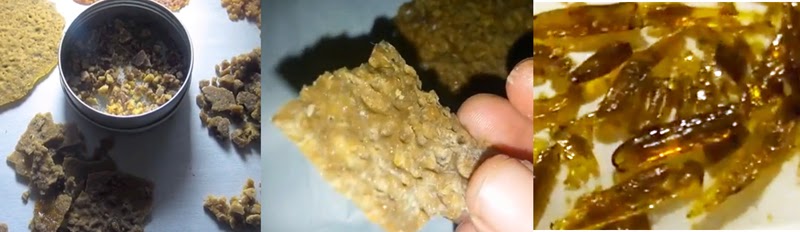
Related
Items to Look For: Butane containers, glass or metal tubes, glass baking dishes,
isopropyl alcohol, coffee filters

"Among
incidents related to its production and use
were
untrained cooks 'blowing themselves up' blasting
butane in
jury-rigged home labs, and 'overdoses,' which as
with strong
marijuana are not fatal but involve extreme discomfort
to
the point of freaking out for long periods of time."
-Animal New York ("Dabs: The World's Most Powerful and
Sought After Weed Product)
For more
information on drugs of abuse, and the many other challenges that young
people face every day, visit our Youth Challenges page.
|
|


