MEC&F Expert Engineers

Saturday, February 7, 2015

Chilean Navy Rescues 120 People from Grounded Cruise Ship

Photo: Armada de Chile

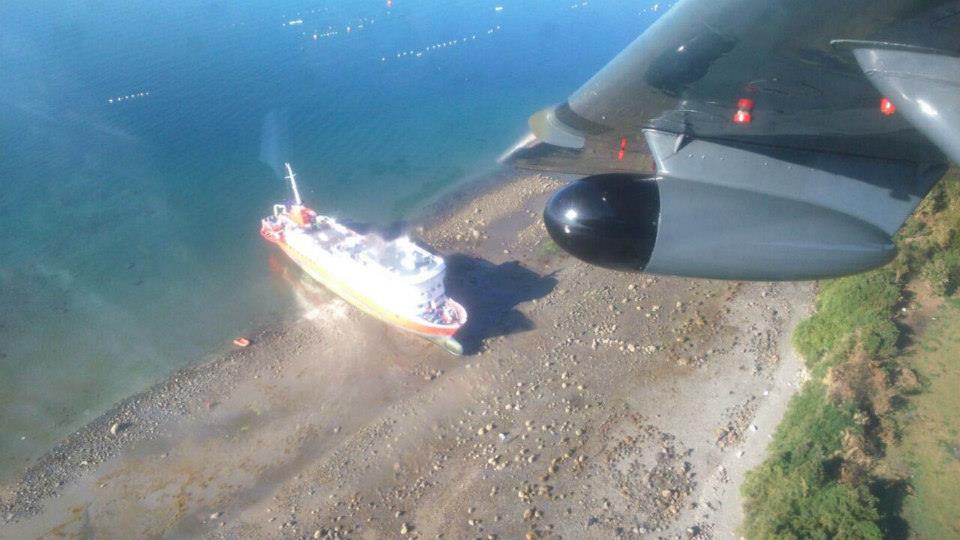
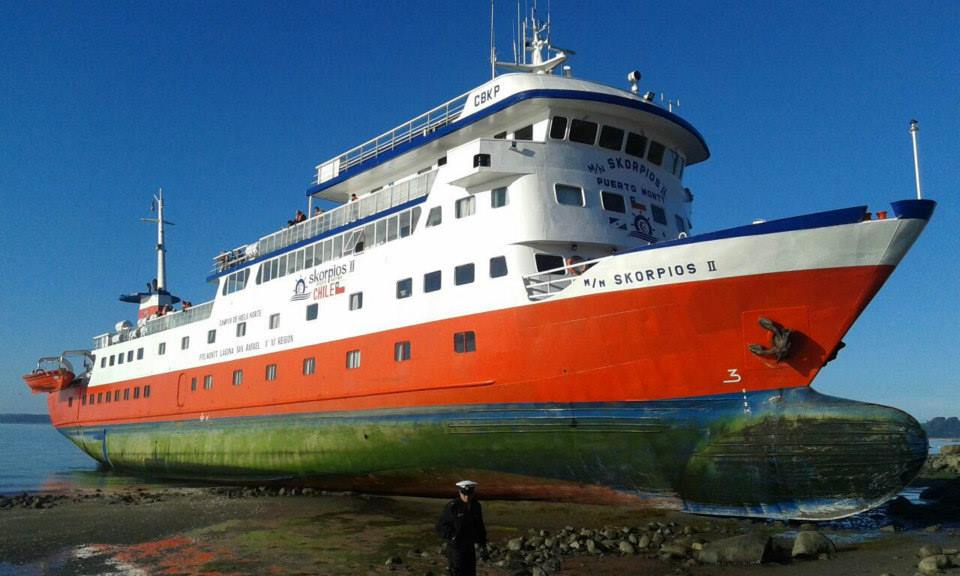
The Chilean Navy on Thursday assisted in the rescue of 120 people from a grounded cruise ship near the port city of Puerto Montt in southern Chile.
According to the Navy, the “Skorpios II” was carrying 89 passengers and 31 crew when it ran aground early Thursday morning in Punta Santo Domingo, approximately 14 kilometers south west of Puerto Montt.

The passengers, mostly foreign tourists, were transferred to a navy ship and taken to a nearby naval base.

No injuries or pollution have been reported.
The accident is under investigation, the navy said.

The 70-meter, ice-classed Skorpios II offers multi-day cruises to southern Chile’s fjords and glaciers out of Puerto Montt.

Photo: Armada de Chile


Photo: Armada de Chile


Photo: Armada de Chile


Photo: Armada de Chile

Three Crew Members Medevaced from Bulk Carrier Off Oregon Coast with Burn and Leg Injuries

An injured crewmember is airlifted from the deck of the MV
An injured crew member is airlifted from the deck of the MV Almasi, U.S. Coast Guard image

February 5, 2015

Three crewman suffering from burns and a broken leg were airlifted from a bulk carrier Thursday approximately 52 miles west of the Columbia River Bar.

The three injured were medevaced from the 623-foot Cyprus-flagged bulk carrier MV Almasi. According to the Coast Guard, the crewmembers suffered injuries consistent with chemical burns and one had a broken leg following an accident reportedly while refueling and cleaning the holds.

Watchstanders at Coast Guard Sector Columbia River received the report at 11:30 a.m. Thursday from Pacific Coast Maritime Agencies, a vessel operation service for tanker and dry bulk vessels. A coast guard Jayhawk crew rendezvoused with ship more than 50 miles off the Oregon coast around 1:42 p.m. and hoisted the three men from the deck of the vessel. The injured were turned over to emergency medical services at 3:09 p.m. and then transported to Columbia Memorial Hospital in Astoria for further medical treatment.

“The outstanding coordination between the Almasi crew and Coast Guard watchstanders and helicopter crew led to an effective medevac,” said Petty Officer 1st Class John Bennett, the search and rescue controller at Sector Columbia River. “Despite the challenging weather conditions, our helicopter crew was able to safely hoist the injured men and get them to the medical care they required.”

Weather on scene was reported as 31 to 38 mph winds with 19-foot seas. Air temperature was 56 degrees Fahrenheit and water temperature was 54 degrees Fahrenheit.

Shippers Suspend Weekend Cargo Ops at West Coast Ports

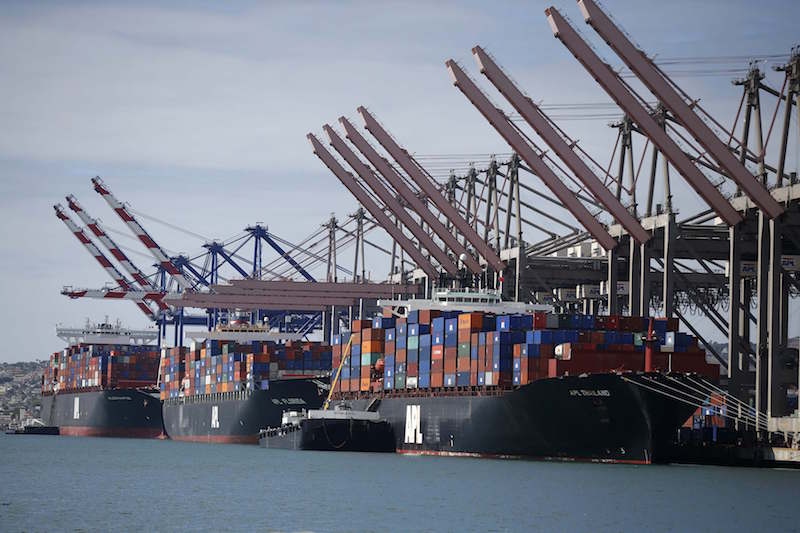
Container ships sit in berths at the Port of Los Angeles, California October 15, 2014. REUTERS/Lucy Nicholson
Reuters
LOS ANGELES, Feb 6 (Reuters) – Cargo freighter loading and unloading operations will be suspended at U.S. West Coast Ports this weekend due to continuing chronic slowdowns that shippers and terminal operators have blamed on the dockworkers’ union, the companies’ representative said on Friday.
However, the Pacific Maritime Association said terminal yard, rail and gate operations at the ports, which handle nearly half of U.S. maritime trade and more than 70 percent of imports from Asia, would go on at the discretion of terminal operators through the weekend, the group said.

“In light of ongoing union slowdowns up and down the coast which have brought the ports almost to a standstill, PMA member companies finally have concluded that they will no longer continue to pay workers premium pay for diminished productivity,” the association said in a brief statement.

It said vessel loading and unloading operations were scheduled to resume on Monday, Feb. 9, while yard operations – moving unloaded cargo containers for truck and rail delivery to customers – would continue at terminal operators discretion.

Announcement of the weekend suspension came two days after the chief labor negotiator for the companies at the 29 West Coast ports warned that waterfronts that have been plagued by severe cargo congestion in recent months were nearing the point of complete gridlock.

The companies have repeatedly accused the International Longshore and Warehouse Union, which represents 20,000 dockworkers, of deliberating orchestrating work slowdowns at the ports to gain leverage in contract negotiations that have dragged on for nine months

The union denies this and faulted the carriers themselves for the congestion, citing numerous changes in shipping practices as contributing factors.

The union also has downplayed the magnitude of the congestion, suggesting that management was exaggerating a crisis as a late-hour negotiation ploy. (Reporting by Steve Gorman; Editing by Sandra Maler)
© 2015 Thomson Reuters. All rights reserved.

Plains All American Pipeline, L.P. cuts cap ex, growth forecast as prices fall


Plains All American Pipeline, L.P. cuts cap ex, growth forecast as prices fall

 February 6, 2015

Houston, Texas: 

Transportation player Plains All American Pipeline, L.P. (NYSE: PAA) trimmed its 2015 capital spending budget and curbed its planned growth Thursday in response to weak oil prices.
Houston-based Plains will trim its expansion capital spending down to $1.85 billion, a 9 percent drop from 2014 levels.

Plains All American Pipeline, L.P is a publicly traded master limited partnership (“MLP”).  As an MLP, PAA makes quarterly distributions of its available cash to its Unitholders. 

The company will also lower the midpoint of its 2015 adjusted earning target by 6.5 percent to $2.35 billion and cut its distribution growth target, Fuel Fix said.
Plains is currently targeting distribution growth of 7 percent for 2015.

“PAA is well positioned to manage through industry down cycles; however, we are not immune to the adverse impacts of a major step change in commodity prices that is accompanied by a similar change in producers’ activity levels,” CEO and chairman Greg Armstrong said.

Plains reported a fourth quarter net income of $389 million, a 26 percent spike over the same period last year.

After adjusting earnings to account for hedges, taxes and a $85 million write down the company booked about $362 million in net income, down slightly from its adjusted 2013 fourth quarter net income $371 million.

The company also announced plans Thursday to construct two new Delaware Basin pipelines and related gathering systems, expand its existing Blacktip station and construct a 20 inch loop line from Blacktip station to Wink, Texas.

Plains All American Pipeline is engaged in the transportation, storage, terminalling and marketing of crude oil, as well as in the processing, transportation, fractionation, storage and marketing of natural gas liquids ("NGL").  They own and operate a diversified portfolio of strategically located assets that play a vital role in the movement of U.S. and Canadian energy supplies.  On average they handle over 3.9 million barrels per day of crude oil and NGL through their extensive network of assets located in key North American producing basins, major market hubs and transportation gateways.  The company is headquartered in Houston. 


WHEN TRUCK DRIVERS OPERATE IN UNFAMILIAR ROADS, EXTRA CAUTION IS REQUIRED TO AVOID DISASTERS: ARKANSAS TRUCK DRIVER CAUSES THE BRAKES/TIRES TO CATCH FIRE AND CRUSHES HIS TRUCK, SPILLING ALMOST 6,000 GALLONS OF SWEET CREAM


WHEN TRUCK DRIVERS OPERATE IN UNFAMILIAR ROADS, EXTRA CAUTION IS REQUIRED TO AVOID DISASTERS: ARKANSAS TRUCK DRIVER CAUSES THE BRAKES/TIRES TO CATCH FIRE AND CRUSHES HIS TRUCK, SPILLING ALMOST 6,000 GALLONS OF SWEET CREAM


It is better to go late to your destination and then go home with your truck, than to be carried home in another type of truck.


February 5, 2015


BRIGHAM CITY, UTAH:

A tanker truck carrying a load of sweet cream from a dairy in Hyrum crashed on Highway 89 in Brigham City Thursday and sent an estimated 5,780 gallons of dairy product onto the street.


Acting Police Chief Mike Nelson, Brigham City PD, tells FOX 13 News the truck was traveling downhill on Highway 89 and that when the truck entered Brigham City the brakes of the truck were on fire as a result of the driver’s efforts to slow the tanker truck down during the descent. The brakes failed completely as the driver was approaching a red light.


There were several cars in the truck’s path, so the driver made a sharp turn to avoid impact and ended up rolling the truck onto Main Street. The load of sweet cream spilled out onto the street, and officials said 5,780 gallons spilled. The driver, a 59-year-old man from Arkansas, suffered facial injuries officials described as being not life-threatening. He was transported to Brigham City Hospital. There were no other injuries reported.


Photos from a Utah Department of Transportation camera showed the scene as well as crews’ efforts to clean up the spill.


Police said it is unclear whether or not the driver will be cited for the crash, and safety teams from the Utah Highway Patrol are checking the tanker for any illegal mechanical problems.  It was obvious that the the brakes failed; the question of course as to why the brakes failed, i.e., was it for lack of maintenance, was it for faulty brake parts, etc.

Break Failure

Truck brake failure is a common cause of serious accidents, particularly when a large truck's brakes overheat and malfunction. This can be caused by negligent maintenance and even improper loading of cargo onto the vehicle. A traditional system of air brakes is generally used on large trucks. If the temperature of the brake drum increases to dangerous levels, then adequate braking may be affected.


Also, when navigating steep inclines, improper downhill braking by a truck driver can result in a serious crash.  In order to avoid this, the trucking industry recommends that drivers repeatedly apply the brakes for a brief amount of time, gradually reducing speed.  However, inadequately-trained or inexperienced drivers, faulty brakes, or a combination of those factors increases the risk of collision or truck crash (overturn, flip, etc) when trying to navigate steep hills.

Trucking companies are responsible for proper maintenance of braking systems on every large vehicle in the fleet.


Laws on Truck Braking Systems
The federal government has imposed strict regulations on the safety of truck braking systems. A truck must be able to:

  • Develop a braking force at least equal to the percentage of its weight
  • Decelerate to a stop from 20 miles per hour at a rate specific to its size
  • Meet the automatic brake adjustment system requirements if the truck is equipped with hydraulic brake systems (applicable to the vehicle at the time of manufacture) 
  • Meet the automatic brake adjustment system requirements if the truck is equipped with air brake systems (applicable to the vehicle at the time of manufacture)

Although there are a few exceptions, most commercial vehicles that are equipped with a hydraulic brake system must also meet federal requirements for anti-lock braking systems.


Unfortunately, all too frequent we see crashes like that where a truck driver operates his rig in unfamiliar territories.  When the truck is loaded with goods, it does not take much for the truck tires/brakes to catch fire and/or to otherwise cause a rollover or flipping or crashing of the truck.  It is very difficult to control a vehicle that weighs many tons when going downhill, uphill or making a turn or making an evasive maneuver.  Such vehicles can only accept a 0.2 to 0.4 g acceleration prior to rolling over and playing dead.  Shushing or loose or displaced  cargo loads also create imbalances that are very difficult to control, leading to so many disasters.  Tens of thousands of people die and/or injured every year due to such truck accidents that are preventable.  


It is better to go late to your destination and then go home with your truck, than to be carried home in another type of truck.