Treatment for Contaminants of Emerging Concern (CECs)
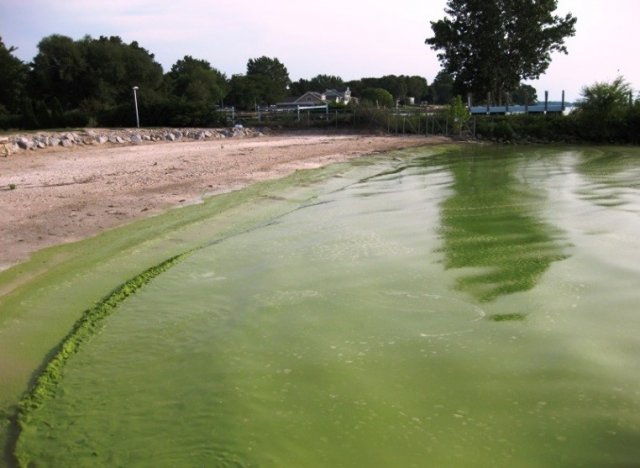 Photo credit: NOAA, July 2009
Drinking water treatment plants (DWTPs) are increasingly being
challenged by changes in the quality of their source waters and by their
aging treatment and distribution system infrastructure. Factors such as
shrinking water and financial resources, climate change, agricultural
runoff, harmful algal blooms (HABs), and industrial land use increase
the probability that CECs (chemicals that have not previously been
detected in water, or that are being detected at significantly different
levels than expected), such as pesticides, pharmaceuticals, personal
care products, endocrine disrupting compounds, and algal toxins will
remain after treatment, ending up in consumers’ drinking water. This is
likely to disproportionately affect small drinking water systems due to
limited resources and treatment options, among other factors.
Identifying and quantifying the source water and treatment challenges
for water systems is an important step towards mitigating present and
future risks.
The following studies will help improve our understanding of the
spread of contaminants through drinking water treatment, and identify
best approaches for removal.
Removal of cyanobacteria and cyanotoxins through drinking water treatment
EPA is examining the spread and removal of cyanobacterial cells and
their associated toxins at DWTPs using samples collected throughout
treatment trains at facilities along the shoreline of Lake Erie. This
study will improve our understanding of the dynamics of algal toxin
release or removal through drinking water treatment processes.
Additional details can be found here: Harmful Algal Blooms Cyanobacteria.
Characterizing the fate of contaminants released from landfills in Alaska
In collaboration with five tribal communities, EPA has completed a
study characterizing the fate of contaminants released from landfills in
rural Alaska and their potential impact on local drinking water
sources. Tribal communities of Allakaket, Eek, Ekwok, White Mountain,
Fort Yukon, and other dump sites throughout the State of Alaska are
using the study findings to improve the management of their landfills.
Top of Page
Removal of Inorganic and Organic Contaminants
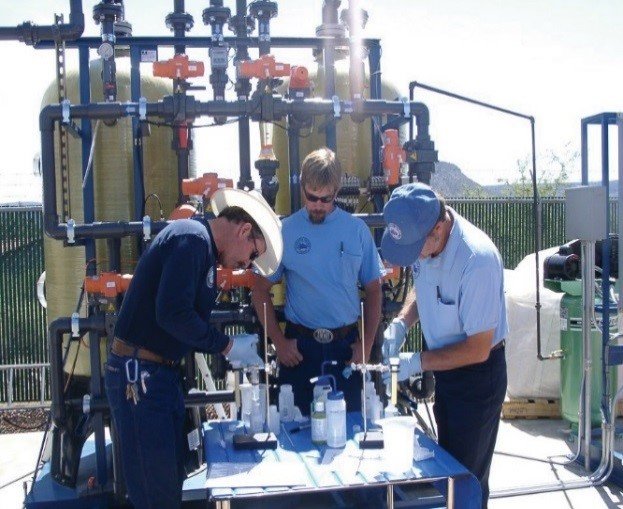 EPA
is working to provide information and treatment approaches to small
systems to help them manage inorganic contaminants in their water
supplies. In addition, the information will assist with revisions to
drinking water regulations and can be used by the states for
communicating novel and relevant treatment technologies to their
systems.
Ammonia Removal Research
Many regions in the U.S. have excessive levels of ammonia in their
drinking water source as a result of naturally occurring processes or
contamination from agricultural runoff. Ammonia in water does not pose a
direct health concern; however, it may pose a concern when
nitrification occurs in the drinking water distribution system.
Nitrification, is the conversion of the ammonia to nitrite and nitrate
by bacteria, and can lead to water quality issues, such as potential
pipe corrosion problems, loss of disinfectant, taste and odor
complaints, elevated nitrate and nitrite levels, and potential poor
water treatment performance. EPA’s research in this area is providing
communities with the technologies they need to address these issues.
Highlight: A small community in Iowa relied on
individual and neighborhood shallow wells, which became contaminated
after a flood in 2008. EPA and the State of Iowa Department of Natural
Resources conducted a pilot study using an EPA developed and patented
biological water treatment technology for ammonia oxidation. The pilot
system, designed, built, and installed by EPA staff, effectively removed
ammonia and iron from the community's source water, while keeping
nitrite and nitrate levels below their respective maximum contaminant
level in the treated water. As part of a federal Housing and Urban
Development (HUD) grant, a full-scale water treatment plant based on the
pilot system was completed in January 2014. The community now has a
functioning public water system that meets all regulations.
Publications:
Arsenic Treatment Technology Demonstrations
EPA is at the forefront of investigating arsenic removal technologies
and their cost, including capital and operating costs. From 2002-2012,
EPA funded and studied 50 small, full-scale arsenic removal systems in
26 different states impacting over 60,000 consumers. The technologies
studied included three that are most commonly utilized by small systems:
adsorptive media, iron removal, and coagulation/filtration. The study
resulted in the most comprehensive set of performance and cost data ever
collected on drinking water treatment for a specific contaminant. The
extensive set of data is currently being summarized for informing other
communities.
Publications:
Evaluation of cost-effective aeration technologies to address disinfection byproducts (DBPs) compliance
EPA conducted evaluations of cost-effective aeration technology
solutions to address DBP compliance, specifically total trihalomethane
(TTHM), at a water treatment plant clearwell (storage tank). DBPs form
during the drinking water treatment process.
Fluoride Treatment Technologies Research
EPA evaluated full-scale water treatment plants with existing
fluoride removal treatment systems and followed with demonstrations of
other novel approaches. Systems' operators collected water samples to
document performance and to determine the ultimate fate of the
contaminants. The results of the studies were used to fill a need for a
comprehensive manual on available fluoride removal technologies. The
manual supports the fluoride maximum contaminant level (MCL) and
provides an in-depth presentation of the steps required to design and
operate a fluoride removal plant using activated alumina, which is a
reliable and cost-effective process for treating excess fluoride from
drinking water supplies. This effort will build confidence in novel
technologies and approaches so that communities and state primacy
agencies will accept them knowing that they will be successful in
removing the contaminants of interest, and without concern about the
systems overall sustainability.
Brominated disinfection byproducts (DBPs) studies
To protect public health, public water system (PWS) operators must
meet federal limits for disinfection byproducts (DBPs) formed during the
water treatment process. A better understanding of the relationship
between bromide in source water and DBP formation will help operators in
the Ohio River Watershed improve treatment processes, ensure compliance
with federal limits, and provide important information to state, local,
and federal regulators responsible for protecting the rivers and
streams in the watershed.
EPA is evaluating water samples collected at eight PWS in order to
investigate relationships between bromide in source water and the
formation of brominated DBPs in finished drinking water. Once the
results from the collected samples have been finalized, EPA will analyze
the data to determine whether correlations exist between bromide in
source water and brominated DBP formation. Based on the analysis, EPA
will then determine if models can be used to estimate DBP formation,
optimize treatment, and inform source control strategies.
Treatment, control, and assessment strategies for lead and copper release
EPA is evaluating water treatment strategies for the control of lead
and copper release from drinking water plumbing materials and
components. Specifically, scientists are conducting investigations on
the impact of water quality on lead and copper release, pipe scale aging
on copper release, and complications of metal contamination arising
from accumulated deposits of iron, manganese, and aluminum on lead or
copper pipe surfaces. EPA is also evaluating the optimization and
interaction of treatment processes and the resulting water quality
impacts on the nature of mineral scales and deposits in real water
systems.
Top of Page
Pathogens and Disinfection
 Drinking
water can be a source of waterborne illnesses due to the contamination
of source waters or treated water as it moves through the distribution
system to consumer taps. The growth of pathogens associated with
microbial communities, known as biofilms, can occur on drinking water
pipe surfaces. Current treatments include the use of disinfectants, such
as chlorine and monochloramine; UV treatment; and filtration. To
control disinfection byproducts, many utilities have switched from
chlorine to monochloramine as both their primary and residual
disinfectant. Previous studies have shown the differences between
chlorine and monochloramine at killing specific types of pathogens and
their ability to penetrate into biofilms; however, there is limited data
on their effectiveness at controlling the occurrence and growth of
pathogens in distribution systems.
Water quality issues in large buildings and emerging treatment technologies for premise plumbing-related pathogens
The Safe Drinking Water Act (SDWA) sets limits on water quality
indicators for water in the distribution system. Once this distributed
water enters a building or household, the responsibility for maintaining
water quality shifts to the owners. The latest data for waterborne
diseases indicates that premise plumbing-related outbreaks are
increasing across the Nation. This fact, and the legal ramifications of
waterborne outbreaks, are leading hospital and hotel owners to address
water quality in their buildings. EPA is investigating water quality
issues in large buildings and evaluating emerging treatment technologies
to control premise plumbing-related microbial pathogens, with the goal
of providing information to building owners on how water quality changes
as it moves through complex premise plumbing systems. These
investigations include research on both pathogen and corrosion control.
Validation of ultraviolet (UV) disinfection of ground and surface water systems
UV disinfection is an effective process for inactivating many
microbial pathogens found in source waters with the potential as
stand-alone treatment or in combination with other disinfectants. Small-
to medium-sized drinking water systems often have limited resources and
expertise to evaluate and install innovative technologies. As a result,
they typically do not optimize operations and often apply significantly
higher UV doses than necessary. Currently, there is no standard UV
testing protocol for viruses under the Ground Water Rule, and there is a
lack of recommendations for efficient operation in small systems for
virus inactivation applications. EPA is evaluating new approaches for
validating UV reactors to meet groundwater and surface water pathogen
inactivation goals, including those for virus control for low-pressure
and medium-pressure UV systems. The research study is expected to
contribute to better public health protection with more accurate UV dose
monitoring and reduced capital and operation and maintenance costs.
This work will also reduce the burden on states and utilities to prove a
novel UV treatment system complies with the EPA’s UV guidance manual.
Publications:
Field studies of low-pressure UV lamps at ground and surface water systems
Some consumers in small rural communities in Puerto Rico face health
risks because they rely on unfiltered ground and surface waters for
drinking water. This causes periodic outbreaks of waterborne diseases.
The remote communities lack economic and technical capabilities in order
to comply with drinking water regulations. In addition, traditional
water treatment technologies are expensive to operate and maintain.
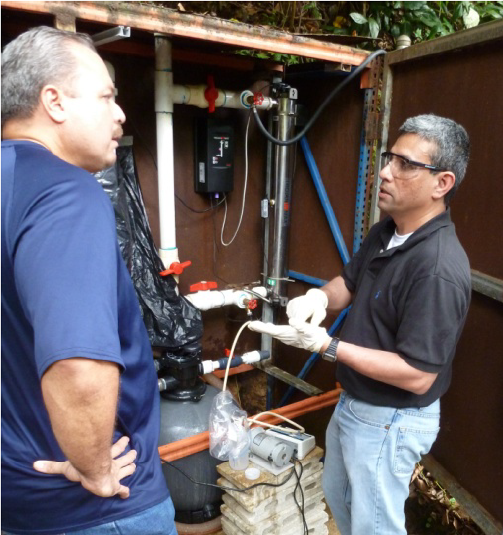
In collaboration with partners, EPA evaluated UV disinfection systems
in two rural communities to determine the effectiveness of low-pressure
UV lamps on inactivating pathogens in groundwater and surface water
supplies. For both studies, the operation and maintenance costs
associated with water delivery, prefiltration, and disinfection systems
were compared. The studies benefited from the inclusion of citizen
science, which involved training the communities on the capabilities and
operation and maintenance of the UV systems. This research study is
expected to provide conceptual diagrams of design alternatives for small
systems capable of UV inactivation of chlorine resistant pathogens.
Research results and lessons learned will be incorporated into a report
on the installation, ease of use, and effectiveness of UV disinfection
for both surface and groundwater supplies in rural Non-PRASA communities
in Puerto Rico and other tropical environments.
Evaluating the effectiveness of disinfectants on microbial communities in water distribution systems
This research will add to our knowledge of how commonly used
disinfectants (chlorine and monochloramine) effect microbial
communities, known as biofilms, in drinking water distribution system
pipes. Using complex molecular tools, a whole metagenome-based approach
was used to evaluate the composition and metabolic potential in these
communities. Such information is critical to the design of effective
management practices and ultimately helps to prevent waterborne disease
and safeguard human health.
Publications:
Filtration alternatives for small communities and households
This study involved case studies on innovative and commercially
available drinking water treatment alternatives for small community
water systems. Emphasis was placed on media and membrane filtration
technologies capable of meeting the requirements of the Long-Term 2
Enhanced Surface Water Treatment Rule (LT2ESWTR) and the Groundwater
Rule. Studies included household water treatment systems for removal of
chemicals and pathogens from well water.
Top of Page
Models, Tools, and Databases
Drinking Water Treatability Database (TDB)
The Drinking Water Treatability Database (TDB) presents referenced
information on the control of contaminants in drinking water. It allows
drinking water utilities, first responders to spills or emergencies,
treatment process designers, research organizations, academicians,
regulators and others to access referenced information gathered from
thousands of literature sources and assembled on one site. It includes
more than 25 treatment processes used by drinking water utilities. The
literature includes bench-, pilot-, and full-scale studies of surface
waters, ground waters and laboratory waters. The literature includes
peer-reviewed journals and conferences, other conferences and symposia,
research reports, theses, and dissertations.
Access the TDB
Cost Models for Drinking Water Treatment Plants
The Safe Drinking Water Act Amendments of 1996, as well as a number
of other statutes and executive orders, require that EPA estimate
regulatory compliance costs as part of its rulemaking process. A new
series of cost models have been designed for the purpose of estimating
the national costs of drinking water regulations, although they can also
be used at the individual site scale. The models were designed to be
transparent and versatile.
EPANET
EPANET was developed as a tool for understanding the movement and
fate of drinking water constituents within distribution systems, and can
be used for many different kinds of applications in distribution
systems analysis. Today, engineers and consultants use EPANET to design
and size new water infrastructure, retrofit existing aging
infrastructure, optimize operations of tanks and pumps, reduce energy
usage, investigate water quality problems, and prepare for emergencies.
EPANET can also be used to model contamination threats and evaluate
resilience to security threats or natural disasters. EPANET's user
interface provides a visual network editor that simplifies the process
of building piping network models and editing their properties and data.
Environmental Technologies Design Option Tool (ETDOT)
The Environmental Technologies Design Option Tool (ETDOT) is a suite
of software models that provides engineers with the capability to
evaluate and design systems that use granular activated carbon or ion
exchange resins for the removal of contaminants, including PFAS, from
drinking water and wastewater.
Breakpoint Chlorination Simulator
The Breakpoint Chlorination Simulator for Drinking Water Systems is a
web-based application relevant to drinking water practice was developed
to assist water utilities in generating chlorine breakpoint curves. The
simulator generates two side-by-side breakpoint curves for comparison
purposes with user defined conditions.
Chloramine Formation and Decay Simulator
The Chloramine Formation and Decay Simulator for Drinking Water
Systems is a web-based application relevant to drinking water practice
was developed to simulate inorganic chloramine formation and subsequent
stability, including a simple inorganic chloramine demand reaction for
organic matter. It provides two side-by-side simulations and associated
graphs to allow comparison of input choices on chloramine formation and
decay.
Free Chlorine and Cyanuric Acid Simulator
The Chlorine and Cyanuric Acid System Simulator is an application
that simulates water chemistry associated with the free chlorine and
cyanuric acid system (i.e., chlorinated cyanurates) at user selected
conditions. This allows users to estimate the free chlorine
concentration when cyanuric acid is present, as in the case when adding
chlorine-containing chemicals (commonly referred to as Dichlor or
Trichlor) to water.


