MEC&F Expert Engineers

Saturday, August 18, 2018

Master plumber Anthony Smith has died after he was burried by 15 feet of dirt and concrete in a shoreless trench in Philadelphia’s East Oak Lane neighborhood


Plumber, Father of 2, Dies in Philadelphia Shoreless Trench Collapse
Dirt and concrete fell on the man as he worked on a private property along the 100 block of West Walnut Park Drive Thursday morning.


By NBC10 Staff


 August 17, 2018

A worker has died after being trapped in a trench in Philadelphia’s East Oak Lane neighborhood Thursday morning.

Family members who prayed as they waited hours for word about the man identified him as Anthony Smith, a master plumber and father of two.

"He’s a great family man, he has two beautiful children, a great wife," family member Kevin Blake told NBC10's Aaron Baskerville. "He’s a hard working guy bro, he helps everybody."

Two other workers were nearby and were not hurt. But Smith, who was in the trench when it collapsed, was trapped for most of the day.

Despite lengthy rescue efforts by about 100 responders, he could not be saved.

Rescuers worked for about five hours to locate Smith, whose body was found about 15 feet below ground level among concrete, wiring and pipes. His body was finally recovered after nearly nine hours of digging.

The dirt and concrete fell as the men worked on a private property along the 100 block of West Walnut Park Drive around 11:15 a.m., Philadelphia police said.


Philadelphia Fire Commissioner Adam Theil said the rescue turned recovery operation was very complex and dangerous, and that responders had to work with extreme caution as to avoid any further collapse.


=========================


PHILADELPHIA, PA (WTXF) - 


The wife of a plumber who was killed when a trench he was working in collapsed is speaking out.

The incident occurred in Philadelphia’s West Oak Lane neighborhood Thursday morning around 11:15 a.m.

Officials say Anthony Smith and two other men were working near the 100 block of West Walnut Park Drive when the trench they were working in collapsed.
(Family handout)

The collapsed left Smith trapped under dirt and concrete inside the trench. Smith’s two co-workers were able to scramble out of the rubble and attempted to save him, but were unable.

"They was digging to get his body out they heard him tapping so every time he kept tapping, he knew they were digging," Smith’s cousin and co-worker Kevin Blake said.

Multiple rescue units arrived and started their tactical rescue operation. They used a vacuum to remove the debris.


"That trench had re-filled with dirt already by the time we got here so we started a very extensive rescue operation," Fire Commissioner Adam Thiel said.

He was found dead nine hours later.

The victim’s wife, Nancy Smith spoke exclusively with FOX 29 after the death of her husband. Nancy Smith contacted FOX 29 claiming that the workers who were with Anthony had information that may have helped rescuers save his life.

“This is where he fell. You guys are digging in the wrong area,” Nancy Smith recalled telling rescuers, “They dug for five hours. Five hours. And after they finally decided to listen, they found my husband in five minutes.”

Rescue officials called the incident ‘unfortunate’ and ‘tragic.’

Anthony Smith is survived by his wife and two children who are seven and eight years old. Smith was also a veteran and served in Afghanistan.
============================


PHILADELPHIA (CBS) — A contractor has died after being trapped when a trench collapsed at a construction site in the East Oak Lane section of Philadelphia.

Fire crews initially responded to the 100 block of West Walnut Park Drive around 11 a.m. on Thursday.


(credit: CBS3)

Police say that three people were working underground when dirt and concrete fell into their work area roughly 15 feet deep and 45 feet long.


Two of the men were able to escape but Anthony Smith became trapped underground and later died.


“It’s just chaos bro. Like its just chaos,” said Kevin Blake, who’s Smith’s cousin.

Blake isn’t just Smith’s cousin, he worked with him at their contracting company. Blake says he went to the store this morning to pick up construction supplies when his phone rang.

“Once the collapse started everything just filled in the whole and unfortunately the gentleman was caught in the hole and pulled down and it appears he was thrown against one of the walls,” said Deputy Commissioner Gary Loesch with the Philadelphia Fire Department.


(credit: CBS3)

Authorities say the heavy rains made cause more moisture around the trench eventually leading to the collapse. Now a family has to say goodbye to a man who loved life.

“He’s a great guy and a great family man. He has two beautiful kids. A great wife. He’s a hard-working guy bro. He helps everybody,” said Blake.

Friday, August 17, 2018

A rare “fire tornado” that barreled into Redding during the destructive Carr fire was responsible for killing Redding fire inspector Jeremy Stoke as he raced toward a neighborhood in flames


Redding fire inspector Jeremy Stoke, died in the Carr fire

A rare “fire tornado” that barreled into Redding during the destructive Carr fire was responsible for killing a firefighter as he raced toward a neighborhood in flames, an investigation has found.

The twister may have been California’s strongest on record. It was roughly 1,000 feet in diameter and reached speeds of 136-165 mph, equivalent to a twister with a rating of EF-3 on the five-level Enhanced Fujita scale, the California Department of Forestry and Fire Protection said.

Not only is it believed to be responsible for the death of Redding fire inspector Jeremy Stoke, but the twister was also in the general area where Melody Bledsoe, 70, and her great-grandchildren, 5-year-old James Roberts and 4-year-old Emily Roberts, died in the blaze.

Stoke died after he became trapped in the fire tornado as he was heading south on Buenaventura Boulevard — the only path of escape for residents of the Redding neighborhoods of Land Park and Stanford Hills, which burned. Stoke had been heading to Land Park.

The tornado was highly unpredictable, resulting in fire behavior that surprised many highly experienced firefighters, the report said. Stoke was killed on the evening of July 26, when the fire suddenly transformed from a fuel-dominated fire to one that was driven and spread in part by wind generated from the fire itself.

Cal Fire also released dramatic video showing the tornado from a couple of perspectives. In a video shot from a helicopter, the immense twister can be seen glowing orange as gray smoke twists counterclockwise, surrounded by flames all around the vortex. In another video shot from a fire engine in Stanford Hills, a giant spinning vortex can be seen in the background.

The tornado was very destructive, causing wind damage to large oak trees, scouring the ground, damaging roofs and throwing high up into the air large steel power-line towers, vehicles and a steel shipping container, the Cal Fire report said. Peak temperatures in the tornado probably exceeded 2,700 degrees, and the strong winds caused the fire to burn all but the smallest vegetation, officials said.

The report said that, based on witness observations and other evidence, there were either several fire tornadoes that occurred in different locations and at different times, or one fire twister that formed, waned and waxed, resulting in several separate areas of damage.

Stoke was racing to Land Park as the rapidly moving blaze approached the Sacramento River from the west and threatened the neighborhoods east of the river.

By 6:38 p.m., firefighters ordered the evacuation of Buenaventura Boulevard. Five minutes later, firefighters determined that the fire was going to cross the river, and by 6:59 they observed smoke just northwest of Land Park.

A spot fire was seen west of Buenaventura Boulevard by firefighters at 7:17, and numerous other spot blazes were detected east of the Sacramento River. Minutes later, firefighters sought to evacuate residents and prepared to defend homes. It was around 7:23 that they began to see a large rotating plume of smoke just north of Land Park near Buenaventura Boulevard.

“The swirling winds at the base of the plume dramatically increased fire intensity. The rotating plume continued to intensify until it developed into a fire tornado,” the report said. “Winds dramatically increased near the fire tornado, and embers were lofted in many directions.”

At around 7:35, Stoke was dispatched from a fire station to Land Park just as the blaze reached the area. Three minutes later, a fire captain saw a fire tornado near Buenaventura Boulevard north of Land Park.

Stoke was last heard at 7:40 radioing a mayday, calling out for a water drop, and said he was getting burned over, the report said. He said he was in the middle of a road. Another firefighter called out to get Stoke’s location. There was no response.

The report also described the circumstances of the death of Don Ray Smith, 81, a bulldozer operator who was killed while battling the fire. Smith had been traveling downhill while trying to improve a pathway toward Spring Creek Reservoir that had been dozed over as a firebreak when he was overcome by flames.

A Cal Fire hand-crew strike team leader who assigned Smith to improve that pathway was unaware that a different dozer earlier that morning had abandoned that pathway because the area was too steep and overgrown with vegetation, and that the firebreak would be left incomplete because it was not viable.

Smith proceeded to improve the firebreak after meeting with the team leader around 5:30 p.m. But soon after, the fire had begun to increase in intensity, and winds were gaining strength from the northwest.

As Smith traveled down the existing dozer line downhill toward the reservoir, firefighters saw the blaze intensify. By 5:44, the fire jumped the dozer line. The team leader radioed to Smith several times to tell him to “get out of there,” the report said.

Two firefighters near the top of the dozer line tried to chase down the tractor, but couldn’t make it through as the flames strengthened. Finally, Smith responded back to the team leader by radio, saying “he could not get out because he was cut off by the fire, and he would push down instead.” He was heard around 5:50 p.m. asking for a water drop and saying he was trying to make a safety zone. That was his last message.

Smith’s fire shelter was found behind his seat, and his fire curtains were not deployed.

As of Thursday, the Carr fire had burned more than 214,000 acres and was 71% contained. The blaze has destroyed more than 1,000 residences and has been blamed for eight deaths. Besides Stoke, Smith, Bledsoe and her two grandchildren, another Redding resident, a Pacific Gas & Electric utility worker and a Cal Fire mechanic have also died in connection with the blaze.

Tree trimmer critically burned after his pole saw contacted overhead power lines while trimming trees from a trailer lift in Jacksonville, Florida


Jacksonville, FL - 


The Jacksonville Fire and Rescue Department (JFRD) says a man has been rescued from a trailer-mounted boom and taken to the hospital.

It happened near the Scottish Inn, off Philips near I-95. JSO says the man accidentally touched a power line with his pole saw.

JSO says the man was taken to the hospital with critical injuries, but he was able to talk to those around him as he was transported.

============================

A man was badly burnt after contacting overhead power lines while trimming trees from a
trailer-mounted boom in Jacksonville, Florida on Tuesday.

The man was working from a 36 feet Genie TZ 34/20 trailer lift and using a pole type saw with which he touched the power lines. He received an electric shock and burns to his back.

The local fire department was able to bring him down using the machine’s lower controls. He remained conscious throughout the relatively slow descent process. He was reported to be in critical condition at the hospital. 


The Genie® TZ™-34/20 trailer-mounted boom has an outstanding working envelope and intuitive controls, allowing operators to efficiently reach where they need to be.
Overview
  • Rugged and heavy-duty, yet lightweight enough to use on lawns, slate and gymnasium floors, as well as other sensitive surfaces.
  • Extension boom with self-leveling platform and dual pneumatic jockey wheels for safe, precise setup
  • Variable-speed control system
  • 359˚ non-continuous turntable rotation for versatile positioning

MISHANDLING OF EXPLOSIVE AND/OR FLAMMABLE CHEMICALS AT LETTERKENNY ARMY DEPOT LED TO THE EXPLOSION AND FIRE IN THE PAINT SHOP OF BUILDING 350. Eric S. Byers, 29, of Huntingdon County, Pa., and Richard Barnes, 60, of Greencastle, Pa., died


MISHANDLING OF EXPLOSIVE AND/OR FLAMMABLE CHEMICALS AT LETTERKENNY ARMY DEPOT LED TO THE EXPLOSION AND FIRE IN THE PAINT SHOP OF BUILDING 350


Letterkenny commander: Paint stripping chemicals sparked explosion, fire that killed two

Jennifer Fitch
Aug 16, 2018 Updated 12 hrs ago


CHAMBERSBURG, Pa. —


Eric S. Byers, 29, of Huntingdon County, Pa. died in the fire


An explosion and fire at Letterkenny Army Depot on July 19 came from an accident with a chemical in the paint shop of Building 350, depot Commander Col. Stephen Ledbetter said Thursday.

The chemical was being used in normal processes, Ledbetter said, declining to name the chemical.

Two employees died from their injuries from the 7:20 a.m. industrial accident. Another man continues to be treated at Johns Hopkins Hospital in Baltimore.

"We're certainly prayerful for his full recovery," Ledbetter said.

The depot has taken initial corrective action, including additional training and signs, he said. More steps are in the works to minimize the risks associated with chemical use.

Building 350 is an industrial-style, 320,000-square-foot building used for maintenance and upgrades on military vehicles.

The building itself did not sustain structural damage in the accident, Ledbetter said.

The Occupational Health and Safety Administration investigated the incident and has up to six months to issue a report.

Eric S. Byers, 29, of Huntingdon County, Pa., and Richard Barnes, 60, of Greencastle, Pa., died. Two people were initially treated at a hospital and released for smoke inhalation.

A depot spokeswoman declined Thursday to provide a condition update for the person still hospitalized. On Monday, she said he was in critical, but stable, condition.

Richard Barnes, 60, of Greencastle, Pa., died

Many violations have been listed in the DEP's web pages.  The more recent ones state that

"Containers of hazardous waste are not closed during storage".  Most likely, mishandling of the toluene-based paint or metal stripping chemicals caused the explosion and fire.  According to the permit for the facility, cleanup solvents are used there.  There is also a flame spay booth. 

The permit also lists the following tank in Bldg. 350:   ONE PAINT STRIPPING TANK, R3419 - BLDG 350
====================


CHAMBERSBURG, PA - Residents living just outside the northern gate of Letterkenny Army Depot were disturbed in 1982 to find out a neighbor had been poisoning their wells.

Residents in the area around Rowe Run Road were advised not to drink their well water. The Army went after the cause of the contamination and connected the homes to a public water system in 1987.

Today, 35 years later, the Army is entering the final stage of containing the hazardous chemicals that pollute the groundwater northeast of the depot.


Environmental regulators and the Army have agreed that “it’s impractical to treat everything to zero,” according to Bryan Hoke, installation restoration program manager. The aim is to shrink the plume of groundwater contamination back toward the depot.

The main contaminant at Letterkenny has been volatile organic chemicals -- most notably trichloroethylene, a suspected carcinogen that may affect a person’s nervous system, liver, respiratory system, kidneys, blood, immune system, heart and body weight.
Letterkenny has been a vehicle maintenance shop for the Army, and from the 1950s to 1970s workers used VOCs to degrease parts. They sometimes dumped the solvents on the ground in expectation that the chemicals would evaporate, Hoke said. Instead, the VOCs seeped into the ground.

Some hazardous chemicals also seeped from a cracked concrete lagoon where industrial wastes settled and from leaking underground pipes. Metals, such as lead and chromium, were also found and removed.

The Army has spent $152 million since 1980 to clean up toxic waste at Letterkenny Army Depot, and is planning to spend another $28 million to finish the job. Hoke said that active treatment of pollution at Letterkenny is expected to end in five years, then monitoring of water wells will continue for another 25 years.


“We haven’t identified anything new since the mid-1990s,” Hoke said. “There are no easy fixes to the groundwater. We did the easy fix digging up the soils.”

The community has all but lost interest in the drawn-out, expensive cleanup, but the pollution has affected commercial development in the area, particularly on land the 1995 Base Realignment and Closure Commission ordered returned to the community.

“Environmental issues brought to the forefront that Letterkenny has a responsibility to be a good neighbor,” said L. Michael Ross, President of the Franklin County Area Development Corp. “They have become a friendly, engaging neighbor. It was started unfortunately by pollution. They’ve taken their responsibility seriously. The depot has won environmental awards. I think the environmental issues have raised the consciousness of taking safety precautions so we don’t have a repeat of what happened in the 1950s, 60s and 70s when the environmental conditions were created.”

More: Roving Letterkenny teams keep Army missiles accurate

Letterkenny, and its tenants, has been one of the county’s leading employers since its creation in 1942. With mechanical skills and limited education, residents could work near home at a well-paying career. Shop employees have taken pride in supporting troops overseas first by repairing tanks, then vehicles and most recently, missiles. The depot has always stored and disposed of munitions.


The Department of Defense spends more than a billion dollars a year to clean up the sites that its operations have contaminated with toxic waste and explosives. In military spending that’s the equivalent of 350 Patriot missiles, 1,200 mine-resistant ambush-protected vehicles or a B-21 stealth bomber or two.

The military has 40,700 hazardous sites, according to a report from ProPublica. The independent non-profit newsroom based in New York City obtained internal reports from the Environmental Protection Agency.

“The Pentagon is the most prolific and profound polluter on the planet,” said Jeff Ruch, executive director of Public Employees for Environmental Responsibility, a national whistle-blower support organization that has chronicled insider reports of pollution and failed cleanups on military sites.

Letterkenny is not on the military’s list of the most expensive cleanups, but ranks No. 20 among installations with sites posing the greatest threat to safety, human health and the environment, according to ProPublica.

Letterkenny has more medium- to high cleanup sites (14) than any of the 170 military installations in Pennsylvania, according to ProPublica’s investigation of EPA records. Letterkenny has violated its environmental permits 27 times in the past 37 years.

Public Opinion looked at the Pennsylvania Department of Environmental Protection records of inspections at Letterkenny during the past five years. DEP recorded nine days when the depot violated its permits. There was no mention of any spills. Repeat violations include open containers of hazardous waste and improper containment and collection systems. Violations most often were corrected.


The most recent violation was on Aug. 29, when the depot was cited for operating a solid waste facility without a permit.

DEP also cited Letterkenny five years ago for operating three paint-stripping tanks for at least 30 years without a required air quality permit from the state. The tanks give off VOCs.

Letterkenny’s history of environmental cleanup dates to the Comprehensive Environmental Response, Compensation, and Liability Act of 1980, which was intended to pay to cleanup up sites contaminated with hazardous materials. CERCLA established Superfund sites. Two are at Letterkenny.


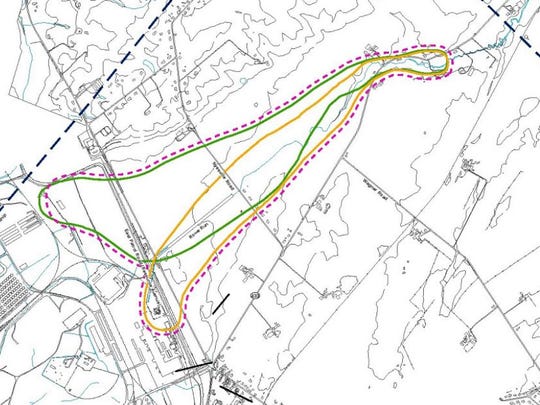
This map shows the extend of the movement of groundwater from Letterkenny Army Depot northeast along Rowe Run, between Pa. 997 and Pa. 433. (Photo: 2016 Joint Land Use Study)

By 1982, Letterkenny had been surveyed for potential contamination landfills and disposal sites. Letterkenny was the first installation in Pennsylvania to sign a cleanup agreement with the EPA. The Army in 1986 began a series of projects to remove contaminated soil on the depot.

“The remaining contamination was in the bedrock that we couldn’t get to,” Hoke said.

The chemicals in the bedrock have continued to leach into the groundwater.

The Army and regulators have agreed to two groundwater treatments – dropping potassium permanganate down some wells to speed up the oxidation of VOCs and sending electricity into the ground where electrodes heat the groundwater and evaporate the VOCs. They are to start in 2018.

The cleanup of the 122 hazardous sites on 45 acres of the depot has proceeded behind the fence and out of sight. Letterkenny’s environmental problems, however, took front and center when community leaders encouraged development in the area.

Ross said a company that made bottle caps for Tylenol was making plans in the mid-1980s to build a plant on Sunset Pike across from Letterkenny. Company officials were worried about being on well water; no one had ever figured out how seven people in the Chicago area had been murdered in 1982, but the victims all had been poisoned and had all taken Tylenol.

“We thought we had the deal done,” Ross said. “I opened my big mouth. I said Letterkenny is a Superfund site (and was installing public water lines.) That changed the decision making on the spot.”

The factory was never built.

The pollution also posed problems for redevelopment of the land that the Army is transferring to the community. BRAC 1995 ordered Letterkenny to give back about 2,000 acres. The transfer was to be completed by 2001, but there was a hitch: Environmental cleanup first had to be designed and started for a property.

“The land still hasn’t transferred due to the fact that some land is awaiting final environmental clearances,” Ross said.

The Army has given back 917 acres and reclaimed hundreds more. The eighth and final phase of land transfer is anticipated in 2019.

The Letterkenny Industrial Development Authority created the Cumberland Valley Business Park on the former Army real estate. Often tenants have agreed to lease-purchase arrangements until the Army surrendered the property. It posed problems for companies wanting to borrow to expand.

Many deeds came with a restriction that limited the depth of excavation to 6 feet.

“We’ve been able to work around it,” Ross said. “The redevelopment of Letterkenny has exceeded all expectations. Private investment has exceeded our expectations. It’s pretty much built out to what can be done.”

All buildings in the business park are occupied and about 85 percent of land has been purchased, Ross said. The rate of build-out is comparable to that of the Chambers5 Business Park, a traditional commercial development in south Chambersburg.

One of the latest additions to the Cumberland Valley Business Park involves food, a first for the park. A poultry farm is storing and shipping eggs from a warehouse. Food processors have shied away from any possible link to Letterkenny.

“Herbruck’s has broken the mold,” Ross said. “There are no environmental concerns with their site. It’s free and clear without deed restrictions.

===================================


Letterkenny pays DEP $14,000 in back fees for VOC emissions Written by Jim Hook, Public Opinion Online | Jun 23, 2015 2:00 PM


(Chambersburg) -- Letterkenny Army Depot has been using three paint-stripping tanks for at least 30 years without a required air quality permit from the state.

The Pennsylvania Department of Environmental Protection apparently never knew the tanks had emissions until 2 years ago.

DEP spokesman John Repetz said state inspectors would check permitted sources at the depot, and Letterkenny personnel were not aware that the material in the unpermitted tanks was high in volatile organics and so did not report them.

To correct matters, Letterkenny has applied to DEP "for the construction of three existing and previously unreported paint stripping tanks."

Letterkenny provided DEP with data for the tanks' emissions in prior years and paid the corresponding air emission fees, according to Janet Gardner, spokeswoman for Letterkenny Army Depot.

Repetz said on Monday that Letterkenny paid $14,835 in back fees after the tanks were reported.

Pennsylvania in 1994 established air emissions fees to pay for the air emissions monitoring program. A facility currently pays $85 per ton of pollutant.

Gardner declined to answer questions about how the unreported tanks were discovered.

DEP's Environment Facility Application Compliance Tracking System lists nine violations from a May 2013 administrative review at Letterkenny. eFACTS tracks environmental permits and compliance throughout Pennsylvania. The violation notices issued to Letterkenny included not having an air quality plan or permits and failing to pay emissions fees.

It's unclear what regulators will do. The U.S. Environmental Protection Agency will handle any enforcement action because Letterkenny is a federal installation, according to Repetz.

"EPA is aware of the situation regarding Letterkenny Army Depot, and we are looking into it," said Roy Seneca, a regional EPA spokesman.

Letterkenny and its tenants and contractors comprise the largest employed in Franklin County. The work includes repairing missile systems and mine-resistant ambush-protected vehicles. Paint is stripped from old vehicles and equipment , which is then repainted.

VOCs vapors may have short- and long-term adverse health effects, according to the EPA. Depending on the chemicals, a specific VOC may be highly toxic or have no known health effect.

None of the VOCs from the tanks are on EPA's Hazardous Air Pollutant list, according to Lindsay.

DEP has given preliminary approval to Letterkenny's plan to deal with VOCs from the three tanks. Letterkenny does not need to add any control equipment to meet either the best available technology or reasonably available controls required in the plan, according to Repetz.

Letterkenny always follows requirements identified in the Best Available Technology and Reasonably Available Control Technology analyses and other work practices to minimize VOC emissions, according to Gardner.

Letterkenny has other operations that are monitored for VOCs and most recently revised its plan to DEP in 2013.

"We continue to track usage and report emissions on our annual Air Emissions Inventory Report," Gardner said.

The vapors from the three unreported tanks account for about 20 to 30 percent of the total VOC emissions at the Letterkenny, according to Repetz.

Building 350 contains one paint-stripping tank, originally installed in 1971 and most recently replaced in 2003, according to Lindsay. Building 370 contains two tanks, both installed in 1985. All tanks have secondary containment in case of a spill or leak.

The tanks formerly contained a product from Turco, and currently a Eurostrip product mixture, both of which are paint stripping chemicals that emit VOCs during use, Gardner said.

Together the three tanks are expected to emit in a year nearly 30 tons of VOCs, a ton of sulfur oxides and less than a ton each of nitrogen oxides, carbon monoxide, dust and hazardous air pollutants, according to the permit application. DEP will hold a public hearing about Letterkenny's application for an operating permit for the tanks. The hearing will be held at 9 a.m. on July 13 at the DEP Southcentral Regional Office, 909 Elmerton Avenue, Harrisburg.

Copies of the application, DEP's analysis and other documents can be seen at the DEP regional office.

People wishing to speak at the hearing should contact Mr. Gary Helsel, P.E., Acting New Source Review Chief, Southcentral Regional Office, at 814-949-7935, no later than July 6. Oral testimony which has not been pre-scheduled will not be accepted at the hearing. Commenters are asked to provide two written copies of their remarks at the hearing. Oral testimony will be limited to ten minutes per person. Organizations are requested to designate a representative to speak on their behalf.

Written comments may be submitted to the Air Quality Program, 909 Elmerton Avenue, Harrisburg, PA 17110-8200, no later than July 23. Written comments must contain the permit number (28-05002M) and the commenter's name, address and telephone number.

The EuroStrip Di phase is a commercial stripper that utilizes monoethanolamine and is formulated according to U.S. Pat. No. 6,248,107, assigned to Chemetall PLC.


Thursday, August 16, 2018

Edmonds, WA asbestos removal company, Above & Beyond Asbestos Removal, LLC, fined more than a quarter-million dollars for exposing workers and the public to unsafe conditions


Edmonds asbestos removal company fined more than a quarter-million dollars for exposing workers and the public to unsafe conditions

July 16, 2018

Tumwater – An Edmonds-based asbestos removal contractor has been cited by the Washington Department of Labor & Industries (L&I) for multiple willful safety violations for improper handling of asbestos. Along with the citations, the company faces fines totaling $229,700.

L&I has cited Above & Beyond Asbestos Removal, LLC in connection with two separate inspections. Along with citing and fining a company, L&I may also decertify an asbestos contractor for multiple willful violations. This company is under review.

"This company has demonstrated a continuous indifference to Washington's asbestos handling rules which protect workers and the public from harm," said Anne Soiza, L&I's assistant director for the Division of Occupational Safety and Health. "This fine delivers a clear message that asbestos is a deadly hazard and we won't tolerate any company that doesn't follow the rules to keep the public and workers safe."

Asbestos is extremely hazardous and can cause potentially fatal diseases like asbestosis, mesothelioma and lung cancer. Only a certified abatement contractor that follows the specific asbestos related safety and health rules may remove and dispose of asbestos-containing building materials.

The two recent inspections of Above & Beyond each uncovered several similar violations. One worksite involved the emergency removal of boiler insulation in a Seattle apartment complex, and the other concerned the removal of asbestos popcorn ceiling material in a single-family residence.

In both cases, the workers did not use proper safety equipment, required air sampling was not performed, and asbestos-containing material was left exposed to the public and was improperly taken through public areas. Asbestos-containing dust can harm both workers and the public until it is eliminated.

The two inspections resulted in multiple willful and serious violations. A willful violation is one where L&I finds evidence of plain indifference or an intentional disregard to a hazard or rule.

Above & Beyond has been cited in the past for similar violations and has been identified by L&I as a severe violator — a designation that carries consequences, such as follow-up inspections at any of their facilities or sites that could have similar hazards.

The employer has 15 business days to appeal the citations.

Penalty money paid as a result of a citation is placed in the workers' compensation supplemental pension fund, helping injured workers and families of those who have died on the job.

For a copy of the citations, please contact Public Affairs at 360-902-5413.


=================


About Above & Beyond Asbestos Removal LLC

Contacting an asbestos removal contractor like Above & Beyond Asbestos Removal LLC that specializes in this removing asbestos will assure you the job is done safely and correctly.

Above & Beyond Asbestos Removal LLC, located in Edmonds, WA, offers a range of consulting, inspection, testing and analysis services to assist clients at each step of the removal process, including demolition, historic preservation, auditing and construction and implementation deployment. Collaborative communications and a highly disciplined management methodology ensure that asbestos abatement projects are completed on schedule and within budget.

Above & Beyond Asbestos Removal LLC is a licensed asbestos abatement contractor that specializes in residential removal of asbestos projects. As with all asbestos removal work, specialized cleaning equipment and confinement techniques are required. But in homes, additional precautions are necessary. For example, extra care must be taken to prevent damage to home finishes and furniture.